
Oh, the age-old dairy dilemma. We're talking cheese, folks.
The great debate between Parmesan and Parmigiano-Reggiano.
In our kitchen, this isn't just about slapping some cheese on pasta. No, sir.
It's a showdown of flavor, tradition, and those little crystals that go "crunch."
Ever stood in the cheese aisle, paralyzed by choice? We've been there.
Picking between these two can feel like choosing a favorite child. One's the real deal from Italy, and the other?
A globetrotting imposter.
Here's the lowdown: Parmigiano-Reggiano is the OG, aged to perfection. Parmesan?
More like its casual cousin that didn't study abroad.
We all have that one friend who claims they can't tell the difference. We're here to lovingly prove them wrong.
Get ready for a cheesy adventure with us.
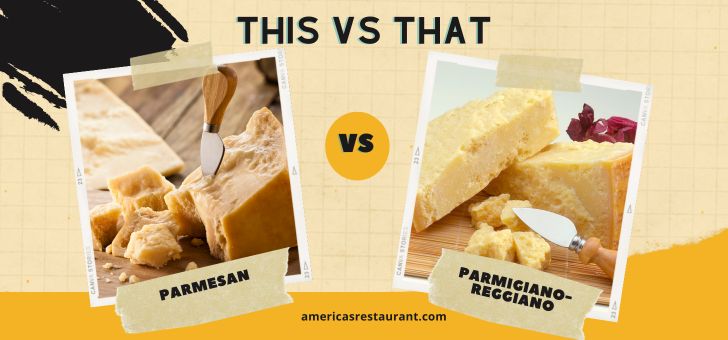
What is Parmesan?

Parmesan is a hard and granular cheese that originated in Italy.
It is made from cow's milk, which goes through the process of curdling, separating the curd from the whey, molding, and then aging for at least 12 months.
Parmesan is usually used as a topping for salads, pasta dishes, pizza, and more.
It has a sharp and nutty flavor with a slightly gritty texture that makes it an excellent accompaniment to many dishes.
When talking about Parmesan cheese, it is essential to understand that authentic Parmesan can only be produced in specific regions of Italy under strict regulations.
In contrast, other types of parmesan-style cheeses are available worldwide but may not have undergone the same standards or quality control processes.
To explore contrasting pairings that highlight sharpness and acidity, lemon dessert pairing ideas suggest nine ways to balance citrus with rich flavors.
What is Parmigiano-Reggiano?

The excellent cheese known as Parmigiano-Reggiano is a hard, granular cheese made from cow's milk.
It is produced in the Emilia-Romagna and Lombardy regions of Italy, following strict traditional methods of production and aging.
The name "Parmigiano-Reggiano" itself is protected by law and can only be used for cheese that satisfies specific requirements; it must be made in designated areas, using local ingredients and techniques, and aged for at least 12 months.
This artisanal cheese has a rich, nutty flavor with hints of fruitiness.
Its texture is dense and grainy, with occasional crystals throughout.
It is often grated over pasta dishes or salads to add depth of flavor.
While it may be expensive compared to other cheeses, its quality makes it a worthy investment for any food enthusiast.
For savory pairing inspiration beyond cheese boards, guacamole serving ideas and combos shows complementary textures and flavors that work well together.
Differences Between Parmesan and Parmigiano-Reggiano

The difference between Parmesan and Parmigiano-Reggiano can be distinguished in a few ways.
Both cheeses come from Italy, with Parmigiano-Reggiano being produced in the Parma region and aged for at least 24 months.
In contrast, parmesan is produced elsewhere - and is commonly used as an alternative to Parmigiano-Reggiano, or see Parmesan vs Asiago comparison for another common swap.
The texture of both cheeses also differs, with Parmigiano-Reggiano having a harder and grainier texture than parmesan.
Also, the flavors are subtly different, with Parmigiano-Reggiano being nuttier and saltier while parmesan is milder.
Origin and Production
The production of Parmesan and Parmigiano-Reggiano is a complex process that involves traditional methods.
Both types of cheese hail from Italy, with Parmigiano-Reggiano originating from the regions of Parma, Reggio Emilia, Modena, Bologna, and Mantua.
Parmesan is an imitation cheese made outside of Italy but follows a similar production method.
To produce these cheeses, high-quality milk is used and heated before rennet or vinegar is added to coagulate it.
The resulting curd is cut into small pieces and cooked at a specific temperature.
After cooking, the curd is placed in molds where it drains off whey before being brined in saltwater for a few weeks.
Then starts the aging process which can last for up to 36 months.
During this period, the cheese undergoes regular turning and salting to develop its unique flavor and texture.
One of the main differences between Parmesan and Parmigiano-Reggiano lies in their respective production locations.
While they use mostly similar techniques to produce these hard cheeses - the region where they are produced impacts their flavor significantly.
Also, while Parmesan aims to imitate authentic Italian cheese-making methods; however, it lacks certain qualities that make its Italian counterpart unique.
In summary, both varieties are flavorful additions to any dish; however, if you want genuine cheese with unparalleled taste, try authentic Parmigiano-Reggiano from Italy's Emilia-Romagna region.
Ingredients and Processing
The production process and ingredients play a important role in the flavor, texture, and quality of cheese.
Understanding the nuances that differentiate cheeses like Parmesan and Parmigiano-Reggiano can aid in grocery shopping or selecting between these types.
The primary ingredient of both Parmesan and Parmigiano-Reggiano is cow's milk.
However, for true Parmigiano-Reggiano, only certain types of cows bred in specific regions may be used, and their feed is regulated.
The cheese must also be produced with specific techniques within a designated region in Italy to earn its certification.
Parmesan cheese, on the other hand, sometimes uses microbial rennet instead of animal rennet during production.
Also, it may contain additives such as cellulose to prevent caking or calcium propionate for preservation purposes.
Although both cheeses share similarities in appearance and taste, differences in production methods lead to notable variations that could impact personal preference.
By choosing certified Parmigiano-Reggiano, individuals can ensure they purchase authentic Italian cheese made with time-honored techniques while avoiding additives present in some Parmesan products.
Flavor and Aroma
The unique aroma and flavor of Parmesan cheese are attributed to its aging process and quality ingredients - for a closer look at what 'flavor' means, see extract vs flavor explanation.
Similarly, the Parmigiano-Reggiano cheese owes its signature taste to the long aging process in special conditions.
Both types of cheeses have a distinct nutty, salty and savory flavor that improves any dish they are added to.
The difference between the two types of cheese lies in their place of origin, aging period, and production process.
While Parmesan cheese is produced all over the world, authentic Parmigiano-Reggiano cheese can only come from Italy's Emilia Romagna region.
In addition, Parmesan typically ages for around 12 months, whereas Parmigiano-Reggiano must mature for at least 12 months but can age up to 36 months or even longer.
This difference in aging time can result in a more complex flavor with additional nuttiness and sweetness in aged Parmigiano-Reggiano.
Quality and Authenticity
Quality and authenticity are the prime concerns.
The dairy industry is highly standardized, but the origin and method of preparation define the uniqueness of Parmigiano-Reggiano and Parmesan.
Both cheeses may seem alike in texture, flavor, and aroma, but Parmigiano-Reggiano stands out for its heritage, superior flavor, nutritional composition and artisanal production.
Parmigiano-Reggiano is a true representation of quality and authenticity in cheese making; it comes from a specific region of Italy and has to adhere to stringent production regulations to bear its name.
It takes 24 months for authentic Parmigiano-Reggiano to reach full maturity and attain that umami-packed flavor which melts in the mouth.
On the other hand, Parmesan cheese can be produced in any part of the world with slight variations from original Italian recipes that impact texture, flavor, nutritional benefits and overall taste experience.
Similarities Between Parmesan and Parmigiano-Reggiano

Parmesan and Parmigiano-Reggiano share many similarities regarding their origin, taste, and texture.
Both cheeses belong to the hard cheese category and are produced using almost similar techniques in terms of making, ageing, and grading.
These cheeses originated from Italy's Emilia-Romagna region and have been popularized globally due to their distinct flavour.
In terms of taste, both Parmesan and Parmigiano-Reggiano possess a nutty, savory, and slightly salty flavour.
Due to their hardness, they are best consumed when grated over pasta dishes or used as a table cheese in combination with wine or fruits - see veal vs chicken Parmigiana comparison to explore dishes that highlight grated cheese.
The texture of these cheeses is grainy but smooth when freshly grated.
They also have a good shelf life and stay well for long periods without refrigeration.
A significant difference between the two cheeses is that only cheesemakers situated within Parma, Reggio Emilia regions, Bologna on the left bank of river Reno can classify their cheese as 'Parmigiano-Reggiano.
' Manufacturers outside this region use other names like Parmesan instead of calling it by its original name 'Parmigiano-Reggiano.
Culinary Uses of Parmesan and Parmigiano-Reggiano
Both Parmesan and Parmigiano-Reggiano are delicious Italian cheeses that have a variety of culinary uses.
They both have slightly different flavors and textures, which make them ideal for specific dishes - and for swap ideas, consult parmesan substitutes list for cooking.
Parmesan is commonly used in pizza toppings, pasta sauces, and risottos.
It has a nutty, savory flavor that improves the dishes.
The grated version of Parmesan is often sprinkled over salads, roasted vegetables or baked potatoes.
Parmigiano-Reggiano has a stronger and sharper flavor than parmesan cheese.
It is often used in dishes such as Caesar salad dressings, meatloaf or antipasti platters because of its harder texture and bold taste.
Aside from their differing flavors, these two cheeses share some common qualities that make them suitable for cooking - they melt well when heated and improve the overall taste of recipes.
Where to Buy Parmesan and Parmigiano-Reggiano?
Finding a reliable source to purchase Parmesan and Parmigiano-Reggiano cheese can be important for those who want the best quality.
Both types of cheese have unique individual tastes and textures that make them stand out from other similar options.
To buy authentic Parmesan or Parmigiano-Reggiano, one should consider contacting cheese mongers or specialty stores that deal with imported Italian products.
It is also possible to find these cheeses in gourmet food markets or online stores that specialize in Italian foods.
Some supermarkets may carry branded versions of the cheeses, but it's essential to check the labeling for authenticity before making a purchase.
Also, when purchasing the cheese, it's advisable to check for certain markings on packaging like "Parmigiano-Reggiano Consortium".
This indicates that the cheese has undergone strict controls and certification processes by an organization governing such cheese production in Italy.
In summary, finding quality and authentic Parmesan or Parmigiano-Reggiano comes down to some research and looking for specific marks on packaging.
If recipes call for a parmesan rind or a substitute, parmesan rind substitutes guide lists five good replacements and how to use them.
Flavor Profiles: Parmesan vs Parmigiano-Reggiano
After examining both Parmesan and Parmigiano-Reggiano, it can be concluded that the latter is a superior option in terms of flavor and authenticity.
Parmigiano-Reggiano undergoes a strict production process in Italy, resulting in a quality product with a nuttier taste and more complex aroma than its imposter counterpart.
Also, Parmigiano-Reggiano contains no additives or fillers, making it a pure cheese for authentic Italian dishes and pairing well with various foods.
However, it comes at a higher price point compared to Parmesan which has added ingredients like milk powder and salt.
Frequently Asked Questions
We all have that one friend who claims they can't tell the difference. They share some similarities but each has qualities that make it better suited for certain recipes.
Sometimes. Parmesan works where Parmigiano-Reggiano is called for in certain dishes, but not all.
Check whether the recipe relies on a specific quality before substituting.
Cold preparations like salads and dressings often favor the option with a sharper, more defined flavor. Heat can mellow both, so the distinction matters more in uncooked dishes.
Do professional cooks prefer one over the other?
Professional preference depends heavily on the dish and cuisine style.
Each has its context where it outperforms the other, so most experienced cooks keep both on hand.
Many dishes that call for grated Parmesan can also use similar substitutes. 5 BEST Substitutes for Parmesan Cheese in Alfredo Sauce covers practical swaps. What to Serve with Chicken Parmesan? 7 TASTY Side Dishes lists side pairings that complement cheesy mains.