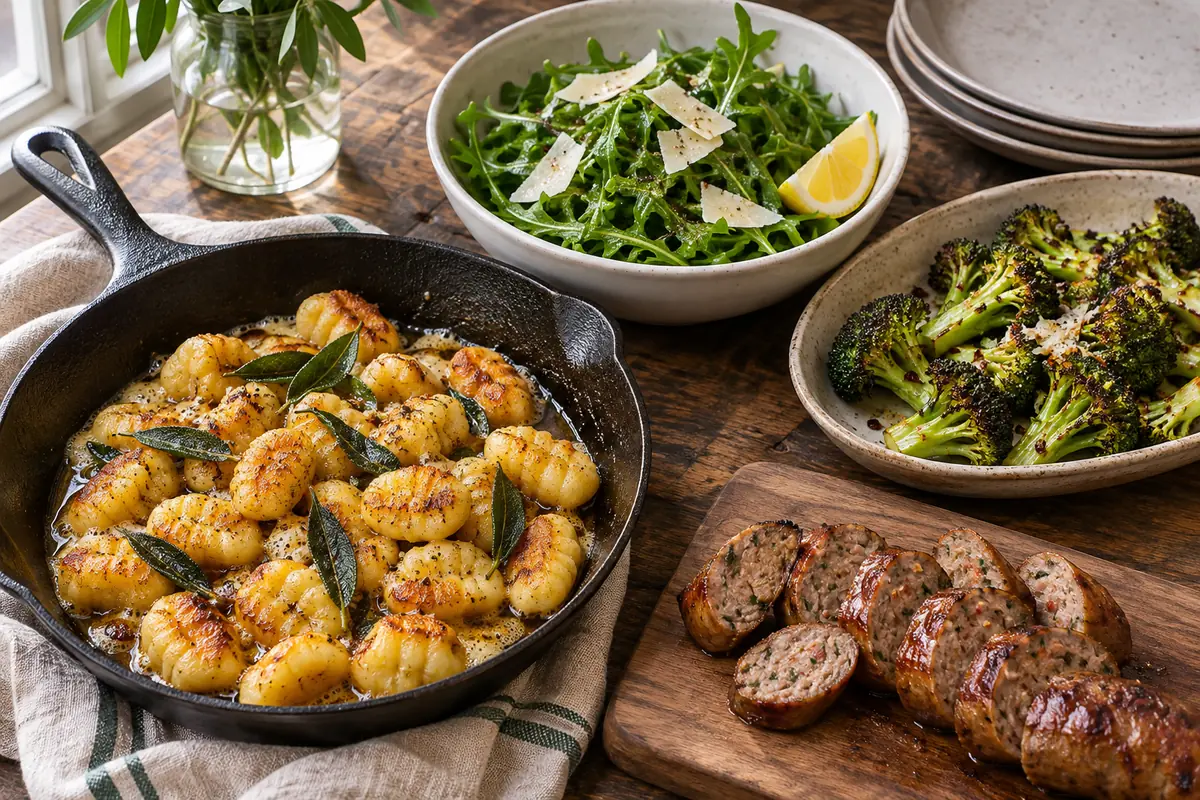
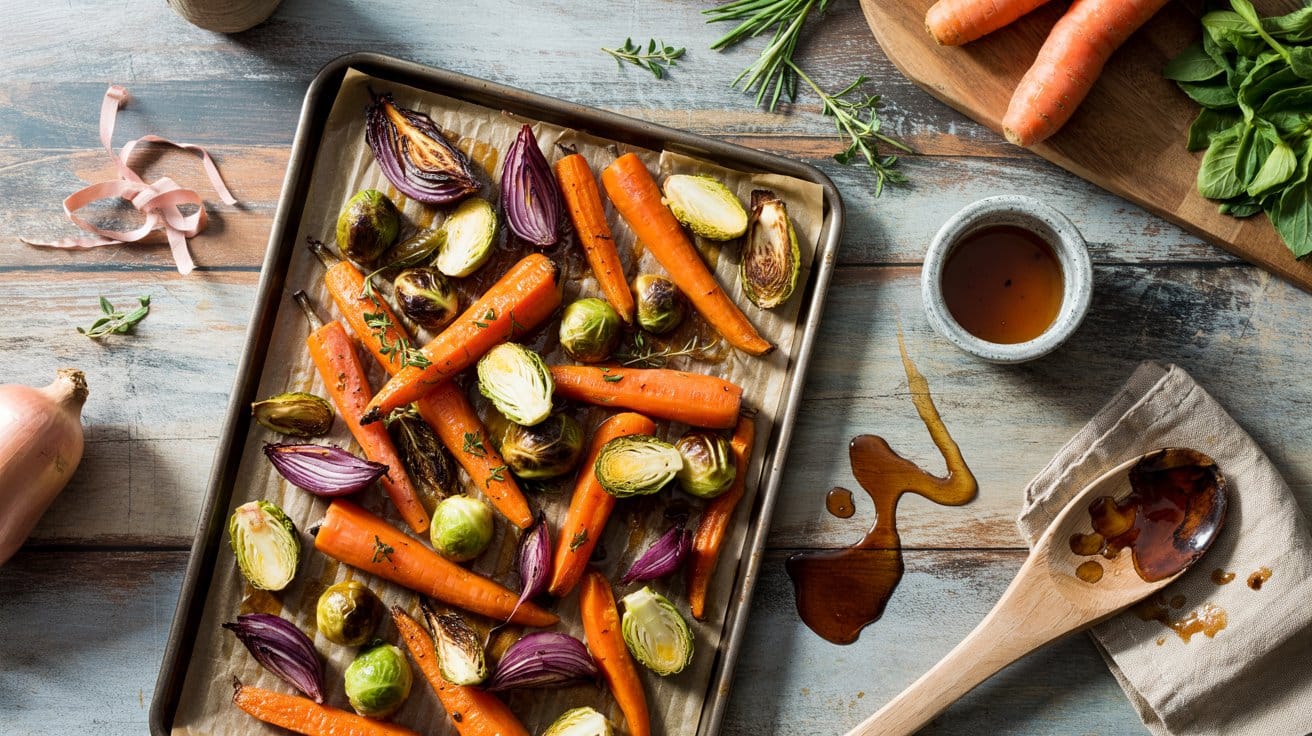
You can build each of these 18 low-sodium sides for a weeknight dinner from lemon, vinegar, herbs, garlic and roasting instead of salt.
- No recipe uses more than ⅛ teaspoon of added salt.
- The sodium that adds up fast hides in broth, canned beans, soy sauce, cheese and olives.
- For each salty ingredient, buy the lower-sodium version that the recipe names.
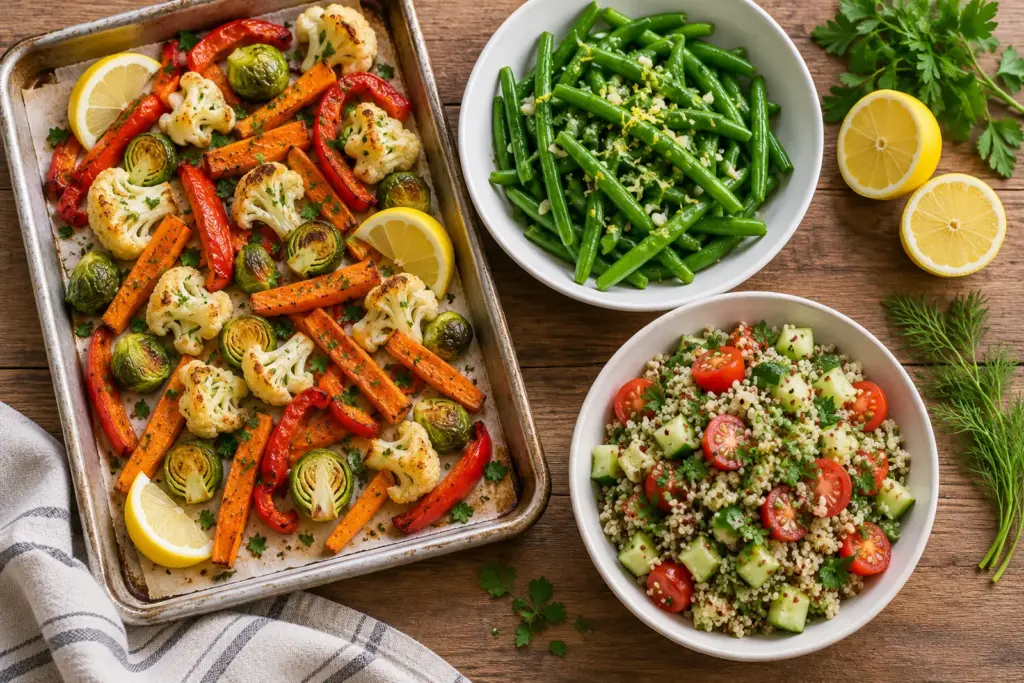
The FDA sets the Daily Value for sodium at less than 2,300 mg a day, which equals about 1 teaspoon of table salt, and the American Heart Association calls 1,500 mg a day an optimal goal for most adults. If a recipe calls for a full teaspoon of salt, you have used the whole day's limit before you eat anything else.
Here, ⅛ teaspoon of table salt is about 290 mg of sodium for the entire pot or pan, an estimate based on the FDA's figure of roughly 2,300 mg per teaspoon.
How Do You Build Flavor Without Salt?
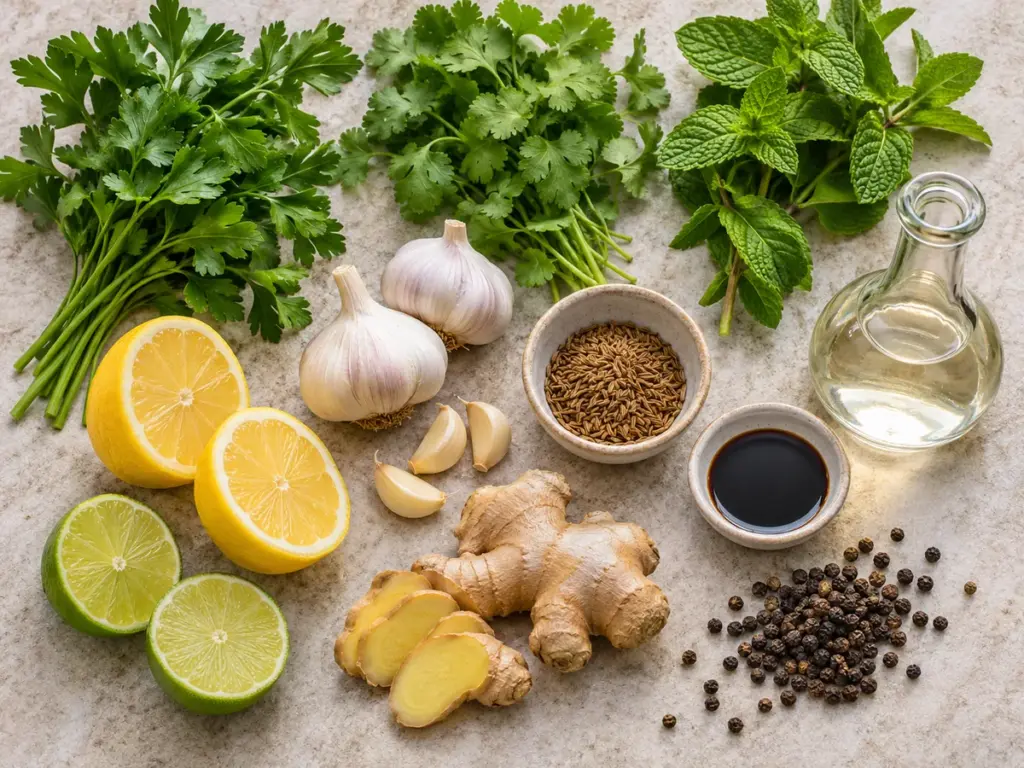
Salt makes food taste more like itself, so when you leave it out, something else has to wake up the flavor. The FDA suggests herbs, spices and no-salt seasoning blends instead of salt, and four habits do most of the work in this list:
- Acid at the end. Lemon, lime and vinegar sharpen every other flavor, but heat dulls fresh juice, so you squeeze or drizzle it on after cooking. Lemon zest holds most of the lemon aroma and the juice supplies the sourness, so these recipes use lemon zest and lemon juice together.
- Herbs by the handful. Soft herbs such as parsley, cilantro, mint and basil go in raw at the end, while hardy dried herbs such as thyme and oregano go in before heat so they can soften.
- Browning and toasting. Roasting at 425°F browns the natural sugars in vegetables, and a minute in a dry pan wakes up almonds, sesame seeds and cumin.
- Aromatics and heat. Garlic, ginger, onion, black pepper, mustard and red pepper flakes add a savory bite that you notice as seasoning even though they carry little sodium.
How Do You Read Sodium on a Food Label?
Check the milligrams on the Nutrition Facts label first, then the %DV column: the FDA calls 5% DV or less per serving low and 20% DV or more high. Front-of-package wording follows FDA definitions, and each claim means something different per serving:
| Label wording | What the FDA says it means |
|---|---|
| Sodium free | Under 5 mg per serving |
| Very low sodium | 35 mg or less per serving |
| Low sodium | 140 mg or less per serving |
| Reduced sodium | At least 25% less sodium than the regular version |
- Light in sodium means at least 50% less sodium than the regular version.
- No salt added means no salt was added during processing, so the food can still contain natural sodium.
Reduced sodium only measures against the regular product, so a reduced-sodium broth or soy sauce can still be well above the 140 mg cutoff, and you should compare the milligram number, not the claim.
If your doctor has given you a sodium limit, use that number instead of the ones above.
Which Ingredients Add the Most Sodium?
The sodium numbers below are arithmetic: USDA FoodData Central (SR Legacy) values multiplied by the amount each recipe uses, not lab results. A few ingredients carry most of the sodium in this list, and the amounts differ a lot.
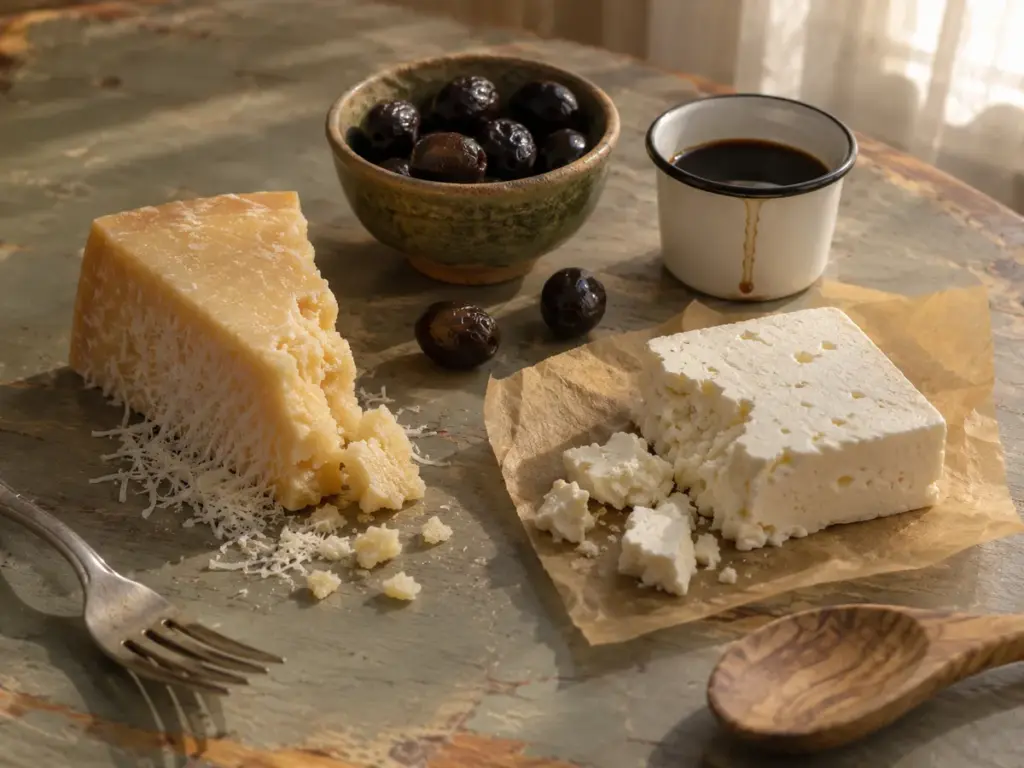
Cheese and olives lead, and the amounts below are what the recipes call for:
- Mozzarella, 8 ounces: about 1,100 mg (USDA whole-milk record).
- Parmesan, ½ cup finely grated: about 900 mg.
- Feta, ¼ cup crumbled: about 430 mg.
- Canned ripe olives, 2 tablespoons: about 120 mg.
Sauces and liquids come next, and a spoonful or a cup is enough to matter:
- Ordinary vegetable broth, 1 cup: about 650 mg.
- Reduced-sodium soy sauce, 1 tablespoon (USDA hydrolyzed-protein record): about 430 mg.
- Mayonnaise, ¼ cup: about 350 mg.
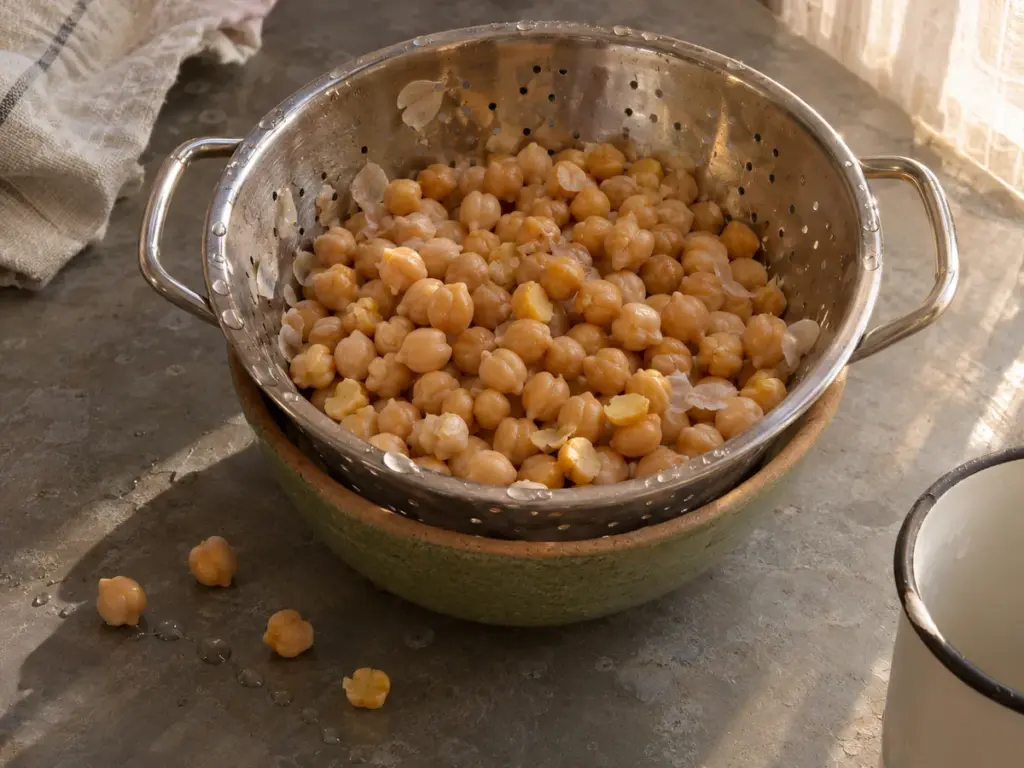
The can you open matters as much as the recipe. The USDA lists canned chickpeas drained and rinsed at 212 mg per 100 g (FDC 173801) and chickpeas cooked without salt at 7 mg per 100 g (FDC 173757), which stands in here for a no-salt-added can:
- Two 15-ounce cans, drained
- About 1,070 mg of sodium
- Two 15-ounce cans, drained
- About 35 mg of sodium
Broth shows the same gap. USDA lists ordinary canned chicken broth at about 920 mg a cup (FDC 174536) and low-sodium canned chicken broth at about 70 mg (FDC 171609). Vegetable broth has no low-sodium record in that file, so the broth recipes below use the FDA's 140 mg per serving ceiling for a low sodium label as the most a cup can add.
Vegetables are not zero either. USDA lists raw carrots at 69 mg per 100 g, raw spinach at 79 mg and raw sweet potato at 55 mg, so a recipe with no added salt at all still carries sodium from the produce.
Which Low-Sodium Side Should You Make?
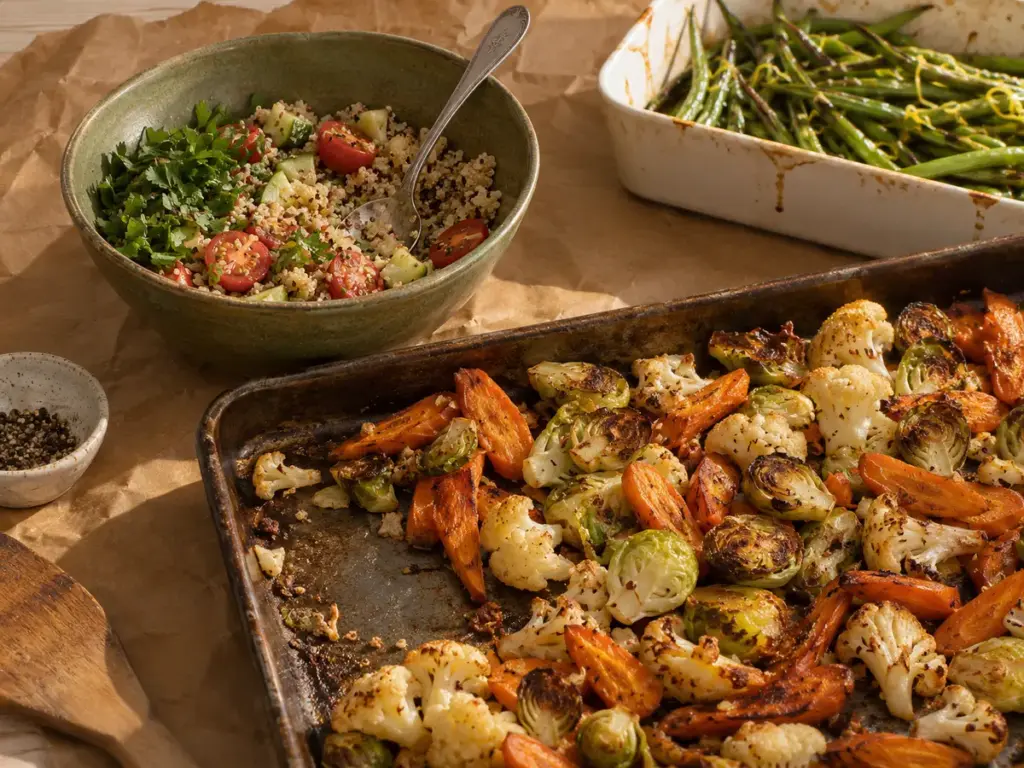
| If you need | Make these |
|---|---|
| Nothing salty beyond the vegetables (no cheese, broth, soy sauce or jarred sauce) | 1 Roasted Veggie Medley, 3 Green Beans, 5 Brussels Sprouts, 8 Sweet Potatoes, 9 Asparagus, 11 Cucumber Mint Salad |
| A fast stovetop side | 3 Green Beans, 6 Couscous, 9 Asparagus, 18 Cabbage Stir-Fry |
| Hands-off oven cooking | 1 Roasted Veggie Medley, 5 Brussels Sprouts, 8 Sweet Potatoes, 14 Ratatouille |
- A salad that holds in the fridge: 2 Quinoa Salad, 10 Chickpea Salad, 15 Broccoli and Cauliflower Salad, 17 Lentil Salad.
- A side that can be the main dish: 4 Cauliflower Steaks, 16 Stuffed Peppers, 17 Lentil Salad.
How Much Sodium Does Each Recipe Have?
Each recipe ends with its own arithmetic, and here they sit side by side per serving. The serving counts are a division chosen for this page, not a yield stated by a source, and every figure leaves out the optional ⅛ teaspoon of salt, which adds about 290 mg to the whole recipe.
Under 50 mg per serving:
- 9 Asparagus: about 3 mg.
- 11 Cucumber Mint Salad: about 4 mg.
- 2 Quinoa Salad and 3 Green Beans: under 10 mg each.
- 10 Chickpea Salad: about 10 mg.
- 14 Ratatouille and 17 Lentil Salad: about 20 mg each.
- 5 Brussels Sprouts: about 45 mg.
From 50 to 140 mg per serving:
- 6 Couscous: at most about 65 mg with low-sodium broth.
- 1 Roasted Veggie Medley: about 70 mg.
- 4 Cauliflower Steaks: about 75 mg.
- 15 Broccoli and Cauliflower Salad: about 85 mg before the Dijon.
- 18 Cabbage Stir-Fry: about 95 mg.
- 8 Sweet Potatoes: about 125 mg.
Above 140 mg per serving:
- 13 Mashed Cauliflower: about 185 mg.
- 16 Stuffed Peppers: at most about 220 mg with low-sodium broth.
- 7 Air Fryer Zucchini Fries: about 270 mg before the panko.
- 12 Tomato Mozzarella Salad: about 285 mg.
For comparison, the FDA's low sodium claim on a package means 140 mg or less per serving. These are homemade dishes, so that number works as a yardstick, not a label claim. Three of the four recipes in that last group get most of their sodium from cheese, and the stuffed peppers get theirs from feta, olives and broth, so trimming the cheese is the quickest fix, and most recipes say how much that saves.
18 Best Low-Sodium Side Dishes With Real Flavor
1. Roasted Veggie Medley
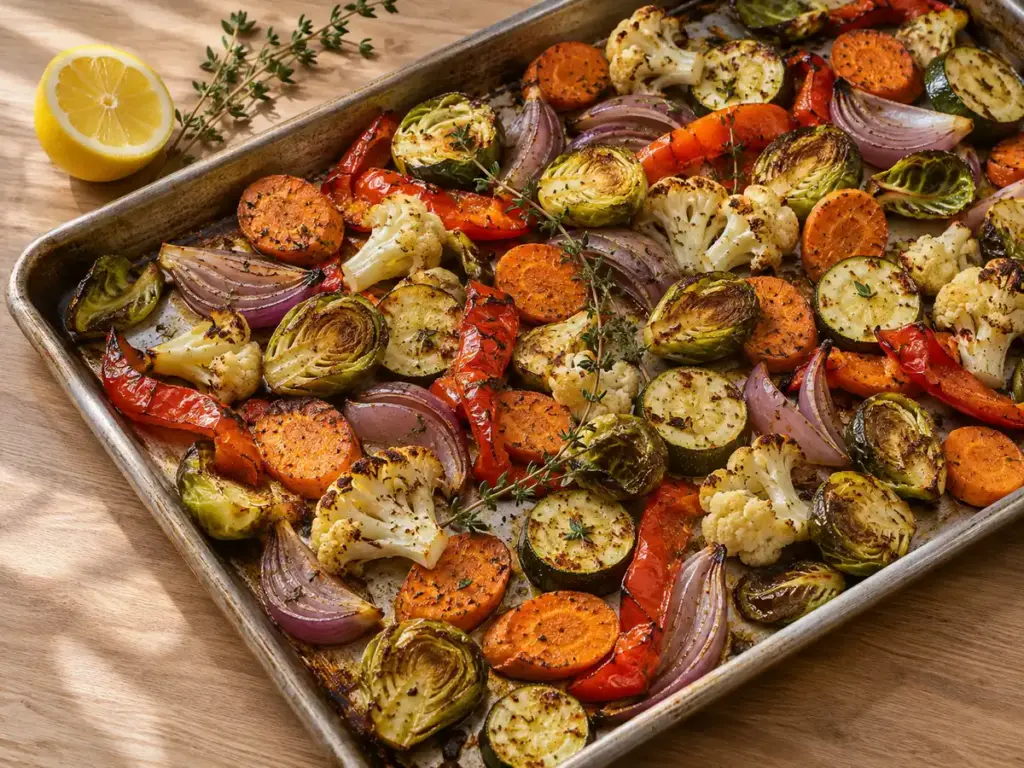
If you roast at 425°F, the natural sugars in carrots, onion and Brussels sprouts brown, and that browning does much of the job salt usually does. Lemon juice and garlic give you the sharp finish, and thyme holds up to the heat.
You will get better browning if you spread the vegetables over two baking sheets, because about 3 pounds crowded on one pan steam instead of brown.
Ingredients
- 4 large carrots, peeled and cut into ½-inch slices
- 1 large red bell pepper, diced
- 1 medium zucchini, sliced into ½-inch rounds
- 1 small red onion, cut into wedges
- 12 ounces Brussels sprouts, halved
- 3 cups cauliflower florets, bite-sized
- 2 tablespoons extra-virgin olive oil
- 2 teaspoons lemon juice, plus more to finish
- 3 cloves garlic, minced
- 1 teaspoon freshly ground black pepper
- 1 teaspoon dried thyme, or 1 tablespoon fresh thyme leaves
Steps
- Heat the oven to 425°F and line two baking sheets with parchment or foil.
- Whisk the olive oil, lemon juice, garlic, thyme and pepper in a large bowl, then toss the vegetables in the dressing until coated.
- Spread the vegetables in a single layer with space between the pieces. Roast 20 to 25 minutes, flipping once halfway, until the edges are browned and the centers are tender.
- Taste, add a squeeze more lemon if you want extra brightness, and serve warm or at room temperature.
Swaps and Sodium
- Brussels sprouts: halved broccoli florets roast to a similar texture and finish a little sooner.
- Zucchini: eggplant cubes soak up the oil and roast tender.
- Dried thyme: dried rosemary holds up to 425°F just as well.
- Lemon juice: a splash of balsamic vinegar gives a sweeter, deeper finish.
This pan needs no added salt, yet the vegetables carry some sodium of their own. The USDA values for every ingredient add up to about 410 mg for the whole pan, and the four carrots supply about 200 mg of it. Split into 6 servings, that is about 70 mg each.
Reheat leftovers on a sheet pan in a 425°F oven instead of the microwave, which steams the browned edges soft.
2. Quinoa Salad With Fresh Herbs
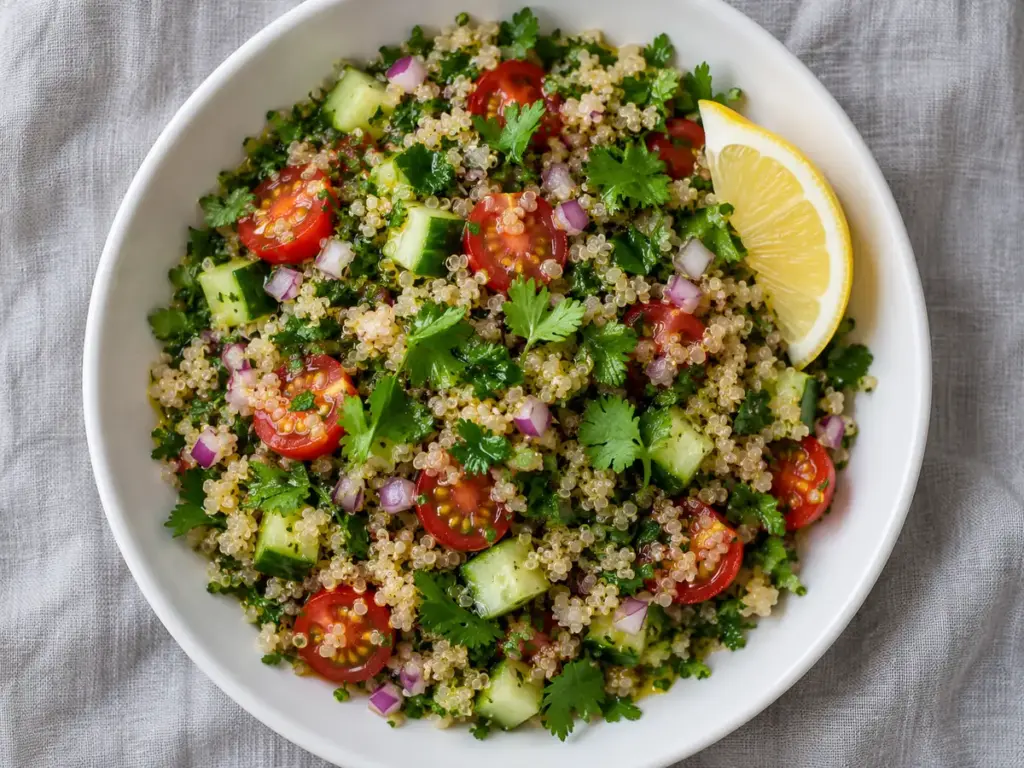
When you rinse quinoa, you wash off saponin, the natural coating that tastes bitter, and if you let the grains cool before you dress them, the salad will not turn gummy. Parsley and cilantro supply the flavor, and cucumber and tomato give you crunch and juice.
The salad suits grilled chicken or fish, travels well to a potluck, and keeps in the fridge as a packed lunch. Rinse the quinoa in a fine-mesh strainer under cold running water before it cooks.
Ingredients
- 1 cup quinoa, rinsed and drained
- 2 cups water
- ½ cup fresh parsley, finely chopped
- ½ cup fresh cilantro, finely chopped
- 1 medium cucumber, diced
- 1 cup cherry tomatoes, halved
- ¼ cup red onion, finely chopped
- ¼ cup extra-virgin olive oil
- 2 tablespoons lemon juice
- ¼ teaspoon freshly ground black pepper
- Optional: ⅛ teaspoon salt
Steps
- Simmer the quinoa and water in a covered small pot for 15 minutes, until the water is absorbed.
- Take the pot off the heat, let it stand 5 minutes, then fluff with a fork and move the quinoa to a large bowl to cool slightly.
- Add the parsley, cilantro, cucumber, tomatoes and onion to the bowl.
- Whisk the oil, lemon juice and pepper (and salt, if using), pour it over the salad and toss.
- Chill 20 minutes if you like it cold, taste, and serve.
Swaps and Sodium
- Cilantro: chopped mint or basil gives a different herb note that still brightens the bowl.
- Parsley: chopped dill adds a sharper, more aromatic finish that suits lemon.
- Cucumber: diced bell pepper keeps the crunch when your cucumber is watery.
- Lemon juice: lime juice gives a slightly tangier edge.
Because you cook the quinoa in plain water, the whole bowl comes to about 45 mg of sodium by USDA arithmetic, and the parsley is the largest single source at about 17 mg. Split into 6 servings, that is under 10 mg each.
If you make the salad a day ahead, stir in the parsley and cilantro shortly before serving, because lemon juice dulls cut herbs over a few hours.
3. Garlic Lemon Green Beans
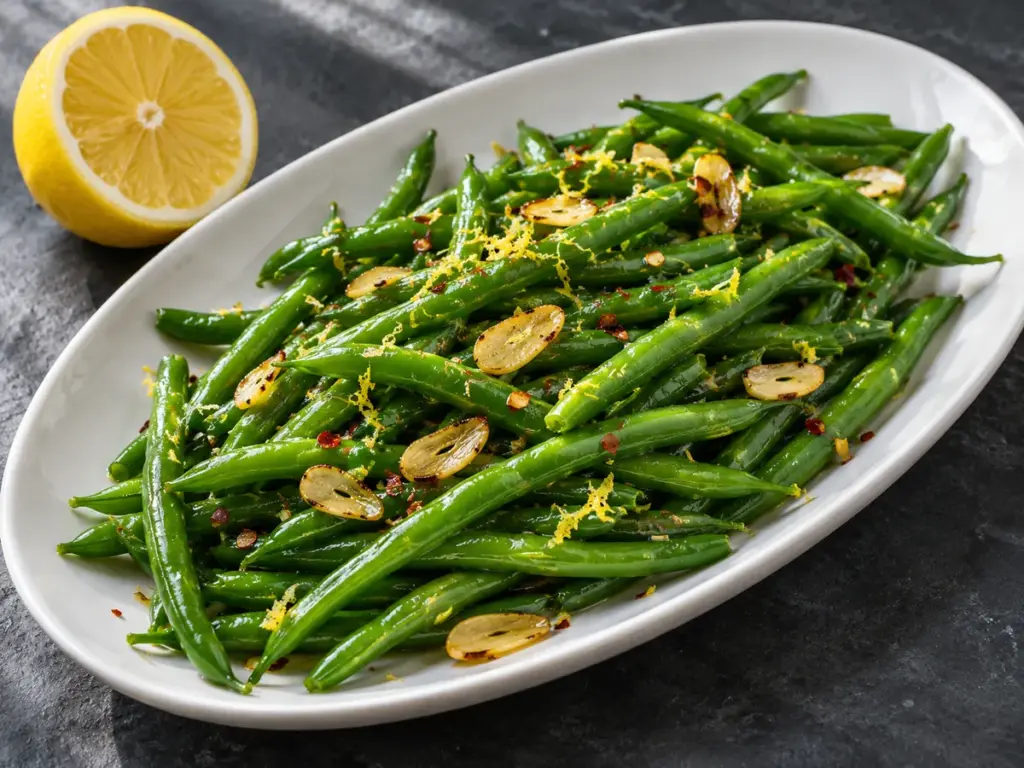
If you blanch the beans and chill them in ice water, they keep their green color and snap, and a quick sauté in garlic oil adds a little char. You add the lemon zest and juice after the pan comes off the heat so they stay fresh.
You can boil the beans in plain, unsalted water, because salted blanching water is a quiet source of sodium in most green bean recipes and the garlic and lemon make it unnecessary.
Ingredients
- 1 pound green beans, trimmed
- 2 tablespoons olive oil
- 3 cloves garlic, minced
- 1 teaspoon lemon zest, finely grated
- 1 tablespoon lemon juice
- ¼ teaspoon freshly ground black pepper
- Pinch of red pepper flakes, optional
- Optional: ⅛ teaspoon salt
Steps
- Boil the beans in a large pot of unsalted water for 3 to 4 minutes, until bright green and crisp-tender.
- Drain, plunge the beans into ice water for 2 minutes, then drain well and pat dry so they do not spatter in the oil.
- Heat the oil in a large skillet over medium heat and stir the garlic for 20 to 30 seconds, until fragrant.
- Add the beans and sauté 3 to 5 minutes, turning now and then, until lightly charred and hot.
- Off the heat, toss with the zest, juice, pepper and red pepper flakes, then serve warm.
Swaps and Sodium
- Green beans: thin haricots verts or trimmed snap peas give a more delicate bite.
- Olive oil: avocado oil handles a hotter pan when you want more char.
- Lemon juice: lime juice gives a sharper citrus note.
- Garlic: 1 tablespoon of jarred minced garlic works in a pinch and tastes milder, but read the label for added salt.
Unsalted blanching water keeps the pound of beans at about 30 mg of sodium, nearly all of it natural to the beans (USDA arithmetic). Split into 4 servings, that is under 10 mg each.
You can blanch and ice-bath the beans earlier in the day, keep them dry in the refrigerator, and do the garlic sauté just before serving.
4. Cauliflower Steaks With Chimichurri
Thick slices give you more surface to brown than florets, so the edges caramelize while the center turns tender. Chimichurri, a raw sauce of parsley, cilantro, garlic, red wine vinegar and olive oil, brings the acid and herbs you would otherwise try to cover with salt.
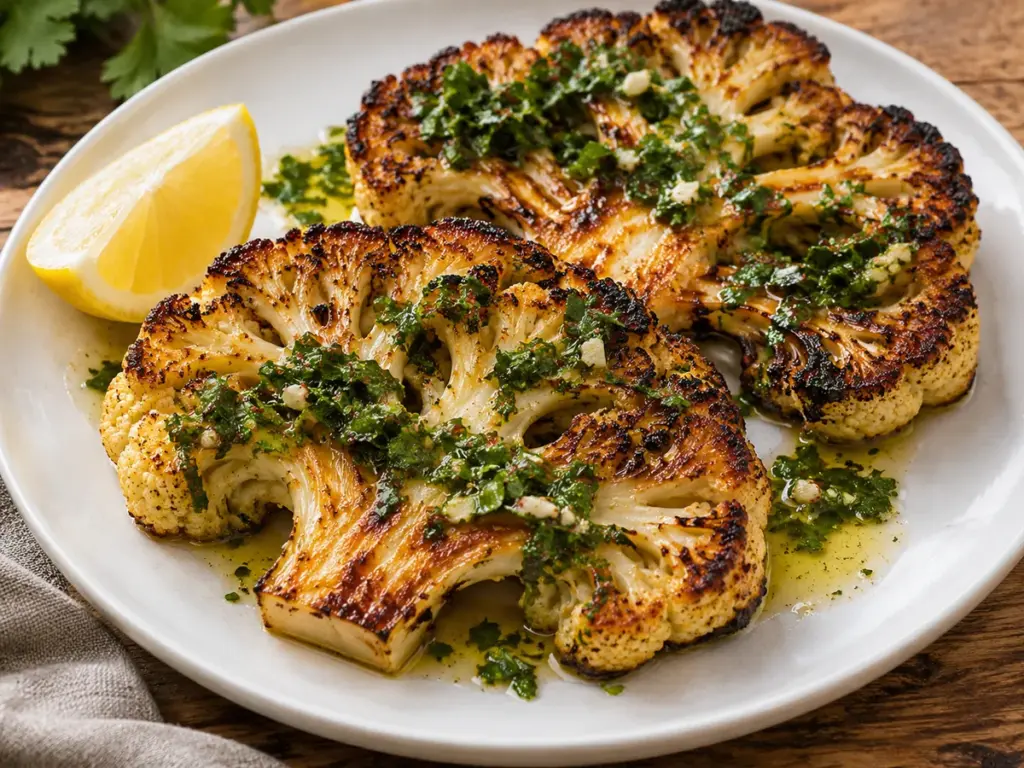
If these steaks are your main, sides that suit cauliflower steaks such as a grain salad or beans round out the plate.
Ingredients
- 1 large head cauliflower, trimmed and core left in
- 2 tablespoons olive oil, for brushing
- ¼ teaspoon freshly ground black pepper
- 1 cup packed fresh flat-leaf parsley, stems removed
- ½ cup packed fresh cilantro, stems removed
- 3 cloves garlic, minced
- 2 tablespoons red wine vinegar
- ½ cup extra-virgin olive oil
- ½ teaspoon red pepper flakes, or to taste
- 1 lemon, cut into wedges
Steps
- Heat a grill to medium-high, or heat the oven to 425°F and line a sheet pan with parchment.
- Slice the head into ¾- to 1-inch steaks through the core so the florets stay attached. Brush both sides with the 2 tablespoons of olive oil and sprinkle with the pepper. Roast the loose florets on the same pan.
- Grill the steaks 5 to 7 minutes per side, or roast 10 to 12 minutes per side, until deeply browned and tender when pierced with a fork.
- Meanwhile, pulse the parsley, cilantro, garlic, vinegar and red pepper flakes in a food processor (or chop by hand), then stir in the extra-virgin olive oil.
- Spoon the chimichurri over the warm steaks and serve with lemon wedges.
Swaps and Sodium
- Cauliflower: thick eggplant slices or large portobello caps pick up char on the same grill.
- Parsley: all basil makes a milder, sweeter chimichurri.
- Cilantro: extra parsley gives a less pungent sauce.
- Red wine vinegar: lemon juice gives a brighter, more citrusy sauce.
The vinegar, garlic and chili carry the seasoning, so you add no salt. USDA arithmetic puts the whole recipe at about 300 mg, and the cauliflower head supplies about 250 mg of it because raw cauliflower holds 30 mg per 100 g. Split into 4 servings, that is about 75 mg each.
Make the chimichurri while the steaks cook or earlier in the day, since the garlic and vinegar blend into the oil as it sits.
5. Balsamic Roasted Brussels Sprouts
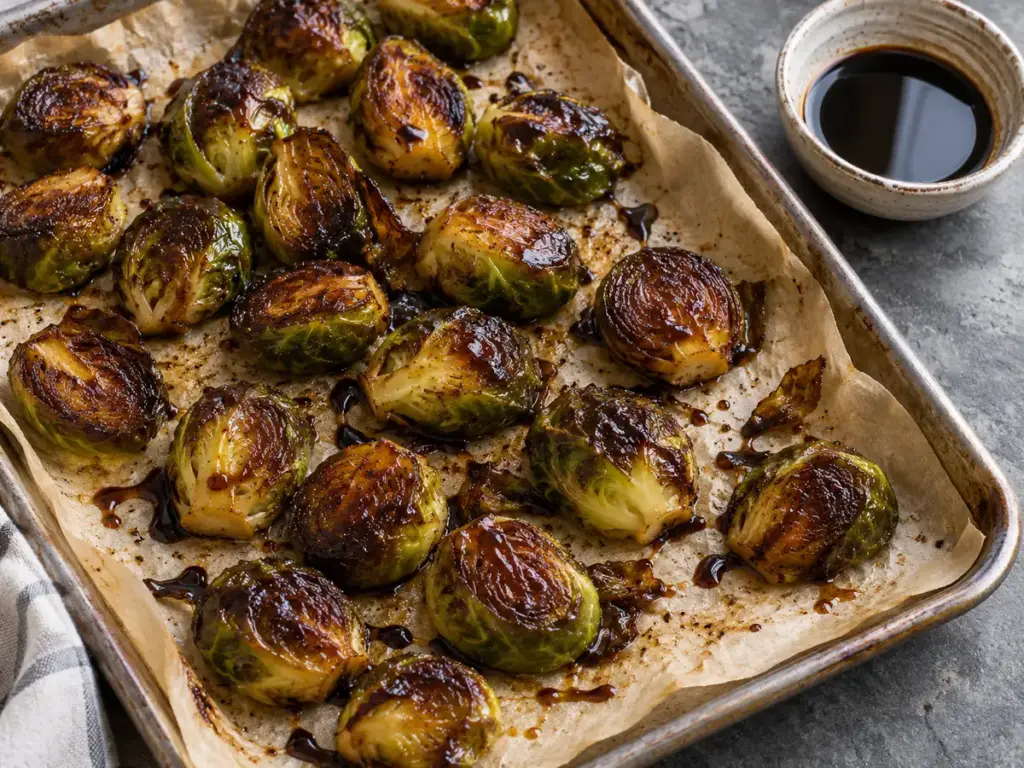
When you place the halves cut side down, you get crisp, deeply browned faces, and the balsamic and maple glaze reduces on the hot sprouts into a sticky coating that balances their bitterness. You add the glaze near the end so the sugar does not burn.
Toss the halves with the oil first so every cut face carries a thin coat that browns instead of drying out. Cut a mixed batch to one size, because small sprouts char before large ones turn tender.
Ingredients
- 1 ½ pounds Brussels sprouts, trimmed and halved
- 2 tablespoons olive oil
- 2 tablespoons balsamic vinegar
- 1 tablespoon maple syrup
- ½ teaspoon freshly ground black pepper
- Optional: ⅛ teaspoon salt
Steps
- Heat the oven to 425°F.
- Toss the sprouts with the oil and pepper in a large bowl.
- Spread them cut side down on a baking sheet and roast 20 to 25 minutes, until the edges are browned and the centers are tender.
- Whisk the balsamic and maple syrup together and drizzle over the hot sprouts, tossing to coat.
- Return the pan to the oven for 3 to 5 minutes to thicken the glaze, then serve right away.
Swaps and Sodium
- Maple syrup: the same amount of honey gives a similar sticky glaze.
- Balsamic vinegar: 1 tablespoon of balsamic glaze, or 1 tablespoon of red wine vinegar plus 1 teaspoon of honey, recreates the sweet-tart finish.
- Olive oil: avocado oil copes better with 425°F.
- Brussels sprouts: halved baby sprouts roast sooner, and shredded sprouts turn crisper.
You add no salt, yet 1 ½ pounds of sprouts hold about 170 mg of sodium on their own, since raw Brussels sprouts carry 25 mg per 100 g. With the glaze under 10 mg, the pan comes to about 180 mg by USDA arithmetic, or about 45 mg per serving across 4.
If you roast the sprouts ahead, hold the glaze until they go back into the oven for the final 3 to 5 minutes, so it thickens on hot sprouts.
6. Herbed Couscous With Spinach
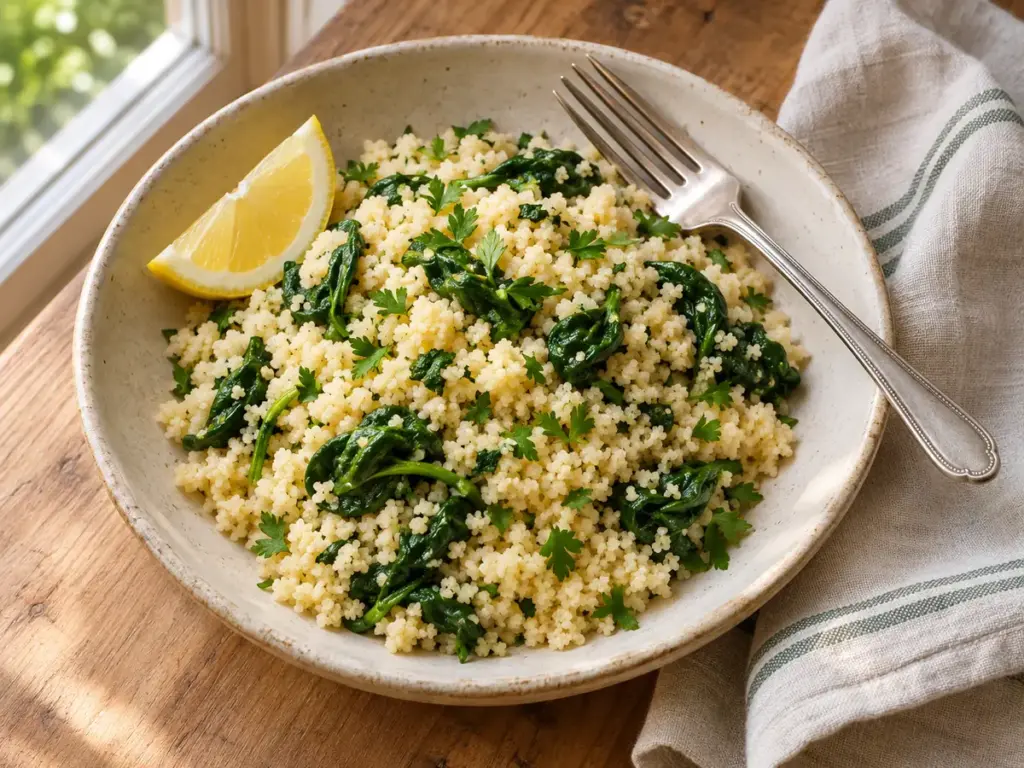
Instant couscous needs only hot liquid and five minutes, so you can finish this side while the main rests. The heat of the couscous wilts the spinach, and lemon juice and parsley keep the grain from tasting heavy.
Couscous is a mild base, so you can turn leftovers into a different meal with one of the sauces that suit couscous.
Broth is the main sodium source here, so buy one labeled low sodium (140 mg or less per serving) or no salt added, and compare the milligrams on the label, since ordinary boxed broth varies widely.
Ingredients
- 1 cup instant couscous
- 1 cup low-sodium or no-salt-added vegetable broth
- 1 tablespoon olive oil
- 2 cloves garlic, minced
- 4 cups packed baby spinach, roughly chopped
- ¼ cup fresh parsley, chopped
- 2 tablespoons lemon juice
- ¼ teaspoon freshly ground black pepper
- Optional: ⅛ teaspoon salt
Steps
- Heat the broth, oil and garlic in a small saucepan over medium heat until it simmers, about 1 minute.
- Stir in the couscous, take the pan off the heat, cover, and let it stand 5 minutes.
- Fluff with a fork, then stir in the spinach, parsley, lemon juice and pepper until the spinach wilts, 1 to 2 minutes.
- Taste, and serve warm or at room temperature.
Swaps and Sodium
- Couscous: pearl (Israeli) couscous simmers 8 to 10 minutes in 1 ¼ cups of broth and gives a chewier bite.
- Vegetable broth: low-sodium chicken broth makes a richer base, and the dish is no longer vegetarian.
- Baby spinach: Swiss chard or sliced kale works if you cook it a minute longer.
- Parsley: cilantro or mint changes the herb note and still brightens the grain.
Without the broth, the couscous, spinach and parsley come to about 120 mg. A cup of broth labeled low sodium adds at most 140 mg, which makes at most about 65 mg per serving across 4. A cup of ordinary vegetable broth adds about 650 mg (USDA FDC 171583) and lifts each serving to about 195 mg.
If you open a carton for one cup, check how long vegetable broth keeps before you plan the rest.
7. Air Fryer Zucchini Fries
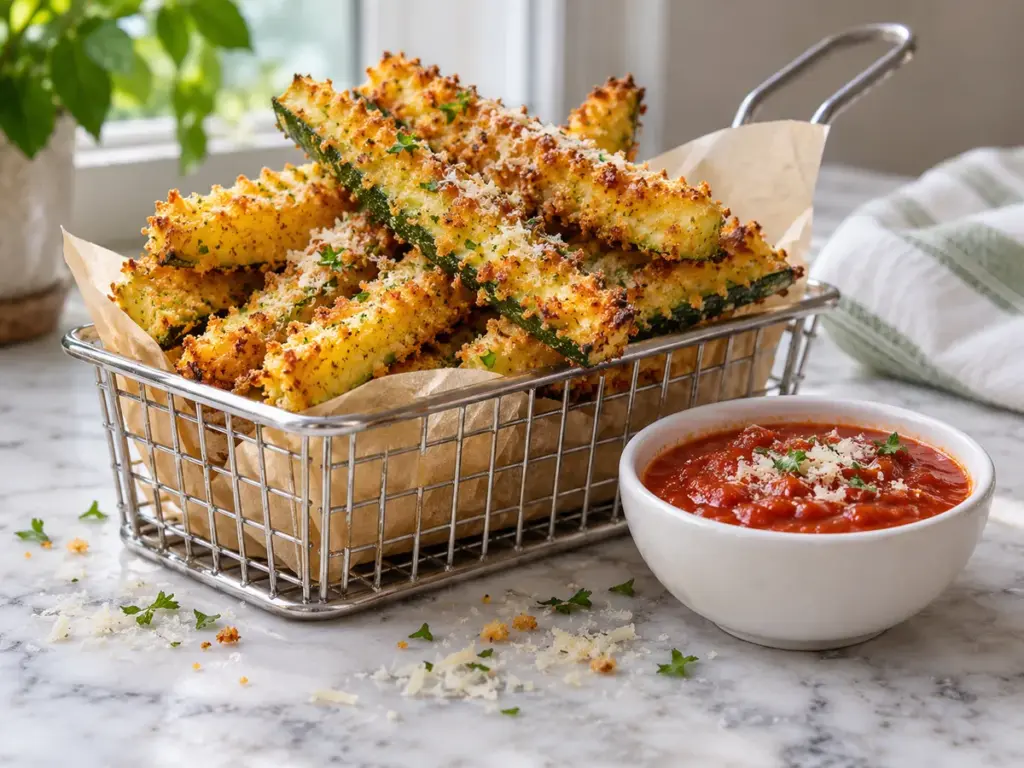
A panko and Parmesan crust browns fast in the air fryer and stays crunchy around a tender zucchini center. Pat the cut sticks dry with a towel first, because if the zucchini is wet, the flour slips off and the crust turns soggy.
Parmesan and panko are the salty ingredients here, so you skip added salt and season with garlic powder (not garlic salt). If you serve the fries with jarred marinara or a mayonnaise dip, you add sodium, while a dip of plain Greek yogurt, lemon and dill adds very little.
Ingredients
- 3 medium zucchini, cut into 3-inch sticks and patted dry
- ½ cup all-purpose flour
- 2 large eggs, beaten
- 1 cup plain panko breadcrumbs
- ½ cup finely grated Parmesan cheese
- ½ teaspoon garlic powder
- ½ teaspoon smoked paprika
- ¼ teaspoon freshly ground black pepper
- Cooking spray, or 1 tablespoon olive oil
Steps
- Heat the air fryer to 400°F for about 3 minutes.
- Set out three shallow bowls: flour in the first, eggs in the second, and panko mixed with the Parmesan, garlic powder, paprika and pepper in the third.
- Dredge each stick in flour, shake off the extra, dip it in egg, then press it into the panko mixture.
- Arrange the fries in a single layer without crowding and spray the tops lightly with cooking spray or brush with a little oil.
- Air fry at 400°F for 8 to 10 minutes, turning halfway, until golden and the zucchini is tender when pierced. Serve right away.
Swaps and Sodium
- Panko: gluten-free breadcrumbs work in the same steps.
- All-purpose flour: a 1:1 gluten-free flour holds the coating the same way.
- Eggs: a flax egg (1 tablespoon ground flax plus 3 tablespoons water per egg) binds the crumbs.
- Parmesan: nutritional yeast gives a cheesy note without cheese, but compare its label for sodium.
Parmesan is the salt here: ½ cup finely grated carries about 900 mg of the roughly 1,090 mg for the whole batch before the panko (USDA arithmetic). Split into 4 servings, that is about 270 mg each. Panko adds more, since USDA lists plain dry breadcrumbs at about 730 mg per 100 g (FDC 174928) and brands differ, so read the label. If you use ¼ cup of Parmesan, you take about 450 mg out of the batch.
Serve the fries right away, because steam collects under the crust and softens it as they cool.
8. Crispy Roasted Sweet Potatoes
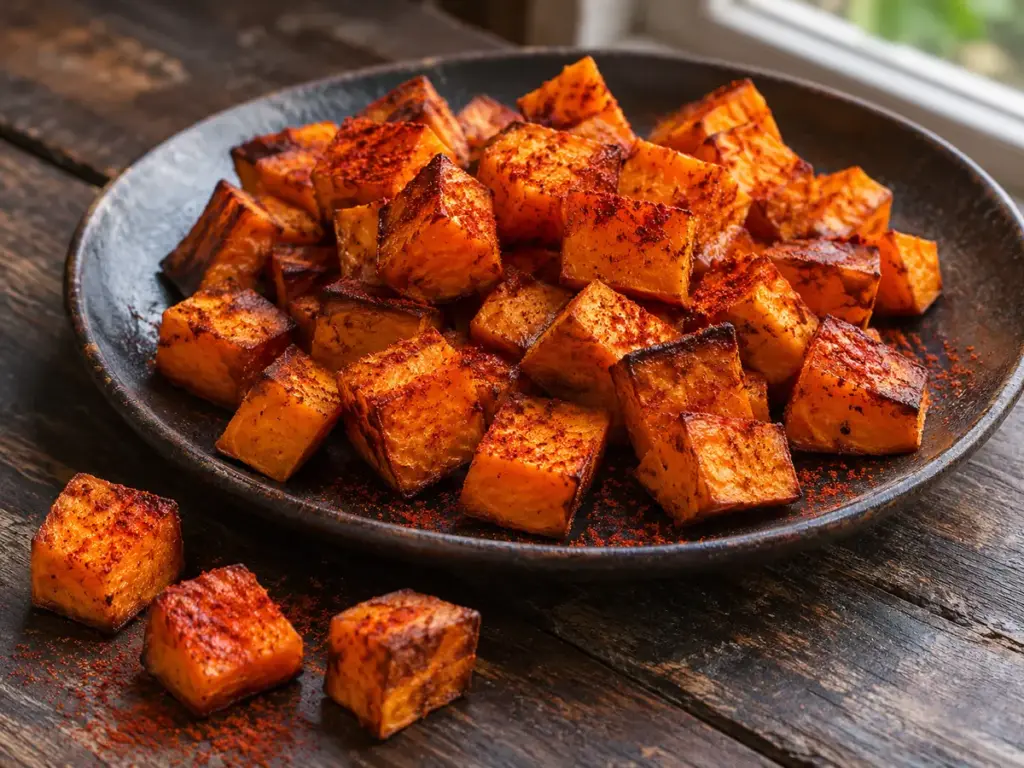
A tablespoon of cornstarch dries the surface of the cubes so the oven can crisp them, and when you roast at 425°F, the cubes turn sweet and toasty. You add no salt at all, and the smoked paprika gives you the savory note.
If you run out of sweet potatoes, peeled butternut squash cubes roast the same way, and you can use other sweet potato substitutes in the same pan.
Ingredients
- 2 pounds sweet potatoes, peeled and cut into ½-inch cubes
- 2 tablespoons olive oil
- 1 tablespoon cornstarch
- ½ teaspoon freshly ground black pepper
- ½ teaspoon smoked paprika, optional
Steps
- Heat the oven to 425°F and line a rimmed baking sheet with parchment.
- Pat the sweet potato cubes dry with a towel.
- Toss with the cornstarch, oil, pepper and paprika until evenly coated.
- Spread in a single layer with space between the pieces.
- Roast 20 to 25 minutes, turning once, until the edges are browned and the centers are tender. Rest 5 minutes before serving.
Swaps and Sodium
- Sweet potatoes: peeled butternut squash cubes roast to a similar sweetness.
- Cornstarch: arrowroot powder crisps the same way and keeps the dish gluten-free.
- Olive oil: avocado oil gives a neutral flavor and tolerates the heat.
- Smoked paprika: ground cumin or chili powder gives a warm, savory note.
Sweet potatoes hold about 55 mg of sodium per 100 g, so 2 pounds supply about 500 mg, nearly the whole total for a recipe with no added salt (USDA arithmetic). Split into 4 servings, that is about 125 mg each.
Reheat leftovers on a sheet pan in a hot oven, because the microwave steams the crisp edges soft.
9. Lemon Garlic Asparagus
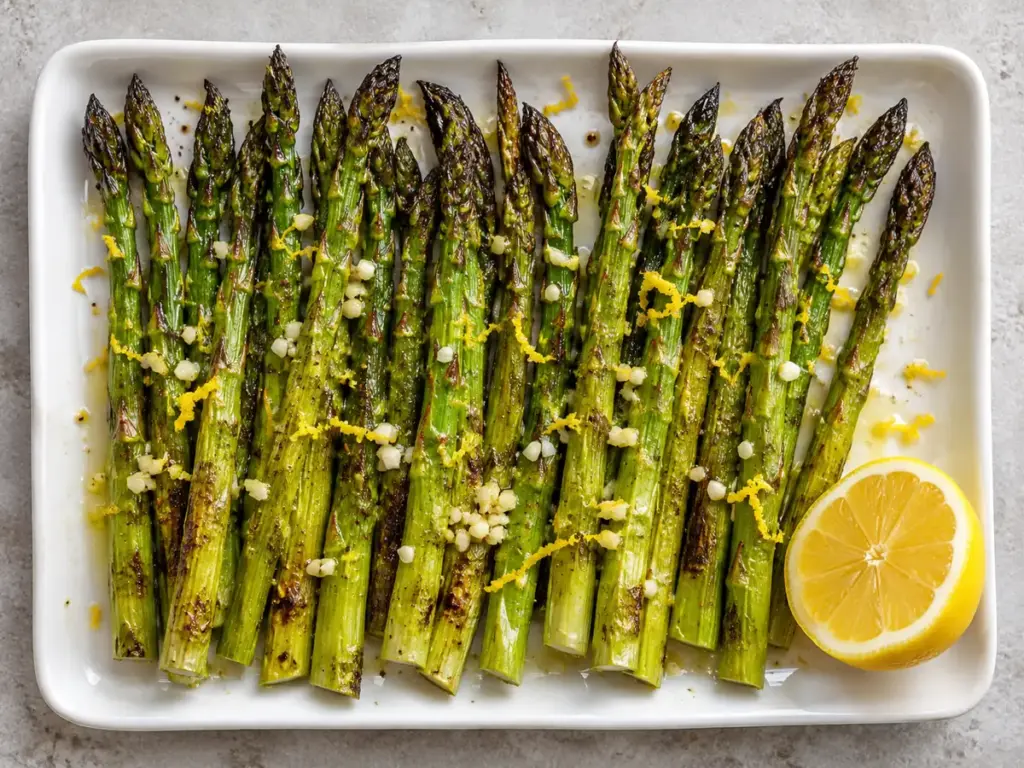
When you cook the spears over high heat for a short time, the tips char while the stalks stay crisp-tender. Raw minced garlic would burn on a grill, so you add it to the hot spears afterward, where the heat softens its raw edge without scorching it.
Pick spears about as thick as a pencil. Thicker ones need longer on the grill, and very thin ones can overcook before the tips char.
Ingredients
- 1 pound asparagus, woody ends snapped off
- 2 tablespoons extra-virgin olive oil
- 1 lemon, zested and juiced
- ¼ teaspoon freshly ground black pepper
- 2 cloves garlic, minced
- Optional: ⅛ teaspoon salt
Steps
- Heat a grill or grill pan to medium-high (about 400 to 450°F) and oil the grate lightly.
- Toss the asparagus with the oil, lemon zest and pepper.
- Lay the spears across the grates and cook 4 to 6 minutes, turning once, until charred at the edges and tender-crisp.
- Move to a platter and toss at once with the garlic and lemon juice. Taste before adding any salt.
Swaps and Sodium
- Olive oil: avocado oil suits a very hot grill.
- Lemon: zest plus a splash of white wine vinegar gives a bright acidic note.
- Garlic: ½ teaspoon of garlic powder (not garlic salt) mixed into the oil gives a milder garlic taste.
- Asparagus: broccolini or thin green beans cook to the same tender-crisp point.
Asparagus holds just 2 mg of sodium per 100 g, so a pound is about 9 mg. The recipe comes to about 10 mg in total, or about 3 mg per serving across 4 (USDA arithmetic).
Cook the spears right before you serve, because they soften and lose their char as they sit.
10. Spicy Chickpea Salad
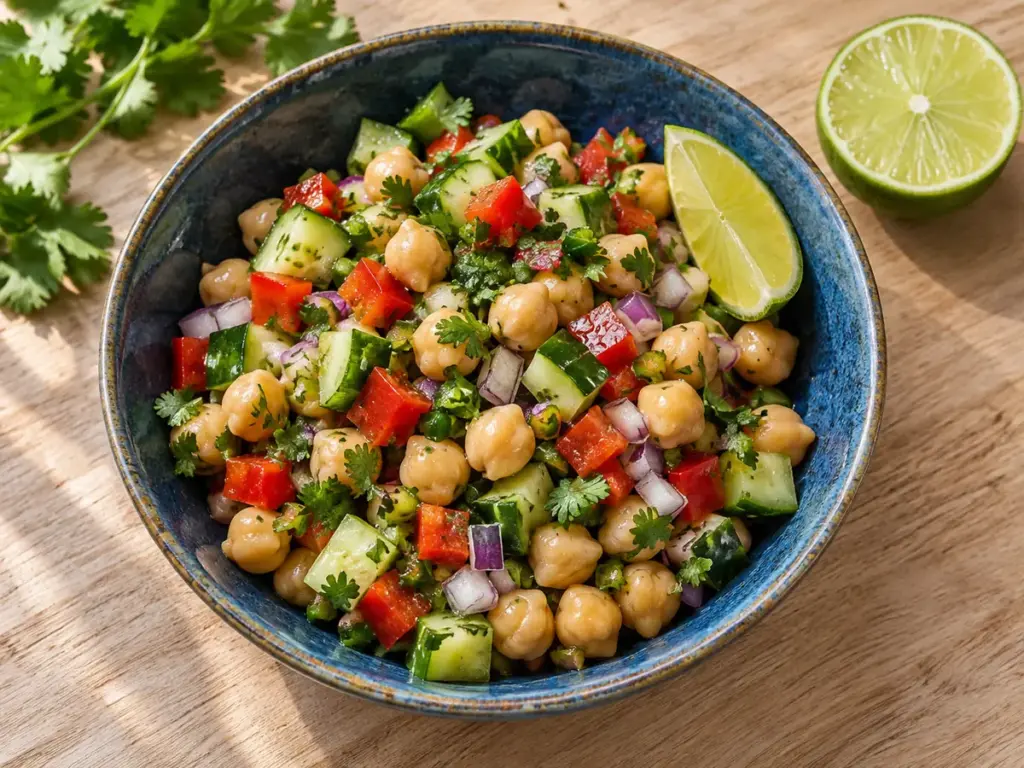
Cumin, lime and a jalapeño give the chickpeas plenty of flavor, and the salad tastes best if you chill it briefly so the beans absorb the dressing.
Canned chickpeas are the biggest sodium source in this bowl, so buy cans labeled no salt added, or drain and rinse regular cans well, which the AHA says can cut sodium by up to 40%.
Ingredients
- 2 cans (15 ounces each) no-salt-added chickpeas, drained and rinsed
- 1 medium cucumber, seeded and diced
- 1 red bell pepper, diced
- ¼ cup red onion, finely chopped
- 1 jalapeño, seeded and minced
- ½ cup fresh cilantro, chopped
- 3 tablespoons fresh lime juice (about 2 limes)
- 3 tablespoons extra-virgin olive oil
- 1 teaspoon ground cumin
- ½ teaspoon smoked paprika, or chili powder
- ¼ teaspoon freshly ground black pepper
- Optional: ⅛ teaspoon salt
Steps
- Pat the chickpeas dry and put them in a large bowl with the cucumber, bell pepper, onion, jalapeño and cilantro.
- Whisk the lime juice, oil, cumin, paprika and pepper in a small bowl.
- Pour the dressing over the salad and toss until coated.
- Chill 15 to 30 minutes, then taste and serve.
Swaps and Sodium
- Chickpeas: cannellini or navy beans make a milder, creamier salad, and you rinse them too.
- Cilantro: flat-leaf parsley gives a fresher, less citrusy herb note.
- Jalapeño: ¼ teaspoon of red pepper flakes gives steady heat without the chopping.
- Lime juice: lemon juice gives similar acidity and a slightly sweeter finish.
With no-salt-added cans, the salad comes to about 55 mg of sodium, or about 10 mg per serving across 6. Ordinary cans, drained and rinsed, would lift the bowl to about 1,100 mg, or about 180 mg per serving, which is why the can label matters most here.
11. Cucumber Mint Salad
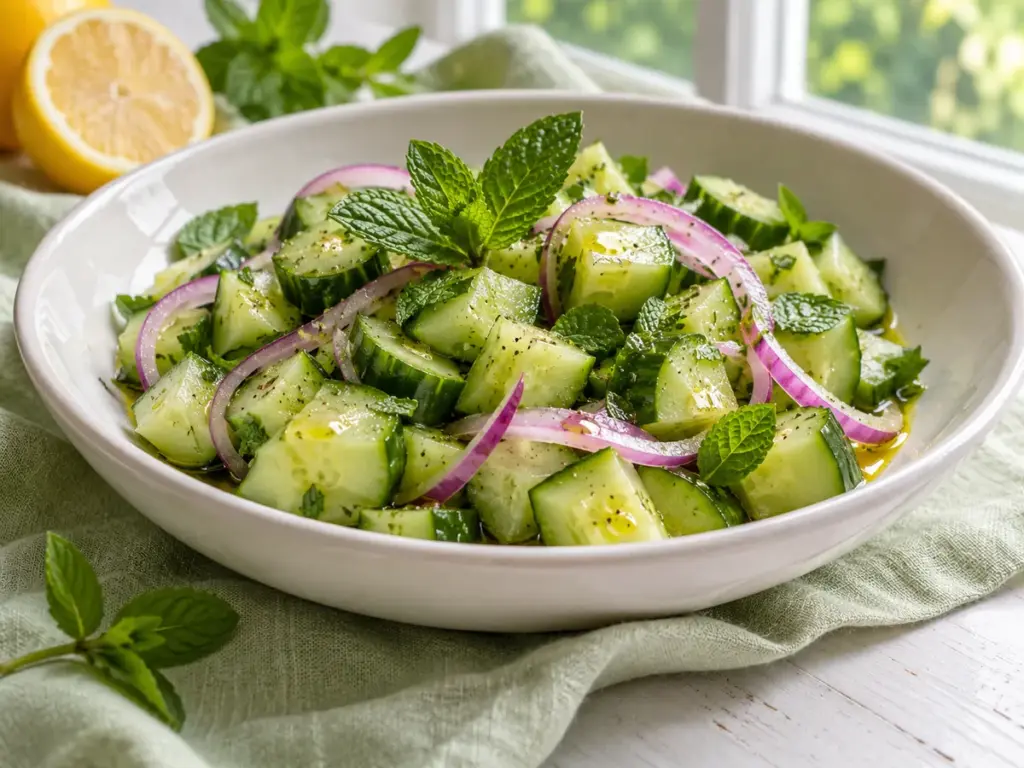
Cucumbers release water once salted, so if you use almost no salt, the salad keeps its crunch longer. Mint cools the palate, and lemon juice and red onion add the sharpness.
Cut the cucumbers into even dice so every bite has the same crunch, and tear the mint by hand just before mixing so it stays green and fragrant. Serve the salad the same day, because cucumbers keep giving off water as it sits.
Ingredients
- 3 medium cucumbers, diced (peel them if the skin is waxy)
- ⅓ cup fresh mint leaves, chopped
- ¼ cup red onion, thinly sliced
- 3 tablespoons lemon juice
- 2 tablespoons extra-virgin olive oil
- ¼ teaspoon freshly ground black pepper
- Optional: ⅛ teaspoon salt
Steps
- Combine the cucumbers, mint and onion in a large bowl.
- Whisk the lemon juice, oil and pepper, pour over the salad, and toss gently.
- Refrigerate 10 to 15 minutes, taste, and serve.
Swaps and Sodium
- Cucumber: Persian or English cucumbers have fewer seeds and stay crunchier.
- Fresh mint: basil gives a sweeter herb note, and cilantro a brighter citrus edge.
- Lemon juice: white wine or apple cider vinegar gives a milder acidity.
- Red onion: thinly sliced scallions or chopped shallot give a gentler onion taste.
Cucumbers hold only 2 mg of sodium per 100 g, so three medium ones and the mint come to about 25 mg in total, or about 4 mg per serving across 6 (USDA arithmetic).
12. Simple Tomato Mozzarella Salad
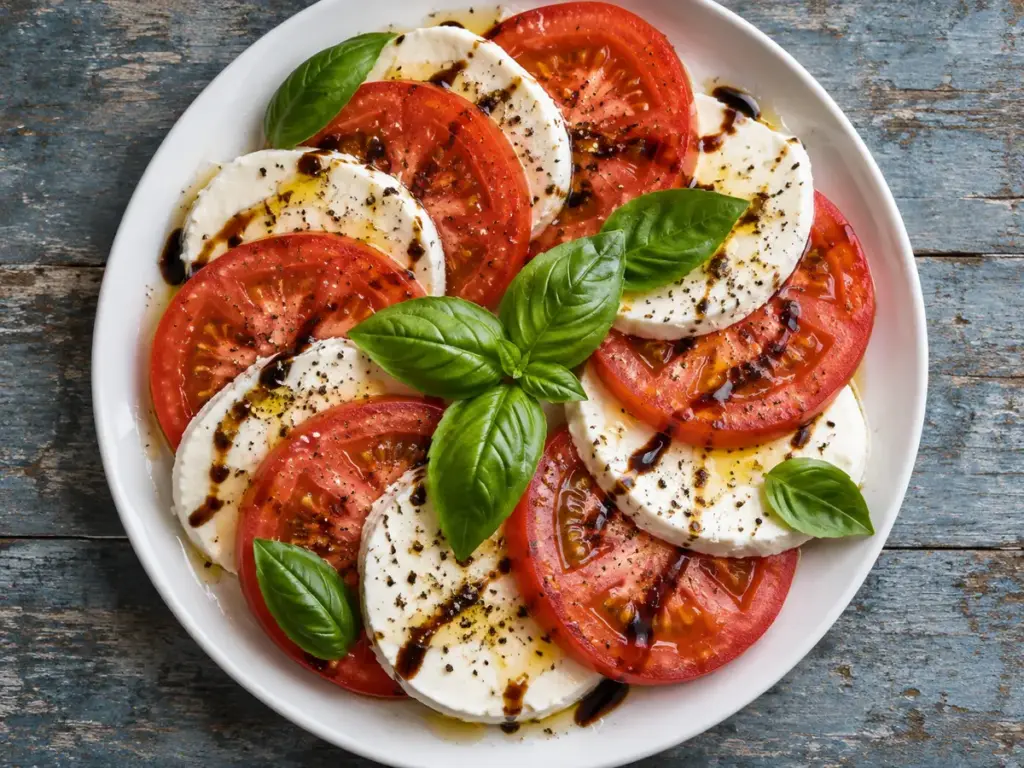
Ripe tomatoes bring sweetness and acid, and fresh mozzarella adds a creamy contrast, so you need little else on the plate. Flaky sea salt is a common finish, but sea salt has about the same sodium as table salt by weight, so this version relies on basil, pepper and balsamic instead.
Mozzarella is cheese and carries sodium, especially when packed in brine, so drain it and pick the brand with the lowest sodium per serving on the label.
Ingredients
- 3 large ripe tomatoes, sliced into ¼-inch rounds
- 8 ounces fresh mozzarella, sliced into ¼-inch rounds
- ½ cup fresh basil leaves
- 2 tablespoons extra-virgin olive oil
- 1 tablespoon balsamic vinegar, or more to taste
- ¼ teaspoon freshly ground black pepper
Steps
- Arrange the tomato and mozzarella slices on a platter, alternating them and tucking basil between the slices.
- Drizzle with the oil and balsamic vinegar and add the pepper.
- Let it sit 5 to 10 minutes at room temperature, then serve.
Swaps and Sodium
- Tomatoes: halved cherry or grape tomatoes make a sweeter, bite-size version.
- Fresh mozzarella: burrata adds creaminess, and you check its label too.
- Basil: arugula or baby spinach gives a peppery or mild leafy base.
- Balsamic vinegar: a reduced balsamic glaze finishes sweeter, and a squeeze of lemon finishes lighter.
Cheese is nearly all the sodium: 8 ounces of the USDA whole-milk mozzarella record carries about 1,100 mg of the roughly 1,135 mg for the platter, and brined fresh mozzarella varies by brand. Split into 4 servings, that is about 285 mg each. If you cut the cheese to 4 ounces, the platter drops by about 550 mg.
Slice the tomatoes and cheese just before you serve, because cut tomatoes release juice that thins the balsamic and leaves the platter watery.
13. Easy Fluffy Mashed Cauliflower
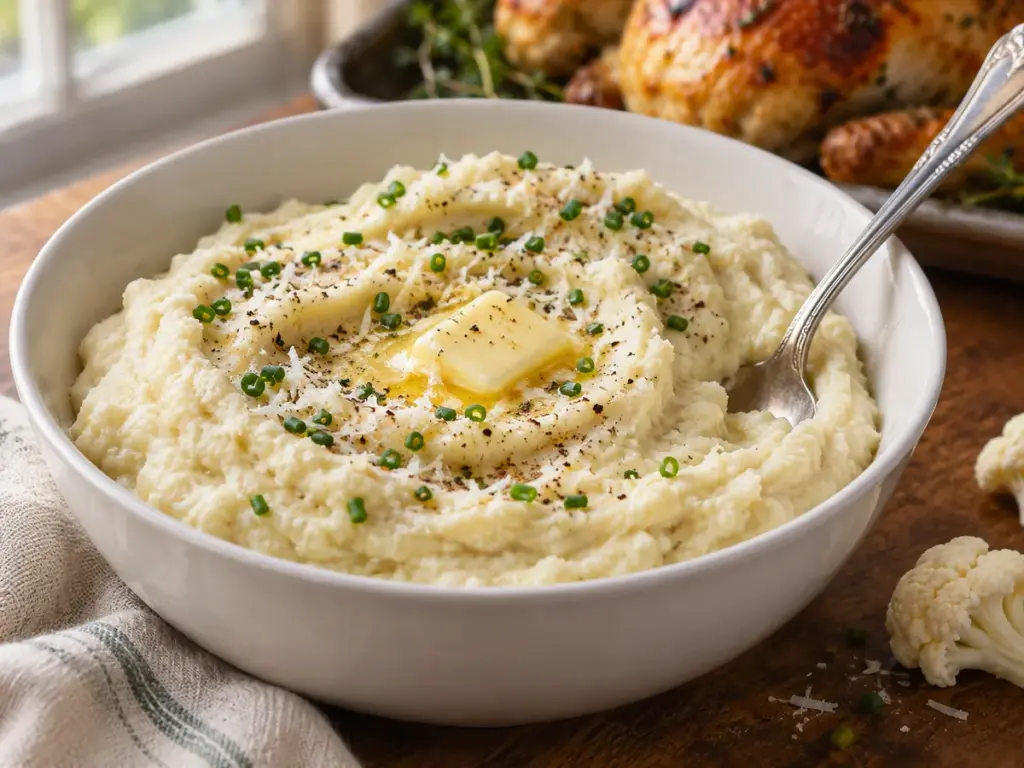
If you steam the cauliflower instead of boiling it, the mash stays thick instead of watery, and warm cream blends in more smoothly than cold. A food processor gives you the smoothest texture. Spoon it next to roasted chicken or other mains that go with mashed cauliflower.
Parmesan is the only salty ingredient, so you use unsalted butter and skip added salt. A quarter cup gives the mash a savory finish.
Ingredients
- 1 large head cauliflower (about 2 pounds), cut into florets
- 3 tablespoons unsalted butter, cut into pieces
- ¼ cup heavy cream, warmed
- 2 cloves garlic, peeled
- ¼ cup finely grated Parmesan cheese
- ¼ teaspoon freshly ground black pepper
- 2 tablespoons fresh chives, thinly sliced
Steps
- Steam the cauliflower and garlic over simmering water for 10 to 12 minutes, until very tender.
- Drain well and let the florets sit in the colander for 1 minute so the steam escapes.
- Put the cauliflower and garlic in a food processor with the butter and warm cream and blend 30 to 60 seconds, scraping the sides once.
- Add the Parmesan and pepper, pulse to combine, then top with chives and serve warm.
Swaps and Sodium
- Cauliflower: 1 pound of cauliflower plus 1 pound of peeled russet potato gives a starchier, more traditional mash.
- Unsalted butter: unsalted ghee or olive oil gives dairy-free richness.
- Heavy cream: ¼ cup of plain Greek yogurt adds tang.
- Parmesan: ¼ cup of nutritional yeast gives a cheesy finish, but compare its label for sodium.
Parmesan supplies about 450 mg of the roughly 745 mg in the pot, and the cauliflower adds another 270 mg (USDA arithmetic). Split into 4 servings, that is about 185 mg each. If you use 2 tablespoons of Parmesan instead, the pot drops by about 225 mg. Salted butter in place of unsalted would add about 270 mg, since USDA lists salted butter at 643 mg per 100 g (FDC 173410).
Reheat leftover mash in a covered saucepan over low heat, and stir in a spoonful of Greek yogurt if it has tightened in the refrigerator.
14. Oven-Baked Ratatouille
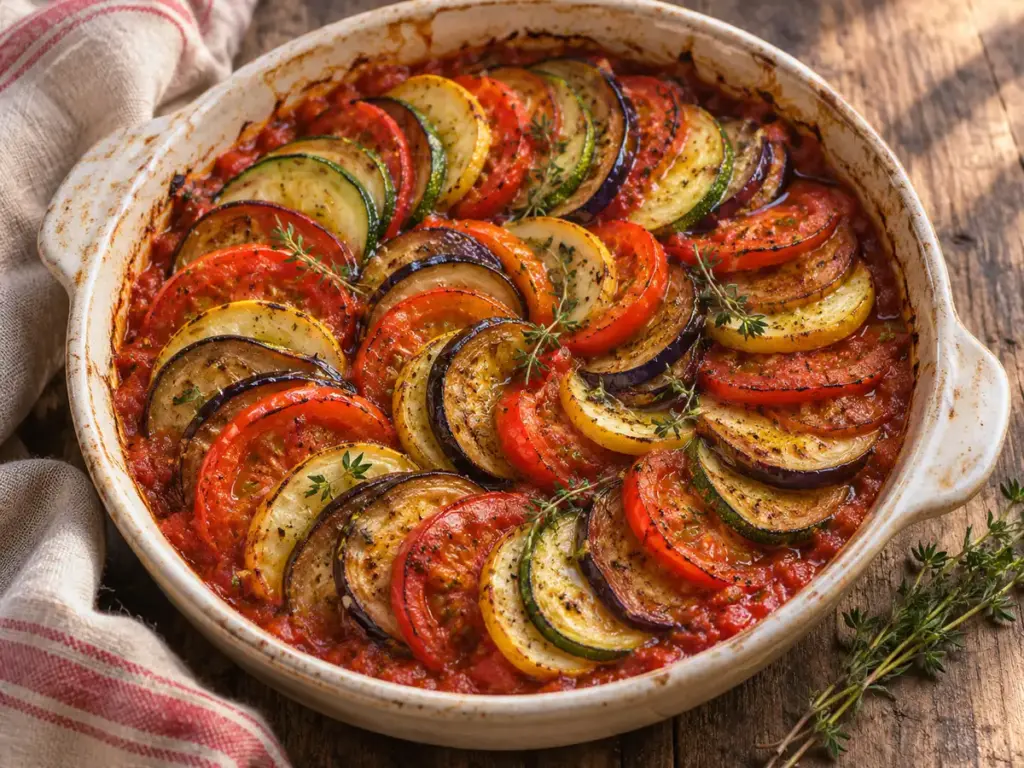
If you slice the vegetables thin and layer them over a tomato base, they bake evenly and look special on the table. Because the slices are layered rather than stewed, this version sits between a classic stew and a tian, and the difference between tian and ratatouille comes down to how the vegetables are cut and cooked.
Tomato passata is the one product to check, so choose a plain jar or carton with no salt added, since some tomato products carry added salt. You add no salt yourself, because the thyme, garlic and basil do the seasoning.
Ingredients
- 1 cup tomato passata, no salt added
- 1 medium eggplant (about 1 pound), sliced ¼ inch thick
- 2 medium zucchini, sliced ⅛ to ¼ inch thick
- 1 medium yellow squash, sliced ⅛ to ¼ inch thick
- 1 red bell pepper, seeded and thinly sliced
- 1 medium onion, thinly sliced
- 3 cloves garlic, minced
- 3 tablespoons olive oil, divided
- 1 teaspoon fresh thyme leaves, or ½ teaspoon dried
- ½ teaspoon freshly ground black pepper, divided
- 2 tablespoons fresh basil, chopped
Steps
- Heat the oven to 375°F. Warm 1 tablespoon of the oil in a skillet over medium heat and cook the onion and garlic about 5 minutes, until soft.
- Stir in the passata and ¼ teaspoon of the pepper, simmer 2 minutes, and spread the sauce in a 9-inch round or 8x10-inch baking dish.
- Arrange the eggplant, zucchini, squash and bell pepper in overlapping rows on the sauce. Drizzle with the remaining 2 tablespoons oil and sprinkle with the thyme and remaining pepper.
- Cover with foil and bake 30 minutes, then uncover and bake 20 to 25 minutes more, until tender and lightly browned. Top with basil before serving.
Swaps and Sodium
- Eggplant: extra zucchini or sliced portobello gives a firmer, meatier bite.
- Zucchini: more yellow squash keeps the same tender, mild texture.
- Passata: a 14-ounce can of no-salt-added crushed tomatoes, thinned with 1 tablespoon of olive oil, works in its place.
- Fresh thyme: ½ teaspoon of dried thyme works, and so does 1 teaspoon of herbes de Provence if its label shows no salt.
With no-salt-added passata, the dish comes to about 130 mg in total, and the passata supplies about half of it (USDA arithmetic, using the record for tomato puree without salt added as the stand-in). Split into 6 servings, that is about 20 mg each. A salt-added puree (USDA: 202 mg per 100 g, FDC 170546) would add about 435 mg and raise each serving to about 95 mg.
You can layer the vegetables earlier in the day, cover the dish in the refrigerator, and bake when dinner is close.
15. Zesty Broccoli and Cauliflower Salad
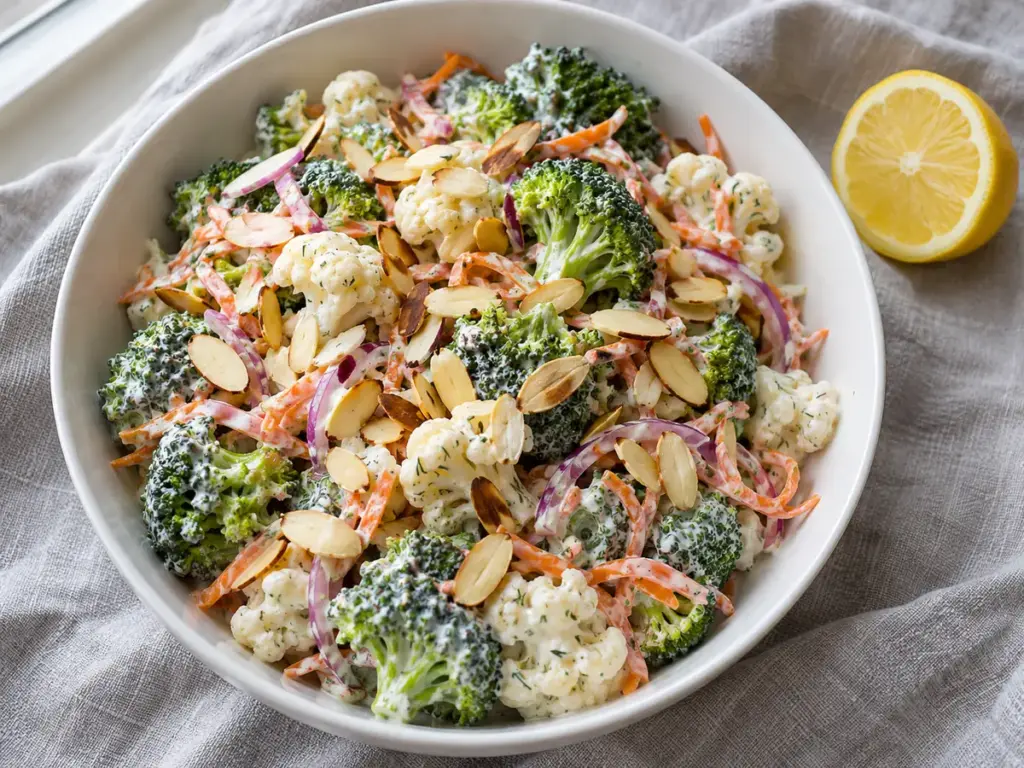
Raw florets stay crunchy under a yogurt, lemon and Dijon dressing, and toasted almonds add a nutty crunch. You can make the salad several hours ahead, since it holds up well.
Mayonnaise and Dijon are the sodium sources here, so if you want it lower, use 2 tablespoons of mayonnaise and add 2 more tablespoons of Greek yogurt. Buy unsalted almonds, since roasted ones are often salted.
Ingredients
- 4 cups broccoli florets, in bite-size pieces
- 4 cups cauliflower florets, in bite-size pieces
- 1 cup shredded carrots (about 2 medium carrots)
- ½ cup red onion, finely chopped
- ½ cup plain Greek yogurt
- ¼ cup mayonnaise
- 2 tablespoons lemon juice
- 1 tablespoon Dijon mustard
- 1 clove garlic, minced
- ¼ cup fresh parsley, chopped
- ⅓ cup sliced unsalted almonds
- ¼ teaspoon freshly ground black pepper
Steps
- Toast the almonds in a dry skillet over medium heat for 2 to 3 minutes, stirring, then cool.
- Toss the broccoli, cauliflower, carrots and onion together in a large bowl.
- Whisk the yogurt, mayonnaise, lemon juice, Dijon, garlic and pepper until smooth.
- Pour the dressing over the vegetables and toss, then fold in the parsley and almonds.
- Chill 15 to 30 minutes, taste, and serve.
Swaps and Sodium
- Broccoli: chopped green beans give a similar snap and a darker color.
- Cauliflower: chopped raw Brussels sprouts keep the base sturdy and crunchy.
- Greek yogurt: plain sour cream makes the dressing richer and tangier.
- Almonds: pumpkin seeds keep the crunch for a nut-free version.
Mayonnaise is the largest source: ¼ cup carries about 350 mg of the roughly 685 mg total, plus the Dijon, whose sodium varies by brand (USDA arithmetic). Split into 8 servings, that is about 85 mg each before the Dijon. If you move 2 tablespoons from the mayonnaise to Greek yogurt, you take about 165 mg out. Roasted salted almonds in place of unsalted ones add about 100 mg, which is why the recipe calls for unsalted.
16. Mediterranean Stuffed Peppers
If you roast the pepper halves first, they turn sweet and tender, and the lemony quinoa filling with tomato, oregano and parsley reheats well.
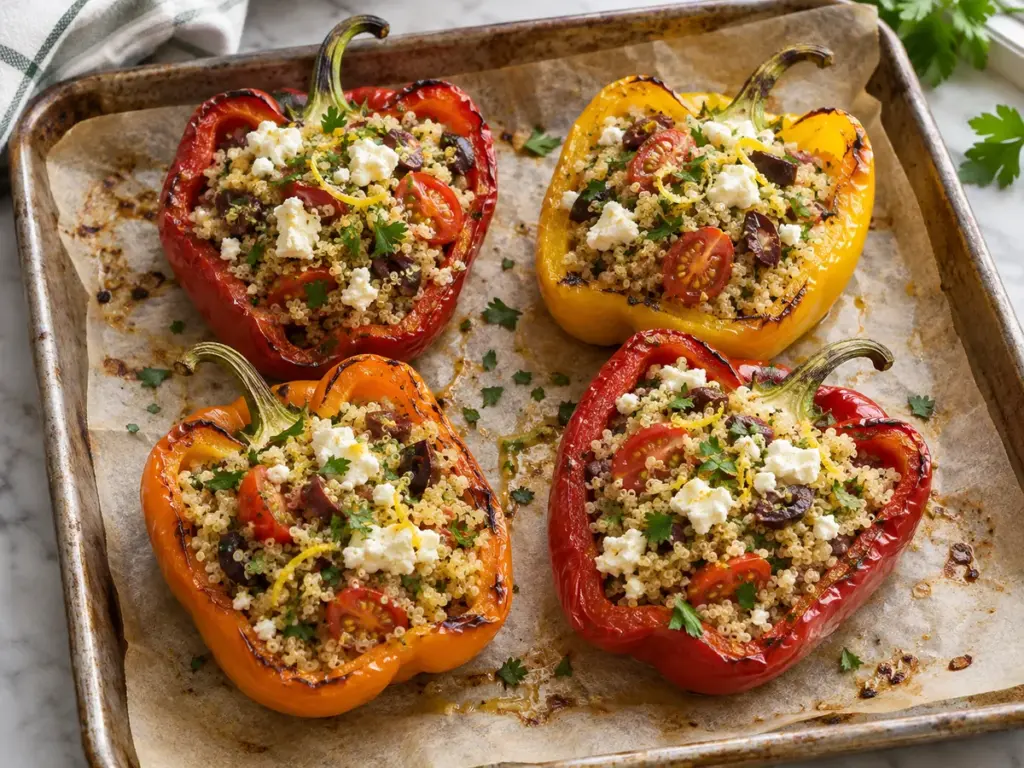
Feta and olives are brined, so this is one of the saltier recipes in the list. To keep it lower, you use just ¼ cup of feta, 2 tablespoons of olives, low-sodium broth and no added salt.
Ingredients
- 4 large bell peppers, halved lengthwise and seeded
- 1 cup quinoa, rinsed
- 2 cups low-sodium vegetable broth
- 2 tablespoons olive oil, divided
- 1 small red onion, finely chopped
- 2 cloves garlic, minced
- 1 cup cherry tomatoes, halved
- 2 tablespoons Kalamata olives, pitted and chopped
- ¼ cup crumbled feta cheese
- ¼ cup fresh parsley, chopped
- 2 tablespoons lemon juice
- 1 teaspoon dried oregano, or 1 tablespoon fresh
- ½ teaspoon freshly ground black pepper
Steps
- Heat the oven to 400°F and line a baking sheet.
- Toss the pepper halves with 1 tablespoon of the oil, set them cut side up on the sheet, and roast 18 to 20 minutes, until tender.
- Meanwhile, bring the quinoa and broth to a boil in a small saucepan, cover, reduce the heat, and simmer 15 minutes, until the liquid is absorbed.
- Warm the remaining oil in a skillet over medium heat and cook the onion and garlic about 5 minutes. Add the tomatoes, olives, oregano and pepper and cook 2 minutes.
- Stir in the quinoa, lemon juice, parsley and feta, fill the pepper halves, and bake 8 to 10 minutes more. Serve warm.
Swaps and Sodium
- Quinoa: couscous or bulgur cooks faster.
- Feta: soft goat cheese is creamier, with 459 mg of sodium per 100 g against 1,139 mg for feta (USDA).
- Kalamata olives: capers and green olives are also brined, at 2,348 and 1,556 mg per 100 g (USDA), so rinse them or skip them.
- Broth: low-sodium chicken broth or plain water also cooks the quinoa.
Feta is the biggest source: ¼ cup carries about 430 mg and the olives about 120 mg, so the peppers, quinoa and filling come to about 605 mg before the broth (USDA arithmetic, with canned ripe olives as the closest record to Kalamatas).
The 2 cups of broth add at most 280 mg when each cup sits at the 140 mg low-sodium ceiling, so a pepper (2 halves) has at most about 220 mg across 4 servings. Soft goat cheese in place of the feta saves about 255 mg by weight.
You can stuff the pepper halves earlier in the day, keep them covered in the refrigerator, and bake them a little longer than the recipe says.
17. Curried Lentil Salad
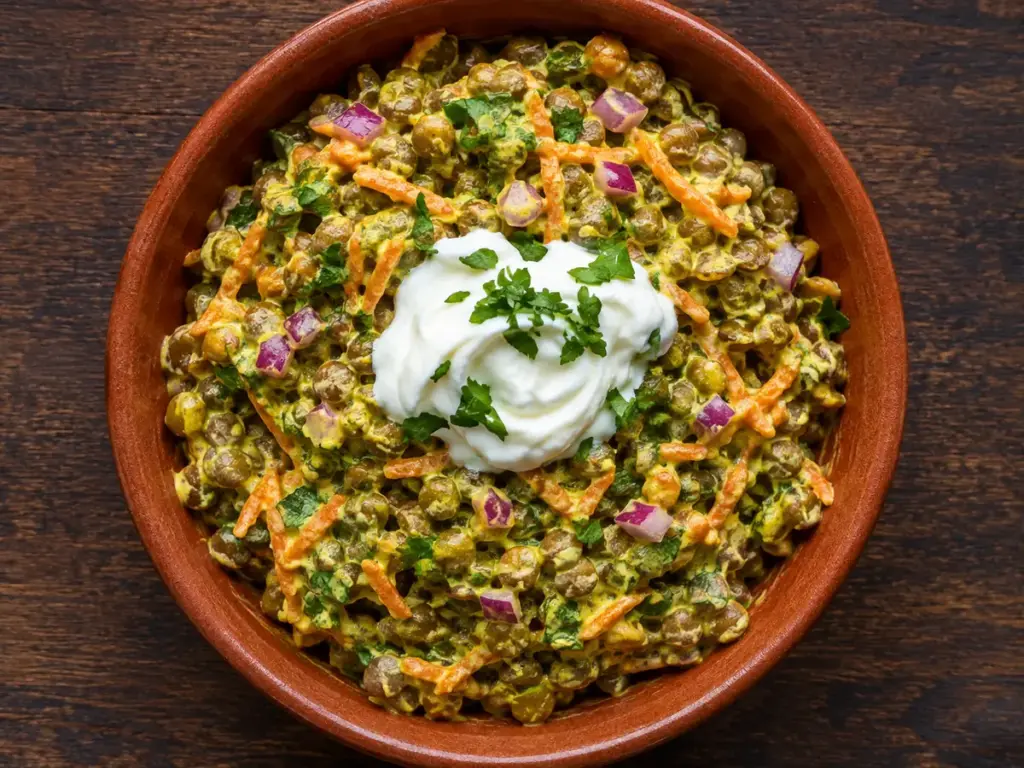
If you simmer the lentils gently, they hold their shape, and curry powder, lemon and yogurt give them warmth and tang. Other lentil salad dressings work on the same base if you want to skip the yogurt.
Cook the lentils in water or low-sodium broth, and look for a curry powder with no salt on the ingredient list, since some blends contain it. Canned lentils are faster, but you should drain and rinse them well first.
Ingredients
- 1 cup brown or green lentils, rinsed
- 3 cups water or low-sodium vegetable broth
- ½ cup plain Greek yogurt
- 2 tablespoons olive oil
- 1 ½ tablespoons curry powder, mild or to taste
- 2 tablespoons lemon juice
- 1 small red onion, finely chopped
- 1 large carrot, grated or diced
- 1 red bell pepper, diced
- ¼ cup cilantro, chopped
- ¼ teaspoon freshly ground black pepper
- Optional: ⅛ teaspoon salt
Steps
- Bring the lentils and water or broth to a boil in a medium saucepan, then reduce to a simmer and cook 18 to 22 minutes, until tender but not mushy. Drain and cool slightly.
- Whisk the yogurt, oil, curry powder, lemon juice and pepper until smooth.
- Toss the lentils with the onion, carrot, bell pepper and dressing.
- Chill at least 15 minutes, top with cilantro, and serve.
Swaps and Sodium
- Lentils: canned lentils, drained and rinsed, make it faster, and the label tells you how salty they are.
- Curry powder: ground cumin plus turmeric keeps the warm spice and color.
- Greek yogurt: plain dairy-free yogurt keeps the dressing creamy.
- Cilantro: parsley gives a milder fresh note.
The USDA lists raw lentils at 6 mg of sodium per 100 g, so the salad comes to about 120 mg in total, mostly from the carrot (about 50 mg) and the yogurt (about 40 mg). Split into 6 servings, that is about 20 mg each. Broth in the pot adds the sodium of whatever the lentils absorb, so read its label.
Brown or green lentils hold their shape in a salad, while red lentils break down into a mash, so keep the red ones for soup.
18. Savory Cabbage Stir-Fry
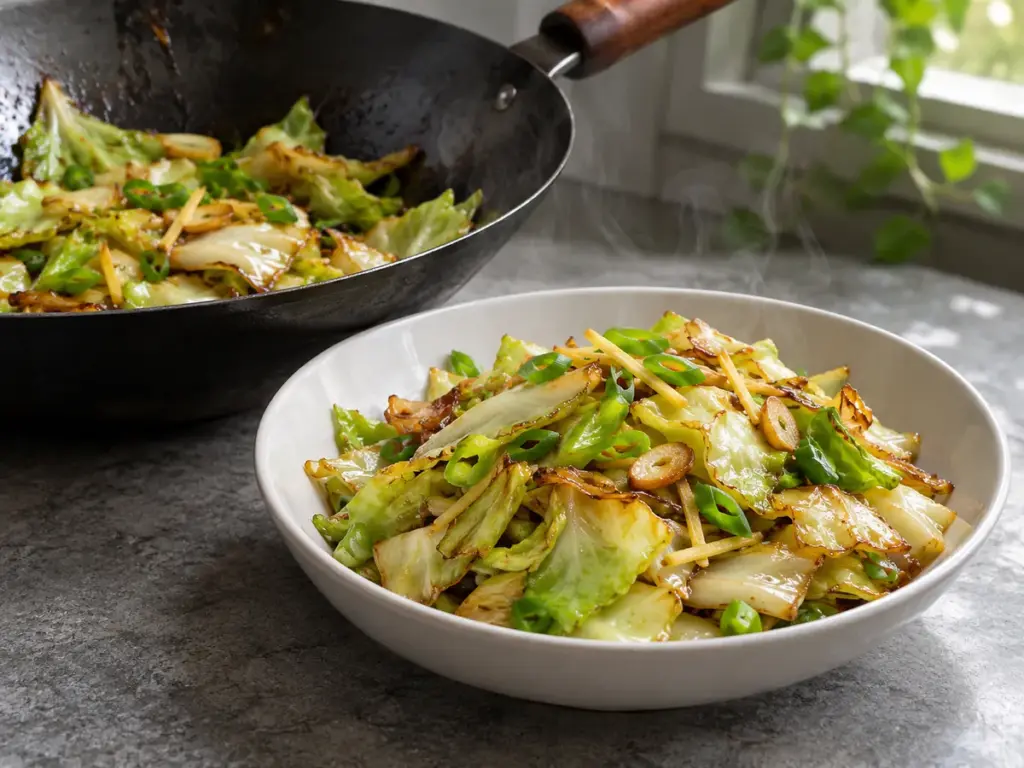
If you cook over high heat, the cabbage edges brown and the leaves stay firm instead of soggy, and ginger, garlic and rice vinegar add the savory bite. Soy sauce is the one real sodium source, so you use 1 tablespoon of reduced-sodium soy sauce (at least 25% less sodium than regular) and 2 tablespoons of rice vinegar.
Buy plain, unseasoned rice vinegar, because the seasoned kind has salt and sugar added. If you swap in napa instead of green cabbage, expect a milder, more tender stir-fry and check it after 3 minutes.
Ingredients
- 1 medium head green cabbage (about 1 ½ pounds), thinly sliced
- 2 tablespoons vegetable oil
- 3 cloves garlic, minced
- 1 tablespoon fresh ginger, minced
- 3 scallions, thinly sliced, whites and greens separated
- 1 tablespoon reduced-sodium soy sauce
- 2 tablespoons unseasoned rice vinegar
- 1 teaspoon toasted sesame oil
- 1 teaspoon granulated sugar
- ¼ teaspoon red pepper flakes
- 1 tablespoon unsalted toasted sesame seeds
Steps
- Heat the vegetable oil in a large skillet or wok over medium-high heat until shimmering, about 1 minute.
- Add the cabbage and scallion whites and stir-fry 6 to 8 minutes, until wilted with browned edges.
- Push the cabbage aside, cook the garlic and ginger 30 seconds until fragrant, then toss everything together.
- Add the soy sauce, vinegar, sugar and red pepper flakes and cook 1 to 2 minutes, until the liquid reduces and the cabbage turns glossy.
- Off the heat, stir in the sesame oil and scallion greens, top with sesame seeds, and serve warm.
Swaps and Sodium
- Green cabbage: napa or savoy cabbage makes a milder, more tender stir-fry.
- Soy sauce: reduced-sodium tamari makes it gluten-free.
- Rice vinegar: apple cider or white wine vinegar gives similar brightness.
- Red pepper flakes: sliced fresh chili adds heat, and bottled chili-garlic sauce adds sodium.
Soy sauce is the main source: 1 tablespoon of the USDA reduced-sodium record (made from hydrolyzed vegetable protein) carries about 430 mg of the roughly 565 mg total, and the cabbage adds about 120 mg (USDA arithmetic, with unseasoned rice vinegar left out because the file has no record for it). Split into 6 servings, that is about 95 mg each.
USDA's record for a brewed low-sodium shoyu carries about 575 mg per tablespoon, so read your bottle, because that swap raises each serving to about 120 mg.
Regular soy sauce (shoyu) would add about 880 mg per tablespoon (USDA FDC 174277), and regular tamari about 1,000 mg (FDC 174278), so buy the reduced-sodium kind and compare the milligrams on your bottle.
Stir-fry the cabbage just before you serve, because it keeps releasing water as it sits.
What Should You Serve with These Low-Sodium Sides?
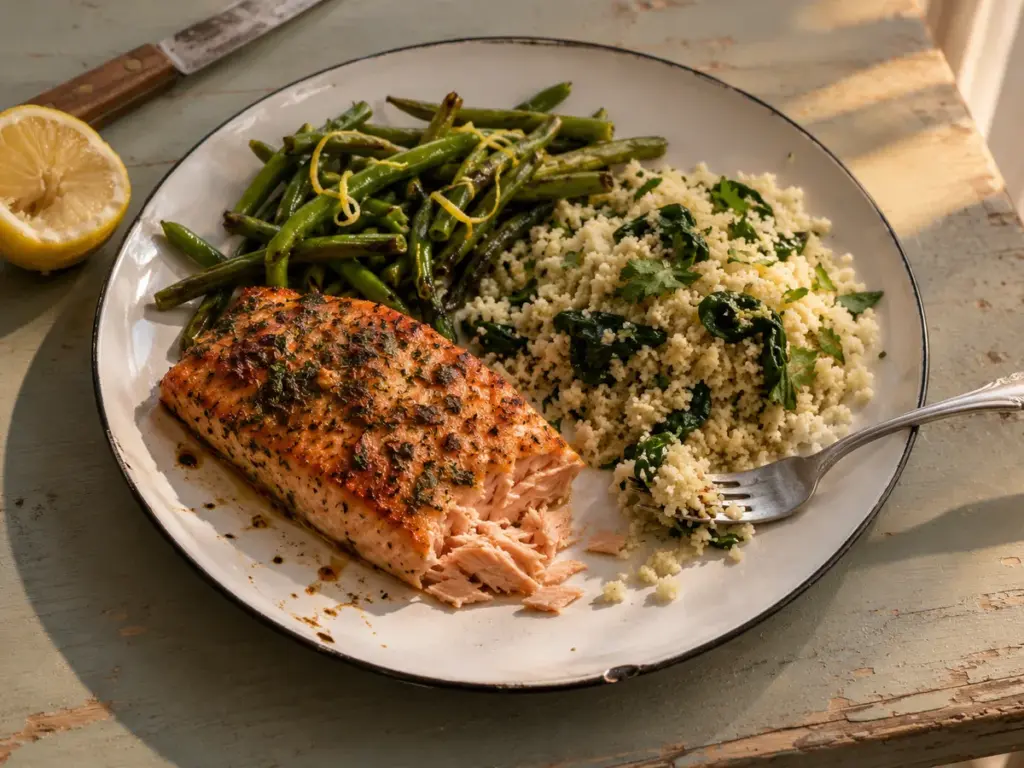
These sides suit plain mains such as grilled chicken, baked fish or roast pork, seasoned with lemon, pepper and herbs too. Check a marinade or sauce before you count the plate as low in sodium, since it can add more than the side does.
- Salmon: 3 Green Beans, 9 Asparagus or 6 Couscous, and the rice sides for salmon cover the starch.
- Grilled chicken or pork: 1 Roasted Veggie Medley, 8 Sweet Potatoes or 11 Cucumber Mint Salad.
- Steak or burgers: 5 Brussels Sprouts or 13 Mashed Cauliflower.
- Pasta night: a crisp salad such as 15 Broccoli and Cauliflower Salad, or the salads that suit lasagna.
- Meatless dinner: 4 Cauliflower Steaks, 16 Stuffed Peppers or 17 Lentil Salad can be the main.
- Holiday table: 1 Roasted Veggie Medley, 5 Brussels Sprouts and 8 Sweet Potatoes all roast at 425°F, so they share one oven, while 3 Green Beans and 13 Mashed Cauliflower stay on the stovetop.
How Long Do Leftover Low-Sodium Sides Keep?
Cooked vegetables, grains and bean salads without meat, fish or egg keep 3 to 4 days in the refrigerator, according to USDA FoodKeeper, so plan to eat your leftovers within that window. Refrigerate them within 2 hours of cooking.
FoodKeeper lists the same kind of leftovers at 1 to 2 months in the freezer. Roasted vegetables, mashed cauliflower, couscous and the quinoa and lentil dishes freeze better than the cucumber, tomato and bean salads, whose crisp vegetables turn watery when thawed.
Sources
- FDA: Sodium in Your Diet (Daily Value, %DV, label claims, rinsing canned foods)
- American Heart Association: How much sodium should I eat per day? (2,300 mg limit, 1,500 mg goal)
- American Heart Association: How to reduce sodium in your diet (rinsing canned beans)
- American Heart Association: Sea salt vs. table salt
- USDA FoodKeeper: leftovers (3 to 4 days refrigerated, 1 to 2 months frozen)
- USDA FoodData Central, SR Legacy (sodium per 100 g for every ingredient counted on this page)

Andrew Gray is the founder of Gusto Meadow, a food site for home cooks. He writes ingredient substitutes, food comparisons, taste guides, storage guides and dinner ideas, with numbers drawn from sources such as USDA, FDA and university extension services.
At Gusto Meadow, Andrew focuses on fresh, seasonal ingredients and simple methods that anyone can follow. His goal is to make cooking feel fun, doable, and rewarding — whether you’re preparing a quick weeknight dinner or exploring something new.
Storage and food-safety numbers follow USDA, FDA and university extension guidance.