A firm pear ripens on the counter in about 3 to 10 days, and once it is ripe you have 1 to 2 days on the counter or 3 to 5 days in the fridge.
- You can tell a pear is ripe when the neck near the stem gives under gentle thumb pressure.
- Cut pears keep about 4 days in a sealed container in the fridge, and they should never sit out longer than 2 hours.
- Frozen slices packed in syrup or with lemon juice and sugar keep their best quality for about 2 months.
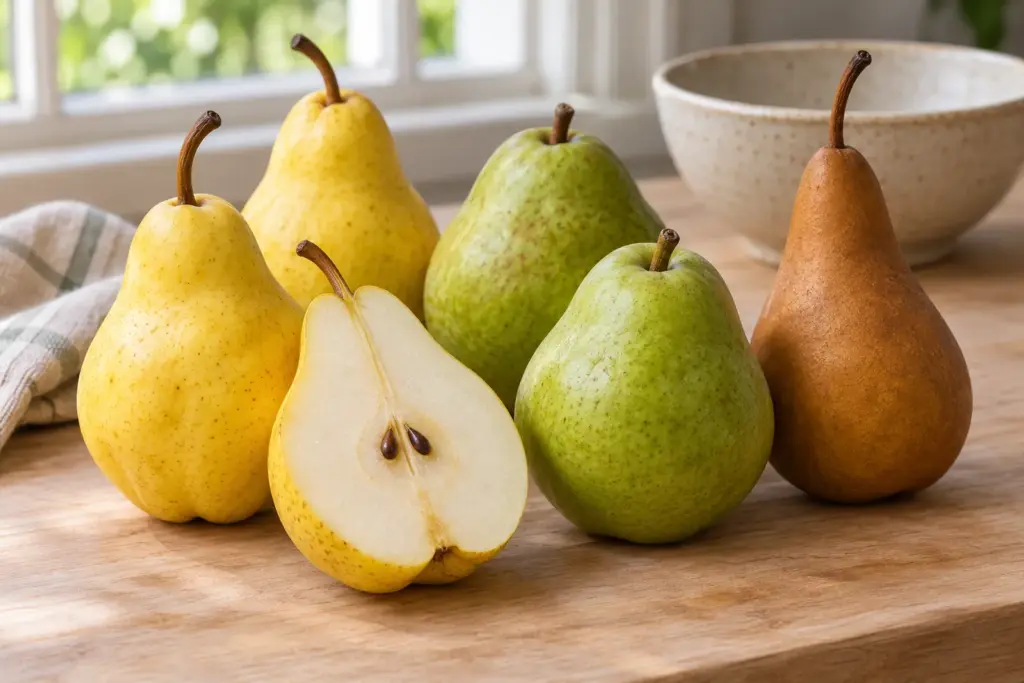
Most of the food shelf lives you look up start counting on the day you buy the food. A pear starts later, because pears are picked mature but still hard and finish ripening in your kitchen. That is why a firm pear can wait on the counter for a week or more while a ripe one has only a few good days left, so the first thing to know about any pear is how ripe it is.
1. How Long Do Pears Last?
The answer depends on how ripe the pear is and where you keep it. The USDA's FoodKeeper app gives a ripe pear 1 to 2 days on the counter and 3 to 5 days in the fridge. The rest of the times below come from FoodKeeper, Oregon State University Extension and Penn State Extension.
| Pear | Where | How long | What to know |
|---|---|---|---|
| Firm, unripe, whole | Counter, 60 to 70°F | 3 to 10 days to ripen | Oregon State's range for pears that come out of cold storage |
| Ripe, whole | Counter | 1 to 2 days | Eat it or move it to the fridge |
| Ripe, whole | Fridge, 40°F or colder | 3 to 5 days | Cold slows ripening once the pear is ready |
| Cut or sliced | Fridge, sealed container | About 4 days | FoodKeeper's time for cut fruit, and 2 hours at most out of the fridge |
| Sliced, with lemon juice and sugar or in syrup | Freezer, 0°F | About 2 months for best quality | It stays safe longer at 0°F, but the texture keeps softening |
| Canned, unopened | Pantry | 12 to 18 months | FoodKeeper's time for high-acid canned fruit |
| Canned, opened | Fridge, covered | 5 to 7 days | Move the pears and syrup into a covered container |
In every row, the counter ripens a pear and the fridge holds it. If you put a hard pear straight into the fridge, it mostly waits there, because USA Pears says pears will not ripen properly inside the fridge.
2. How Do You Ripen Pears at Home?
Bartlett, Anjou, Bosc and Comice are European pears, and they ripen best after picking. Oregon State Extension says pears left to ripen on the tree turn coarse and mealy and their cores often break down. Iowa State Extension adds that tree-ripened pears turn gritty because hard stone cells form in the flesh.
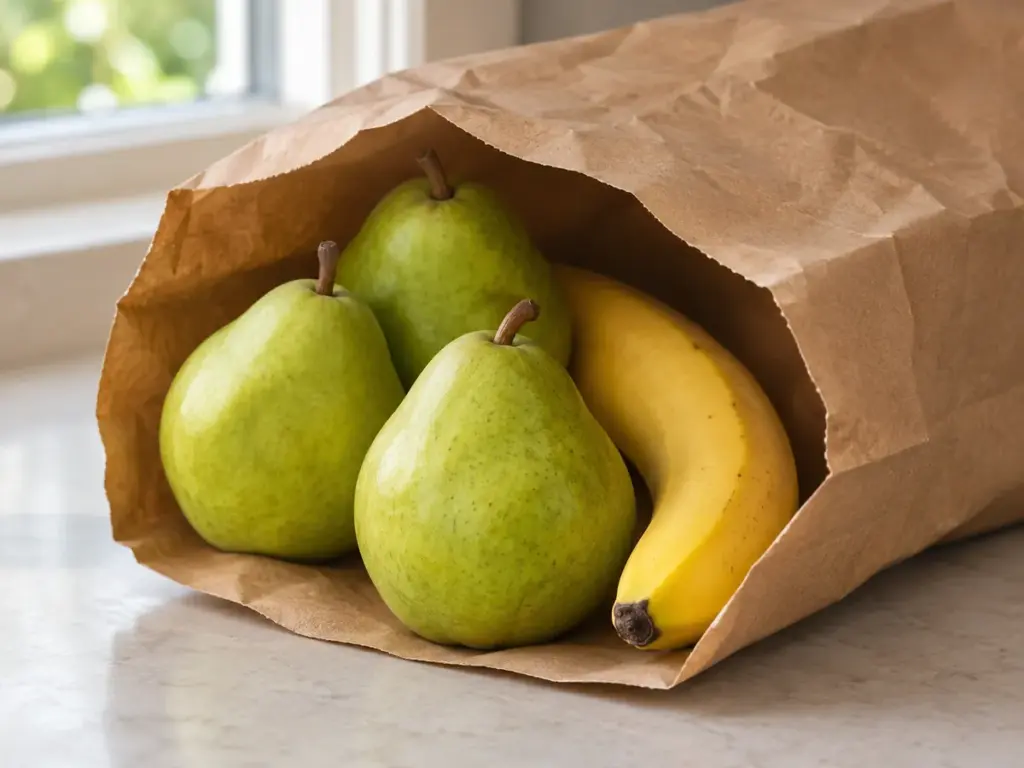
A pear needs room temperature, time and ethylene, the gas that ripening fruit gives off. These steps take a bowl of hard pears to ready-to-eat:
- Leave them on the counter at 60 to 70°F, out of direct sun. Oregon State gives pears 3 to 10 days once they leave cold storage, and Iowa State plans on 7 to 10 days for home-grown fruit.
- Close them in a paper bag if you want them sooner. The bag holds the ethylene around the fruit, and USA Pears suggests you add an apple or a banana for more of it.
- Check the neck once a day, as USA Pears advises, so you catch each pear on its first ripe day.
- Move each pear to the fridge as soon as its neck gives, which buys you 3 to 5 more days.
Some varieties need cold before they can ripen at all. Oregon State's guide to picking and storing pears lists about 1 month of cold for Comice and 2 months for Anjou, while Bartlett, Bosc and Seckel need none. If a Comice or Anjou from your own tree stays hard on the counter and then wrinkles, it most likely missed that cold period.
3. How Can You Tell When a Pear Is Ripe?
Press gently near the stem with your thumb. Oregon State explains that pears ripen from the core outward and from the neck down, so the neck softens first. USA Pears calls this "check the neck" and says that if you wait until the middle feels soft, the pear is likely overripe.
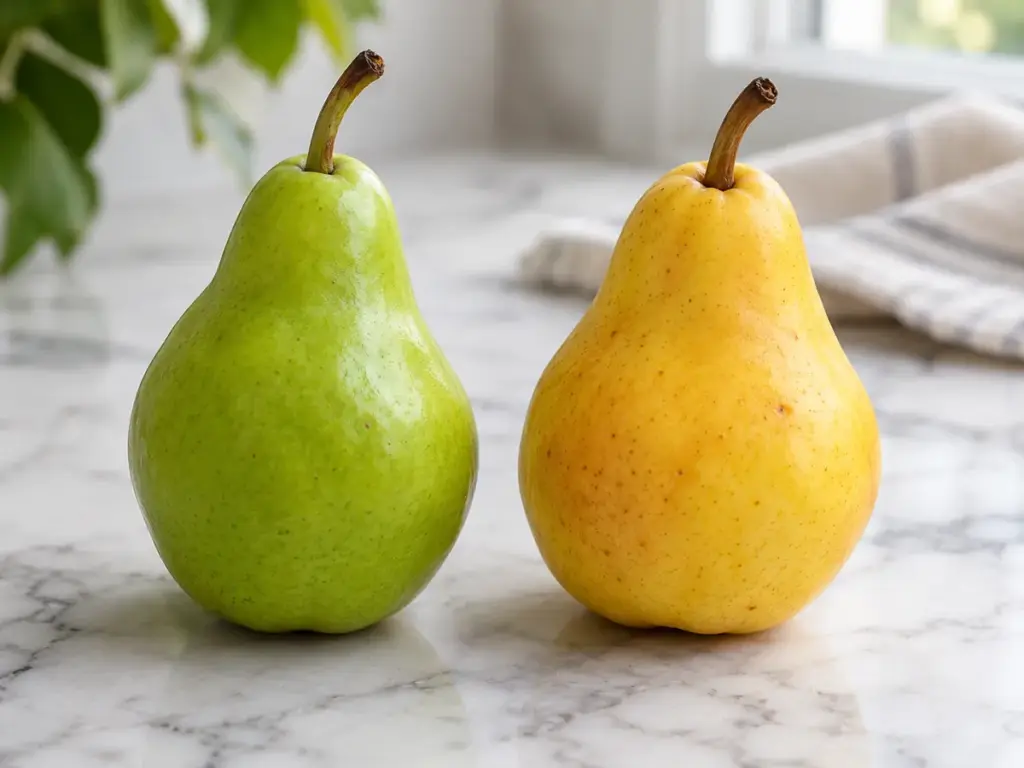
Color only helps with one variety. Bartlett skin turns from green to yellow as the pear ripens, while an Anjou keeps its basic color the whole time, which is one of the clearest ways Anjou and Bartlett pears differ at the store. Bosc stays brown, so for every pear except Bartlett your thumb is the better guide.
- The neck feels hard under your thumb.
- A Bartlett is still bright green.
- A slice tastes starchy and crisp instead of sweet.
- The neck gives a little when you press it.
- A Bartlett has turned yellow.
- If the middle is soft too, use it today.
A pear picked at the right moment and ripened on your counter gets the sweet, juicy, buttery flavor of a ripe pear. Comice shows little color change as it ripens, and it is the variety Harry & David sells in gift boxes of Royal Riviera pears, so the neck test is the one to trust for those as well.
4. Should You Refrigerate Pears?
Refrigerate a pear once it is ripe, or earlier only when you want to slow it down on purpose. Oregon State says you can hold a ripe pear in the fridge for up to five days, and the FDA's guidance on storing produce safely puts the fridge at 40°F or colder.
Firm pears can wait in the cold much longer if you have a crop from your own tree. Oregon State gives these storage times at 40 to 42°F, close to a home fridge, for pears picked mature but hard:
- Bartlett keeps 15 to 20 days.
- Bosc keeps 30 to 40 days.
- Comice keeps 45 to 55 days.
- D'Anjou keeps 70 to 80 days.
At 30 to 32°F, the range Oregon State recommends, each time stretches further, with Bartlett lasting 30 to 45 days. The same guide says pears spoil faster above 45°F, and a pear kept past its normal storage life will not ripen after you take it out, so take pears out to ripen well before those days run out. Pears freeze at 29°F, which makes the back of an overcold fridge a risky spot.
5. How Long Do Cut Pears Last?
A sliced pear keeps about 4 days in a sealed container in the fridge, the time FoodKeeper gives for cut fruit. The time out of the fridge is much shorter. Penn State Extension says to refrigerate cut produce within two hours and to throw out cut produce left at room temperature longer.
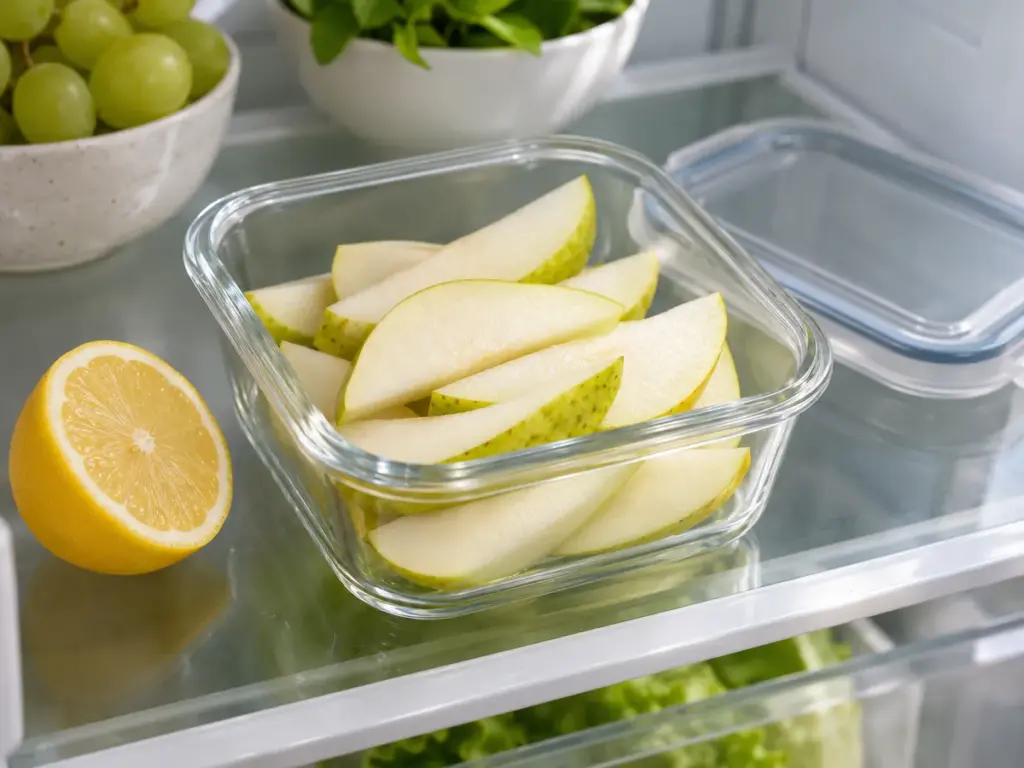
Cut pears turn brown because the flesh reacts with oxygen. That browning is a change in looks, and USA Pears says a mild lemon-and-water dip slows it. For frozen slices, the National Center for Home Food Preservation uses ascorbic acid, which is vitamin C, for the same job.
If you have more cut pear than you will eat in a few days, USA Pears also suggests poaching it, and poached pears pair well with mascarpone, nuts or a spoonful of cream for an easy dessert.
6. How Can You Tell If a Pear Has Gone Bad?
Look at the skin, smell the stem end, and cut the pear open if you are unsure. These signs mean the pear goes in the trash:
- You see mold anywhere on a ripe pear. The USDA puts soft fruits such as peaches on its list of foods to throw out when moldy, because mold can reach below the surface of soft, moist fruit.
- The pear smells like wine or vinegar, which tells you the sugar has started to ferment.
- The flesh is brown and mushy from the core outward, the core breakdown that Oregon State links to overripe and overstored pears.
- The skin is leaking juice or has split open, which gives mold an easy way into the flesh.
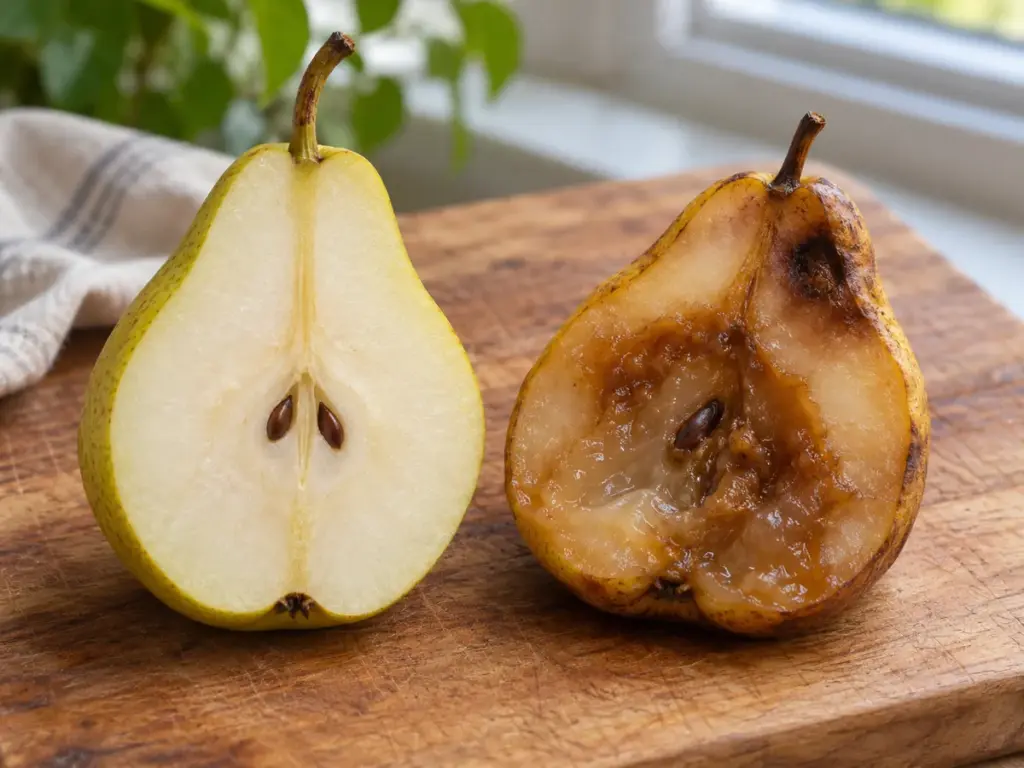
Other changes only lower the quality. A small bruise is fine, because the FDA says you can cut away bruised or damaged areas before you eat or cook the fruit. Wrinkled skin means the pear has lost moisture, so it will taste drier, but wrinkles alone are not a safety sign.
A very soft pear with no mold and no sour smell still has a job. USA Pears says overripe pears are still delicious for smoothies, sauces and thickening soups, and there are plenty of uses for overripe pears in baking too.
7. Can You Freeze Pears?
Yes, as long as you slice and treat them first. USA Pears does not recommend freezing fresh pears that have not been processed, and FoodKeeper's 2-month freezer time applies to slices packed with lemon juice and sugar. The National Center for Home Food Preservation gives this method for freezing pears in syrup:
- Pick firm, crisp pears with full flavor, and skip any that already feel mealy.
- Make a 40 percent syrup by dissolving 2 ¾ cups of sugar in 4 cups of lukewarm water, then chill it.
- Peel, core and slice medium pears into twelfths and large ones into sixteenths.
- Heat the slices in boiling syrup for 1 to 2 minutes, then drain and cool them.
- Pack and cover them with cold syrup mixed with ¾ teaspoon of ascorbic acid per quart, leave headspace, press crumpled water-resistant paper on top, seal and freeze.
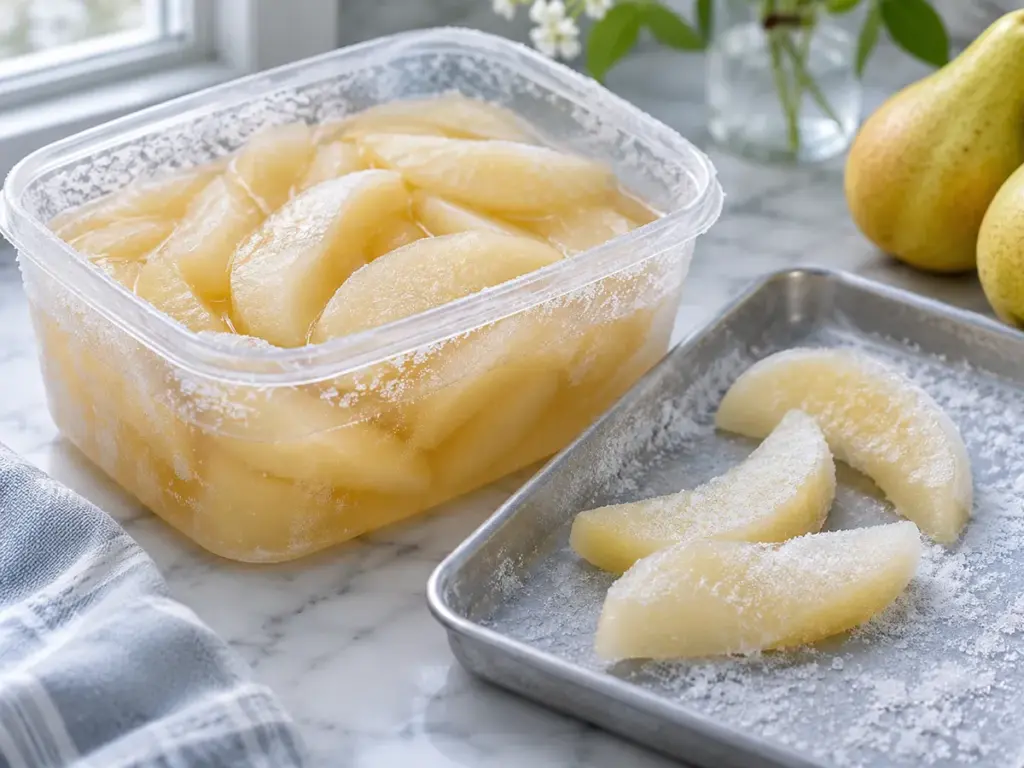
The 2 months is a quality limit. The USDA says food kept at a steady 0°F stays safe indefinitely and that freezer times are for quality only, so an older bag is still safe but lower in quality. Thawed slices lose their crunch, which makes them a better fit for smoothies, crisps and sauces than for a cheese board.
Cooked pears with sugar also freeze well, according to USA Pears. Pear sauce is close to applesauce, and homemade applesauce keeps about 3 weeks in the fridge and 8 to 12 months in the freezer by FoodKeeper's count, so we'd use the same limits for a batch of pear sauce.
8. How Long Do Asian Pears Last?
Asian pears follow different rules. Iowa State Extension says they ripen on the tree, so the round, crisp pear you buy is already ready to eat and goes straight into the fridge.
- Bartlett, Anjou, Bosc and Comice ripen on your counter after picking.
- They are ready when the neck gives under your thumb.
- A ripe one keeps 3 to 5 days in the fridge.
- They are ripe when picked and should taste crisp, crunchy and sweet.
- They keep 1 to 3 months at 32 to 35°F, according to Iowa State.
- Long storage can give them a strong, winy taste.
If yours are gone before a slaw or marinade, a crisp apple is among the easiest Asian pear stand-ins.
Prickly pear shares the name and nothing else. It is the fruit of a cactus with its own flavor and peeling needs, and FoodKeeper gives it 1 to 2 weeks in the fridge and 2 to 5 days on the counter.
Sources
- USDA FoodKeeper app (FoodSafety.gov): pears, cut fruit, high-acid canned goods, homemade applesauce, prickly pear.
- Oregon State University Extension, Picking and Storing Apples and Pears (FS 147): ripening at 60 to 70°F, check the neck, chilling needs and storage days by variety.
- Iowa State University Extension, How to Harvest, Ripen, and Store Pears: tree ripening, paper bag, Asian pear storage.
- USA Pears, General Questions: check the neck, fridge time for ripe pears, browning, freezing, overripe pears.
- Penn State Extension, Proper Care and Handling of Fruits and Vegetables: the 2-hour rule for cut produce.
- FDA, Selecting and Serving Produce Safely: 40°F fridge, cutting away bruises.
- National Center for Home Food Preservation, Freezing Pears and Syrups for Use in Freezing Fruits.
- USDA FSIS, Molds on Food: Are They Dangerous?
- USDA FSIS, Freezing and Food Safety.

Andrew Gray is the founder of Gusto Meadow, a food site for home cooks. He writes ingredient substitutes, food comparisons, taste guides, storage guides and dinner ideas, with numbers drawn from sources such as USDA, FDA and university extension services.
At Gusto Meadow, Andrew focuses on fresh, seasonal ingredients and simple methods that anyone can follow. His goal is to make cooking feel fun, doable, and rewarding — whether you’re preparing a quick weeknight dinner or exploring something new.
Storage and food-safety numbers follow USDA, FDA and university extension guidance.