
A scuppernong is a muscadine, and muscadines are the grape species native to the Southeastern United States.
- "Scuppernong" is the name for the bronze, gold-green muscadines.
- Dark muscadines (black, purple or red) are the other half of the comparison.
- Color is the one dependable difference, while sweetness, skin and ripening time change from variety to variety.
- Ask a seller for the variety name instead of the color.
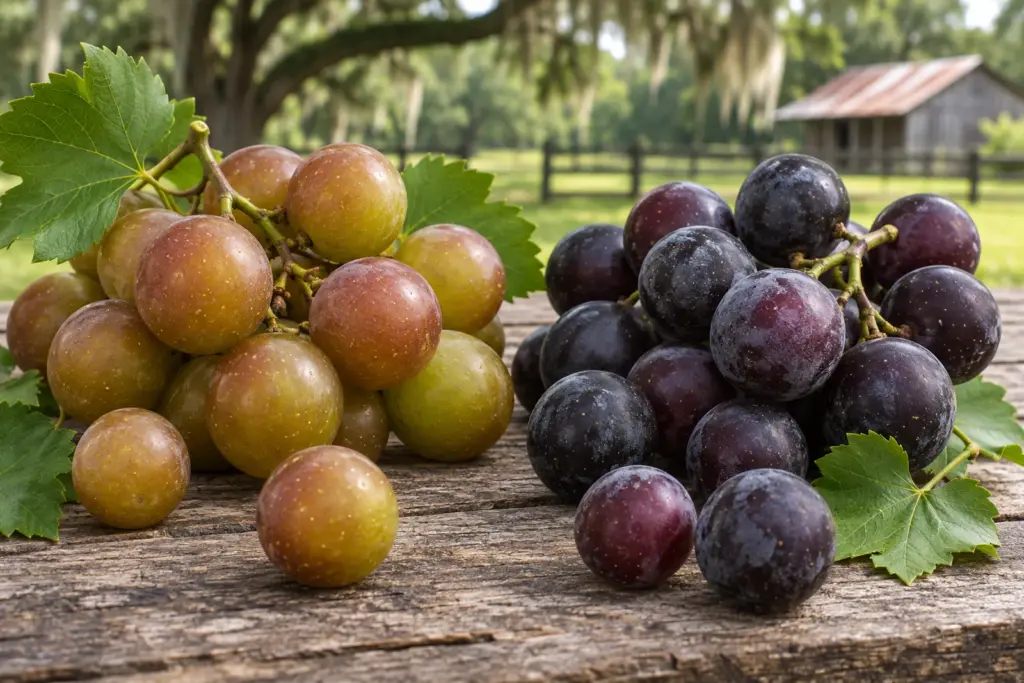
If a farm stand sells "scuppernongs" and your recipe calls for "muscadines," you are holding the same kind of fruit, and the only change you will notice is the color of your jelly or juice. That makes this an odd entry among everyday food comparisons, because one name sits inside the other.
1. What Is the Difference Between Scuppernong and Muscadine?
Read the table with one idea in mind: the "muscadine" column describes the whole group, and the "scuppernong" column describes the bronze members of it.
- The name covers a native Southeastern grape species, Vitis rotundifolia (many botanists now file it as Muscadinia rotundifolia), with more than 100 improved varieties.
- Strictly, it is one old North Carolina variety named 'Scuppernong'.
- In everyday use, it means any bronze or gold-green muscadine.
| Trait | Muscadine (the whole group) | Scuppernong (bronze muscadine) |
|---|---|---|
| Skin color | Light bronze, pink, red, purple or black | Light bronze to gold-green |
| Flesh | Clear and translucent in every muscadine | Same |
| Berry size | About ¼ to 1 ½ inches across, 4 to 15 grams, depending on the variety | Falls inside the same range |
Muscadine sugar runs about 16% to 21% by variety, and bronze examples sit at both ends of that range. Traditional varieties have thick skin and several seeds, while a few newer ones have thinner skin and no seeds, and scuppernongs are the same.
- Most varieties ripen from early August through September, and late ones into early October.
- Perfect-flowered varieties such as 'Carlos', 'Noble' and 'Ison' set fruit on their own.
- The 'Scuppernong' variety ripens mid-season.
- It is female-flowered and needs a perfect-flowered vine nearby.
A scuppernong and a dark muscadine differ in skin color and almost nothing else. Sweetness, texture and how long the grapes keep depend on the variety you are holding.
2. Why Is a Bronze Muscadine Called a Scuppernong?
The first muscadine anyone selected and named was a bronze one. NC State Extension says it was found before 1760 by Isaac Alexander in Tyrrell County, North Carolina, first called the "Big White Grape," and later named Scuppernong after the area.
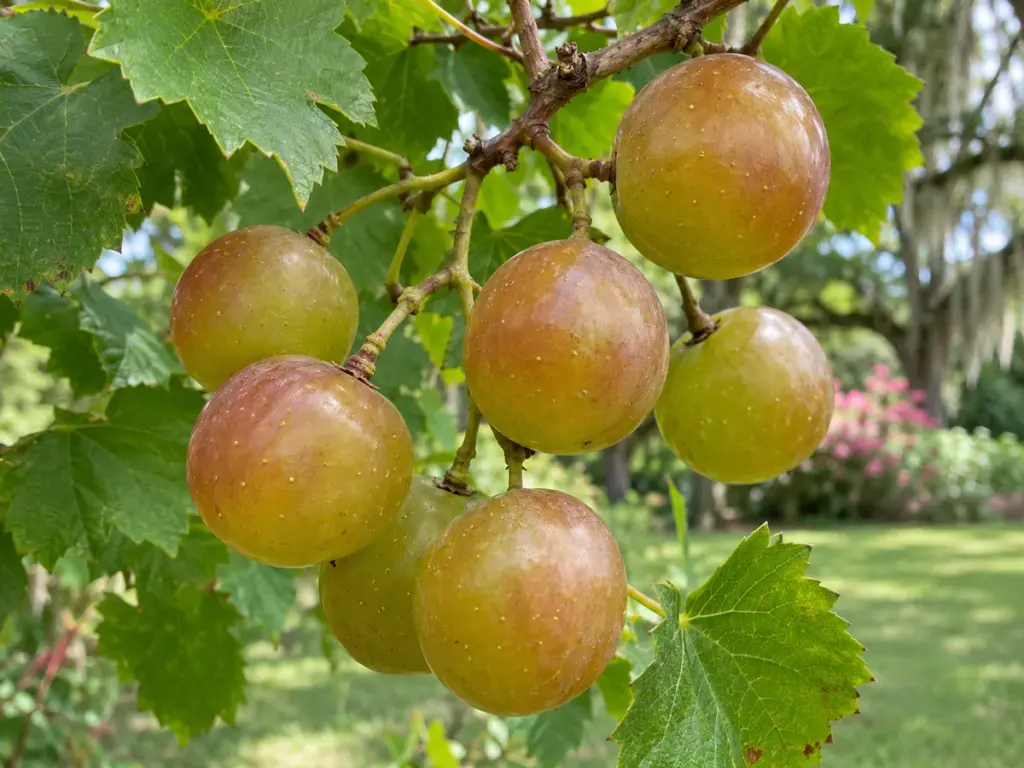
Over the years the name spread to every bronze muscadine, wild or planted, which is why a golden vine beside a Georgia road gets called a scuppernong. Some people go further and use "muscadine" only for the dark grapes and "scuppernong" only for the bronze ones, so a seller who uses the two words as separate fruits is following local habit, not botany. Clemson and NC State both ask that the name stay with the true variety.
3. How Do the Grapes Look and Feel Different?
Color is the visible split, and since muscadine flesh is clear in every variety, the skin alone supplies the color of juice and jelly.
- Skin runs red, purple or black
- Wild vines usually bear 4 to 10 berries per cluster
- Examples: 'Noble', 'Ison', 'Supreme', 'Cowart'
- Skin runs light bronze to gold-green
- Same clear flesh and the same berry size range
- Examples: 'Carlos', 'Fry', 'Summit', 'Scuppernong'
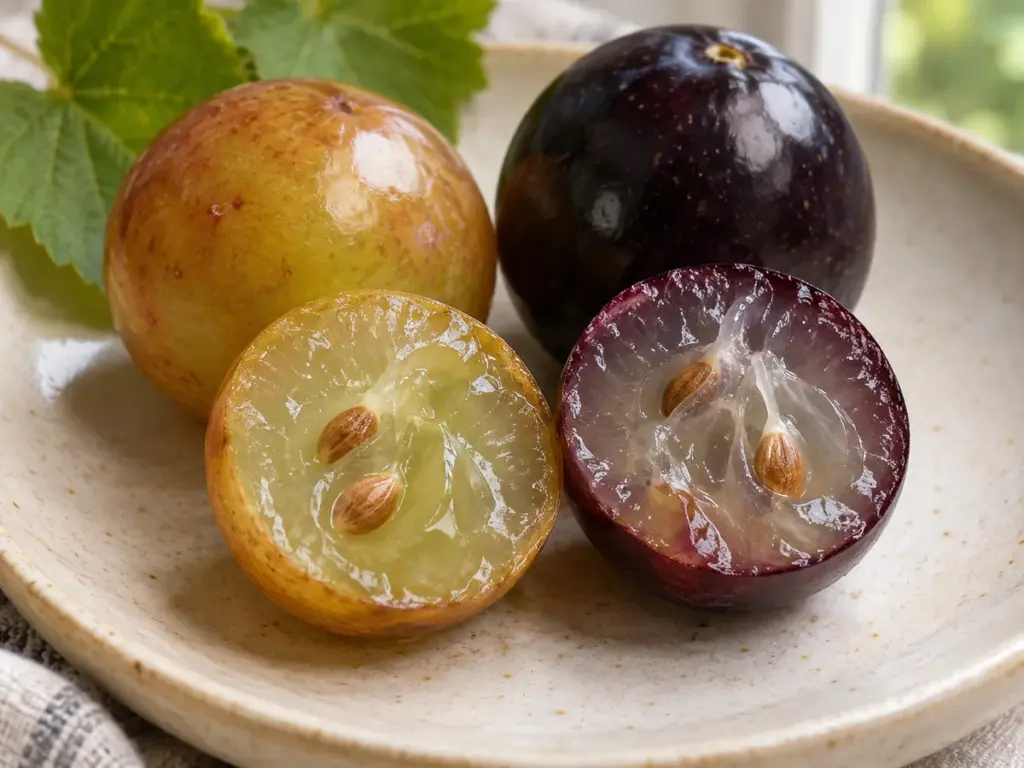
Size does not separate the two. Muscadines of every color run from about ¼ inch to 1 ½ inches across, and it changes within a color too: Clemson calls the black 'Noble' small, the black 'Ison' medium-large and the black 'Supreme' the largest black variety.
The older claim that scuppernongs have more tender skin does not hold up either: traditional muscadines of any color have a tough skin around several seeds, and only some newer varieties have thinner skin and no seeds.
You will not mistake either one for a supermarket grape. The gold-green of a scuppernong looks nothing like the green table grapes sold in plastic bags, which are thin-skinned bunch grapes you eat whole, the same kind of fruit that dries into raisins.
4. Do Scuppernongs Taste Different From Other Muscadines?
All muscadines share a strong musky aroma, the quality that makes them taste like nothing else on a grape shelf. Sweetness is where the old rule says scuppernongs win, and Clemson's sugar figures show why that rule is shaky:
- 'Carlos' (bronze): about 16% sugar, the same as the black 'Noble'.
- 'Ison' (black): about 19%, which is sweeter than 'Carlos'.
- 'Fry' (bronze): about 21%, the sweetest on the list.
Color does not predict sweetness, so a bronze 'Fry' is sweeter than most dark muscadines, while a bronze 'Carlos' is no sweeter than a black 'Noble'. When you want a sweet berry, taste one or ask for the variety, because the color on the label will not tell you.
5. Is One Healthier Than the Other?
If you are choosing between the two for health, we found no source that compares bronze and dark muscadines head to head, so treat the numbers as describing muscadines as a group. NC State Extension lists 55 calories, 13.4 grams of carbohydrate and 3.4 grams of fiber in a half cup (about 16 grapes), with under 1 gram each of protein and fat.
The older claim that muscadines carry noticeably more protein than scuppernongs has no support, and the amounts are small either way.
NC State also says the plant compounds in muscadines, such as resveratrol, ellagic acid and anthocyanins, are most concentrated in the skins and seeds. Anthocyanins are the pigments behind purple and black skin, so a dark muscadine and a bronze one are unlikely to carry the same mix. No source we found says that either one is healthier.
6. Which Is Better for Jelly, Juice, Wine or Snacking?
The variety decides this more than the color does. The table uses Clemson, Texas A&M and NC State variety notes:
For eating fresh, pick 'Summit' (bronze), 'Doreen' (green), 'Late Fry' or 'Granny Val'. Choose dry-scar varieties, since they hold up in the fridge. The skin is tough on any of them.
- For wine, use 'Noble' and 'Magnolia' (dark), 'Carlos' or 'Doreen'. 'Nesbitt' is good fresh but not recommended for wine.
- For jam, pie and sauce, any variety works. For a hull pie, NC State's method is to boil the pulp until the seeds loosen, press it through a sieve, then cook it with the skins.
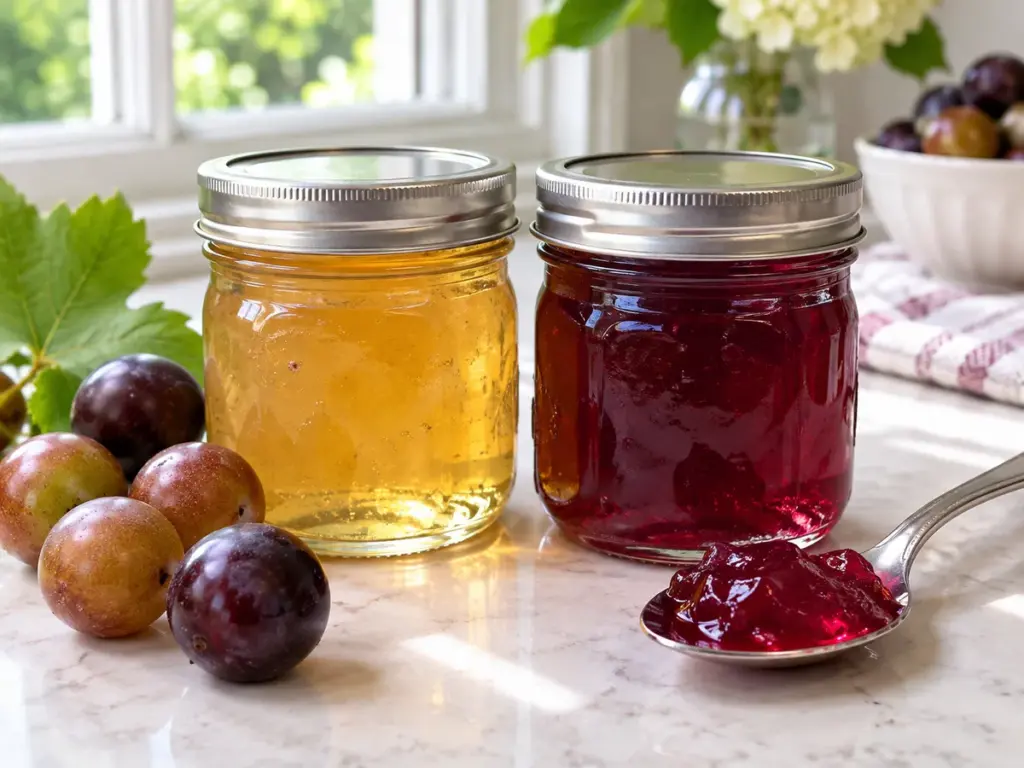
Because the fruit is cooked and strained, thick skin is no obstacle for jelly and jam from either grape. Cooked down with onion and a splash of vinegar, both make a sweet-tart sauce for pork chops, and plain sides for pork chops let the fruit stay the main flavor.
7. Can You Use a Scuppernong Instead of a Muscadine in a Recipe?
Yes, in both directions and in the same amount, because they are the same species and cook the same way. Swap by weight or by cup, and expect two changes:
- Color: bronze grapes make pale gold jelly, juice and sauce, while dark grapes make a deep red-purple one. For a recipe built around a purple color, a bronze swap will look washed out.
- Sweetness: a 21% variety like 'Fry' needs less added sugar than a 16% one like 'Carlos' or 'Noble', so taste the cooked fruit before measuring sugar and add it in small amounts.
Because seeds and skins behave the same in both, a pie or jam method written for one works for the other, and you do not need to change the cooking time.
8. How Long Do Fresh Muscadines Keep?
Fresh muscadines do not keep long. NC State Extension says they keep up to a week in the refrigerator and taste best within a few days. Texas A&M adds that the stem scar tells you how long a variety lasts:
- Examples: 'Summit' and 'Doreen'
- Keeps at least a week at 35 to 45°F
- Example: 'Regale'
- Does not store well, so turn it into juice or jelly soon after picking
Keep the berries in a shallow, covered container in the fridge, wash them only before eating, and pick out any that soften or leak, because decay spreads through the container. The longer-lasting form is cooked: the USDA FoodKeeper gives opened jars of jam, jelly and preserves 6 to 12 months in the refrigerator. If you plan to cook the fruit, freeze it, because thawed berries turn soft.
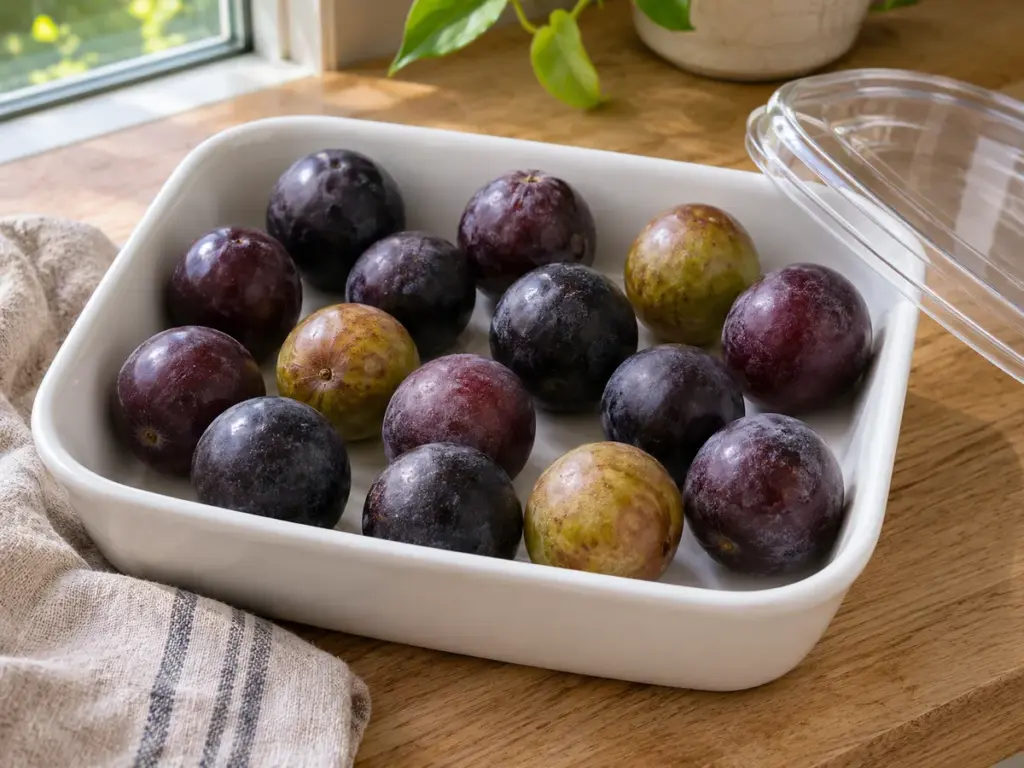
9. Where Can You Buy Scuppernongs and Muscadines?
Look in August through October, at farmers' markets, farm stands and pick-your-own vineyards across the Southeast, where the wild range runs from Delaware to central Florida and west along the Gulf to east Texas. Supermarkets in the region stock them in season, though that fruit can have sat longer than fruit from a farm stand. If you order fruit by mail, it spends days in transit, which uses up part of that one-week window.
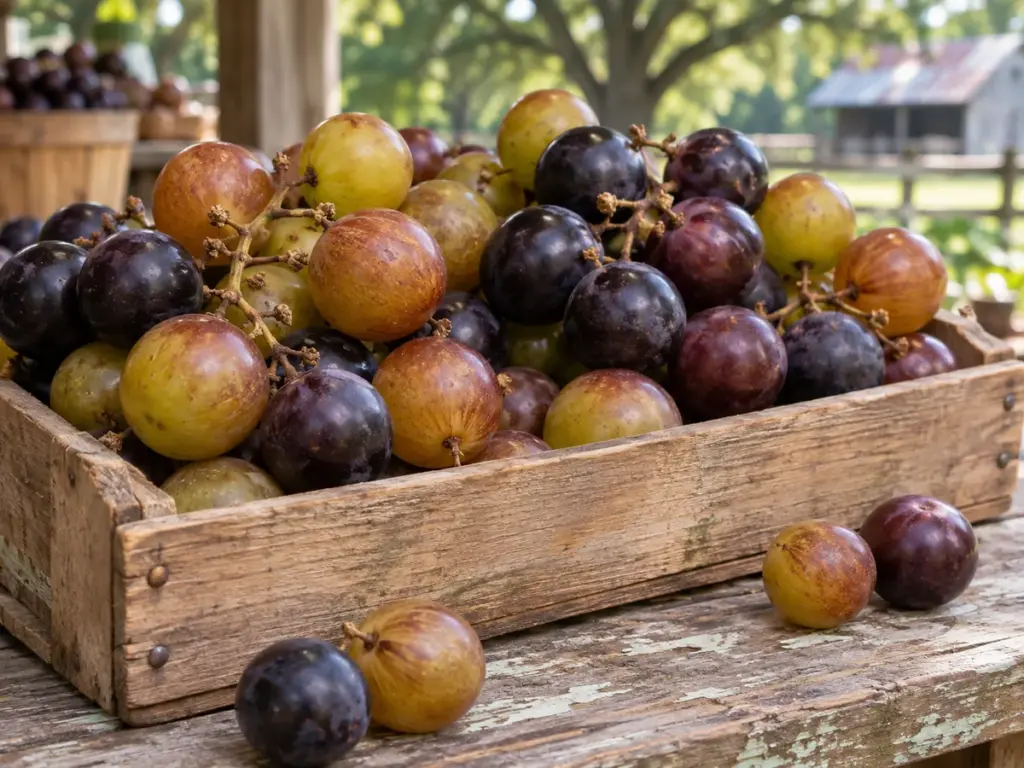
Muscadines do not ripen further once picked, and ripe ones fall easily from the stem, so growers go through a vine every 2 to 5 days. Use these steps at the stand:
Step 1. Check the stem end. A small, dry scar means the berry pulled away cleanly and will keep. A wet, torn scar means the berry spoils fast and belongs in jelly or juice soon after picking.
- Skip leaking or soft berries. Decay starts there and spreads to the rest.
- Smell one. Ripe muscadines have a sweet fragrance, and they do not ripen further after picking, so a berry that smells of nothing will not improve on your counter.
- Ask for the variety name and its best use. A fresh-eating variety like 'Summit' and a wine variety like 'Noble' are not interchangeable.
To eat a fresh one, follow NC State's tip: put the stem-scar end in your mouth and bite or squeeze, and the pulp bursts out of the thick skin. You can chew the skin or spit it out with the seeds.
10. Which Should You Buy or Grow?
Pick by the job, because the color only tells you what the finished food will look like:
- Snacking: choose a dry-scar variety and taste one first. 'Summit' (bronze) and 'Doreen' (green) are both listed for fresh eating, so the color is your choice.
- Pale gold jelly or a light-colored juice: choose bronze, such as 'Carlos' or 'Fry'.
- Deep red-purple jelly, juice or wine: choose dark, such as 'Ison' for jelly and juice or 'Noble' for wine.
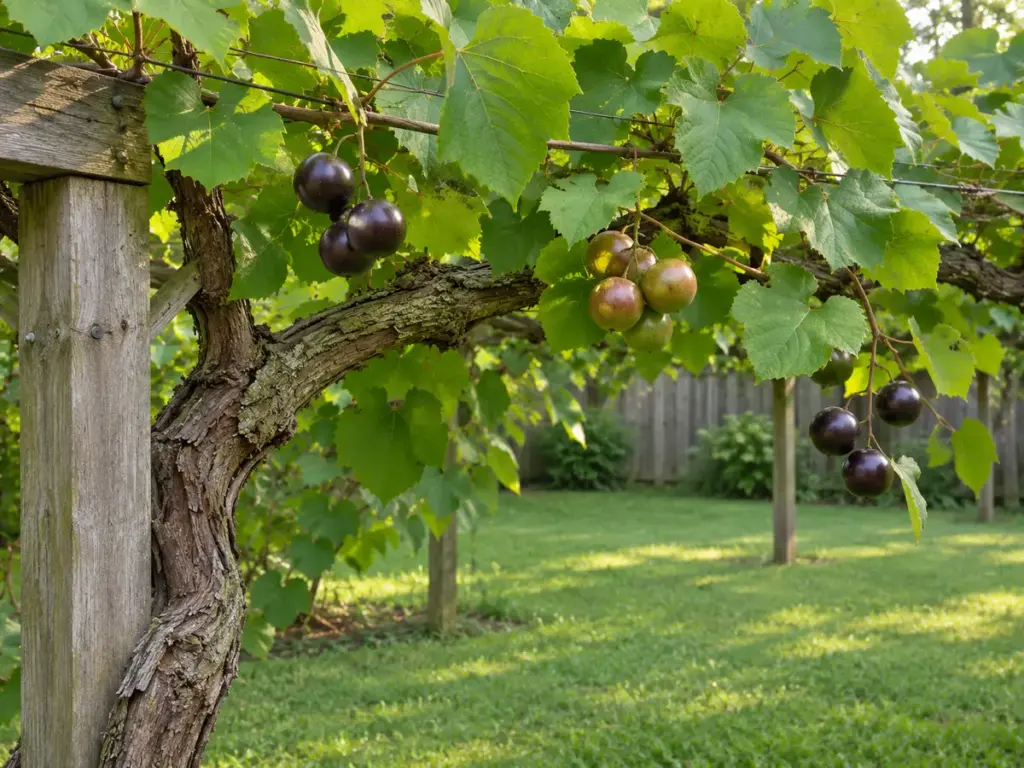
One vine in the yard: plant a perfect-flowered variety like 'Carlos', 'Noble' or 'Ison'. A lone 'Scuppernong' vine is female-flowered and will not fruit without a perfect-flowered neighbor, which is the one catch with the original bronze variety.
If you do plant, give each vine at least 20 feet by 6 feet of trellis room, according to Clemson, and expect it to live for decades. The 'Scuppernong' variety is very cold hardy, while 'Fry' is prone to winter damage, so in a colder yard the bronze you choose matters as much as the word "bronze."
Sources
- NC State Extension: Muscadine Grapes in the Home Garden
- NC State Extension, Pender County: It's Time for Muscadines
- NC State Extension, Beaufort County: Muscadine or Scuppernong Grapes
- NC State Extension, Franklin County: Nutritional Benefits of Muscadines
- Clemson Home and Garden Information Center: Muscadine Grape
- UF/IFAS Nassau County: Are my grapes Scuppernong or muscadine?
- Texas A&M AgriLife: Muscadine fact sheet
- USDA FoodKeeper: jams, jellies and preserves

Food writer at GustoMeadow. Writes ingredient substitutes, food comparisons, taste guides and storage guides for home cooks.
Storage and food-safety numbers follow USDA, FDA and university extension guidance.



