
A soft Medjool and a firmer "dried" Deglet Noor both hold about 20% water and almost the same nutrition.
- Truly fresh Barhi dates appear only for a few weeks from late summer into early fall.
- Swap dates by weight, not count: one Medjool is about 24 g, one Deglet Noor about 7 g.
- Buy Medjool for eating and paste and Deglet Noor for baking.
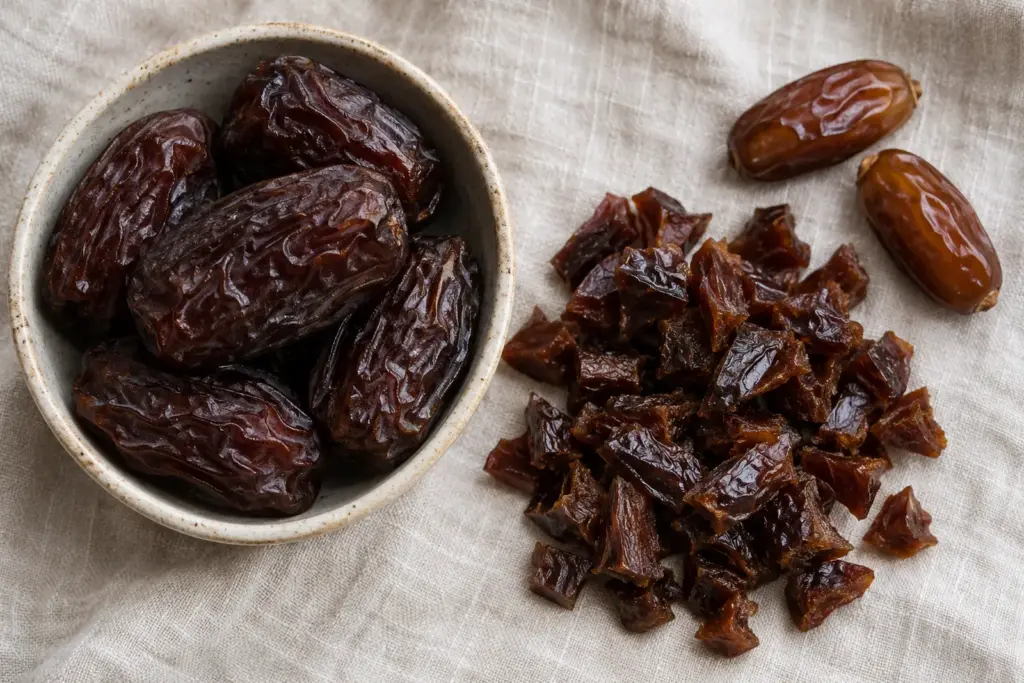
A produce-aisle box of dates and a baking-aisle bag of chopped dates look like different foods, yet both usually hold fully ripe dates. That makes dates unusual among the fresh-versus-dried ingredient pairs you meet in recipes, where drying normally changes the food a great deal.
1. What Is the Difference Between Fresh and Dried Dates?
Soft dates sold as "fresh" and firmer dates sold as "dried" share the same ripeness and almost the same water, according to USDA figures, while their size and firmness differ.
| Trait | Soft dates (Medjool) | Firm dates (Deglet Noor) |
|---|---|---|
| Ripeness when sold | Fully ripe (tamar) | Fully ripe (tamar) |
| Water per 100 g (USDA) | 21.3 g | 20.5 g |
| Size, pitted | About 24 g per date | About 7 g per date |
| Feel | Large, soft and sticky | Slim, firm and chewy |
| Flavor | Very sweet | Medium sweet, lighter |
| Best use | Eating whole, stuffing, paste | Chopping into bars, cookies, granola |
Because the ripeness and water rows match, the gap you feel in your hand comes from the variety and its size. Stores often sell Medjool as "fresh" and Deglet Noor as "dried", so look for the variety name on the package and press one date before you buy.
2. Are Dates a Dried Fruit?
Dates look dried, but the date you buy is a fresh fruit that finished ripening on the palm. A Kansas State University food science text says it directly: "Although dates appear to be dried, they are actually fresh fruits."
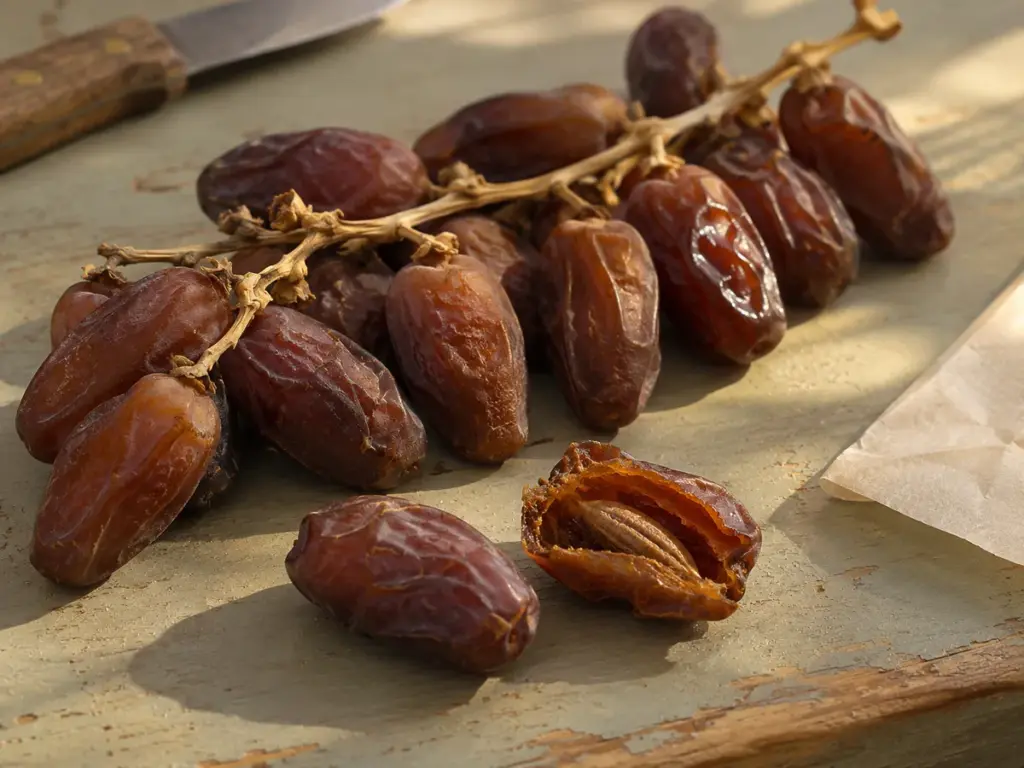
Many growers leave dates on the palm until they are completely ripe to prolong shelf life, so the fruit is slightly dry before it is picked. The Ag Marketing Resource Center still counts those dates as fresh.
You can also buy dates that are dried further. The same center lists completely dried dates next to paste, syrup, pitted dates and concentrate as processed date products.
Do Dates Have a Shell or a Skin?
A date has no shell. It is about 1 to 2 inches (2.5 to 5 cm) long, with a paper-thin skin and a single grooved seed in the center, according to the Kansas State text.
You eat the skin together with the flesh and pit out the seed. The same text gives ripe color as golden to dark brown, so a pale yellow date is an earlier stage of the same fruit.
3. Which Ripeness Stage Counts as a Fresh Date?
Dates ripen through four stages with Arabic names, and the FAO's postharvest chapter on dates says the last three are sold for eating. The soft box of Medjool in the produce aisle sits at the final stage.
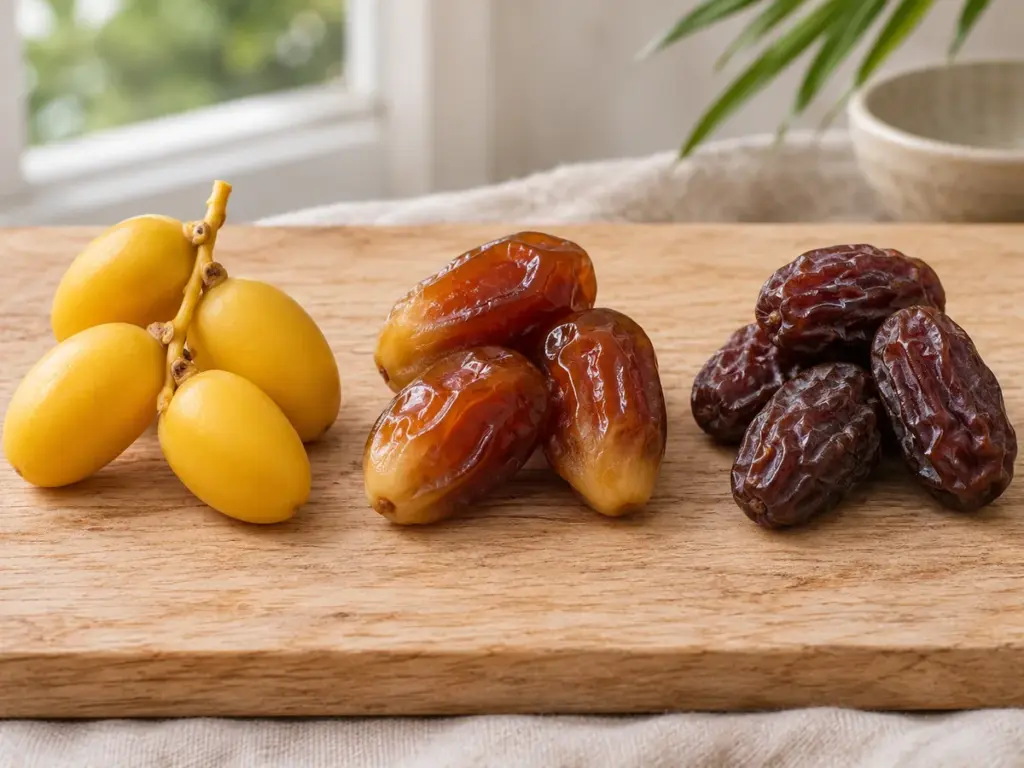
- Kimri is the green stage with up to 85% water, and growers do not sell it for eating.
- Khalal dates are bright yellow or red, hard and crisp, with about 50% water or more.
- Rutab dates brown from the tip, turn soft and succulent, and drop to about 35% water.
- Tamar dates are amber to dark brown, soft to firm, with under 25% water, a level the FAO calls self-preserving.
In the US, Barhi is the main date eaten at khalal, because Medjool and Deglet Noor are often too astringent at that stage. Barhi arrives yellow, firm and crunchy, with coconut and sugarcane notes, and it softens into a moist rutab date if you leave it at room temperature.
Do You Need to Dry Fresh Dates?
You do not need to dry tamar-stage dates, because they already sit below 25% water, the level where the FAO calls a date self-preserving.
Growers do dry dates picked earlier. Sun-drying works on whole or halved khalal dates, and cutting them in half and removing the pit speeds the loss of water.
The FAO adds that fast drying may cost the date its last stage of ripening. If you bring home a yellow Barhi, leave it at room temperature, where it softens into rutab, rather than drying it.
4. What Do Soft, Semi-Dry and Dry Dates Mean?
The FAO sorts dates into soft, semi-dry and dry by texture and pliability at the tamar stage. When your recipe or a store clerk talks about wet and dry dates, the words usually point to the soft and semi-dry ends of that scale.
- Soft dates, such as Medjool and Barhi, are plump and sticky.
- Semi-dry dates, such as Deglet Noor, are firmer and less sticky.
- Dry dates, such as Thoori, hold only 5 to 10% water in desert regions, per the FAO.
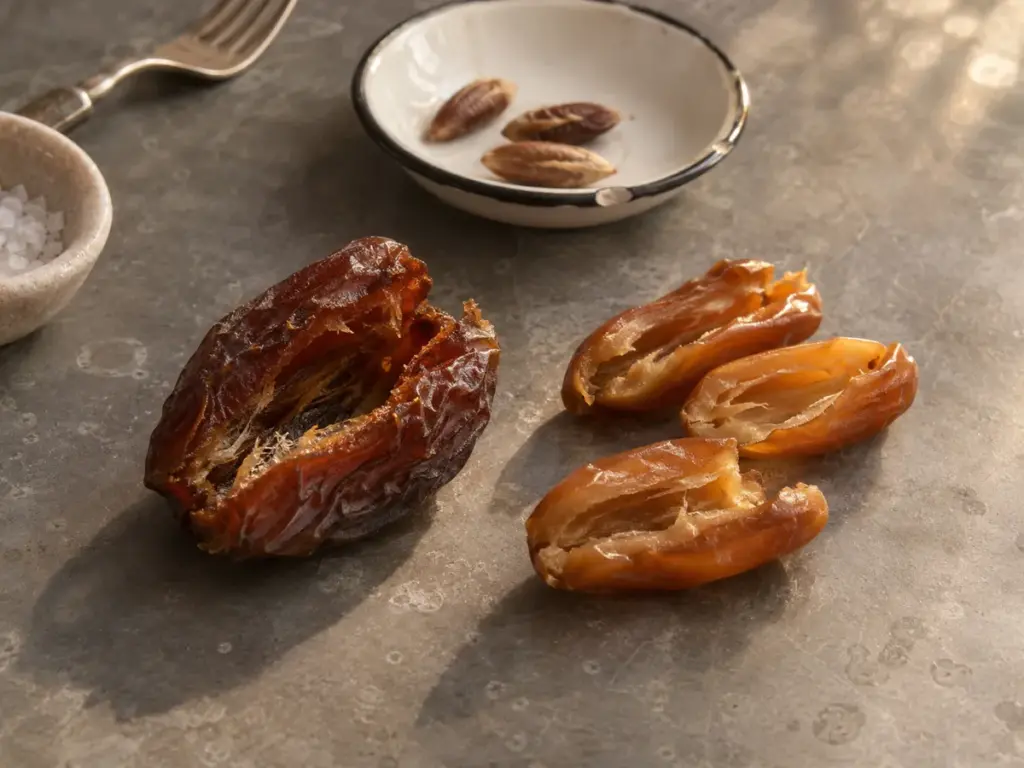
Medjool and Deglet Noor are the two most widely grown dates in the US, according to the Ag Marketing Resource Center, so they are the soft and semi-dry dates you will find on most shelves.
A semi-dry date can still arrive softer than it grew. Julia Morton's fruit reference says Deglet Noor "is hydrated before shipping", and the FAO lists hydration and steaming as ways to add water to dates.
How Can You Tell Soft Dates From Firm Ones?
- Read the variety name: Medjool is soft and Deglet Noor is semi-dry.
- Press one date: a soft date gives under your thumb, while a semi-dry date pushes back.
- Look at the color: yellow and crunchy is khalal, and amber to dark brown is tamar.
- Weigh it: a pitted Medjool is about 24 g and a Deglet Noor about 7 g.
5. How Do Fresh and Dried Dates Compare on Nutrition?
USDA FoodData Central has no separate fresh and dried records for dates. It lists Medjool (FDC 168191) and Deglet Noor (FDC 171726), the two varieties most US shoppers buy, and both come out close to each other per 100 g.
| Per 100 g | Medjool (FDC 168191) | Deglet Noor (FDC 171726) |
|---|---|---|
| Water | 21.32 g | 20.53 g |
| Calories | 277 kcal | 282 kcal |
| Total sugars | 66.47 g | 63.35 g |
| Fiber | 6.7 g | 8.0 g |
| Potassium | 696 mg | 656 mg |
| Vitamin C | 0 mg | 0.4 mg |
| One pitted date (USDA portion) | 24 g | 7.1 g |
| Calories per pitted date | about 66 | about 20 |
| Sugar per pitted date | about 16 g | about 4.5 g |
Calories, sugar and potassium agree within a few percent, and Deglet Noor carries a little more fiber. Neither record shows meaningful vitamin C, so do not count dates as a vitamin C source.
Sugar runs 66.47 g in Medjool and 63.35 g in Deglet Noor per 100 g, so the firmer date has only about 5% less sugar and is no more concentrated than the soft one. A Medjool has far more sugar per date mostly because it weighs about 3.4 times as much as a Deglet Noor.
Both records are close to fat free, at 0.15 g and 0.39 g of fat per 100 g, and both carry magnesium, 54 mg in Medjool and 43 mg in Deglet Noor.
A khalal date holds about 50% water or more, so gram for gram it carries fewer calories than a tamar date. USDA publishes no record for khalal dates, so no calorie number is given for them here.
6. Which Date Tastes Sweeter and Feels Softer?
Taste and texture change with the variety and the stage, so the useful comparison is between the dates you can actually find:
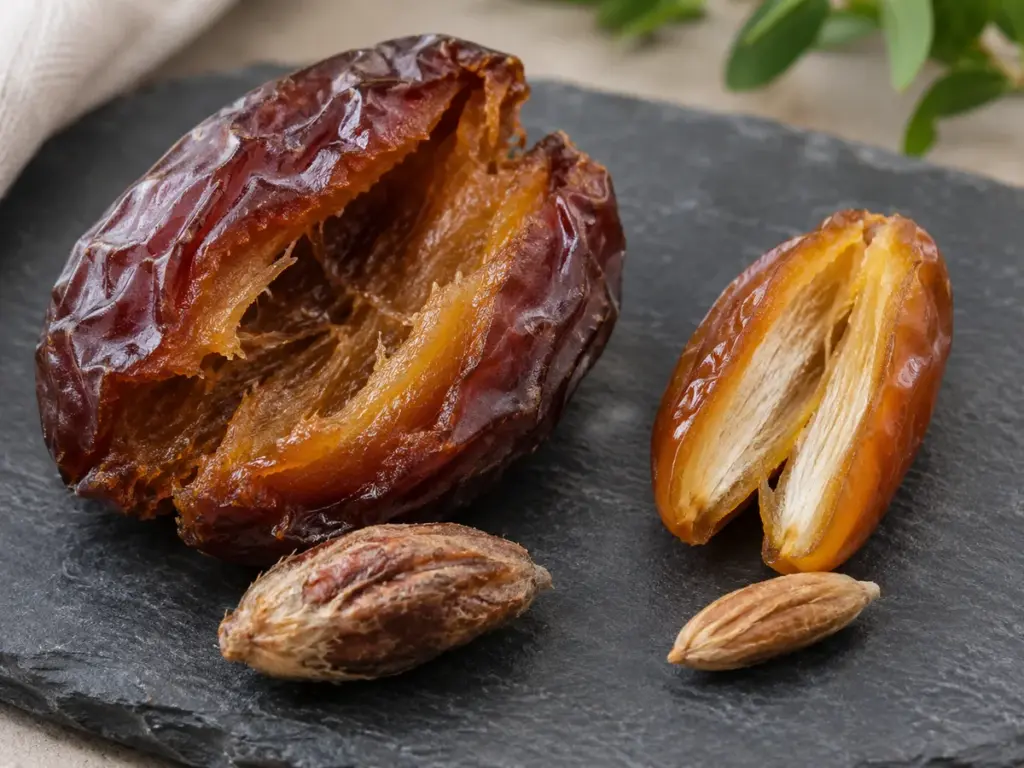
- Medjool is large, very sweet and medium-soft, so you can eat it straight from the box.
- Deglet Noor is slim, very firm and medium sweet, with light, translucent flesh that keeps its shape when you chop it.
- Barhi at khalal is crunchy, yellow and slightly astringent, with coconut and sugarcane notes.
- Barhi at rutab is soft and moist, with none of the stringy fibers it has at khalal.
For eating straight from the box, Medjool is the softer, sweeter date, and it sells at a premium price. For chopping, Deglet Noor wins on firmness, and it makes up almost 80% of California production, so you will find it easily.
7. Which Dates Work in Chutney, Stews and Sauces?
Texture decides which date you reach for. A soft date breaks down in warm liquid, and a firm date keeps its shape.
- Chutney and jam take soft dates, which melt into the pot and thicken it.
- Stews and tagines take firm dates, which stay in pieces beside the meat.
- Pestos and dressings blend smoothly with soft dates, while firm dates need a hot soak before you blend them.
In baking, firm chopped dates stay visible as sweet, chewy pieces, and soft dates vanish into the batter and add moisture.
8. Can You Swap Fresh Dates for Dried Dates?
Both types are fully ripe, so they behave alike in a recipe once you match the weight. Swap them 1:1 by weight, then adjust the softness with these steps.
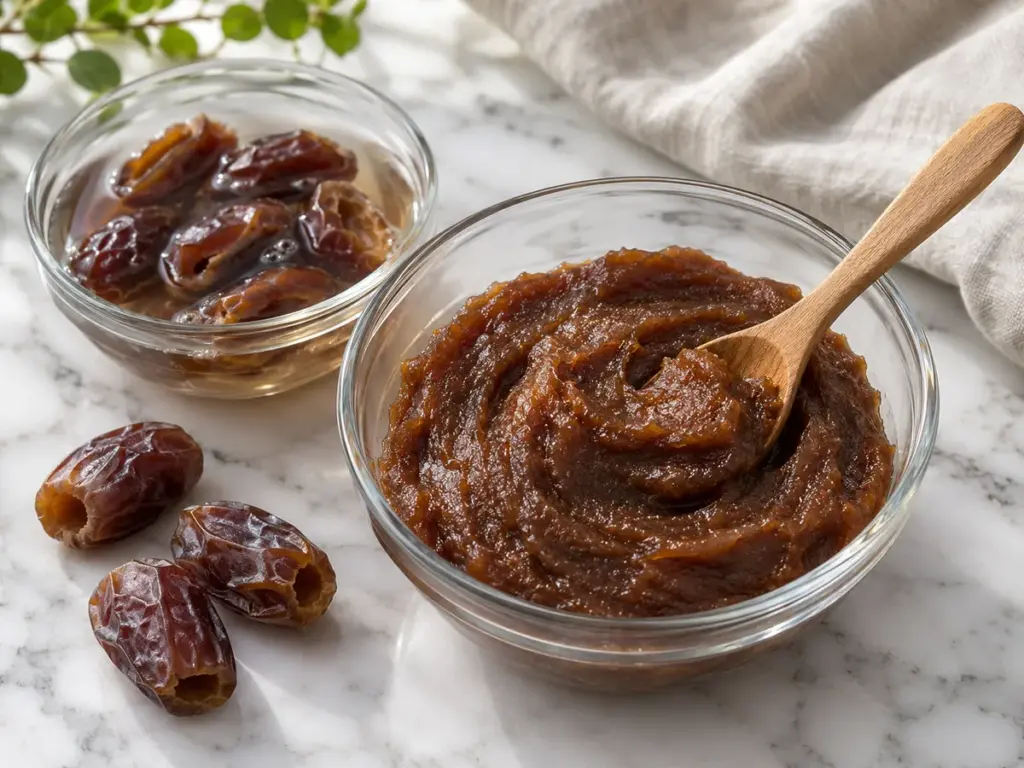
- Weigh the dates, because one Medjool equals about three Deglet Noor, and one cup of chopped Deglet Noor (147 g by USDA) equals about six Medjool.
- Pit and chop them to the size the recipe wants, using a knife dipped in hot water so the sticky flesh does not cling.
- Soak firm dates for 10 minutes in hot water when you need a soft result, such as paste or a smoothie, then drain them and keep the liquid.
- Toss soft chopped dates in a spoonful of the recipe's flour so they do not clump in batter.
Khalal and rutab dates do not swap this way. A crunchy khalal Barhi holds about 50% water or more and tastes astringent if it is underripe, so you eat it from the bowl or slice it into a salad instead of baking with it. A rutab date is soft and delicate, which makes it better eaten whole.
When your pantry has no dates at all, prunes are one common stand-in, and dried cherries or jujube also work in baking. A recipe that names Medjool wants its soft, sticky flesh, so dried apricots fill that gap better than hard, dry fruit.
For granola and oatmeal cookies, raisins are the usual cheap option, and you can swap raisins for dates at the cost of a tarter, less caramel flavor. Dried figs also work for snacking, with a seedier crunch and a less sticky chew.
Date paste differs from date syrup, which is a pourable liquid, so a recipe that calls for syrup needs a liquid sweetener. If you run out, maple syrup and honey are the usual fill-ins.
9. Which Dates Should You Buy?
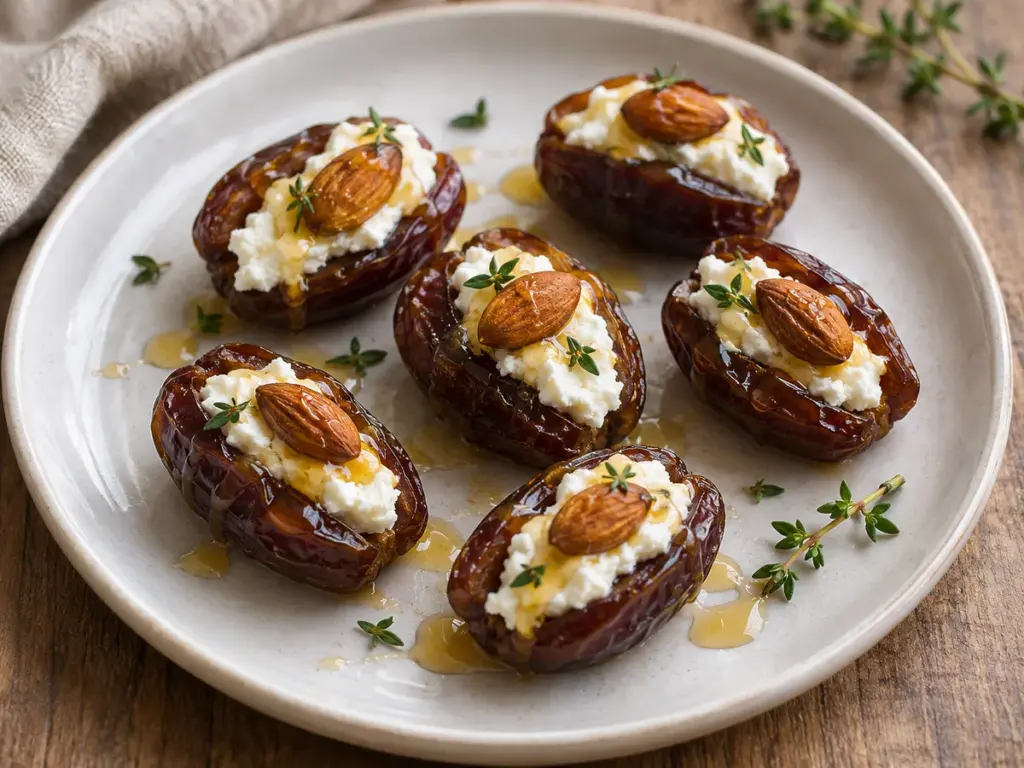
Soft Medjool halves are the usual base for stuffed dates, because the pit hole holds an almond or a spoonful of soft cheese. If you wrap dates in bacon for a party, choose sides for bacon-wrapped dates that are light, because the dates are already sweet and rich. Match the date to the job with this list.
- You eat the dates whole or stuff them with nuts or cheese.
- You want smooth date paste for smoothies or bites.
- The recipe names Medjool.
- You bake bars or cookies and want pieces to hold shape.
- You cook a braise and want whole pieces.
- You want a lower price than Medjool.
- Look for plump, glossy skin with fine wrinkles, since hard, brittle skin means the date has dried out.
- Skip any package that smells sour or fermented, because that smell points to spoilage.
- Bite or chop carefully, because whole dates carry pits and packaged pitted dates can still hide a pit piece.
- Check the ingredient list on chopped dates, because some carry a coating of added sugar or flour.
When Are Fresh Dates in Season?
You can buy fresh dates in the US from mid-August to mid-March, the marketing season the Ag Marketing Resource Center gives. Southern California grows the most, followed by Arizona.
Barhi is also eaten before it ripens fully, because the same center says it can be eaten either unripe or fully ripe.
10. How Long Do Dates Last, and How Should You Store Them?
The USDA FoodKeeper gives one set of times for dates and makes no split between fresh and dried, so these times fit the tamar-stage Medjool and Deglet Noor you find in stores.
| Where | How long (FoodKeeper) | Tip |
|---|---|---|
| Pantry, airtight | About 2 months | Keep it cool and dark |
| Refrigerator | Up to 12 months | Use a sealed container |
| Freezer | 1 to 2 years | Use a moisture-proof bag or container |
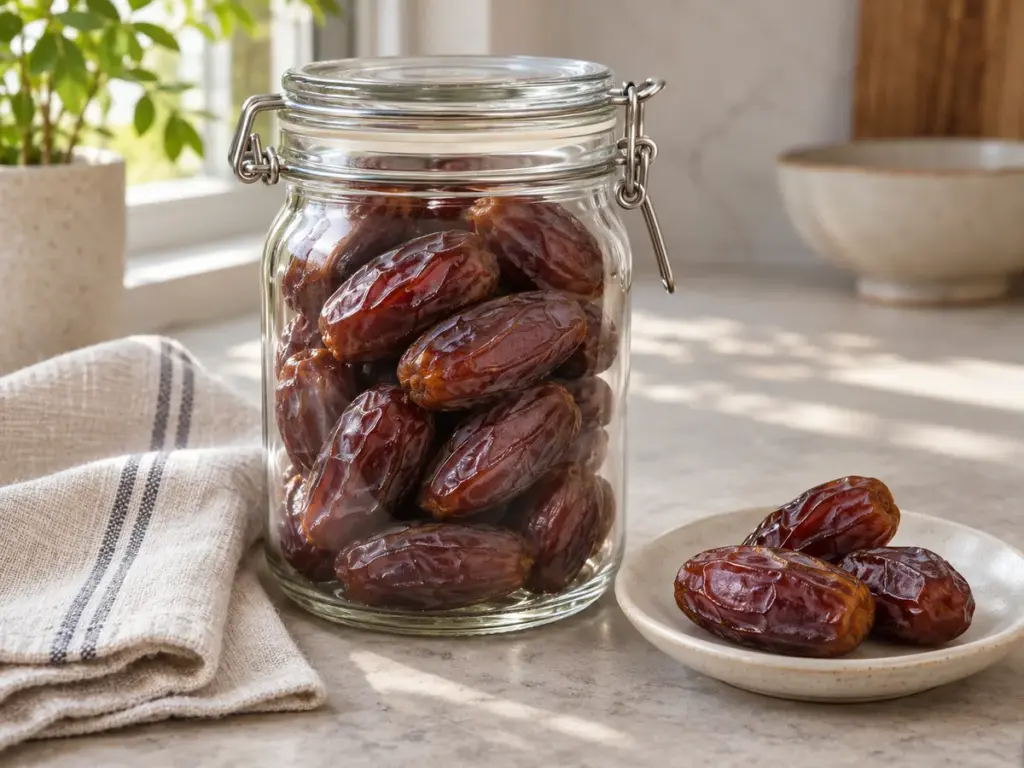
For soft Medjool, the freezer beats the fridge. UC Davis says a moisture-proof container at 0°F keeps date quality much better than the refrigerator at about 41°F, and the high sugar means freezing does not harm the texture. Let the dates warm up in a sealed bag, so condensation forms on the bag and not on the fruit.
Barhi at khalal or rutab is the exception. It softens quickly at room temperature, so you refrigerate it, and cold storage preserves it for months but dries the skin until it turns brittle.
White, grainy spots under the skin are usually sugar crystals. Fuzzy patches or a sour smell mean mold, so throw those dates out.
Sources
- USDA FoodData Central, FDC 168191: Dates, medjool
- USDA FoodData Central, FDC 171726: Dates, deglet noor
- USDA FoodKeeper: dates storage times
- FAO, Dates: ripening stages and moisture by stage
- UC Davis Postharvest Technology Center: Date
- Kansas State University, Science of Food: Stone Fruits and Tropical Varieties (dates)
- Ag Marketing Resource Center: Dates (marketing season, varieties, processed forms)
- Julia F. Morton, Fruits of Warm Climates: Date (soft, semi-dry and dry dates)
- Perishable News: Date varieties at farmers markets (Barhi at khalal and rutab)
- Clovegarden: Date palm varieties (Medjool, Deglet Noor, Barhi)

Food writer at GustoMeadow. Writes ingredient substitutes, food comparisons, taste guides and storage guides for home cooks.
Storage and food-safety numbers follow USDA, FDA and university extension guidance.



