
Glass noodles are starch noodles that turn clear and springy when soaked, while most rice noodles stay opaque white and soft.
- Pick glass noodles for japchae, yum woon sen and hot pot, where you want a chewy strand.
- Pick rice noodles for pad Thai and pho, where you want a soft ribbon.
- Dry, they have about the same calories per ounce.
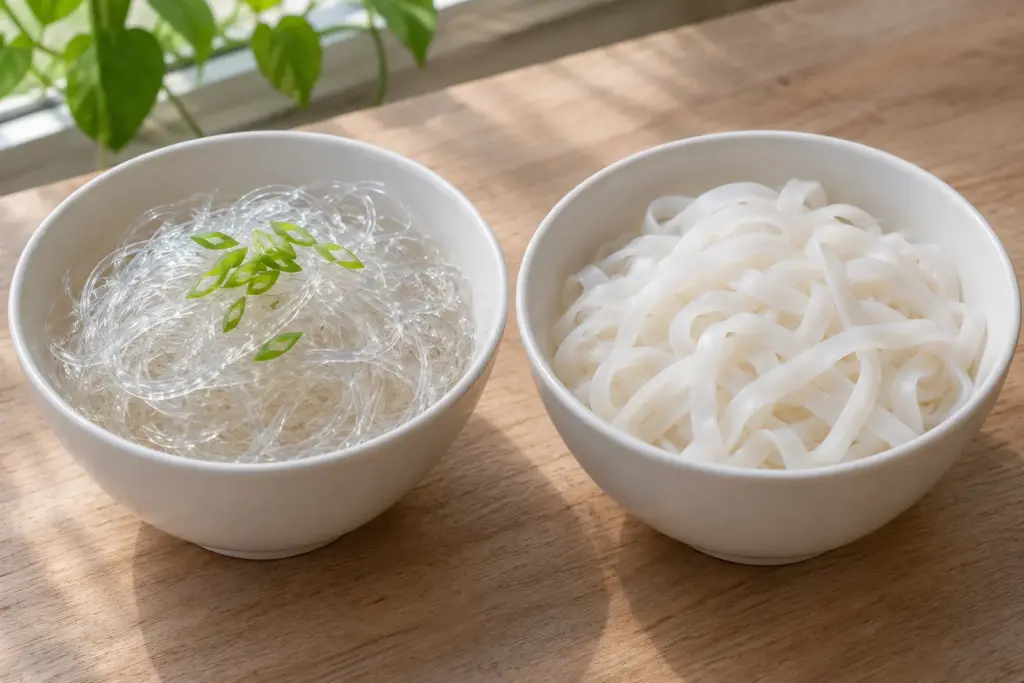
Dry bundles of thin glass noodles and rice vermicelli look so alike on the shelf that they rank among the pantry staples people mix up, and grabbing the wrong one gives you a chewy, clear noodle instead of a soft, white one.
1. What Is the Difference Between Glass Noodles and Rice Noodles?
Glass noodles, also sold as cellophane or bean thread noodles, are made from starch and water. Mung bean and sweet potato starch are the usual choices in China, Korean dangmyeon use sweet potato starch, and tapioca, potato and canna starch turn up in other brands.
Rice noodles are made from rice flour and water, and they turn opaque white after you cook them. Some makers add tapioca or corn starch to make them a little clearer and chewier, so if a rice noodle looks see-through, check the ingredient list.
| Trait | Glass noodles | Rice noodles |
|---|---|---|
| Made from | Mung bean, sweet potato or potato starch | Rice flour |
| Color when cooked | Clear and glossy | Opaque, milky white |
| Texture | Slippery, springy, chewy | Soft and tender |
| Shapes | Mostly thin strands, plus thick Korean dangmyeon | Thin round vermicelli to wide flat ribbons |
At the table you can tell them apart in a second: clear strands are glass noodles and white ones are rice noodles. Both are mild, so the sauce or broth supplies most of the flavor, and the taste of plain rice noodles is gentle.
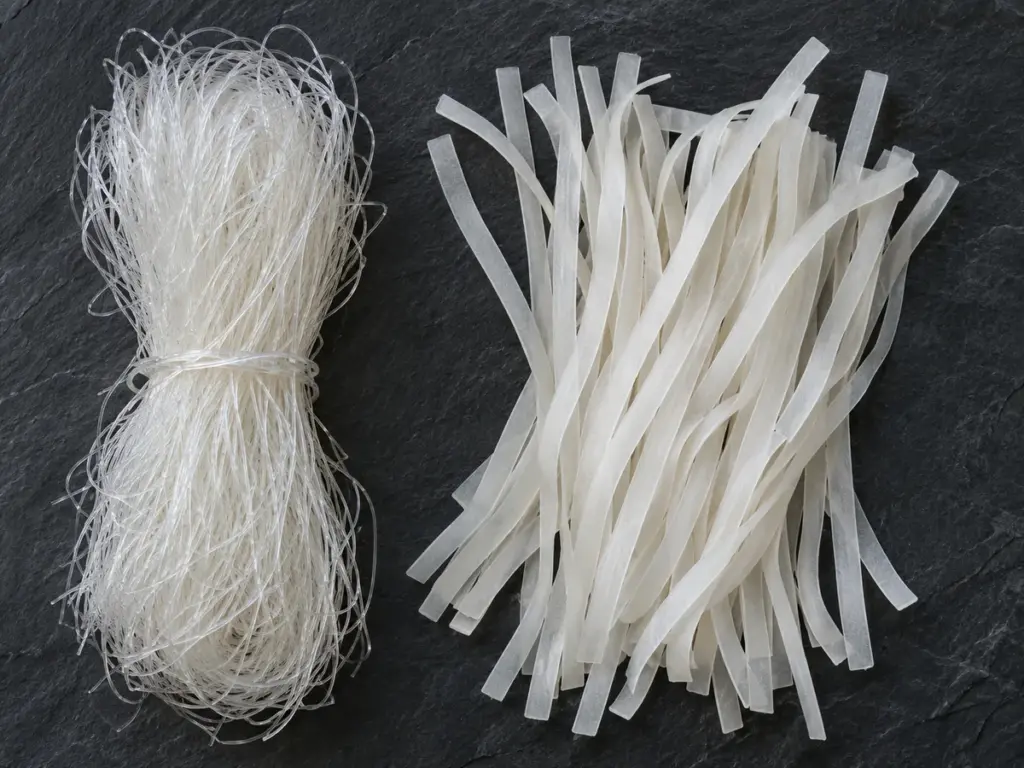
| Trait | Glass noodles | Rice noodles |
|---|---|---|
| Prep | Soak about 20 minutes (thin) or 2 to 3 hours (dangmyeon) | Steep 5 to 15 minutes in off-the-boil water |
| In hot broth | Stays chewy | Softens, so add it late |
| Classic dishes | Japchae, pad woon sen, yum woon sen | Pad Thai, pho, rice vermicelli bowls |
What Else Are They Called?
The names overlap, and that is where most shopping mistakes start. Wikipedia lists a different word for glass noodles in nearly every country, while rice noodles go by a shorter list.
- Cellophane or bean thread noodles
- Fensi (Chinese), dangmyeon (Korean), harusame (Japanese)
- Wun sen (Thai), miến (Vietnamese)
- Rice sticks and rice vermicelli
- Mei fun (Cantonese), bún (Vietnamese)
- Bihon (Filipino), bihun (Malaysian)
Kimchimari notes that dangmyeon is often sold in English as "Glass Noodles," "Starch Noodles" or "Vermicelli". Turn the bag over and read the ingredient line, because "vermicelli" can mean either noodle.
Wikipedia is clear that glass noodles are not the same as rice vermicelli, which is made from rice and stays white after cooking. Rice vermicelli is the closest lookalike, so it is the noodle most often grabbed by mistake.
2. How Do Korean and Thai Glass Noodles Differ?
Both are glass noodles, but they behave like two different products. The Korean kind is thick and chewy, and the Thai kind is thin and quick.
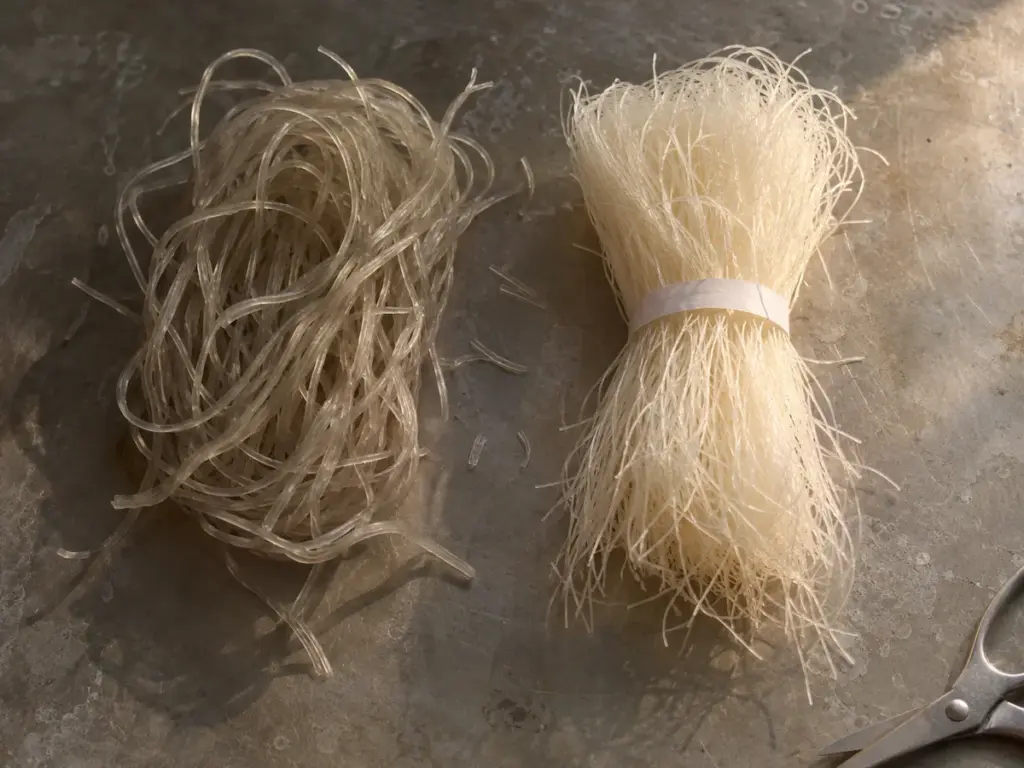
- Made from 100% sweet potato starch.
- Chewier than most, and not as white or transparent.
- Soak 2 to 3 hours.
- Made from mung bean starch.
- Thin and white when dry, translucent after cooking.
- Soak about 20 minutes.
Kimchimari calls dangmyeon "more chewy than most" cellophane noodles, and that bite is why japchae uses it. Milk Street soaks the thin kind for pad woon sen and notes that the dry noodles plump and turn translucent as they cook.
The soak time is the practical gap. A recipe written for dangmyeon needs a head start of a few hours, while a thin-noodle recipe is ready by the time you have chopped your vegetables.
3. How Do You Cook Glass Noodles?
Glass noodles are sold dry, so you will soak them more than you cook them. Milk Street soaks thin mung bean noodles in room-temperature water for about 20 minutes. Thick sweet potato dangmyeon take much longer: a Korean japchae recipe soaks them 2 to 3 hours in room-temperature water, or overnight in the fridge in warm weather.
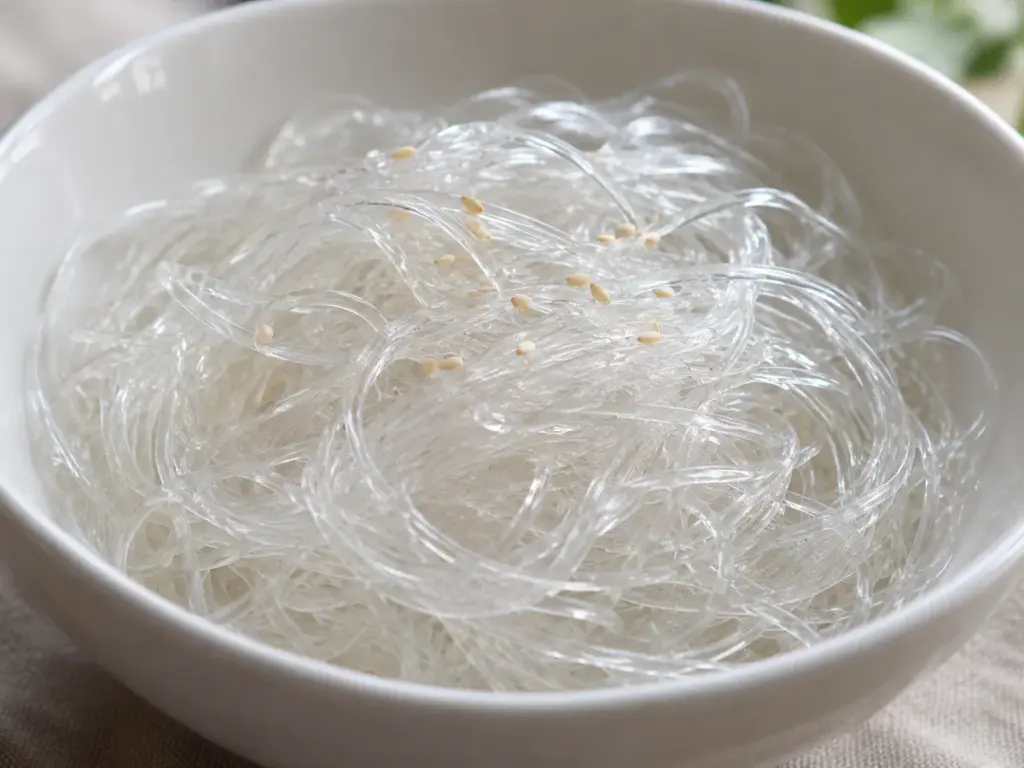
- Soak. Cover the noodles with water and wait: about 20 minutes for thin mung bean noodles, 2 to 3 hours for dangmyeon.
- Cut. Snip the soaked noodles into shorter lengths with kitchen shears, or they tangle into one nest in the pan.
- Finish in the pan or broth. Toss the drained noodles in the pan for about 1 minute, as Kimchimari does for japchae, or stir them into hot broth at the end.
- Rinse for salads. Drain and rinse with cold water when the noodles will be served cool.
For a stir-fry such as japchae, Kimchimari tosses the drained noodles with the vegetables and oil for about 1 minute first. That coats each strand so it does not stick.
4. How Do You Cook Rice Noodles?
Rice noodles go wrong when they are boiled. America's Test Kitchen pours boiling water over them off the heat, stirs once halfway through, then rinses them under cold water until the water runs clear. If you boil them, they turn soggy and clumpy, and if you soak them at room temperature they stay stiff, so your stir-fry takes longer and ends up dry and sticky.
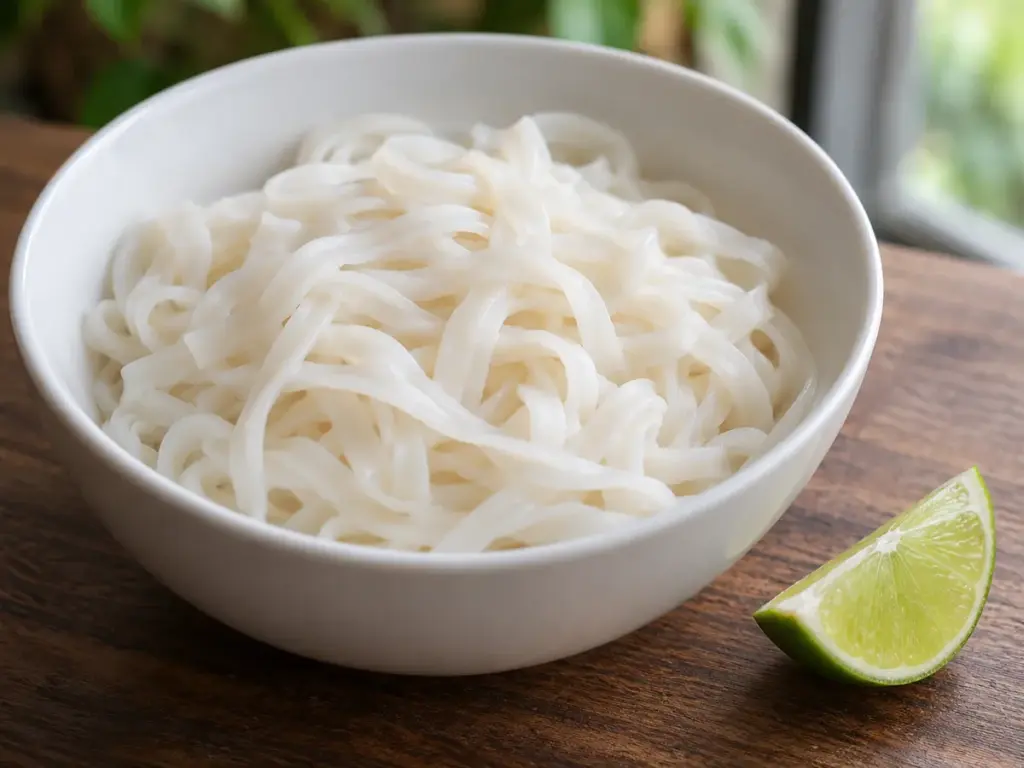
| Rice noodle | Steep time | What happens next |
|---|---|---|
| Thin, round (vermicelli) | About 5 minutes | Ready to use as is |
| Thick, flat (pad Thai width) | 8 to 15 minutes | Finish in the skillet with the sauce |
For pad Thai, stop while the noodles are pliable but not fully soft, because they keep softening in the sauce. Sources differ on temperature: Thai Table calls for lukewarm water for pad Thai and boiling water for 7 to 10 minutes for general use. They agree on stopping before the noodles turn mushy.
Thai Table adds that an under-soaked noodle is fine when it will cook further or when you pour hot soup over it. An over-soaked one should be drained and left to dry out a little.
Which Rice Noodle Shape Fits Which Dish?
"Rice noodle" covers at least four shapes, and the dish decides which one you buy.
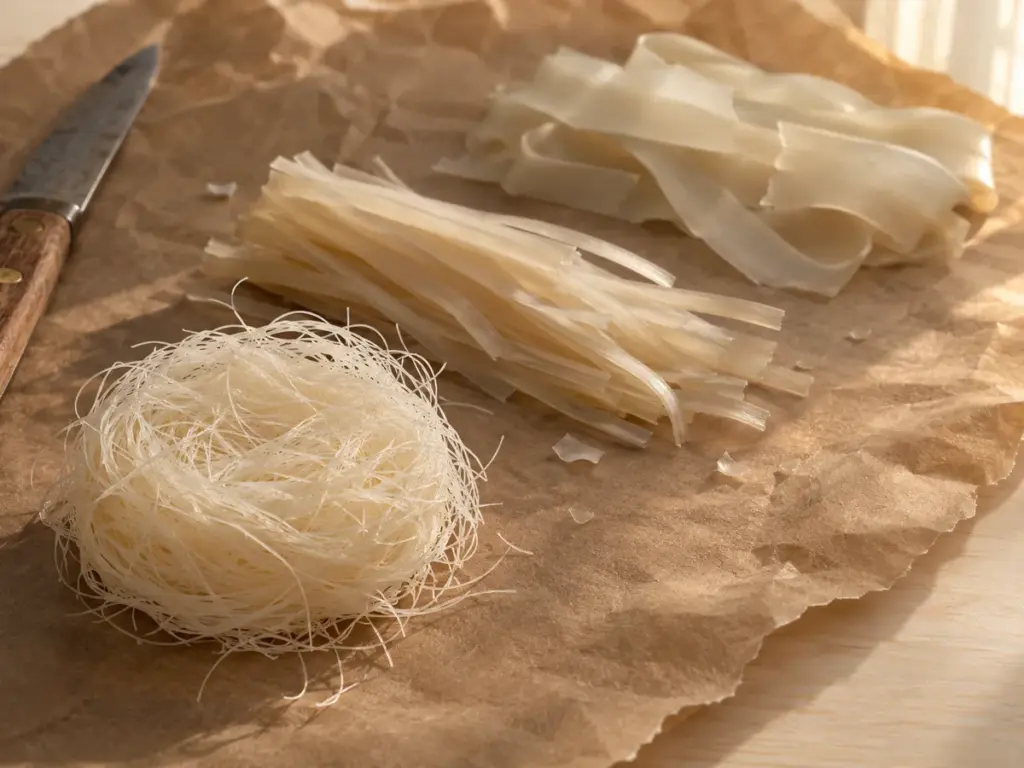
- Rice vermicelli is the thin kind, and it suits bowls, salads and chow mei fun stir-fries.
- Pad Thai noodles are flat, dried and about the width of linguine. "Rice stick" is a loose label that appears on vermicelli bags and on some pad Thai packs.
- Wide sen yai noodles are the base of Thai drunken noodles (pad kee mao).
- Bánh phở is the fresh rice noodle used in Vietnamese pho, and shahe fen (chow fun) is a wide Chinese rice noodle.
So the pho question has a short answer: pho noodles are rice noodles, not glass noodles. Thai Table also uses the pad Thai width for curried noodles in beef curry sauce.
5. Which Has Better Nutrition, Glass Noodles or Rice Noodles?
By dry weight the two are close. USDA lists dehydrated mung bean glass noodles at 351 calories per 100 g and dry rice noodles at 364, so a 57 g (2 oz) handful from your pantry comes to about 200 calories of glass noodles against 207 of rice noodles.
| Per 100 g, dry | Glass noodles (FDC 174258) | Rice noodles (FDC 169742) |
|---|---|---|
| Calories | 351 | 364 |
| Carbohydrate | 86.1 g | 80.2 g |
| Protein | 0.16 g | 5.95 g |
| Fat | 0.06 g | 0.56 g |
| Fiber | 0.5 g | 1.6 g |
| Iron | 2.17 mg | 0.7 mg |
| Sodium | 10 mg | 182 mg |
Cooked weights are not comparable, because both noodles soak up water and 100 g of cooked noodles holds far fewer calories than 100 g dry. USDA lists cooked rice noodles at 108 calories and 24.0 g of carbohydrate per 100 g (FDC 168914) but has no cooked glass noodle entry, so compare the dry numbers on the package.
Neither noodle is a fiber source, and iron is the only mineral that stands out: glass noodles carry 2.17 mg per 100 g dry, while calcium and potassium are tiny in both. Both are gluten-free by ingredients, since starch and rice flour contain no wheat, but read the label if you cook for someone with celiac disease, because brands and factories differ.
How Do They Compare With White Rice?
Dry long-grain white rice has 365 calories per 100 g (FDC 168877), so all three dry starches sit within 14 calories of each other.
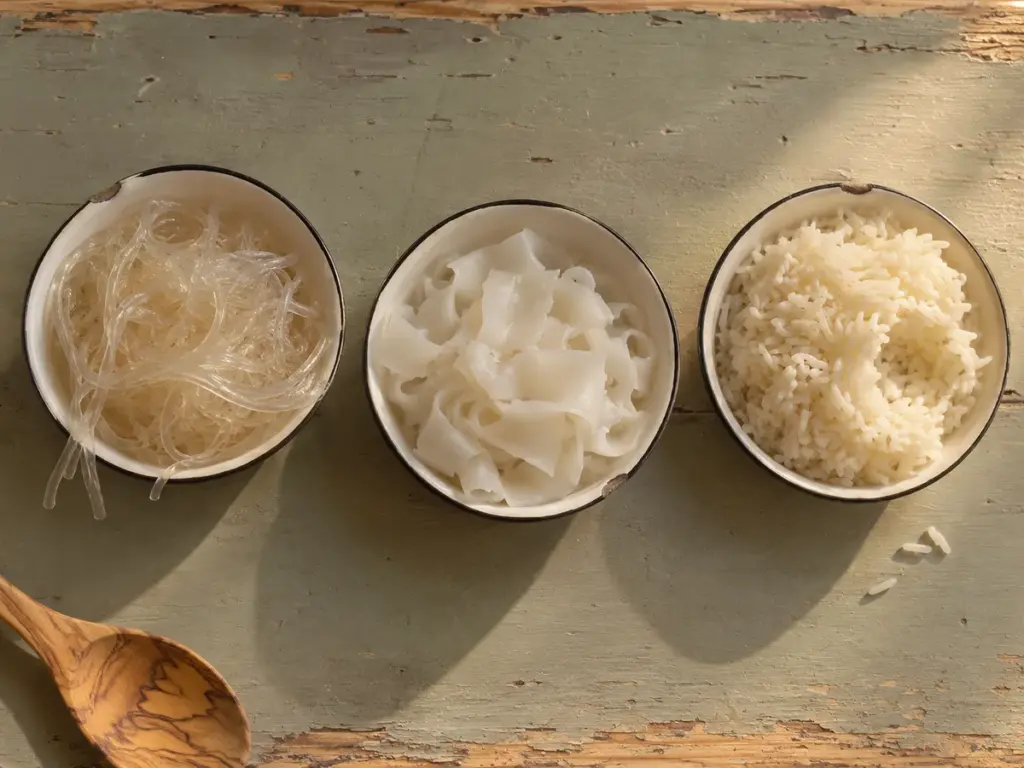
Cooked, the gap shows up. By USDA cup weights, a cup of cooked rice noodles and a cup of cooked white rice come out like this.
- 108 calories per 100 g (FDC 168914).
- 1 cup is 176 g, about 190 calories.
- 130 calories per 100 g (FDC 168878).
- 1 cup is 158 g, about 205 calories.
The bigger difference is protein. A 2 oz portion of dry rice noodles carries about 3.4 g, while the same portion of glass noodles carries about 0.1 g.
Which One Is Better for Blood Sugar or Weight?
Neither noodle wins on weight alone, because the calories match and the portion you serve decides the total. The vegetables and protein you add to the bowl matter more than the noodle you start with.
For rice noodles, the 2008 international tables of glycemic index list one rice noodle entry at 53 and udon at 55. Those numbers come from different studies than the mung bean one, so read them as separate data points, not a head-to-head test. If you manage diabetes, ask your dietitian how a noodle fits your plan.
6. Which Dishes Call for Glass Noodles and Which for Rice Noodles?
Dishes Built on Glass Noodles
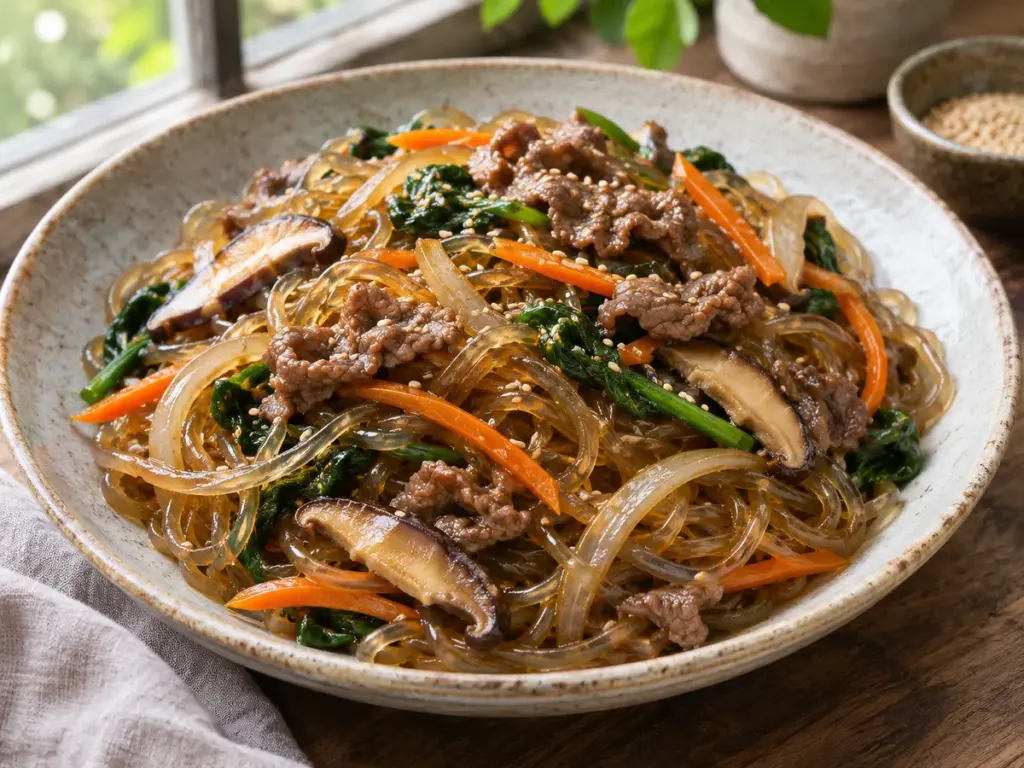
- Japchae uses sweet potato dangmyeon, and its chew is the point of the dish.
- Pad woon sen is a Thai stir-fry of soaked mung bean noodles, while pad Thai's flat rice noodles sit in a tamarind sauce instead.
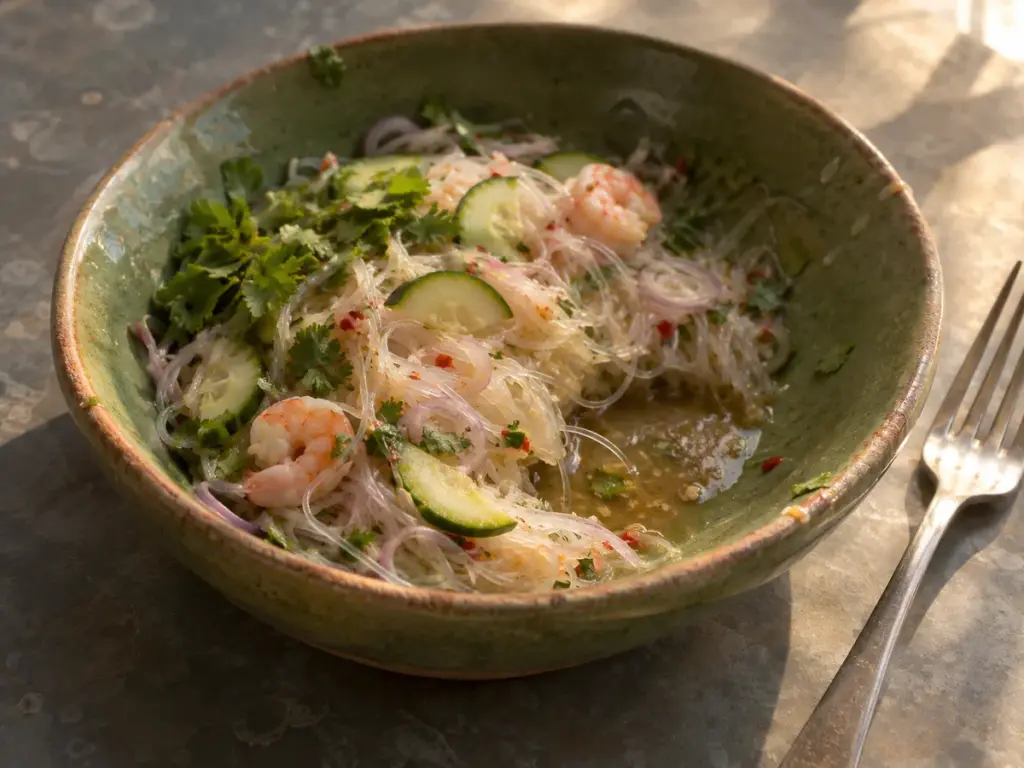
- Yum woon sen is a Thai glass noodle salad, so rinse the soaked noodles in cold water before you dress them.
- Hot pot and soups suit them: Wikipedia says that in Taiwanese hot pot they soak up the broth while keeping a chewy texture.
- Spring rolls often hold soaked glass noodles in the filling, and spring, summer and egg rolls differ in their wrapper and their cooking.
The list is longer than most cooks expect. Wikipedia names Sichuan ants climbing a tree, dumpling fillings, Filipino sotanghon with chicken and wood ears, Hawaiian chicken long rice and Vietnamese miến gà.
Glass noodles also go in sweet dishes. In India, Wikipedia says, falooda is served over kulfi.
Dishes Built on Rice Noodles
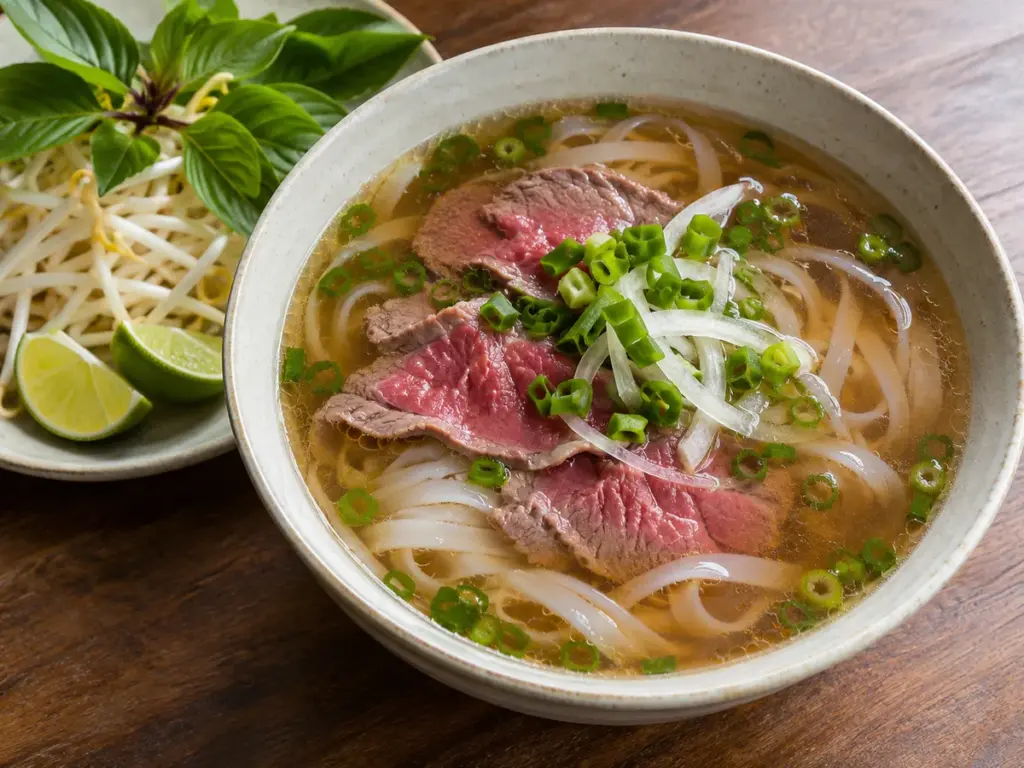
- Pad Thai uses flat dried rice noodles about the width of linguine, which soften in the pan and soak up the sauce.
- Pho serves flat rice noodles in broth. They carry almost no flavor of their own, so the broth decides how pho tastes.
- Rice vermicelli bowls and salads use the thin, round noodles that steep in about 5 minutes.
- Drunken noodles (pad kee mao) stir-fry wide sen yai noodles in a wok.
- Laksa, the noodle soup of Malaysia and Singapore, is on Wikipedia's list of rice noodle dishes.
If a drunken noodles recipe tempts you to reach for glass noodles, expect a different dish.
7. How Do Glass Noodles Compare With Udon?
Udon is a wheat noodle, so it falls in a different category from both starch noodles.
- Made from wheat flour, so it contains gluten.
- Thick, chewy and bouncy, hot in soup or cold.
- Made from starch, with no wheat.
- Thin, slippery and springy, often clear.
Just One Cookbook describes udon as thick, chewy and elastic, with a texture that holds up in hot soups and stir-fries.
If you cook gluten-free, skip udon. Glass noodles will not give you its thick, bouncy bite either, so treat them as a different noodle, not a stand-in.
8. Can You Swap Glass Noodles for Rice Noodles?
Yes, in most noodle dishes, but the bite and the color change. Swap by dry weight, ounce for ounce, because the dry calories are so close. Your soak time changes too: thin glass noodles soak about 20 minutes at room temperature, while rice noodles steep 5 to 15 minutes in hot water.
- You get a clear, springier strand, not a soft ribbon.
- Cut soaked noodles short so they do not clump.
- You get a softer, less chewy noodle, so japchae loses its bounce.
- They turn opaque white, so yum woon sen looks different.
- Add them to hot dishes late, because boiling makes them soggy.
In pho, glass noodles stay chewy in the broth, so the bowl keeps its bite but loses the classic soft noodle.
In noodle salads served cold, thin rice vermicelli can replace the glass noodles in Thai yum woon sen, and glass noodles can replace the vermicelli in a Vietnamese rice noodle salad.
Thick rice noodles are the hard swap. Glass noodles cannot make the wide, flat ribbon of pad Thai or drunken noodles, so your stir-fry ends up with slippery strands and a different sauce grip.
If you have neither noodle, stand-ins for glass noodles include shirataki and rice vermicelli. As rice noodle stand-ins, udon and wheat-based ramen work too, but they contain gluten and break a gluten-free plan.
9. Which Should You Buy?
- Japchae: buy sweet potato dangmyeon, and plan a soak of 2 to 3 hours.
- Pad Thai or pho: buy flat rice noodles, and steep them until they bend without snapping.
- A salad that must keep its chew: buy glass noodles, soak them about 20 minutes, cut them and rinse them.
- Hot pot: buy glass noodles, since they stay chewy in broth.
- A wheat-free kitchen: either works, so read the ingredient list and the allergen line.
Clear kelp noodles and shirataki are made from sea vegetable and konjac, not starch, so they chew and cook differently from glass noodles.
Sources
- USDA FoodData Central, FDC 174258 (Noodles, chinese, cellophane or long rice (mung beans), dehydrated), FDC 169742 (Rice noodles, dry), FDC 168914 (Rice noodles, cooked), FDC 168877 (Rice, white, long-grain, regular, raw) and FDC 168878 (Rice, white, long-grain, regular, cooked).
- Lin MA, Wu MC, Lu S, Lin J. Glycemic index, glycemic load and insulinemic index of Chinese starchy foods. World Journal of Gastroenterology, 2010.
- Atkinson FS, Foster-Powell K, Brand-Miller JC. International tables of glycemic index and glycemic load values: 2008. Diabetes Care, 2008.
- America's Test Kitchen: How to Prepare Tender Rice Noodles.
- Milk Street: Stir-Fried Glass Noodles (Pad Woon Sen).
- Kimchimari: Japchae (Korean Glass Noodles) recipe.
- Thai Table: Thai rice noodles.
- Eating Thai Food: Gai Pad Kee Mao Sen Yai.
- Just One Cookbook: Udon noodles.
- Wikipedia: Glass noodles (starch types, names and regional dishes).
- Wikipedia: Rice noodles (shapes, added starches and dishes).

Food writer at GustoMeadow. Writes ingredient substitutes, food comparisons, taste guides and storage guides for home cooks.
Storage and food-safety numbers follow USDA, FDA and university extension guidance.



