
Pickling salt is fine-grained, pure sodium chloride with no iodine or anti-caking agent, and tested canning and fermenting recipes call for it.
- Kosher salt has bigger, flakier crystals that are best for seasoning by hand.
- 1 teaspoon of pickling salt equals about 2 teaspoons of Diamond Crystal kosher salt or 1¼ teaspoons of Morton.
- Swap by weight for any pickle or ferment.
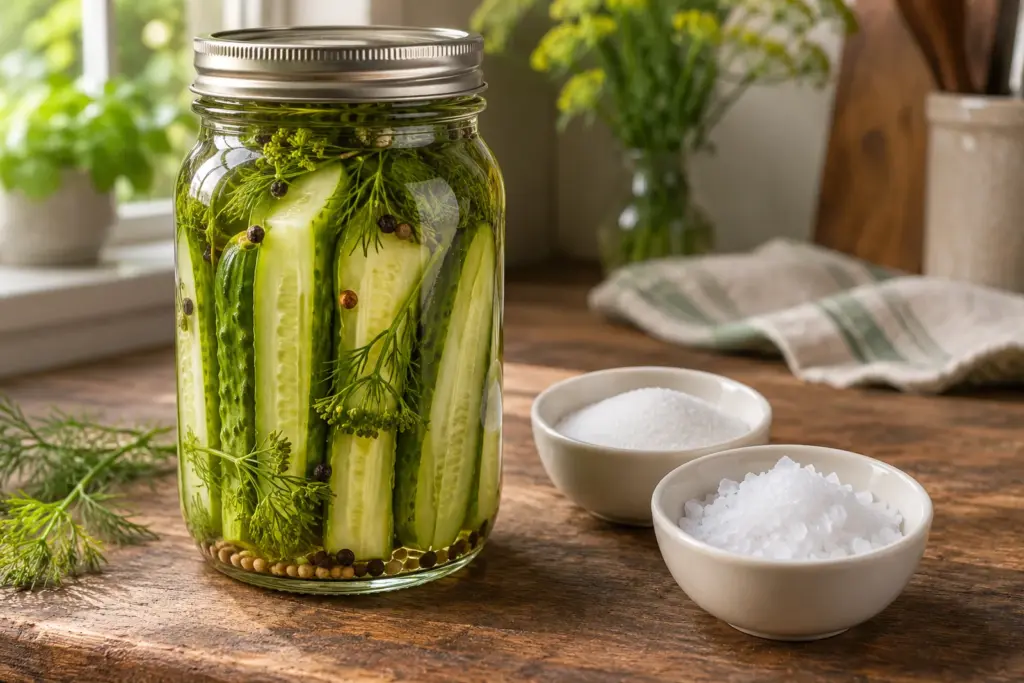
Both salts are almost entirely sodium chloride, so the confusion starts at the measuring spoon. It shows up in many ingredient pairs that look alike, but here the gap is big: a teaspoon of Diamond Crystal holds less than half the salt of a teaspoon of pickling salt. If you swap them one for one, you get either bland pickles or a brine that is far too strong, depending on the direction.
1. What Is the Difference Between Pickling Salt and Kosher Salt?
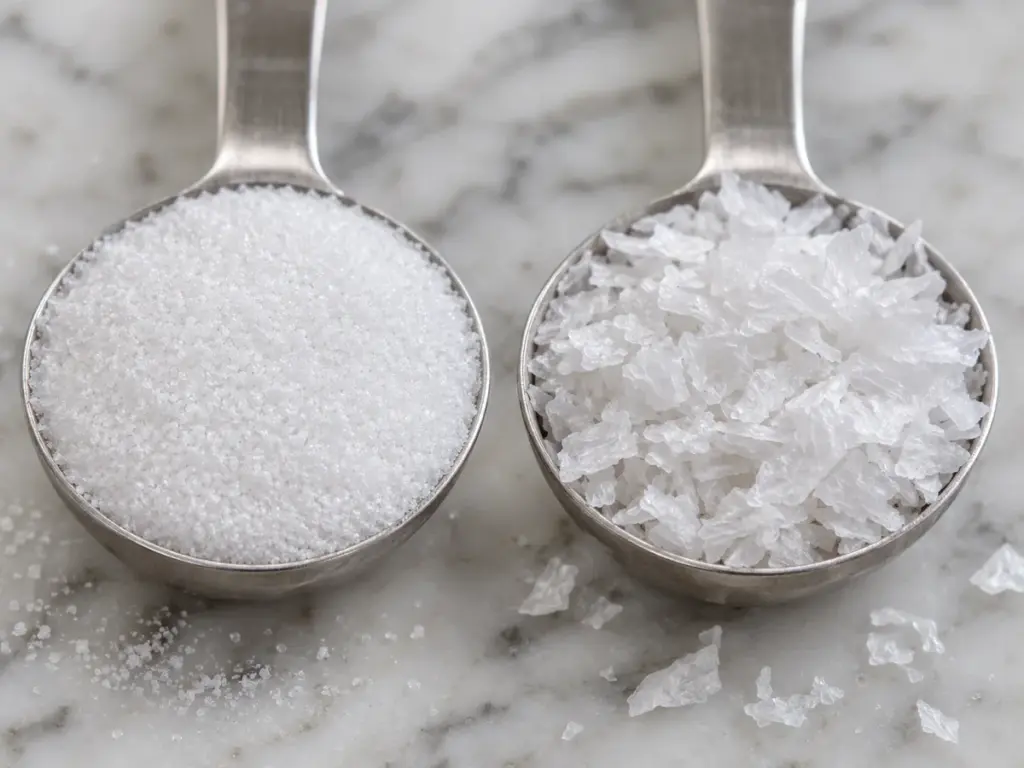
You'll find pickling salt sold as canning salt, or "canning and pickling salt", and it is ground to small, even granules. Kosher salt gets its name from koshering, the Jewish practice of salting meat to draw out surface blood, which is why its crystals are coarse and flaky. The two main US brands also differ from each other, so here is each one:
| Trait | Pickling salt | Diamond Crystal kosher | Morton kosher |
|---|---|---|---|
| Crystal | Fine, uniform granules | Light, fragile, concave flakes | Denser, flat flakes made by rolling |
| Weight of 1 teaspoon | about 6 g | 2.8 g | 4.8 g |
| Sodium in 1 teaspoon (approx.) | 2,350 mg | 1,100 mg | 1,900 mg |
- Pickling salt has no additives, so there is no iodine and no anti-caking agent.
- Diamond Crystal kosher is salt only, with no iodine.
- Morton kosher is salt plus yellow prussiate of soda, an anti-caking agent, and it is non-iodized.
Use pickling salt for canned pickles, sauerkraut and brined cucumbers, Diamond Crystal kosher for seasoning meat and vegetables by hand, and Morton kosher for seasoning, brining and general cooking.
We worked out the sodium row from the weights, since sodium chloride is about 39% sodium by weight. Gram for gram the three salts are equal, so none of them is healthier than another, but if you measure by the teaspoon, pickling salt gives you about twice the sodium of Diamond Crystal.
2. Why Does a Teaspoon of Kosher Salt Hold Less Salt?
If you fill a spoon with large, hollow or flat flakes, the gaps mean it holds part salt and part air, while fine granules fill the same spoon almost solid. America's Test Kitchen describes Diamond Crystal's fragile, concave grains and Morton's dense flakes, and Cook's Illustrated weighed them at 2.8 g and 4.8 g per teaspoon. Milk Street rounds those to 3 g and 5 g.
Fine pickling salt packs tighter than either, and Oregon State Extension's figure of 289 g per cup of granulated salt works out to about 6 g per teaspoon.
3. Does the Salt Change How Pickles Look and Taste?
The salt you pick changes how your jar looks more than how the pickle tastes, and it comes down to what else is mixed into the salt:
- Anti-caking agents cloud the brine. The National Center for Home Food Preservation (NCHFP) says the non-caking additives in some table salts can turn the brine cloudy, and its troubleshooting table lists them as a cause of white sediment in the jar. Morton kosher salt contains one, so your brine may turn hazy with it too. Diamond Crystal lists only salt.
- Iodine darkens pickles. NCHFP lists iodized salt as a cause of dark or discolored pickles. Neither kosher brand is iodized, so you only need to worry if table salt gets into the jar.
- Minerals in specialty salts change color and flavor. Oregon State Extension warns that gourmet salts contain minerals that can cause discoloration or off-flavors.
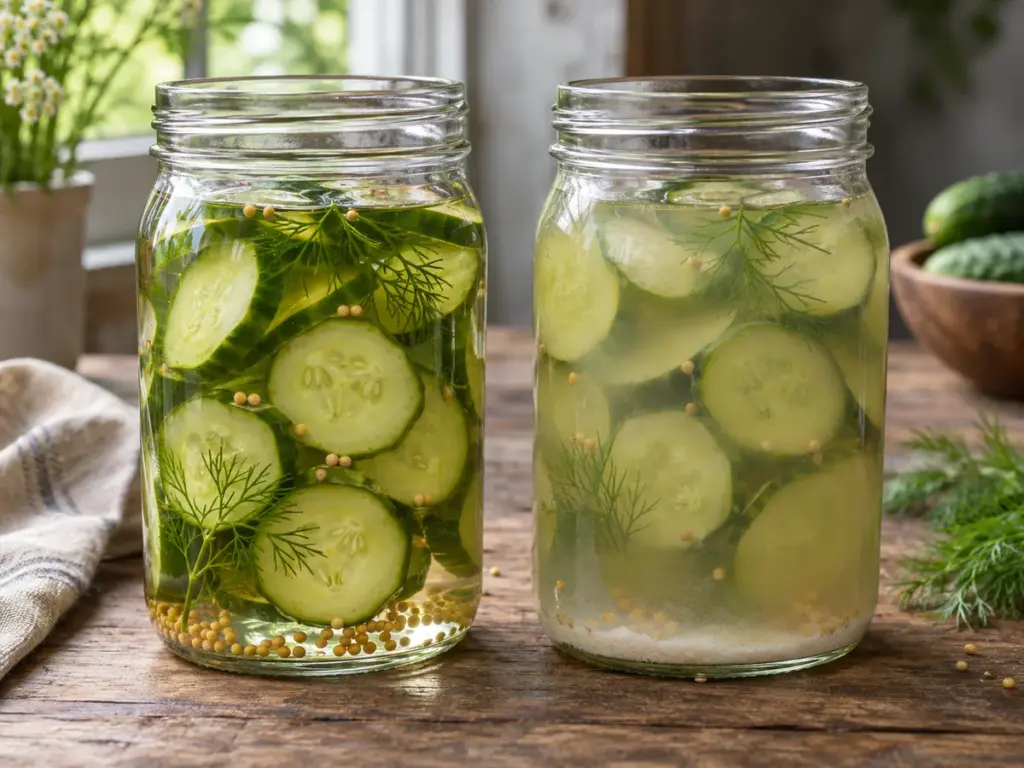
Crunch is a separate matter. It depends on fresh cucumbers with the blossom end trimmed and, in some older recipes, on firming agents such as pickling lime or alum, so switching salts will not make a limp pickle crisp.
4. Which Salt Is Safe for Canning and Fermenting?
If you're canning pickles, NCHFP states that canning or pickling salt is recommended, and Penn State Extension calls it the preferred choice for canning, pickling and sauerkraut. If you want to use flake salt, you'll hit a snag: NCHFP does not recommend it because its density varies, and Oregon State Extension says that if you use it anyway, weigh it instead of using spoons or cups.
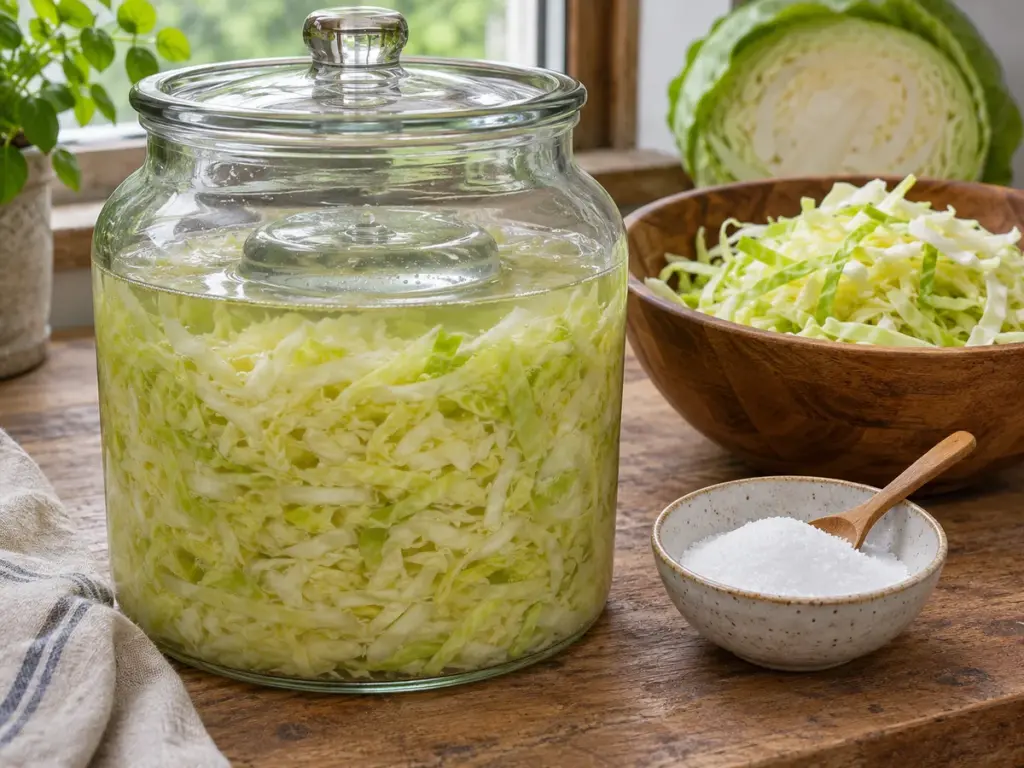
If you ferment, the stakes are highest, because salt favors the helpful bacteria and holds back the others. Clemson's extension service gives 3 tablespoons of canning or pickling salt per 5 pounds of cabbage, a brine strength of 2.25% to 2.5%. Our arithmetic from the weights above shows what happens if you swap carelessly:
- 3 tablespoon pickling salt: gives you about 54 g of salt in 2,268 g of cabbage, roughly 2.4%, which is inside the target.
- 3 tablespoon Morton kosher: gives you about 43 g, roughly 1.9%, which is below the target.
- 3 tablespoon Diamond Crystal: gives you about 25 g, roughly 1.1%, which is less than half the salt the recipe intends.
If you use water-bath canning for vinegar pickles, it works differently, because the vinegar's acidity does the safety work and the salt mostly sets flavor and firmness. Even so, follow the amount the tested recipe gives, and use pickling salt or its weight equivalent.
5. Can You Use Kosher Salt Instead of Pickling Salt?
Yes, if you convert the amount. The ratios below come from the weights in the first table (6 g per teaspoon of pickling salt, 2.8 g for Diamond Crystal, 4.8 g for Morton). Sources round the brand weights a little differently, so treat the spoon amounts as close, not exact.
| Recipe calls for | Use Diamond Crystal | Use Morton kosher | Weight |
|---|---|---|---|
| 1 teaspoon pickling salt | about 2 tsp | 1¼ tsp | 6 g |
| 1 tablespoon pickling salt | about 2 Tbsp | 1¼ Tbsp | 18 g |
| 1 cup pickling salt | about 2⅛ cups | 1¼ cups | 289 g |
If your recipe is written for 1 teaspoon of Diamond Crystal, you need only about ½ teaspoon of pickling salt, and 1 teaspoon of Morton equals about ¾ teaspoon.
If a recipe says only "kosher salt", you're taking the bigger risk: by weight 1 teaspoon of Morton is about 1¾ teaspoons of Diamond Crystal, which Milk Street rounds to 2, so Morton can make a Diamond Crystal recipe nearly twice as salty. Table salt is as dense as pickling salt, so if you use one of the substitutes for kosher salt, you'll usually need to cut it back by volume.
When you only have kosher salt and the recipe is a pickle, convert with a scale:
- Find the pickling salt amount. Note the teaspoons, tablespoons or cups in the recipe.
- Turn it into grams. Use 6 g per teaspoon, 18 g per tablespoon or 289 g per cup.
- Weigh the kosher salt. Spoon it onto a scale until it reaches that number of grams.
- Stir until it dissolves. Flakes dissolve a little slower than fine granules, so warm the brine briefly if crystals linger.
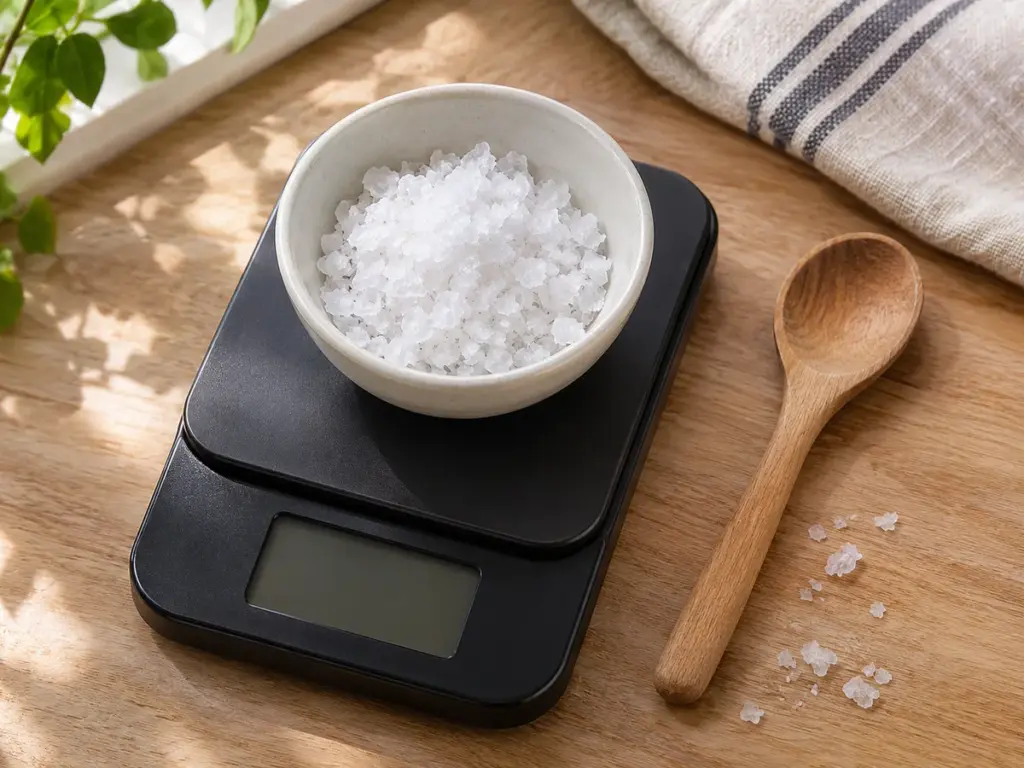
Extension guidance still prefers pickling salt for canning and fermenting, so keep this conversion for a one-time gap in the pantry and buy a box of pickling salt for the next batch.
6. Which Should You Buy or Use?
- Canned pickles: the brine stays clear with no sediment
- Sauerkraut and brined cucumbers: the salt percentage must be right
- Refrigerator pickles: fine grains dissolve fast
- Steaks and roasts: flakes spread evenly by hand
- Everyday cooking: big crystals make oversalting harder
- Recipes that name a kosher brand: the author tuned amounts to it
Once you read the label, the choice is simple: look for a box that says canning or pickling salt for preserving, and for kosher salt choose one brand and stay with it, because the gap between Diamond Crystal and Morton is large enough to ruin a recipe tuned for the other. A pickling weekend usually needs spices too, and if your jar of pickling spice is empty, common pickling spice replacements can cover it.
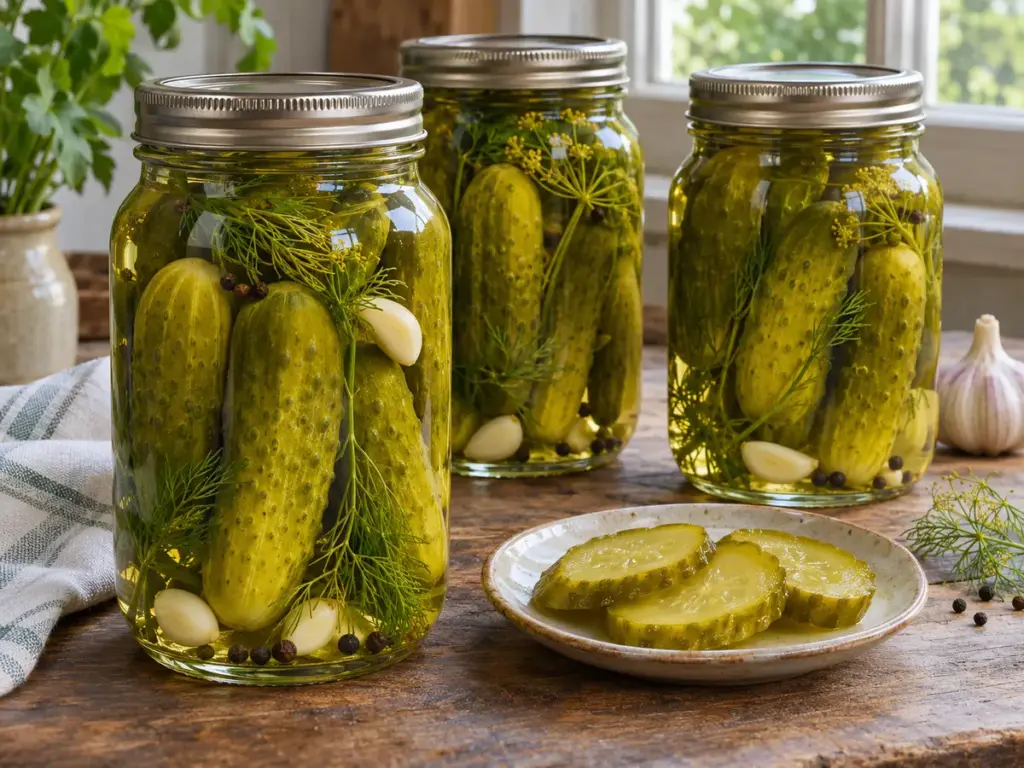
7. Which Other Salts Should Stay Out of the Pickle Jar?
Table salt makes safe pickles, but NCHFP notes its additives can cloud the brine, and Penn State Extension says iodized salt can darken or spot vegetables. Oregon State Extension also warns that ice cream and rock salts might carry unsafe impurities and that gourmet salts bring minerals that discolor the brine, so you should keep sea salt and rock salt on the plate, not in the jar.
Neither pickling salt nor kosher salt is a curing salt. If you're making bacon, ham or sausage, buy curing salts such as Prague powder, which add the sodium nitrite that neither of these contains.
Sources
- National Center for Home Food Preservation, Salts Used in Pickling: canning or pickling salt recommended, flake salt not recommended, anti-caking additives and cloudy brine.
- National Center for Home Food Preservation, Problems with Pickled Foods: iodized salt and dark pickles, anti-caking agents and white sediment.
- Oregon State Extension, Pickle Fact Sheet: salts to use and avoid, weighing flaked salt, 289 g per cup of granulated salt, do not alter salt in ferments.
- University of Maine Cooperative Extension, The Best Salts for Canning and Pickling: crystals are not interchangeable by volume.
- Penn State Extension, Salt in Canning: canning or pickling salt preferred, salt substitutes not safe for ferments.
- Clemson Home and Garden Information Center, Making Sauerkraut: 3 tablespoons of salt per 5 pounds of cabbage, 2.25% to 2.5% brine.
- Cook's Illustrated, Salt taste test: 2.8 g and 4.8 g per teaspoon for Diamond Crystal and Morton.
- America's Test Kitchen, Table Salt, Kosher Salt and Other Salts: crystal shapes, 1 : 1.5 : 2 table to Morton to Diamond Crystal ratio.
- Milk Street, Worth Our Salt: about 3 g and 5 g per teaspoon, 1 teaspoon of Morton to about 2 of Diamond Crystal.
Frequently Asked Questions
Yes. Both names describe the same pure, fine-grained salt with no iodine or anti-caking agent, and NCHFP treats "canning or pickling salt" as one product.
You can, and it dissolves fast in soups and sauces. A teaspoon holds about twice the salt of a teaspoon of Diamond Crystal, so use half as much by volume, or add it in small pinches and taste as you go.

Food writer at GustoMeadow. Writes ingredient substitutes, food comparisons, taste guides and storage guides for home cooks.
Storage and food-safety numbers follow USDA, FDA and university extension guidance.



