
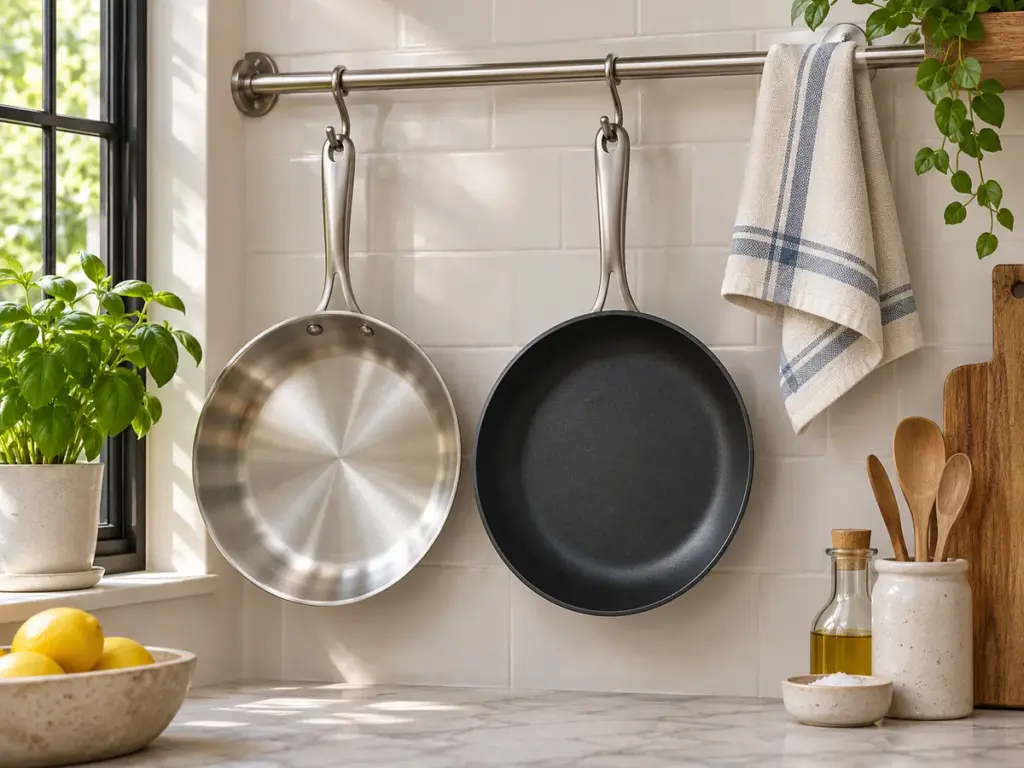
Anolon's nonstick pans suit eggs, fish and fast cleanup, and All-Clad's bonded stainless pans suit searing, pan sauces and oven finishing.
- All-Clad's D3 pans are oven safe to 600°F and work on induction.
- Anolon's Advanced Home pans have a nonstick coating, so food slides out, and they do best on medium heat with wood or silicone tools.
- Both brands list a limited lifetime warranty.
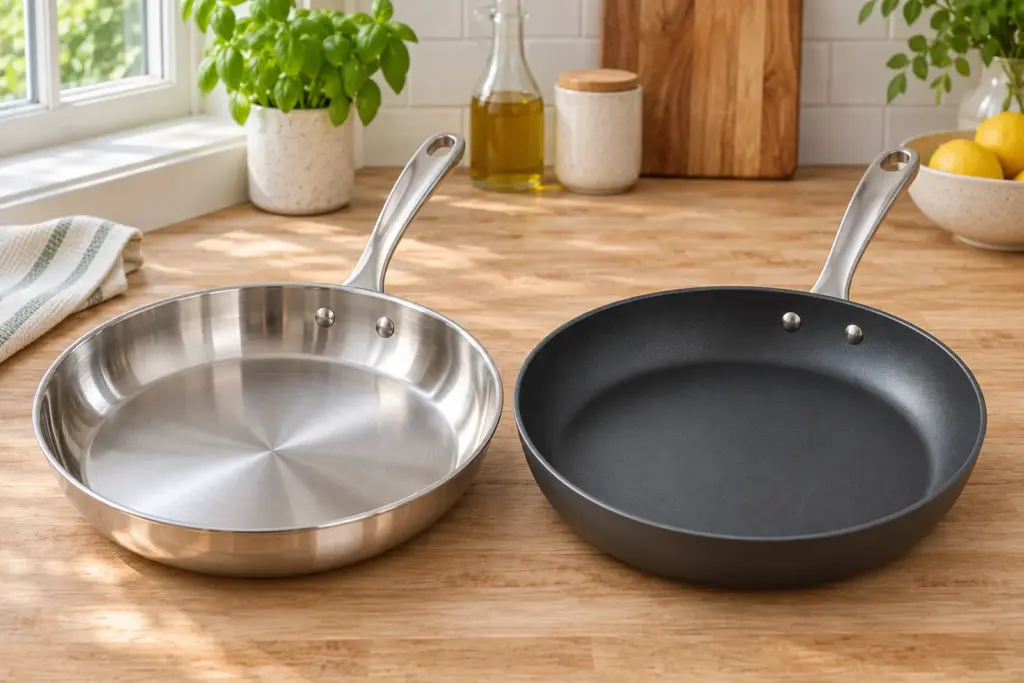
Among everyday kitchen comparisons, this pair splits cleanly on the cooking surface: Anolon's Advanced Home line is nonstick, and All-Clad's D3 and D5 lines are bare stainless steel.
That is the matchup here: Anolon's Advanced Home nonstick line against All-Clad's bonded stainless. Anolon also sells clad stainless, ceramic and hybrid nonstick lines, so a different Anolon pan can behave differently.
1. What Is the Difference Between Anolon and All-Clad?
| Trait | Anolon Advanced Home | All-Clad D3 and D5 |
|---|---|---|
| Body | Hard-anodized aluminum | Stainless steel bonded around an aluminum core |
| Cooking surface | Nonstick coating | Bare 18/10 stainless steel |
| Best jobs | Eggs, pancakes, delicate fish | Searing, browning, pan sauces, oven finishing |
| Oven and induction | 14.5-inch open skillet: oven safe to 400°F, not induction compatible; other pans differ | Oven safe to 600°F, induction compatible |
| Warranty | Limited lifetime | Limited lifetime |
All-Clad describes D3 as three layers bonded all the way to the rim: an 18/10 stainless interior, an aluminum core and a polished stainless exterior. D5 uses five layers, and Copper Core adds a copper layer. The aluminum spreads heat across the pan, while the steel gives a surface that browns food and does not wear off.
All-Clad says every D3 Everyday piece is bonded, engineered and assembled in Canonsburg, Pennsylvania. The glass lids are the exception, because the product page lists them as designed in Canonsburg and made in China.
Anolon is one of the brands Meyer lists as its own cookware. The Advanced Home line is hard-anodized aluminum with a nonstick interior, and Anolon says its hard-anodized metal is 8 times harder than standard aluminum. That is a maker claim, and it says nothing about how long the nonstick coating itself lasts.
2. Which Lines Should You Compare?
Both brands sell far more than the two pans in the table, so check the line name on the box before you buy. All-Clad groups its bare stainless pans like this:
- D3 Stainless: three bonded layers around a thick aluminum core.
- D3 Everyday: the same three-layer build with over 30% more skillet surface area than D3, and stainless or glass lids that swap between pieces.
- D5: five layers with a stainless core, in a polished or brushed finish.
- G5 Graphite Core and Copper Core: five layers with a graphite or copper core.
All-Clad's comparison chart rates every one of these stainless lines oven safe to 600°F and induction compatible.
Anolon's own site splits its range into collections that behave very differently:
- Advanced Home: hard-anodized aluminum with a nonstick interior and SureGrip handles.
- Clad Ceramic: clad stainless with a ceramic nonstick interior.
- Anolon X Hybrid Nonstick: nonstick with stainless steel durability, listed as metal utensil safe.
Three more collections are stainless or seasoned steel:
- Clad Stainless (EverLast): tri-ply stainless that Anolon calls dishwasher safe because of its flush rivets and sealed rims.
- Nouvelle Copper: stainless steel with a five-ply clad copper base.
- Carbon Steel: pre-seasoned, listed for high heat to 1000°F and metal utensil safe.
Does All-Clad Make Nonstick Pans?
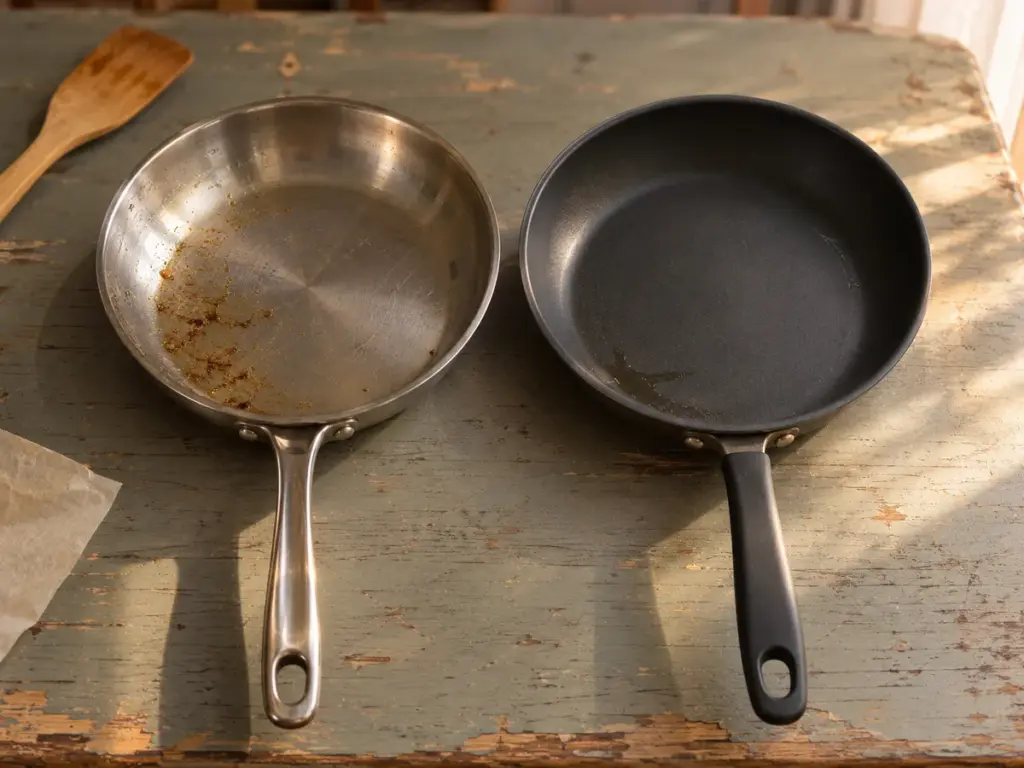
Yes. All-Clad's HA1 Expert and NS Pro collections are nonstick, and its nonstick page rates both oven safe to 500°F. The 10-inch HA1 fry pan is hard-anodized aluminum with a stainless-steel base, so you can use it on induction, and its page says the pan contains PTFE for its nonstick properties.
That gives you two closest pairs: Anolon Advanced Home against All-Clad HA1 for nonstick, and All-Clad D3 against Anolon Clad Stainless for stainless. All-Clad lists the HA1 pan as designed in Canonsburg and made in China, while it says the D3 Everyday pieces are assembled in Pennsylvania.
3. Which Pan Sears and Browns Better?
Searing Chicken and Steak
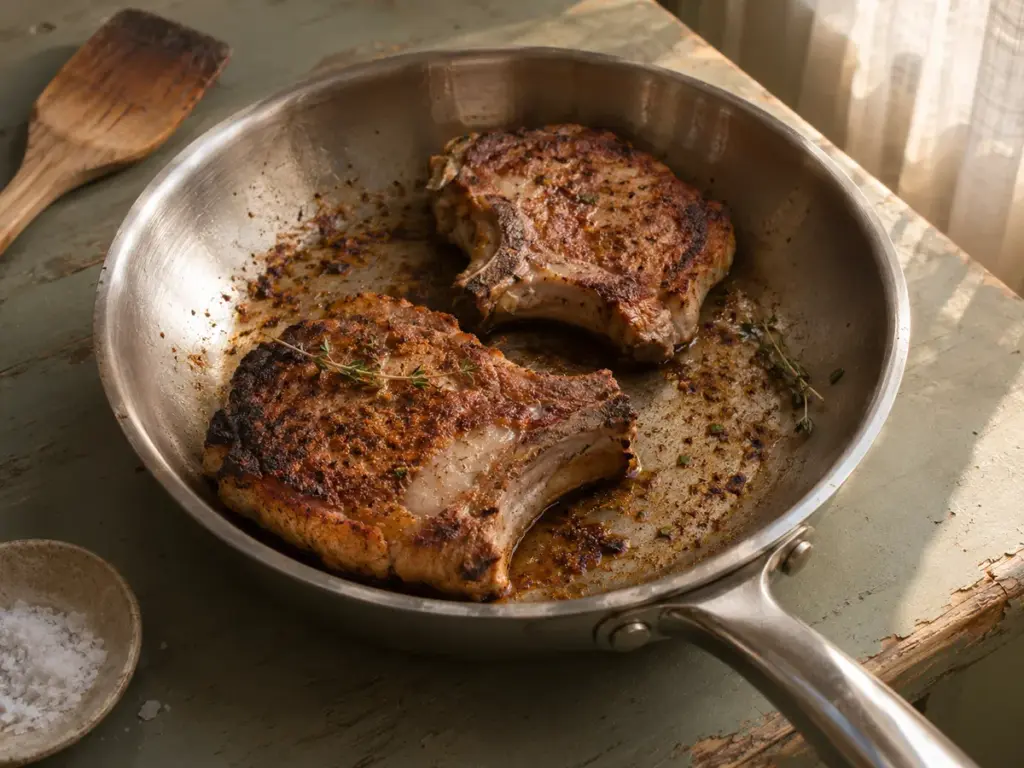
All-Clad's stainless wins here. A stainless pan lets the meat's surface stick briefly and brown hard, and it releases on its own once the crust forms. A nonstick coating is made so food slides, and a deep crust needs the food to grip the pan for a moment, so the two work against each other.
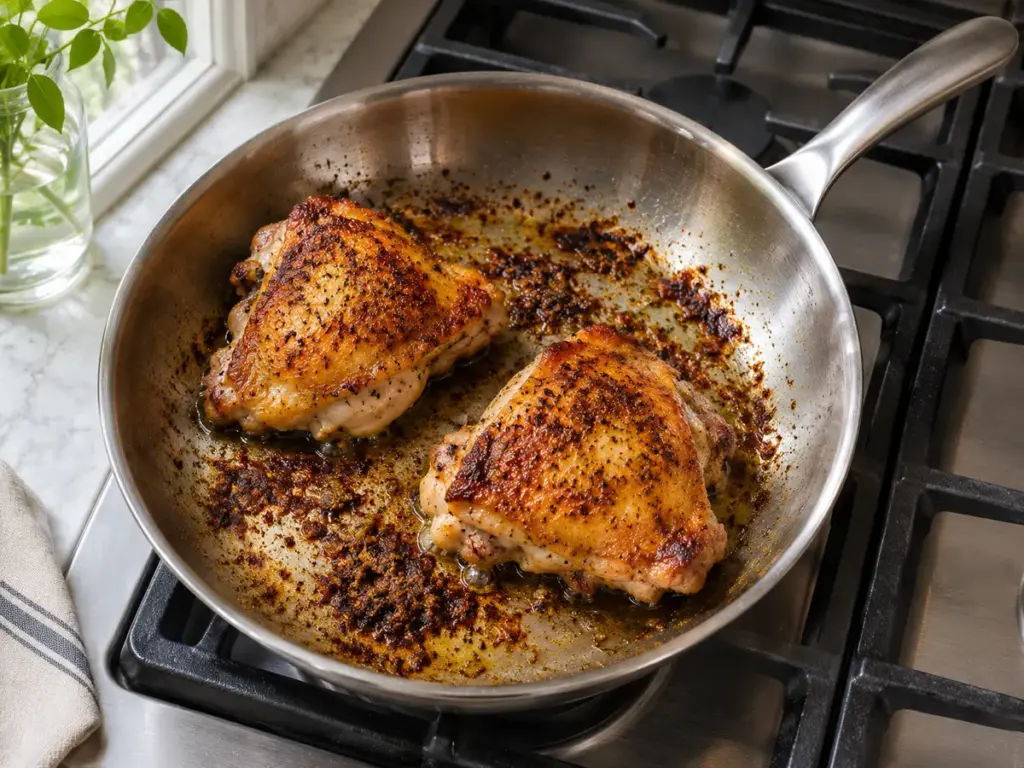
- Preheat dry. Heat the empty stainless pan on low to medium heat until a drop of water dances around.
- Add the fat. Pour in a thin layer of oil and let it shimmer before the food goes in.
- Leave it alone. Meat that sticks when you first try to turn it has not finished browning, and it lifts easily a minute later.
- Deglaze. Pour stock, wine or water into the hot pan to dissolve the browned bits.
All-Clad's D3 Everyday skillet page gives the same order: preheat on low to moderate heat, then add enough oil to cover the surface and put the food in when a faint vapor rises from the oil. It says food is ready to turn when it no longer sticks, and that high heat is for boiling only.
Salt can pit the steel, so the page says to add it after liquids boil or once the food starts to cook. It also says not to leave an empty pan on a hot burner.
Pan Sauces From the Browned Bits
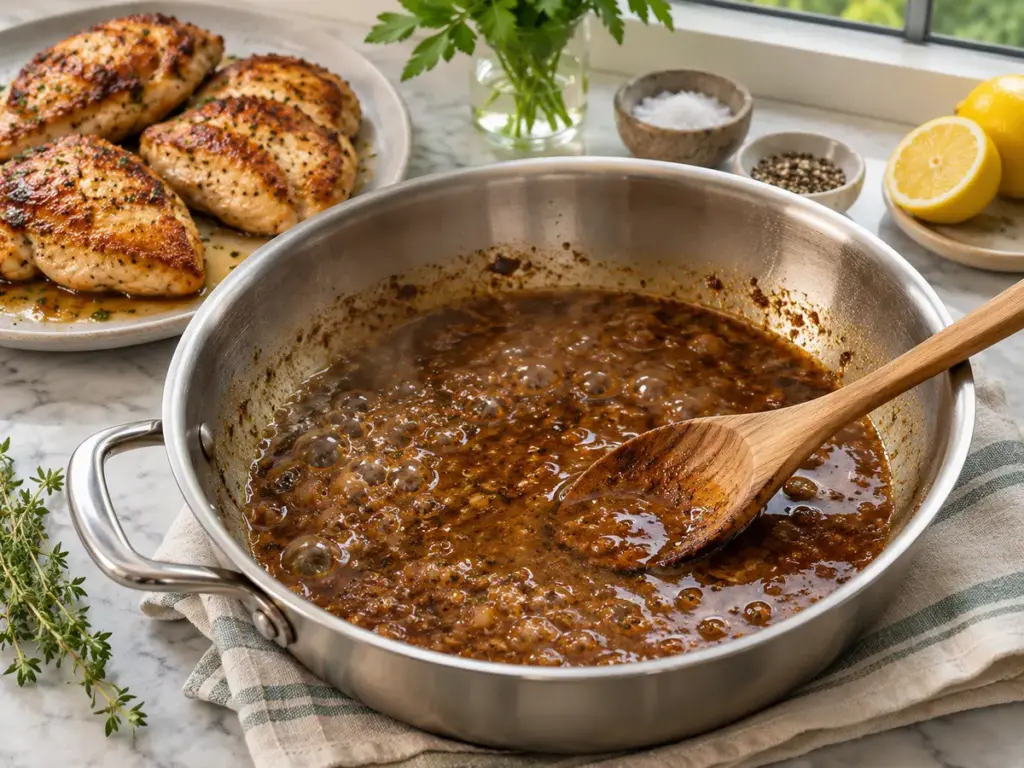
The brown film that sticks to stainless after searing is called fond, and it is the base of a pan sauce. Stainless builds plenty of it, while a nonstick pan leaves little behind to dissolve into the liquid, so a sauce made in one tastes thinner.
4. Which Pan Is Better for Eggs, Fish and Pancakes?
Eggs and Pancakes
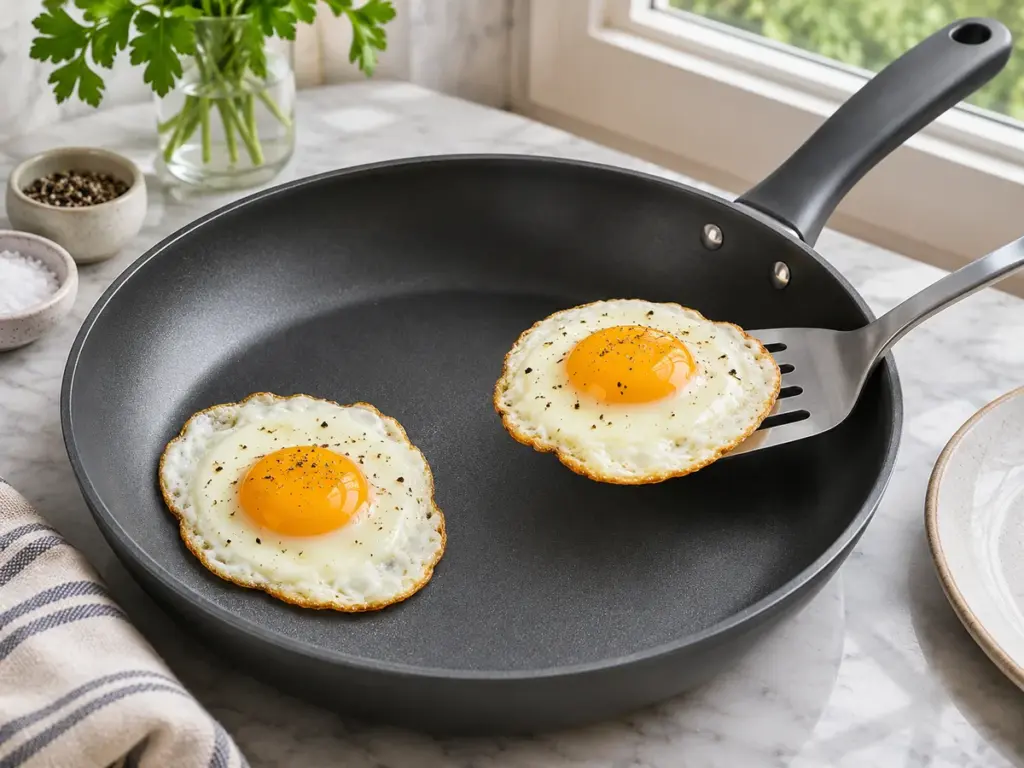
Anolon's nonstick surface is the easier tool for eggs. A fried egg or a thin pancake slides out with a spatula, and you can cook it with only a little oil. A stainless pan can fry eggs too, but you need a hot, well-oiled surface and a patient hand.
Delicate Fish
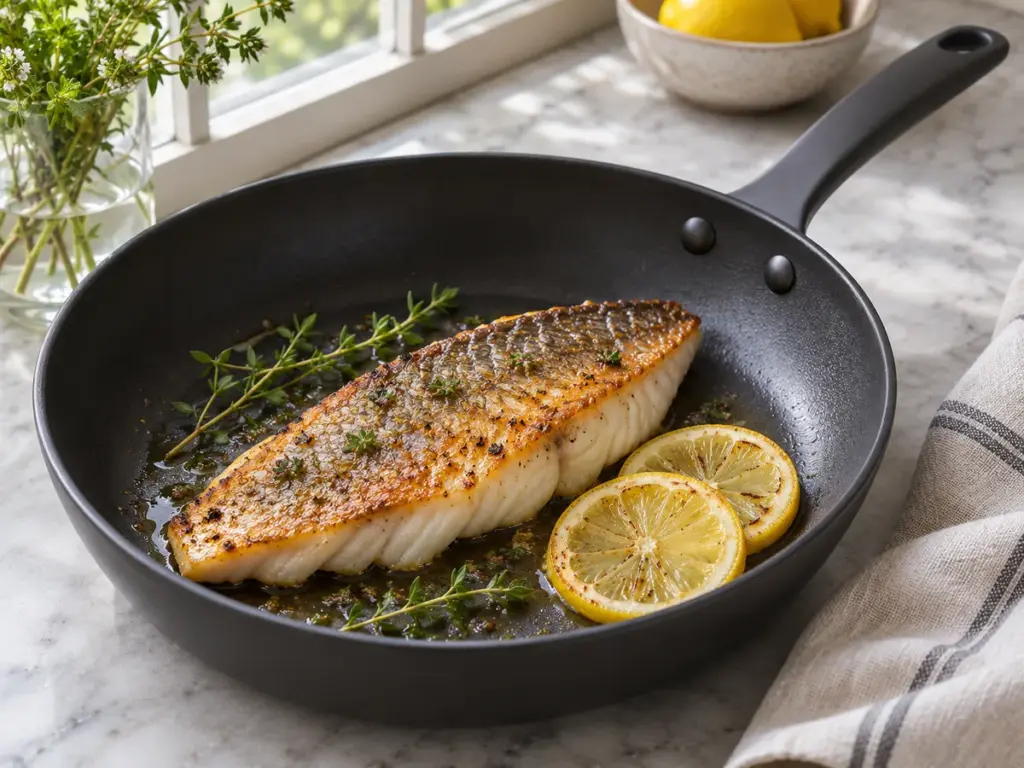
Thin fillets of sole, tilapia or flounder tear easily when they grab onto bare steel. In a nonstick pan, the fillet stays whole when you turn it, and cleanup takes a wipe. A thick salmon or snapper fillet skin-side down does fine in stainless once the pan is hot.
Anolon labels its Hybrid Nonstick and carbon steel lines metal utensil-safe on its site, and its pages say nothing about metal utensils for Advanced Home, so use wood or silicone on that line. Anolon also lists a Clad Ceramic line with a ceramic nonstick interior, and the ceramic versus classic nonstick question is the one to settle before you pick that line.
5. How Evenly Do the Pans Heat?
Each build puts aluminum or copper between your food and the flame, and each maker describes its own layers. The pages list no heat-up measurements, so these are maker claims, not test results:
- All-Clad D3: "a thick aluminum core quickly conducts heat."
- All-Clad G5 Graphite Core: heats "with extraordinary speed" and is described as lighter in weight.
- All-Clad Copper Core: five-ply bonding with copper and aluminum.
- Anolon Nouvelle Copper: a five-ply clad copper base "for exceptional heat conduction."
- Anolon X Hybrid: keeps oil "centered for better caramelization."
You can pick among All-Clad lines mostly on looks and weight. All-Clad says D5 Brushed performs the same as D5 Polished and differs in its matte, slightly textured finish.
6. How Do They Compare on Oven Use and Induction?
That 600°F limit means an All-Clad skillet can go from the stovetop into a hot oven to finish a thick chop or a frittata. The magnetic stainless exterior also makes D3 and D5 compatible with induction cooktops, so they suit a kitchen you may rebuild later.
Pan shape matters on induction too. All-Clad says its square and rectangular pieces have no stainless steel base and are not induction compatible, and it names the HA1 square griddle, double burner griddle and roaster among them. The round 10-inch HA1 fry pan is not on that list.
Anolon's 14.5-inch Advanced Home open skillet lists a 400°F oven limit and says it is not induction suitable and not dishwasher safe. Other Anolon lines differ, so read the spec for your exact pan before you move it into a hot oven or onto an induction hob.
7. How Hot Can You Run a Nonstick Pan?
The coating sets the limit on a nonstick pan, and the maker's own words are the safest guide. All-Clad says nonstick pans suit delicate foods and low to medium heat, and its HA1 page adds a stricter rule.
Anolon's Advanced Home pages give no stovetop heat figure, so follow the care card in the box. Until you have read it, medium heat and a little oil is the cautious habit on any PTFE pan.
The same page recommends plastic, nylon, silicone or wooden utensils and warns that metal can scratch the coating. Stainless has no coating to scratch, so it takes the high heat that would ruin a nonstick pan, which is why you can preheat it dry as in the steps above.
8. How Do the Handles, Lids and Rims Compare?
All-Clad says the D3 Everyday line has redesigned double riveted stainless handles that are more comfortable and stable, plus drip-free pouring rims. Its sets come with stainless or glass lids, and most pieces take interchangeable lids.
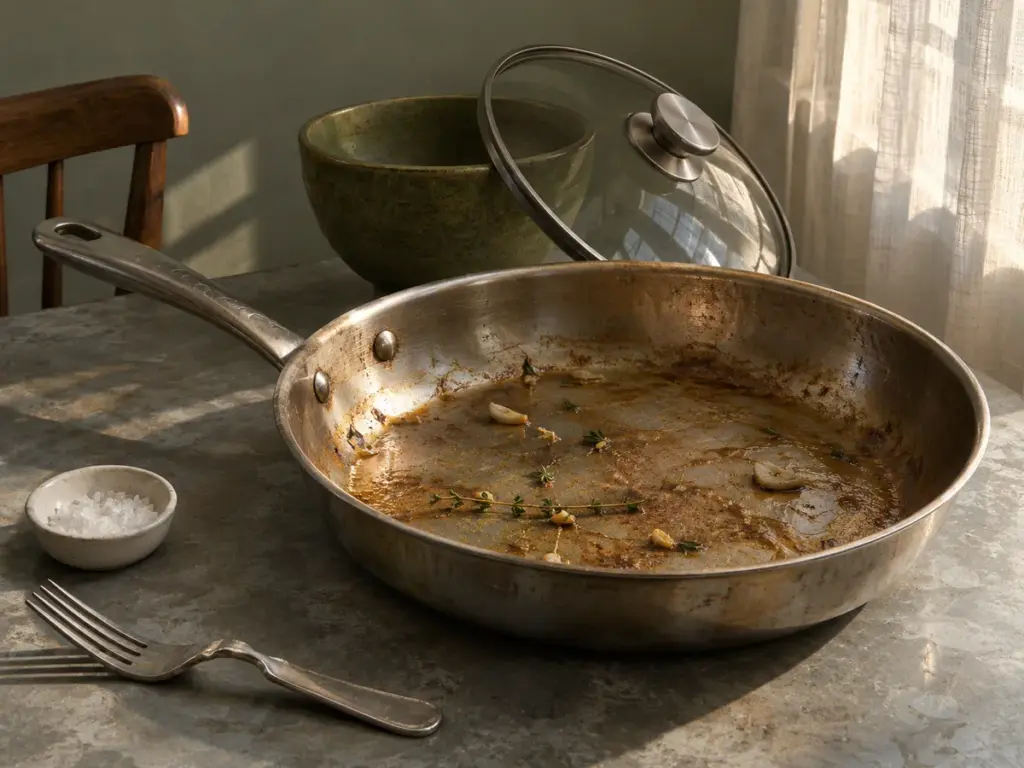
Glass lids stop at 350°F while the pan is rated to 600°F, so a skillet that goes under a hot oven loses its lid first. Anolon lists SureGrip handles on its Advanced Home pans, and the 14.5-inch open skillet page puts the oven limit at 400°F.
9. How Do You Care for Each Pan?
- Hand wash with soap, a sponge and a nylon pad for stuck-on bits
- Dry it right away to avoid water spots
- Skip oven cleaner, steel wool and bleach
- Hand wash with a soft sponge
- Use wood or silicone tools on Advanced Home pans
- Keep the heat at medium or lower
- Open skillet: 400°F oven limit, not dishwasher safe
All-Clad also says to let the pan cool before cleaning, then wash it in warm soapy water with a non-abrasive sponge. For stubborn residue or discoloration, it points to a stainless-steel cleaner that restores the shine.
The D3 Everyday page lists a fix for each common mark:
- Burnt food: simmer baking soda and water in the pan, then loosen the residue with a wooden spoon.
- Stubborn marks: a non-abrasive, non-chlorine cleanser such as Bar Keepers Friend or Bon Ami.
- Blue or rainbow tint: wipe with white vinegar.
- White hard-water spots: boil a 1:1 mix of white vinegar and water in the pan.
The same page says to never put a hot pan under cold water, because it can warp, and to dry the pan right away to prevent spotting. It allows nylon scrubbing pads on stainless only.
All-Clad says hand-washing is recommended to keep the polish, and its D3 Everyday product page lists the pan as handwash only, so check the page for the exact line you own.
Dishwasher rules change by line. All-Clad's 10-inch HA1 nonstick page lists that pan as dishwasher safe, though it still recommends washing by hand to keep it shiny, Anolon says its Clad Stainless line is dishwasher safe, and its 14.5-inch Advanced Home open skillet page lists dishwasher safe as No.
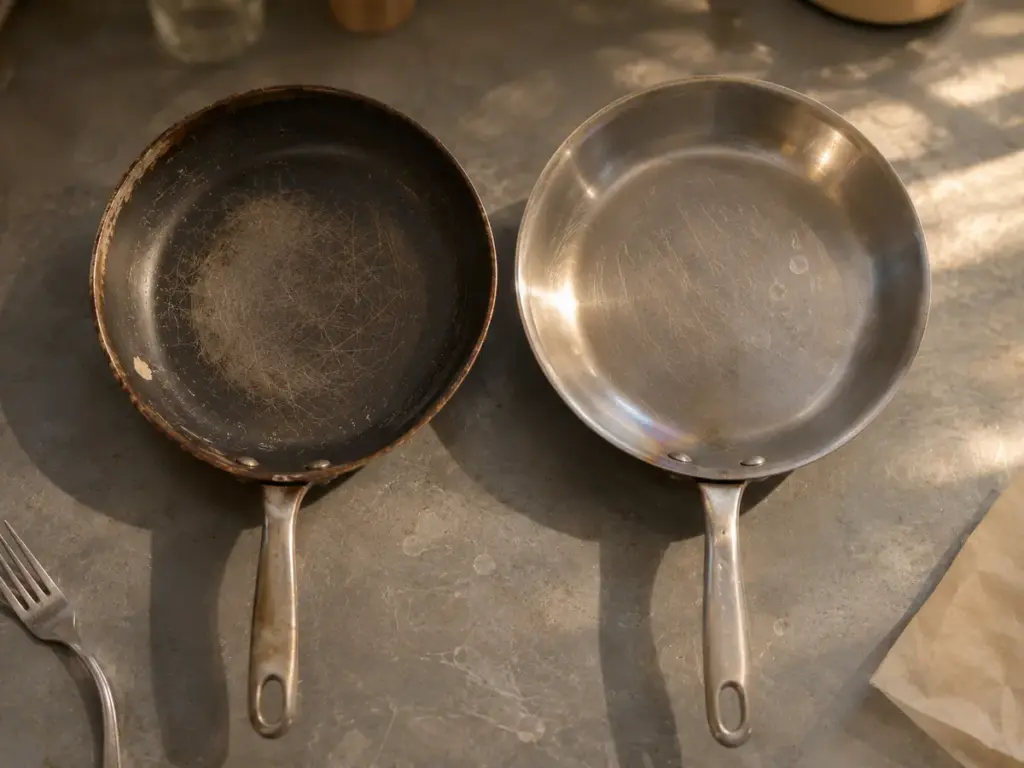
A nonstick coating wears with use, so hang or pad it when you store it. Stainless lasts much longer because the cooking surface is the metal itself, and a stuck-on spot comes off with a soak and a nylon pad.
10. Can You Use One Instead of the Other?
You can, but each swap costs you something.
- Stainless for eggs: preheat the pan, add enough oil, and expect to wipe it clean afterward.
- Nonstick for a hard sear: the crust comes out paler, and high heat shortens the coating's life.
- Nonstick for pan sauce: you get little fond, so use stock and butter for flavor.
- Stainless in a hot oven: fine for D3 up to 600°F, while a nonstick pan needs its own limit checked.
If you love a hard sear but dislike stainless sticking, carbon steel is a third option. You can also set a pan beside cast iron when the oven is the main job.
11. Does Price or Lifespan Decide It?
Prices change by size, color and sale, so what you pay may differ from the brands' own listings on November 17, 2026:
- $79.99 for the 10-inch HA1 nonstick fry pan, with a $64.99 special price showing.
- $149.99 for the D3 Everyday 10.5-inch skillet.
- $179.99 for the D3 Everyday 3-quart saute pan with glass lid.
- $64.99 for the Anolon Advanced Home 12-inch deep nonstick frying pan with lid, and $79.99 for its 10.25 and 12.75-inch frying pan set (Anolon collection page).
Inside one brand, the nonstick fry pan lists for just over half the price of the similar-size stainless skillet. A nonstick coating wears with use, so the cheaper pan may be the one you buy twice.
When Should You Replace a Nonstick Pan?
The Singapore Food Agency says to replace a nonstick pan once the coating shows excessive scratches, peeling, flaking or chipping, and to stop using it after it is damaged.
It also says not to preheat an empty pan, because the pan can reach high temperatures within minutes, and PTFE can start to give off fumes above 260°C (500°F). Run the exhaust fan or open a window, and use an uncoated metal pan for high heat.
Both brands attach a limited lifetime warranty to their cookware. The product pages print no terms, so read the warranty document before you assume a worn nonstick coating is covered.
12. Which Should You Buy?
- You cook eggs, pancakes or fish most mornings
- You want a pan that needs only a wipe afterward
- You cook on medium heat and use soft tools
- You sear meat and make pan sauces
- You move pans from the stove to a hot oven
- You cook on induction and want a pan that outlasts a coating
Many kitchens end up with one pan of each kind: a stainless skillet for browning and a nonstick skillet for eggs. Buy the piece you reach for most. If nonstick is your choice, Anolon or Calphalon is the closer brand decision, and if you want stainless, you can also weigh All-Clad against Wolf's cookware.
Sources
- All-Clad, D3 Everyday Saute Pan product page: construction, 600°F and 350°F lid limits, induction, handwash, warranty, Canonsburg assembly.
- All-Clad, D3 Everyday collection: 18/10 interior, aluminum core, magnetic exterior, care.
- All-Clad, Stainless lines: D3, D5 and Copper Core layers.
- All-Clad, HA1 Expert 10-inch nonstick fry pan: PTFE, 500°F, induction, utensils, heat rules, made in China, price.
- All-Clad, nonstick cookware: low to medium heat, 500°F for NS Pro and HA1, induction rule.
- All-Clad, D3 Everyday 10.5-inch skillet: price, 600°F, handwash, surface area, preheating, oil and salt tips, cleaning fixes, warranty.
- Singapore Food Agency, safe practices for non-stick pans: PTFE fume temperature, empty-pan preheating, when to replace.
- Anolon, home page: collections, hard-anodized claim, warranty, metal utensil-safe lines, Clad Stainless dishwasher claim.
- Anolon, Advanced Home collection: hard-anodized nonstick description, frying pan and set prices.
- Anolon, Advanced Home 14.5-Inch Open Skillet with Helper Handle: 400°F oven limit, not induction suitable, not dishwasher safe, limited lifetime warranty.
- Meyer, About Us: Anolon among Meyer's cookware brands.

Food writer at GustoMeadow. Writes ingredient substitutes, food comparisons, taste guides and storage guides for home cooks.
Storage and food-safety numbers follow USDA, FDA and university extension guidance.



