
Split peas are not lentils. They are dried peas, skinned and halved, and they melt into a thick purée, while whole lentils keep their shape.
- Neither needs soaking, but split peas simmer 25 to 40 minutes and whole lentils 15 to 20.
- Split red lentils cook in 5 to 7 minutes and are the closest swap.
- Split peas collapse in a salad, so use lentils there.
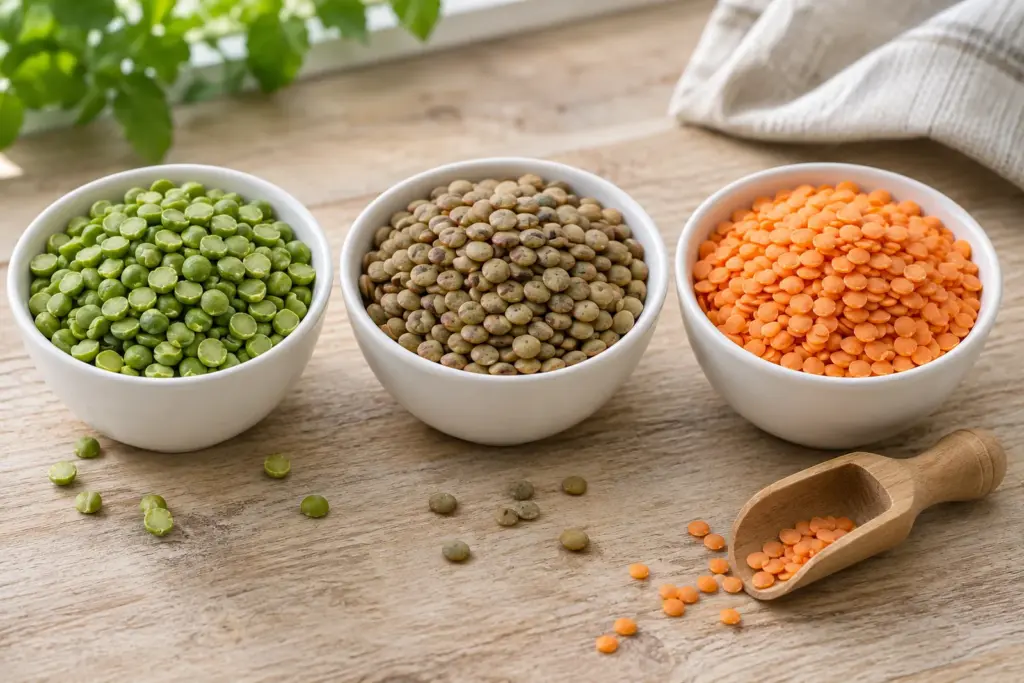
Split peas and lentils sit on the same grocery shelf, so it is easy to grab the wrong bag. You can tell most of them apart by eye, which makes this one of the simpler dried legume comparisons: a split pea is half of a round seed and a lentil is usually a small whole disc. The harder part is knowing what each one does once the water is hot.
1. Are Split Peas the Same as Lentils?
No, split peas are not lentils. Split peas are dried field peas (Pisum sativum) with the skin removed and each pea split in half, according to Illinois Extension. Lentils come from a different plant, Lens culinaris, and most stay whole with the skin on.
Pulses.org defines pulses as the dried seeds of legumes, and peas and lentils are two of its four everyday groups, next to beans and chickpeas. That shared family is why they sit side by side in the store. Neither needs an overnight soak, according to Illinois Extension, NDSU Extension and Lentils.org.
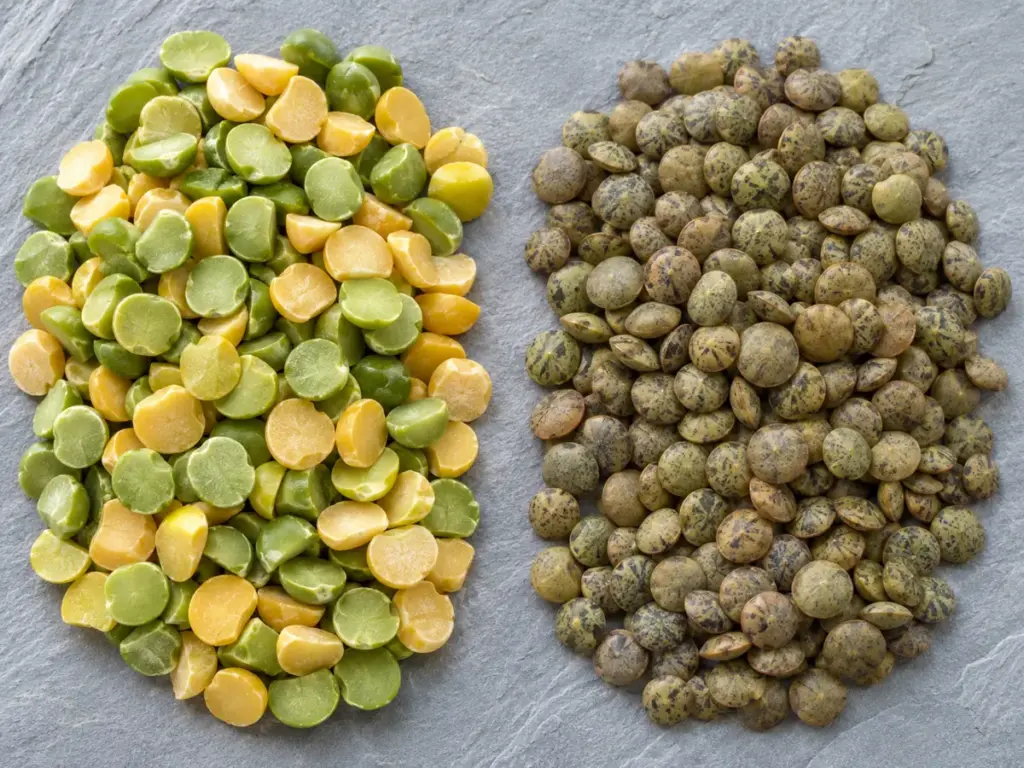
Colors cause most of the mix-ups, so match each look-alike pair:
- Green split peas and green lentils: the pea is a flat-sided half with no skin, and the lentil is a whole disc.
- Yellow split peas and yellow lentils: both are halves, so shape no longer helps. Read the bag for "peas" or "lentils".
- Orange-red lentils: Pulses.org lists red and yellow lentils as split lentils, which is why they resemble yellow split peas.
2. What Is the Difference Between Split Peas and Lentils?
Two things change what ends up in your bowl: how long the seeds take and what shape they keep. This table lines the two up at the stove:
| Trait | Split peas | Lentils |
|---|---|---|
| Plant | Pisum sativum (field pea) | Lens culinaris |
| Shape | Flat-sided half, skin removed | Small disc, skin on (red sold split) |
| Colors | Green or yellow | Green, brown, red, yellow or black |
| Simmer, unsoaked | 25 to 40 minutes | 15 to 20 minutes whole, 5 to 7 split red |
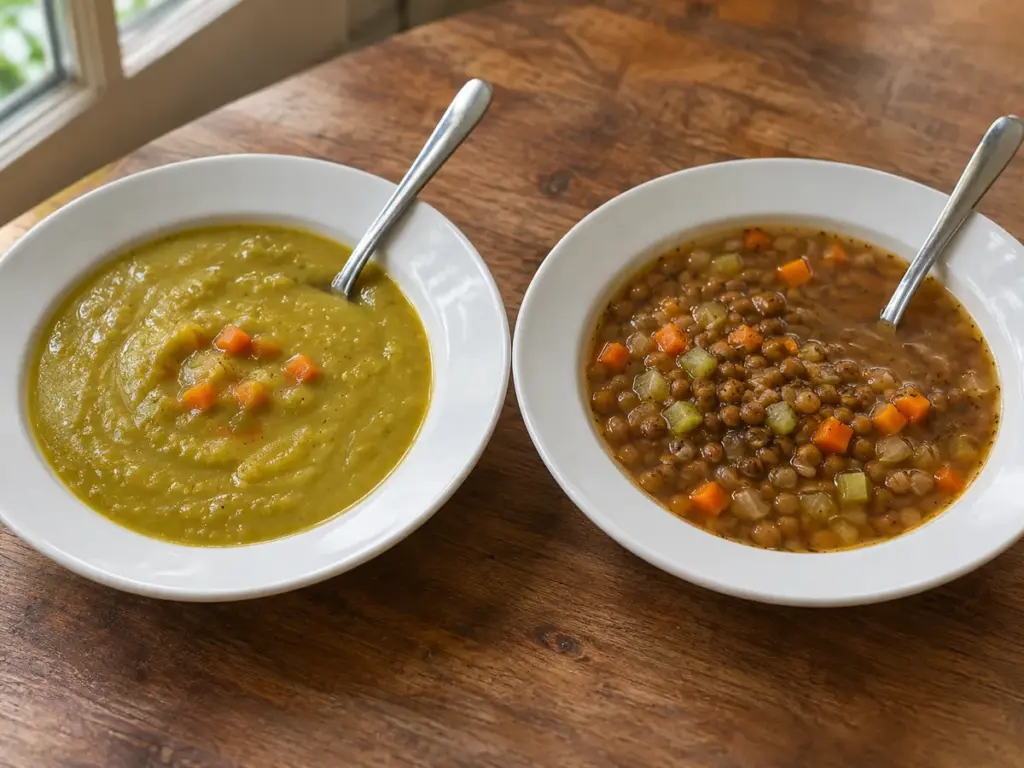
| After cooking | Thick purée | Whole lentils keep their shape |
Split red lentils break the pattern. They are halved like peas, but they cook in minutes and fall apart even faster, so you can treat them like split peas in a hurry.
3. Why Do Split Peas and Lentils Cook So Differently?
A pea changes once it loses its skin and gets split. Illinois Extension notes that split peas cook faster because they are split, so you will see the starchy halves keep softening until they fall apart in the pot. A lentil keeps its skin, and the USA Dry Pea and Lentil Council's lentil guide says whole lentils retain their shape better when cooked.
- Split peas: 25 to 40 minutes at a simmer. Illinois Extension simmers 1 cup of peas in 2 cups of water for about 25 minutes, and NDSU Extension gives 30 minutes in its cooking table and 35 to 40 in its text.
- Whole lentils: 15 to 20 minutes, with 2½ cups of water per cup of lentils (NDSU Extension) or 3 cups of liquid (Lentils.org).
- Split red lentils: only 5 to 7 minutes, and they blend into sauces, soups and purées (Lentils.org).
Published clocks disagree. Pulses.org simmers brown and green lentils 35 to 45 minutes until tender and gives red and yellow split lentils 10 to 15 minutes alone and 15 to 30 in soups, and NDSU Extension points out that the dryness of pulses varies. Taste a few seeds near the low end of each range, and let a soup pot run longer than a salad batch.
4. How Do You Cook Split Peas and Lentils?
- Sort and rinse the seeds, and pick out any stones.
- Measure the water: 2 cups per cup of split peas, 2½ to 3 cups per cup of lentils.
- Simmer and taste near the low end of the time range.
- Salt lentils last, once they are tender.
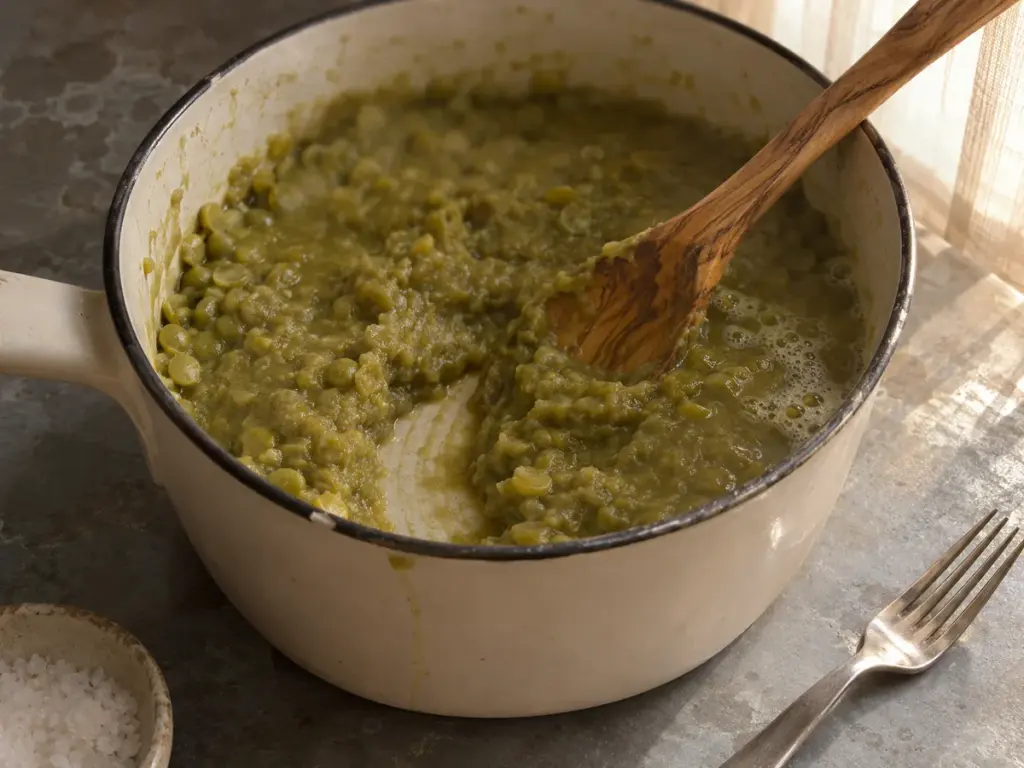
- Yield: 1 cup of dry lentils makes about 2½ cups cooked, and 1 cup of dry split peas about 2 cups (NDSU Extension).
- Slow cooker split peas: 3 to 4 hours on low or about 2 hours on high, with no pre-soak (Illinois Extension).
5. Which Types of Lentils Are There?
"Lentils" covers several seeds that cook very differently, so the type decides whether a lentil acts like a split pea. These descriptions come from Pulses.org:
- Brown: the most common lentil, and it holds its shape when cooked.
- Green: a more robust, slightly peppery flavor, and it also keeps its shape.
- French green (Puy): dark, bluish-slate-green with a rich, peppery flavor, simmered 20 to 30 minutes.
- Black (beluga): tiny, shiny and black when cooked, simmered 25 to 30 minutes.
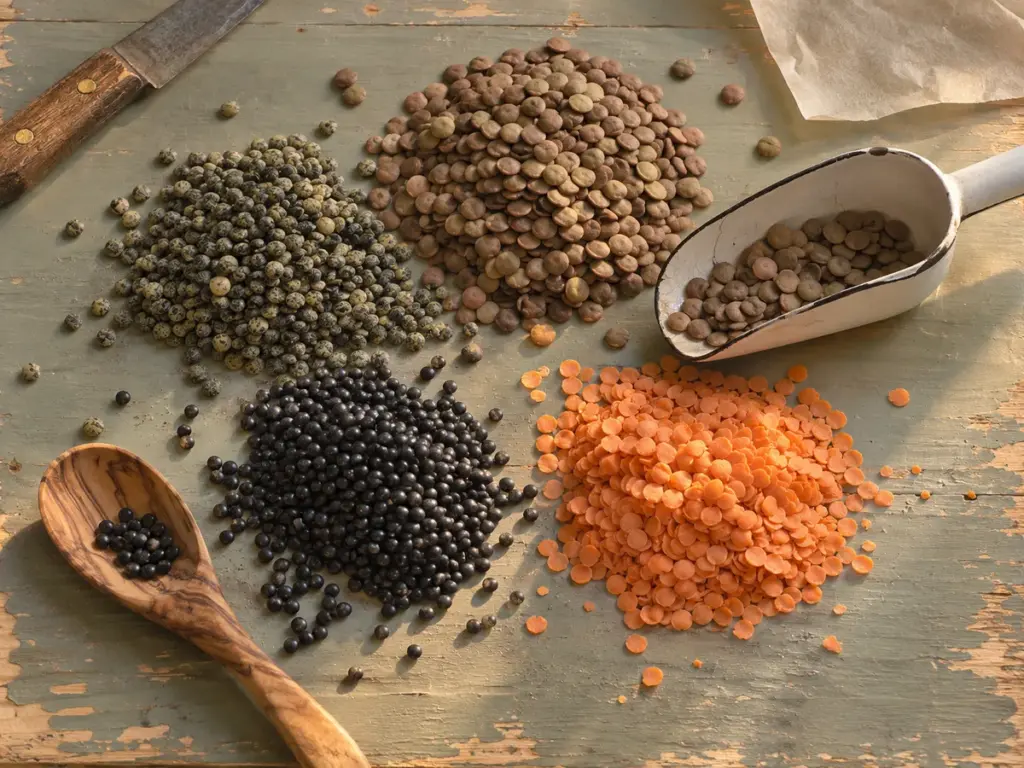
- Red and yellow split: golden yellow to orange and red, and they tend to disintegrate as they cook.
That makes the split versus whole difference easy to remember. Lentils.org says whole lentils still have their seed coat, which is why they hold up, while split red lentils suit sauces, soups, stews and purées. If a recipe says "lentils" and you want a pot that tastes like split pea soup, the split red or yellow ones are the match.
6. Do Split Peas and Lentils Taste Different?
Flavor is the smaller gap. Illinois Extension says green split peas are sweeter than yellow ones, while Pulses.org calls green split peas more earthy and yellow ones milder and more neutral. Yellow split peas are the kind Illinois Extension names for Indian dal.
Lentils vary more by color: red lentils taste mildly sweet and nutty, brown ones earthy and green ones peppery, as laid out in how each lentil color tastes. In a pot with onions, broth and spices, texture is what you notice first: a creamy spoonful from split peas, or separate seeds from whole lentils.
7. How Do Split Peas and Lentils Compare on Nutrition?
Both are good sources of plant protein and fiber. These USDA numbers are for 100 grams of boiled seeds without salt, about half a cup:
| Per 100 g, boiled | Split peas | Lentils |
|---|---|---|
| Calories | 118 kcal | 116 kcal |
| Protein | 8.34 g | 9.02 g |
| Fat | 0.39 g | 0.38 g |
| Fiber | 8.3 g | 7.9 g |
| Iron | 1.29 mg | 3.33 mg |
| Folate | 65 µg | 181 µg |
| Potassium | 362 mg | 369 mg |
You will see the two land nearly level on calories, fat, fiber and potassium. Lentils carry about 2.6 times the iron and nearly 3 times the folate, plus a little more protein, so lean toward lentils if those nutrients matter to you. Split peas edge ahead on fiber, but 8.3 grams against 7.9 grams will not change your meal. Both sets of figures come from the USDA's mature-seed entries (FDC 172429 and FDC 172421).
A real bowl is closer to a cup than to 100 grams, so these amounts scale the USDA figures by the USDA cup weights (196 g of split peas, 198 g of lentils) and compare them with the FDA Daily Values, per boiled cup:
- Iron: lentils 6.6 mg (about 37% of the 18 mg Daily Value), split peas 2.5 mg (about 14%).
- Folate: lentils 358 µg (about 90% of 400 µg DFE), split peas 127 µg (about 32%).
- Fiber: split peas 16.3 g (about 58% of 28 g), lentils 15.6 g (about 56%).
- Protein: lentils 17.9 g, split peas 16.3 g.
These per-cup amounts are arithmetic on the USDA data, not a separate USDA listing. In the dry bag the order is the same: USDA lists 24.6 g of protein per 100 g of raw lentils and 23.1 g for raw green split peas, so lentils stay slightly ahead either way (FDC 172420 and 172428). Raw and boiled numbers do not compare with each other, because boiling adds water.
8. Can You Use Split Peas Instead of Lentils?
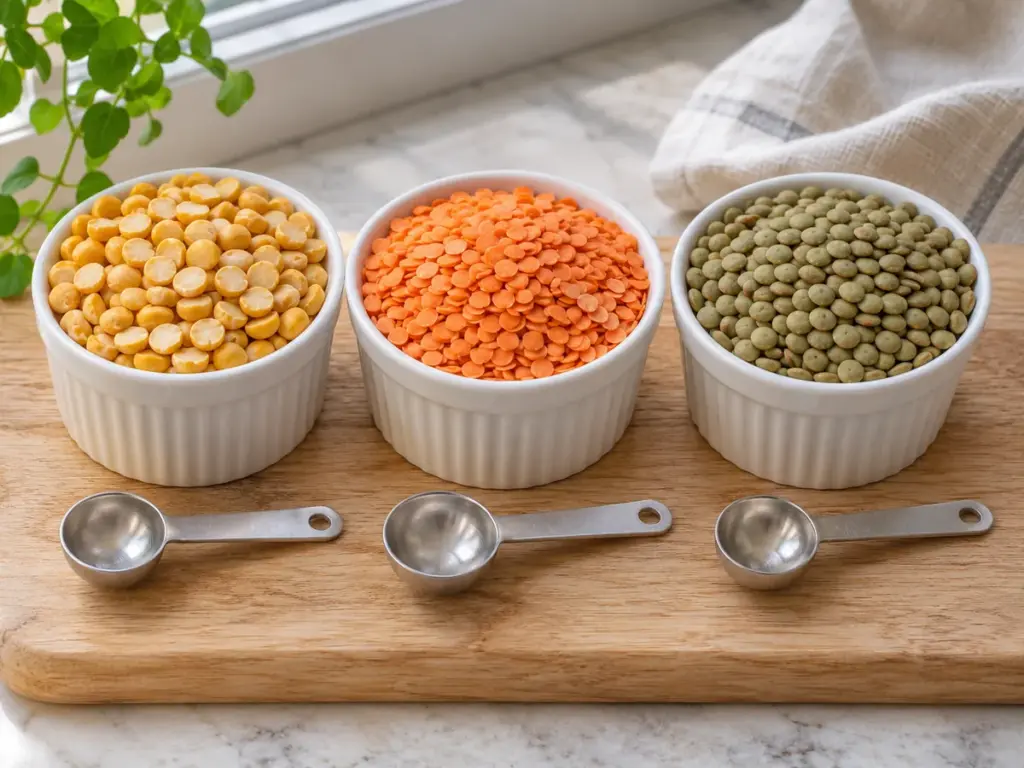
Yes in soup, no in a salad. Start with the same volume of dry seeds in a soup or stew, then change the simmer time, the water (2 cups per cup of split peas against 2½ to 3 for lentils) and your expectations for texture. Anything that needs separate seeds is where a swap fails.
- Use them in soups for a thicker pot
- Plan on 25 to 40 minutes, not 15 to 20
- Skip them in salads, where the halves collapse into mush
- Split red lentils are closest: 5 to 7 minutes
- Whole lentils keep visible seeds; purée some to thicken
- Simmer whole lentils just 15 to 20 minutes
If a recipe calls for red lentils, split peas are a fair swap for red lentils because both melt into soups and dips, though you will simmer them much longer than the 5 to 7 minutes red lentils need. When you need seeds that stay whole and split peas would collapse, a firm legume such as chickpeas keeps its shape, which is the logic behind several other stand-ins for lentils.
9. Which One Should You Cook?
Pick by what you want the finished dish to feel like in the spoon:
- A thick split pea soup: green split peas, which Illinois Extension says are the usual choice for it. Thyme, bay leaf and parsley are three of the herbs for split pea soup.
- A smoky pot: many recipes simmer the peas with a ham bone, and a ham hock stand-in such as chopped bacon or smoked sausage gives you the same smoky pork flavor.
- Dal or a smooth purée: yellow split peas, the type Illinois Extension names for Indian dal. A side for dal such as rice or flatbread rounds it out.
- A soup where you want to see each seed: whole brown or green lentils, ready in 15 to 20 minutes by the Lentils.org clock, with sides for lentil soup on the table.
- A warm or cold salad, a grain bowl or a side: whole green, brown or black lentils, because they stay round after cooking. Dress them with something sharp, such as a dressing for a lentil salad with lemon and garlic.
- A fast weeknight pot: split red lentils, which need the least time of any option here.
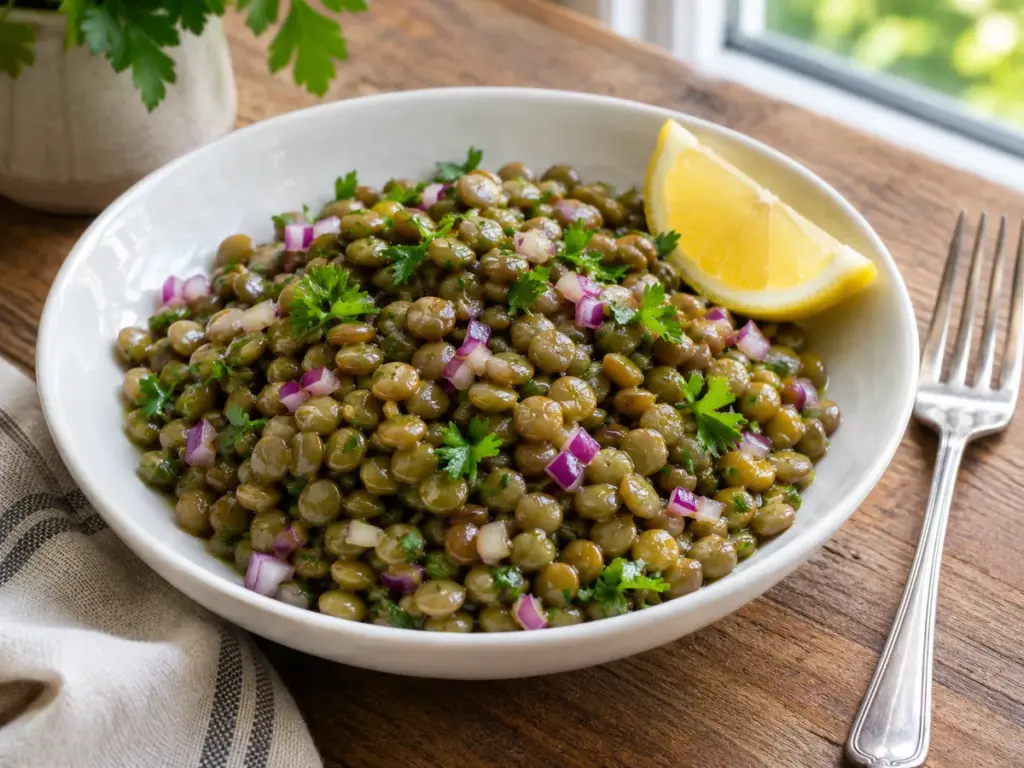
At the store, a bag of peas often says "split" on the label, and a bag of whole lentils names its color. Dried split peas keep 2 to 3 years in an airtight container, according to Illinois Extension.
Sources
- University of Illinois Extension, Split Peas: Are They Peas or Lentils?: what split peas are, green versus yellow, no soaking, 25-minute stovetop time, slow cooker times, 2 to 3 years of storage.
- NDSU Extension, Pocket Guide to Preparing Pulse Foods: water ratios, cooking times, yields, no soaking, variable dryness.
- USA Dry Pea and Lentil Council, Lentils.org cooking guide: no soaking, 15 to 20 minutes whole, 5 to 7 minutes split red, salt after cooking, shape and texture.
- Pulses.org, lentil varieties guide and Visual Guide to Pulses: lentil types, longer simmer times, green and yellow split pea flavor, pulses defined.
- USDA FoodData Central, FDC 172429: split peas, mature seeds, boiled, without salt.
- USDA FoodData Central, FDC 172421: lentils, mature seeds, boiled, without salt.
- USDA FoodData Central, FDC 172420 and FDC 172428: raw lentils and raw green split peas.
- FDA, Daily Value on the Nutrition and Supplement Facts Labels: 18 mg iron, 400 mcg DFE folate, 28 g fiber.
- Montana State University Extension, Enjoy Legumes: raffinose, rinsing and soaking.
Frequently Asked Questions
Are Split Peas or Lentils Easier to Digest?
Montana State Extension does not rank one pulse above the other. It says the gas-causing sugar in beans, raffinose, drops with careful rinsing, and that soaking dried beans overnight and discarding the water removes most of it.
Its raffinose advice, rinsing and soaking dried beans and discarding the water, is written for beans. You can skip the soak with split peas and lentils, as Illinois Extension, NDSU Extension and Lentils.org say.
Can You Cook Split Peas and Lentils in the Same Pot?
Yes, if you stagger them. Split peas need 25 to 40 minutes and whole lentils 15 to 20, so start the split peas first and add the lentils for their last 15 to 20 minutes.
Split red lentils need only 5 to 7 minutes, so they go in near the end and melt into the purée. This timing is worked out from the cook times above, not taken from a published recipe.

Food writer at GustoMeadow. Writes ingredient substitutes, food comparisons, taste guides and storage guides for home cooks.
Storage and food-safety numbers follow USDA, FDA and university extension guidance.



