
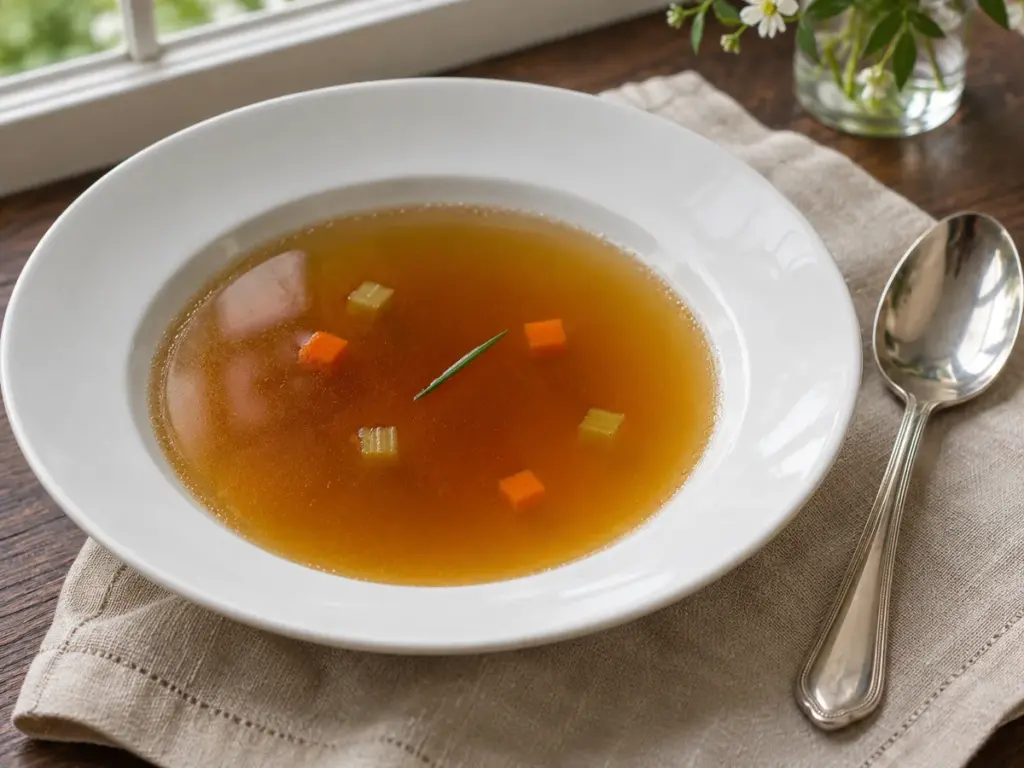
Beef consommé is stock clarified until it is crystal clear and richly flavored, while beef broth is cloudier.
- Cook's Country found canned broth and consommé swap cup for cup with little difference, but taste before you add salt.
- Canned condensed consommé needs one can of water per can.
- Pick consommé when the liquid must stay clear, and broth for everything else.

Beef consommé and beef broth look like close cousins on the shelf, and unlike most look-alike food pairs, they really are related: consommé is made from a finished broth or stock. What you do to that liquid afterward decides how it looks, how strong it tastes and where it belongs in your recipe.
1. What Is the Difference Between Beef Consommé and Beef Broth?
Consommé is broth that has been cooked a second time with a clarifying raft, and that extra step changes its look, strength, body and best uses.
- Starts from a finished stock or broth, simmered again with a raft
- Cooks about 90 to 100 minutes at a bare simmer, then goes through cheesecloth
- Starts from beef, sometimes bones, with onion, carrot and celery in water
- Cooks roughly 1 to 4 hours and is strained once
| Trait | Beef consommé | Beef broth |
|---|---|---|
| Look | Transparent amber | Cloudy brown, with some fat |
| Flavor | Richly flavored, and the raft adds ground beef | Beef, vegetables and water, with no raft |
| Body | Light on the tongue, but it can set to jelly when chilled | Thin, and usually does not gel |
| Best at | Clear soups, jellied dishes, French onion soup | Stews, braises, gravies, grains |
2. How Is Each One Made?
Consommé begins with a stock or broth that already exists, and Food Republic notes that the base is preferably homemade. That is why the difference between consommé and stock comes down to what you do after the first simmer. The classic clarification works in five steps:
- Skim the base. Chill the stock and lift off the fat, because fat clouds the finished soup.
- Mix the raft. Whisk egg whites with lean ground beef and chopped onion, carrot and celery. A little tomato helps, since acid makes the proteins set.
- Add warm stock. The professional method cools boiled stock to 160°F before it goes over the raft, because hotter stock cooks the egg whites before they can catch anything.
- Simmer gently. Heat until it barely bubbles, stop stirring, and hold it for about 90 to 100 minutes, as A Spicy Perspective does. The raft floats up and traps the cloudy particles, and a boil would break it.
- Strain. Rest it 15 minutes, ladle the liquid out through a hole in the raft, and pour it through cheesecloth. Season with salt at the end.

Recipes differ on the details. A Spicy Perspective starts from cold stock instead of 160°F stock and holds a low simmer for 90 to 100 minutes, so the times above are a range, not a fixed rule.
Beef broth skips all of that. You simmer beef, sometimes with bones, plus onion, carrot and celery in water for roughly 1 to 4 hours, strain it once and use it. Tiny proteins and fat droplets stay in the liquid after one strain, which is why broth looks cloudy.
The base you pick changes the result. A stock base carries gelatin from the bones, so the finished consommé can set when chilled. A broth base made mostly from meat has no collagen to give, so it does not gel when chilled.
3. Where Do Stock and Bone Broth Fit In?
Labels use broth, stock and bone broth loosely, so it helps to know what each one is meant to be. Jessica Gavin separates them by ingredients and simmer time:
- Mostly meat, sometimes a few bones
- Simmers 1 to 4 hours
- No collagen, so it does not gel
- Made with bones
- Simmers 2 to 8 hours
- Collagen turns to gelatin, so it feels thicker
Bone broth goes further, at 12 to 48 hours against 2 to 8 for a traditional stock, so more collagen from the bones and connective tissue turns to gelatin. None of the three is consommé by itself. Consommé is any of them after clarification, and cartons blur the line, so go by the ingredient list instead of the word on the front.
4. How Do Clarity, Flavor and Body Compare?
Each difference changes what happens in your pot, so the consequence sits next to the trait:
- Clarity: only consommé is transparent, so it can go into a cup on its own and show off a garnish, while broth would look muddy there.
- Flavor: the raft adds ground beef to the stock, so consommé can taste richer than the stock it started from. That is a reading of the method, not a measured result, and Cook's Country found the two interchangeable apart from salt.
- Body: neither is thick like gravy. Consommé made from a gelatin-rich stock still sets to a wobbly jelly in the fridge, and Saveur has a jellied consommé recipe that chills to a soft set.
- Fat: the base is skimmed of fat before clarifying, while broth keeps tiny fat droplets after one strain, per Jessica Gavin.

Cook's Country makes the same point: restaurant consommé is clarified with a raft of egg whites and ground meat, while the canned kind includes gelatin and other additives to add body.
5. How Do the Nutrition Numbers Compare?
USDA FoodData Central lists canned versions of both, and a cup of either is low in calories and high in sodium. USDA files its condensed record under one name, beef broth, bouillon and consommé, so the first row stands for that whole canned group. The table scales USDA's per-100-gram values to one cup of the prepared or ready-to-serve liquid.
| Per 1 cup | Calories | Protein | Sodium |
|---|---|---|---|
| Condensed broth, bouillon and consommé, 1:1 water (FDC 174557, 241 g) | 29 | 5.4 g | 636 mg |
| Canned beef broth, ready to serve (FDC 171538, 240 g) | 17 | 2.7 g | 893 mg |
| Canned beef broth, reduced sodium (FDC 172889, 219 g) | 13 | 2.5 g | 493 mg |
The condensed record carries about twice the protein of ready-to-serve broth, but 5 grams a cup is still small, so neither one is a protein source. Sodium is the number to watch: against the FDA Daily Value of 2,300 mg, one cup is about 28% for the condensed record, 39% for regular broth and 21% for reduced-sodium broth.
- Home-prepared beef stock: USDA's record (FDC 172883) works out to about 31 calories, 4.7 g of protein and 475 mg of sodium a cup, or 21% of the Daily Value (arithmetic from USDA's per-100-gram values).
- Brand labels differ: Campbell's condensed beef broth lists 810 mg of sodium per ½ cup of condensed soup, before any water goes in.
These are canned products diluted as the label directs, so homemade versions differ, and what you add to a pot changes the total.
6. Can You Use Beef Broth Instead of Consommé?
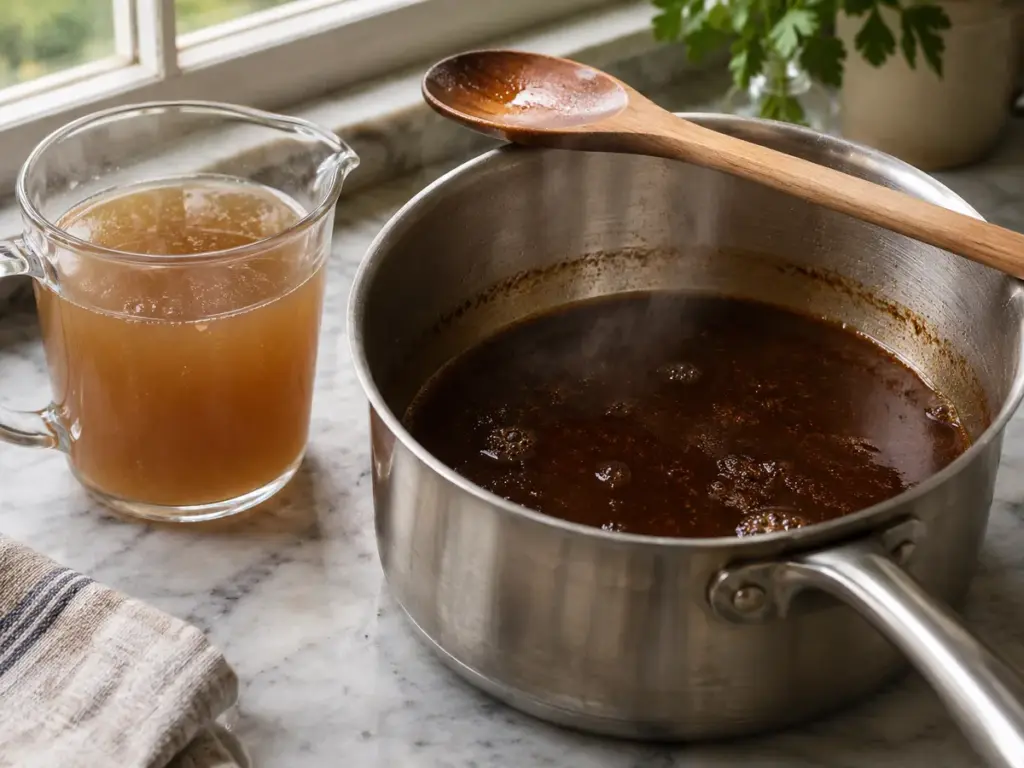
Yes, in most dishes. Cook's Country says you can swap broth for consommé without much difference, save for one element: salt. When a recipe wants consommé's stronger beef flavor, simmering the broth down closes part of the gap, because water evaporates while the flavor stays behind.
| Recipe calls for | Use | Ratio |
|---|---|---|
| 1 cup consommé (soup or sauce) | Beef broth | 1 ⅓ cups, simmered down to 1 cup |
| 1 cup broth | Prepared consommé | 1 cup, unchanged |
- The quarter reduction is a rule of thumb for soups and sauces, not a measured match, so taste as it cooks.
- Condensed means water was removed, and the can's directions add one can of water back, so an undiluted recipe wants a liquid twice as strong.
- Going the other way is simple, but taste before you add salt: Cook's Country reports the commercial consommés were incredibly salty.
Salt is the catch when you reduce. When you simmer a carton of regular broth down, the sodium concentrates along with the flavor, so reduce first, then taste, then season. A reduced-sodium broth gives you more room to do that.
If you are out of both, a dissolved bouillon cube or base works as a beef broth substitute when you follow the label's water amount, and there are other ways to replace consommé too.
7. Which Should You Use for Your Recipe?
- Clear first-course soup in a cup
- French onion soup, as in Campbell's foodservice version
- Aspic-style dishes that must set
- Sauces needing strong beef flavor
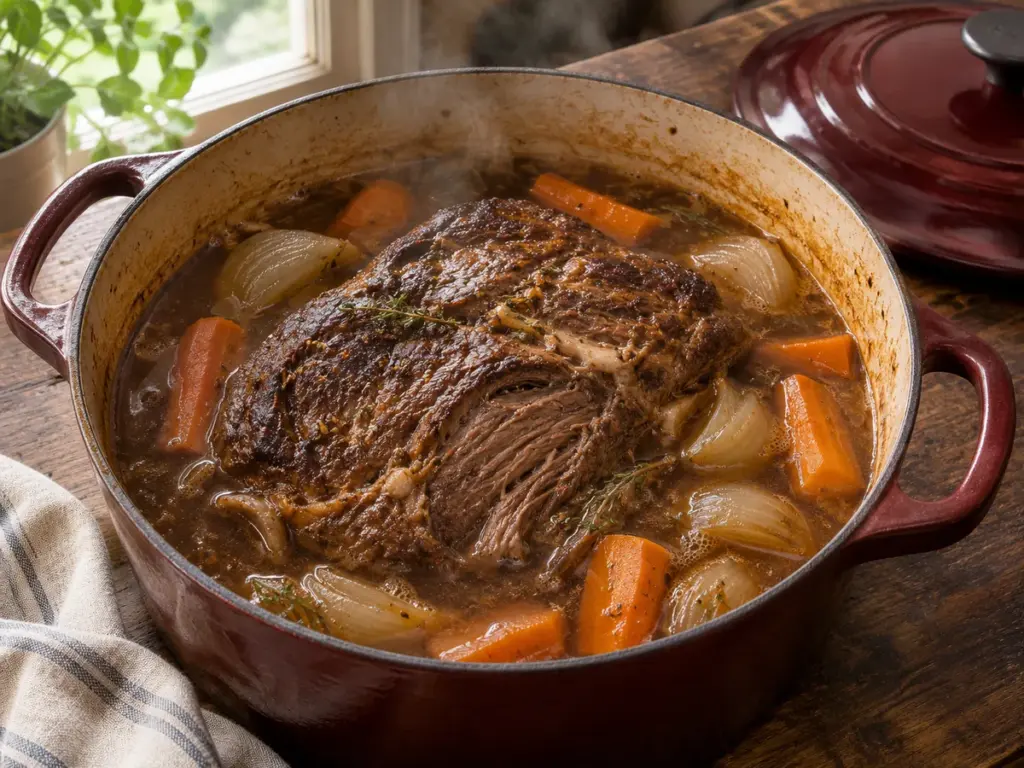
- Pot roast, stew and braises
- Pan gravy and deglazing
- Everyday soups with vegetables, noodles or beans
- Rice, barley or quinoa
Long braises such as beef bourguignon build most of their flavor from the meat itself, so a milder broth is enough as the base. If you make your own stock, collagen-rich cuts such as oxtail or beef shank give it the gelatin that makes a consommé set.
French Dip Sandwiches
French dip is where the choice shows most, because the liquid goes in a cup and is tasted straight. Named recipes go both ways:
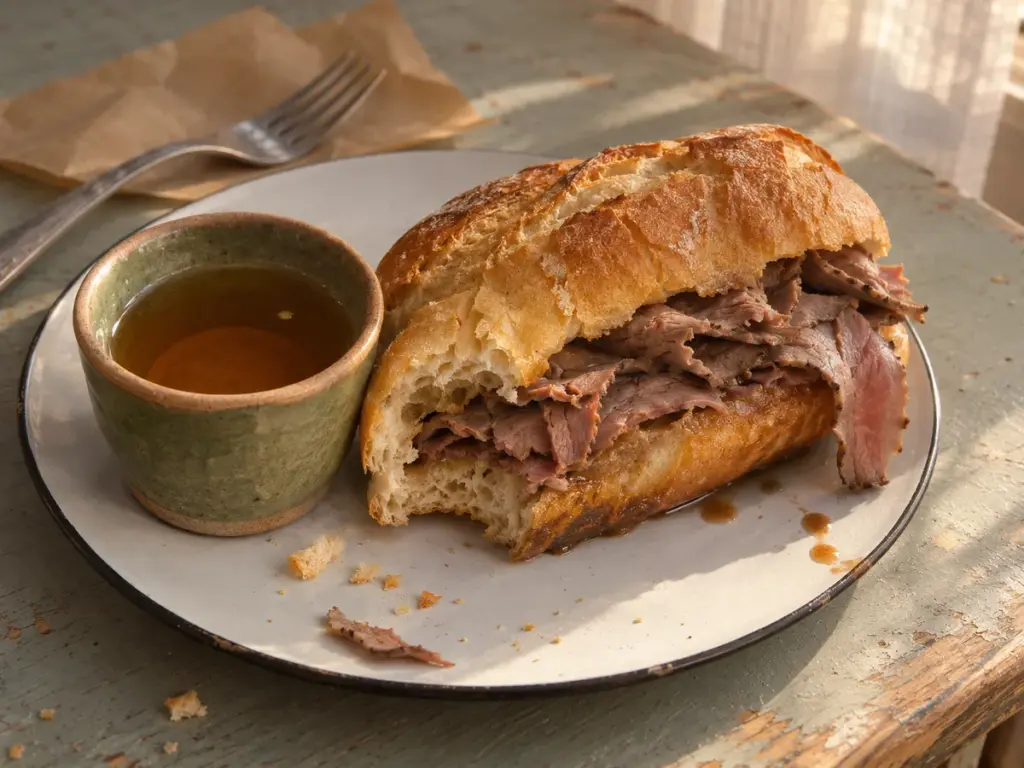
- With consommé: Everyday Cheapskate's 15-minute French dip uses two 10.5 oz cans of Campbell's beef consommé and says not to dilute it, even though the label calls it concentrated.
- With broth: A Cozy Kitchen's French dip makes its au jus from 3 cups of low-sodium beef broth, 1 teaspoon of dry sherry and 2 teaspoons of Worcestershire sauce.
Both start from a ready-made liquid, so either one works. The consommé version uses the can undiluted, and the broth version adds sherry and Worcestershire sauce for depth.
What to Check at the Store
Look at three things before you buy:
- The sodium line. USDA's canned examples run from 493 mg to 893 mg per cup, so a "less sodium" carton is the better choice for anything you will reduce.
- The word "condensed." It means you add water, so one can makes about two cans of soup.
- Gelatin in the ingredients. It matters if you plan to serve the liquid cold, because gelatin is what sets it.
Strength words vary by brand and country. Campbell's condensed beef broth and condensed consommé both say to mix the soup with one can of water, while its Canadian concentrated beef broth takes a 250 mL carton plus 3 cups of water to make 4 cups. Ready-to-use cartons need no water.
Check the allergen line too. Campbell's lists wheat and soy on its condensed beef broth and gluten on its foodservice consommé, so a gluten-free recipe needs a product whose own label says gluten-free.
8. How Long Do Beef Consommé and Beef Broth Keep?
Both follow the same clock once they are open. USDA FoodKeeper lists commercially produced beef broth, stock and consommé at 3 to 4 days in the refrigerator after opening and 2 to 3 months in the freezer, and homemade broth gets the same 3 to 4 days.
- Diluted condensed soup: FoodKeeper gives opened canned soup 3 to 4 days in the refrigerator, so mix only what you will use.
- Bouillon cubes: they keep their best quality for 1 year, and the reconstituted broth lasts 3 to 4 days in the refrigerator.
An unopened carton or can keeps until its package date, so pour leftovers into a clean container the day you open it. Opened beef broth that smells sour, turns slimy or looks cloudier than when you opened it should go in the trash, and so should anything past the 3 to 4 day mark.
Sources
- USDA FoodData Central, FDC 174557 (canned condensed beef broth, bouillon and consommé, prepared with equal water), FDC 171538 (canned beef broth, ready to serve), FDC 172889 (reduced-sodium beef broth), FDC 172883 (home-prepared beef stock).
- USDA FoodKeeper: beef broth, stock and consommé storage times.
- Campbell's Foodservice: Classic Condensed Beef Consommé ingredients and directions.
- Campbell's: Condensed Beef Broth (ingredients, sodium), foodservice directions, and Canadian concentrated beef broth (dilution).
- Cook's Country: Canned Beef Consommé vs. Beef Broth.
- Food Republic: What's the Difference Between Broth and Consommé?
- ckbk: General procedure for making consommés (cooling to 160°F, resting 15 minutes).
- A Spicy Perspective: Easy Beef Consommé.
- Jessica Gavin: Stock vs. Broth.
- Everyday Cheapskate: 15-Minute French Dip Sandwiches; A Cozy Kitchen: French Dip Sandwiches.
Frequently Asked Questions
Can You Drink Beef Consommé on Its Own?
Yes. Food Republic describes consommé as a filtered soup that is ready to eat, usually served at the start of a meal, and says it is eaten with a spoon or sipped. Canned condensed consommé still needs its can of water first, as the directions say.
Which One Is More Forgiving in a Recipe?
Broth, for most cooks. Food Republic notes it is the liquid that routinely serves as a base for soups, stews and gravies, and Cook's Country found the two swap with little difference apart from salt, so check the salt when you swap.

Food writer at GustoMeadow. Writes ingredient substitutes, food comparisons, taste guides and storage guides for home cooks.
Storage and food-safety numbers follow USDA, FDA and university extension guidance.



