
Daikon is a popularly known Japanese traditional dish that's quite widespread in other Asian regions as well.
It's a white-hued root vegetable that is incorporated to enhance and brighten the taste of various meals.
Whether cubed, sliced, or grated, the crunchy veggie boosts the texture and brings a personality and bite to any dish.
So, what is Daikon exactly, and how do we prepare it? Let's explore the world of Daikon Radish and find out what dish we need to bring to the next family gathering.
But first, what does Daikon Radish taste like?
What is Daikon Radish?
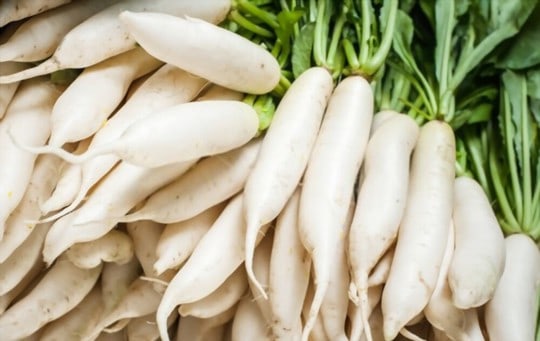
Daikon Radish, also termed as 'winter radish', is a vegetable that's tube-shaped and quite long.
This root vegetable has an incredibly crisp texture, with flavors that are mild.
Although they are found in varying shapes, sizes, and colors, they are most commonly found in white colored with green leaves at their top.
Although the root veggie originates from China, it's widely used in Japan because of the Korean immigrants who migrated there.
The Japanese call it Daikon because of its large size and white hue.
It's been incorporated into Japanese cuisine over centuries to create various sushi dishes, pickles, and as added flavor in soups such as Dashi (soup stock).
Taste is not only its characteristic but also versatility - compare with watermelon radish taste guide to see how color shifts flavor profiles.
Its ability to be eaten raw and cooked with no severe consequences makes it more palatable.
They can grow 50 cm to 1 m in length with tastes that differ according to origins.
However, the Japanese-grown Daikon is one that's much smoother than the rest and heavily refined.
If bright citrus would complement a dish that includes daikon, lemon dessert pairing ideas suggest nine flavors that balance tartness and sweetness.
What Does Daikon Radish Taste Like?
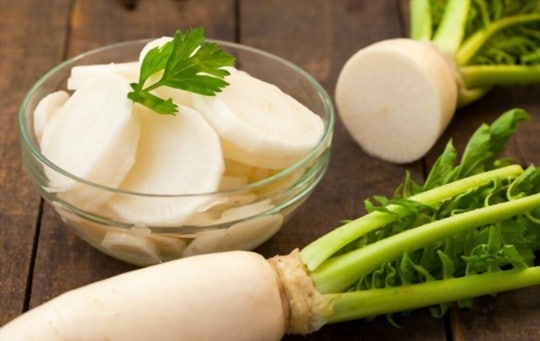
It has a rawness to it that makes the texture pop with a resemblance nearest to that of a scrumptious raw apple.
Its flavor is razor-sharp with a slight hint of bitterness to it.
There is a medium-level tartness or acidity that balances the richness of anything it is added to.
Appearing as if it's a carrot, it's covered in a white shade.
As it is part of the radish family, the Daikon Radish is most commonly described as having a solid radish-y flavoring and fluster texture similar to cabbages.
It is not spicy as people might expect it to be, but because of its bristly astringency, it is described as such.
It is a vegetable that's exceptionally refreshing with a mild flavor, some of them containing an almost tasteless bite.
When cooked, the Daikon Radish is soft in texture but does not become smooth or mushy like a cooked potato or baked pear.
It may lack the bitter flavors it once had when raw, but it will gain a certain level of sweetness.
Many even describe this vegetable as having a similar texture to a cucumber, while others perceive it to be like a zucchini.
It's filled with the same nutrients as a banana or orange, with lots of potassium and vitamin C in its system.
With the excellent level of nutrition, the vegetable contains, the Daikon offers several benefits when it comes to health.
It not only protects against damage to cells but also boosts the healing of any external wound.
As it's a source of vitamin C, the vegetable can also produce collagen at a high rate and help reduce inflammation.
The non-starchy item can also maintain blood sugar in the body to reduce sudden sugar spikes.
How to Serve Daikon Radish?
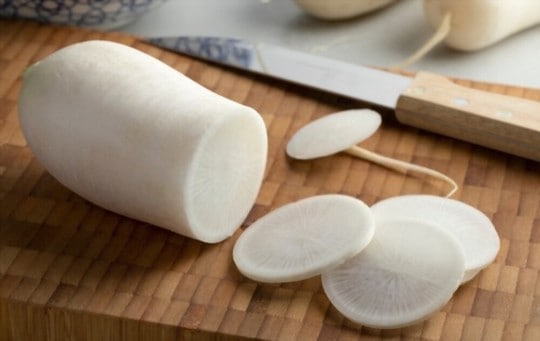
Cooked or raw, Daikon Radish can be served using different methods.
Raw daikon can work exceptionally as part of a salad or slaw side dish.
So if you're looking for a new ingredient to add to your picnic slaw or salad, Daikon thinly sliced or pickled are great options.
Using it in sandwiches is also a great choice too.
Just add it to the combination of carrots, meat, lettuce, and cucumber, and you are good to go.
You can even substitute potatoes when you want to stir-fry it with meat, as the Daikon is starchy and soft, just like potatoes.
If you're vegan, lettuce wraps are filling and low-carb.
Fix the radish with some mushrooms, tofu, and other veggies of your choice, and wrap them up to enjoy a nutritious snack.
For a non-vegan version of this, add some steamed prawns for a light addition of savory flavors, and you're set.
Daikon Radish is quite common in Korean cuisine, and so you can't think of Daikon without experiencing Kimchi.
Fermented cabbages, as well as the pungency from garlic, will turn your dinner for one into a feast.
If wraps and Kimchi aren't your go-tos, you can always incorporate some shredded Daikon into minced meat and make some tasty meatballs for lunch.
For a light finish after a meal featuring daikon, consider single-serve dessert ideas that keep portions tidy and satisfying.
Flavor Profile of Daikon Radish
The mild taste can be familiarised to the taste of cucumbers and cabbages.
It's a great item that can be incorporated in several different recipes all over the world.
So, if you are searching for methods to use such a vegetable within your diet or venturing about new recipes, you can pick the perfect veggie-Daikon.
radish vs beet vs turnip differences helps clarify how daikon compares to similar roots. daikon substitutes and best swaps lists practical alternatives for recipes.
Frequently Asked Questions
It's a white-hued root vegetable that is incorporated to enhance and brighten the taste of various meals. But first, what does Daikon Radish taste like?
This root vegetable has an incredibly crisp texture, with flavors that are mild.
The texture of Daikon Radish depends on how it is prepared. Raw, cooked, and processed forms each offer a distinct mouthfeel that changes the overall eating experience.
Is there a strong smell that comes with the taste?
Aroma and taste are closely linked.
A strong smell usually signals an equally bold flavor.
If the smell is mild, expect a subtler taste that becomes more apparent with seasoning.
Depends on the ingredient. Some improve dramatically with heat, developing sweetness or losing bitterness.
Others are best raw, where cooking dulls the brightness that makes them worth trying.