With so many styles of knives on the market, it can be difficult to decide which type is the best for your needs.
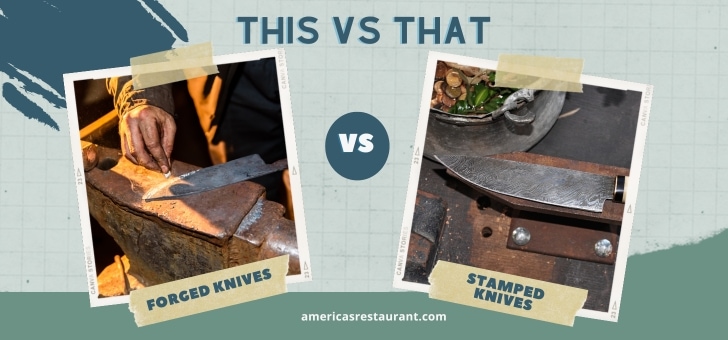
What are Forged Knives?

Forged knives are considered to be higher quality than stamped knives.
They are created by a process of heating, shaping, and cooling the metal blade.
The process is known as forging because the metal is hammered or pressed into its desired shape.
Forged knives tend to have a heftier weight as compared to stamped knives, which can make them more comfortable to use for cutting tasks that require some pressure.
When held in the hand, they often feel well-balanced due to their single piece construction.
The forging process creates tiny air pockets within the steel which helps with food release during cutting.
This makes forged knives especially ideal for slicing meats or fruits with skins.
When properly maintained, forged knives can last for years.
For a sense of complementary flavors in a different context, try lemon dessert pairing ideas and options to see how balancing elements enhances results.
What are Stamped Knives?

Stamped knives are a type of kitchen knife that is manufactured by a completely different process than forged knives.
Unlike forged knives, stamped knives are made using machines and a metal stamping process.
In this process, the blade of the knife is cut out from a large sheet of steel using a hydraulic press or another type of machine.
Stamped knives are often perceived as lower-quality compared to forged knives.
However, they do offer some benefits over their counterpart.
The machine manufacturing process allows for mass production of stamped knives which lowers the cost significantly - this makes them an attractive option for those on budget constraints.
On the downside, stamped knives lack the durability and strength of forged knives because they use thinner steel sheets which can easily bend or warp if not gripped properly.
Also, since they require frequent sharpening, it's best practice not to use harsh dishwasher detergents while cleaning these flimsy kitchen essentials.
Stamped knives serve everyday needs; similarly, simple combinations work well with dips - see guacamole pairing ideas and combos for snack-friendly matches.
Differences Between Forged and Stamped Knives

Forged and stamped knives are two different types of kitchen knives that have distinct differences.
While forged knives are crafted using a traditional method that involves heating and shaping metal, stamped knives are created using a stamping machine that cuts them out of large sheets of steel.
Forged knives tend to be more reliable and long-lasting than stamped knives - see a Miyabi vs Shun comparison guide for how brand and construction affect longevity.
Since they are made from high-quality steel, these knives have thicker blades with a reinforced spine, making them strong enough to tackle even the toughest food items.
On the other hand, stamped knives tend to be thinner with a lighter weight, which makes them easier to use but less durable over time.
Another difference between these two types of knives is their sharpness.
Forged knives tend to hold their edge for longer periods due to their sturdy blade construction.
This means that you may not need to sharpen them as often as you would with stamped knives.
In contrast, while stamped knives need frequent sharpening as they become dull quickly because of their thin blades.
Construction and Durability
Construction and durability are important factors.
The two most common types of knife construction are forging and stamping.
Forged knives are typically more durable than stamped knives because of their high-quality steel and the forging process.
This process involves heating a single piece of steel until it becomes malleable enough to be easily hammered into shape, creating a solid piece with no weak spots or imperfections.
On the other hand, stamped knives are made by cutting out blades from large sheets of steel before being heat-treated and sharpened with machine precision.
While this is an efficient method of mass-producing affordable knives, it results in less durable blades with weaker points along their edges.
In summary, if you're looking for a knife that will last for years to come, investing in a well-made forged knife is likely your best bet.
Sharpness and Edge Retention
The construction method can play a significant role.
Generally, forged knives tend to maintain their sharpness for a longer time than stamped knives - for a look at how edge style changes performance, read the Granton vs straight edge comparison.
This is because of the manufacturing process that they undergo, which involves heating the metal to high temperatures and then compressing it under extreme pressure.
This process creates a denser metal that is more resistant to wear and tear.
While both types of knives can be sharp, forged knives tend to have better edge retention than their stamped counterparts.
However, this doesn't mean that all forged knives are superior in this regard since other factors such as the specific type of steel used also play a role.
In addition to the manufacturing method and type of steel used, individual care also plays a critical role in maintaining a knife's sharpness and edge retention over time.
Regardless of whether your knife is forged or stamped, proper storage and regular sharpening are necessary steps towards making sure optimal performance.
Overall, when it comes to sharpness and edge retention, forged knives tend to be higher performing than stamped knives due to their manufacturing process.
However, other factors such as steel type and individual care should also be considered.
Weight and Balance
Weight and balance are two important factors to consider when choosing a knife.
Forged knives tend to be heavier than stamped knives due to their thicker, denser construction - for another look at when weight matters, see pie weight substitute ideas for baking scenarios where weight changes results.
This added weight can make them feel more substantial in your hand, which some people prefer.
However, it can also make them more tiring to use for longer periods of time.
Forged knives generally perform better than stamped knives.
This is because they are typically designed with a full tang that extends into the handle, providing better weight distribution throughout the knife.
As a result, you may feel like you have more control over the blade when using a forged knife.
On the other hand, stamped knives often have a partial tang or no tang at all, which can affect their balance.
They may feel lighter in your hand as a result, but this could also translate to less precision and control when slicing or chopping.
In summary, if you're looking for a heavier knife with better balance, a forged knife may be the way to go.
But if weight isn't an issue and you prioritize agility over heftiness, then you might prefer a stamped knife instead.
Price
For as long as knives have been used for cooking, there has been a debate of whether to purchase a forged or a stamped knife.
Both types have their advantages and disadvantages, and the price point is certainly one of the most talked-about differences.
When it comes down to it, stamped knives are usually more affordable than their forged counterparts.
This is Because they require much less handwork in their production process.
Stamped blades are cut out from a larger sheet of metal using a machine, whereas forged knives are pounded into shape by hand on an anvil.
To give you an idea of just how much more affordable stamped knives can be, let's take a quick look at some numbers.
In general, high-quality stamped knives can be found for around $30-50 dollars each, while top-of-the-line forged options will set you back several hundred dollars apiece.
Of course, price isn't everything when it comes to purchasing kitchen appliances.
If you're someone who enjoys investing in quality tools and equipment that will last for years and years, then splurging on a set of forged knives could be well worth it in the long run.
Still, not everyone has hundreds (or even thousands) of dollars to drop on high-end kitchen gear.
For those on a budget who still want to get great performance out of their knives without breaking the bank, stamp options will likely be the better choice.
So ultimately, choosing between forged and stamped blades comes down to weighing your priorities: Are you willing to pay extra for expertly crafted tools that will last for generations? Or do you value affordability above all else?
Which One Should You Choose?

The decision ultimately depends on your personal preferences and needs.
To help you make the right choice, let's take a deeper look into the differences between the two.
When deciding which one is best for you, consider factors like how often you use your knives, what kind of tasks you perform with them, and what your budget is.
If you're someone who uses their knives frequently for heavy-duty tasks, opting for a forged knife may be worth the investment due to its durability.
On the other hand, if you are not going to be using your knives as much, or cannot afford an expensive range then stamped knives can still perform adequately while being relatively cost-effective.
While forged knives tend to be more expensive than stamped knives, this isn't always the case.
Some high-end stamped knife brands can be just as costly due to factors like material quality and craftsmanship.
In summary, both options have their merits; stamped knives are great for everyday use without extensive cares while investing in a set of forged blades should only happen if someone frequently cuts or chops food.
Ultimately, it's up to you when it comes down to picking one up from these two methods.
If convenience and time savings matter, consider how tools and meals align - one-pot pasta dinners for weeknights shows options that simplify cooking and cleanup.
Professional Chefs' Opinion
Professional chefs are the experts when it comes to choosing the best culinary tools.
Their preference for knives is, of course, dependent on their specific needs and the nature of their work.
However, most professional chefs tend to opt for forged knives over stamped ones - compare technique expectations with chef-level vegan plating recipes for professional technique that reflect precision tools.
As we can see from this table, most professional chefs prefer forged knives due to their superior quality, durability, and overall performance.
They believe that these knives offer better balance, weight distribution and grip compared to their stamped counterparts.
This makes them ideal for heavy-duty tasks such as cutting through bones or tougher cuts of meat.
Also, forged knives are manufactured using a more intensive process than stamped ones.
They are made by heating and hammering a single piece of steel until it takes shape - resulting in a stronger blade that can maintain its sharpness for longer periods.
On the other hand, although some professional chefs do use stamped knives because they are less expensive and versatile.
Stamped knives are produced by stamping out blades from large sheets of metal before being sharpened - this creates weaker blades that need sharpening more often.
In summary, Professional cooks prefer forged knives due to their quality performance-ability in tough cooking conditions but some may choose stamped knives depending on the job' requirements.
Home Cooks' Opinion
As a home cook, you may not have considered the difference between forged and stamped knives.
But when it comes to choosing the right tool for your kitchen, it's worth considering which type of knife is best suited to your needs.
Of course, these are just generalizations - there are high-quality stamped knives out there that can rival their forged counterparts in terms of performance and longevity.
So what do home cooks actually think about the differences between forged and stamped knives? Some perspectives mirror service preferences, similar to a Blue Apron vs Home Chef comparison of value versus convenience.
It ultimately comes down to personal preference and budget.
However, as with any kitchen tool or appliance, it's important to do your research before making a purchase so that you can make an informed decision.
Consider reading reviews from other home cooks or consulting with knowledgeable salespeople at your local kitchen store.
Forged vs Stamped Knives: Construction Differences
A comparison of forged and stamped knives has been brought to light
As a home cook, it is natural to seek an affordable and durable option when it comes to choosing a knife.
After all, a good investment in kitchen equipment can go a long way in so that your cooking experience is enjoyable.
However, while selecting between forged and stamped knives ultimately depends on personal preferences, it is important always to consider what works best for you in terms of performance expectations since all knives require care and maintenance to extend their lifespan.
Frequently Asked Questions
Stamped knives are a type of kitchen knife that is manufactured by a completely different process than forged knives. They share some similarities but each has qualities that make it better suited for certain recipes.
They can stand in for each other in a pinch. Forged Knives and Stamped Knives overlap in some uses, but the flavor or texture will shift.
Adjust quantities to taste.
Shelf life differs based on processing and packaging. One often keeps longer unopened, while the other may need refrigeration or faster use after opening.
Which one is more forgiving in recipes?
One tends to perform more consistently across a range of cooking methods, making it the safer choice when experimenting.
The other delivers stronger results in specific applications.
Further brand comparisons can clarify choice. Calphalon vs Henckels knife comparison helps when deciding between widely recommended lines. Miyabi vs Shun comparison guide adds perspective on how construction and finish influence feel and performance.