
One's a rod, the other's a block. Sounds simple enough, right?
Wrong. The nuances between the two could mean the difference between a perfectly sliced tomato and a squished one.
I vividly remember the first time I used a sharpening steel. Picture this: me, a dull knife, and a hope to make culinary magic.
Spoiler alert: it didn't go as planned.
The stone? Oh, that's a whole other story.
It felt like I needed a degree in ancient blade craft to use it properly.
Why does this matter, you ask? Well, in the grand scheme of kitchen tools, knowing your steel from your stone is important.
We're about to take the mystery out of these kitchen essentials. It's not rocket science, but it's close.
Sharpening Steel vs Stone: At a Glance
| Feature | Sharpening Steel | Sharpening Stone |
|---|---|---|
| Purpose | Realigns existing edge | Grinds a new sharp edge |
| Speed | Quick, a few strokes | Slower, requires patience |
| Material | Steel or ceramic rod | Natural or synthetic stone |
| Skill Level | Beginner-friendly | Requires technique |
| Best For | Regular maintenance between sharpenings | Restoring a dull blade |
| Frequency | Before each use | Every few months |
Summary of key points
Sharpening steels are used to hone a knife's edge, realigning the micro-edge of the blade for better cutting efficiency - see stainless steel comparison guide.
Sharpening stones, or whetstones, are used to grind and sharpen the edge of a knife, removing material from the blade to create a sharper edge.
What is a Sharpening Steel?

A sharpening steel is a tool used to keep knives sharp.
It is made of hard steel and realigns the blade's microscopic teeth, which become misaligned with regular use.
This restores the knife's cutting ability and reduces the chance of accidental cuts.
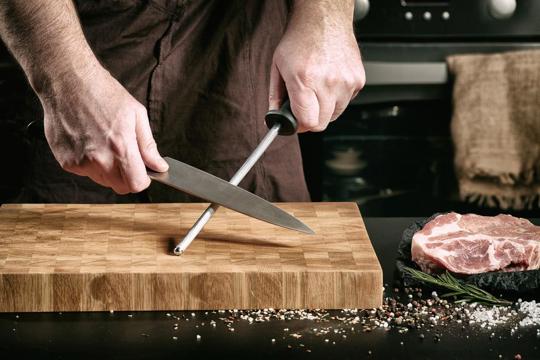
When using a sharpening steel, hold the blade at a 20-degree angle.
Firmly draw it across the steel in a sweeping motion from base to tip.
Repeat this process on each side of the blade several times.
Be careful and focused - improper technique can damage both the knife and the user.
Sharpening steels are different from sharpening stones.
Stones remove metal to create a new edge, while steels mainly realign the existing edge.
Steels are seen as quick and convenient tools for regular maintenance or touch-ups between more extensive sharpening sessions.
To ensure its longevity and effectiveness, regularly clean and inspect your sharpening steel for any signs of wear or damage.
Also, choose a steel that matches your type of knife - some are designed for European-style knives, while others are better suited for Asian-style knives.
If thinking about complementary pairings is useful, lemon dessert pairing ideas shows how thoughtful combinations enhance results in a different kitchen task.
What is a Sharpening Stone?
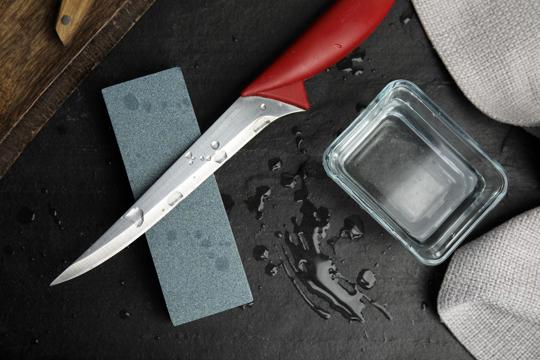
A sharpening stone is an instrument used to sharpen knives and other cutting tools.
It has a flat surface with embedded abrasive particles, such as natural or synthetic diamond resin or ceramic.
Rubbing the blade against the stone removes tiny pieces of metal, making the blade sharper.
Sharpening stones have different grit levels, from rough to fine.
Low grits are used to repair damaged blades or reshape them.
Higher grits are for polishing and refining the edge.
Sharpening stones come in various sizes and shapes.
Some are hand-held, while others are big bench stones for stationary use.
Whetstones, oilstones, and waterstones are all types of sharpening stones, each with its own special properties.
It is up to each person to decide if they prefer a sharpening steel or stone.
Both tools can sharpen blades, but a sharpening stone has more control due to its varying grits and ability to remove material.
Differences Between Sharpening Steel and Stone

Sharpening steel and stone are two distinct tools for honing blades.
For another look at how different metals and finishes compare in kitchen tools, porcelain vs stainless steel comparison breaks down key differences.
Purpose and Use
The purpose of a sharpening steel and stone are very different.
A steel helps to keep an edge sharp by fixing misaligned microscopic teeth.
A stone removes metal to create a new edge.
Sharpening steels are often made of hardened steel and have a ridged or grooved surface.
This helps to realign the edge and make it sharper.
Sharpening stones are usually made from abrasive materials.
They come in various grits from coarse to fine.
You must hold the blade at a consistent angle to sharpen it.
A sharpening steel quick-fixes a knife but for knives that are dull or damaged over time, a sharpening stone is better.
Knowing the purpose and use of each can help you choose the right tool.
This will keep blades sharp and effective for longer.
If comparing tools by intended use helps, plain flour vs all-purpose flour comparison shows how choosing the right ingredient for the job matters in another context.
Material and Construction
Material and construction are important for sharpening tools.
Steel vs stone? They differ in composition and design.
Steel sharpeners are made from high-carbon alloys, while sharpening stones are made from natural or synthetic materials.
Steel sharpeners have grooves or ridges for realigning the edges of a blade.
Hard and abrasive, they hone the cutting edge quickly.
Sharpening stones come in various grit levels, with abrasive particles to remove metal from the blade's edge.
Steel sharpeners have a handle for grip and control.
Compact and portable, they're ideal for kitchen knives and scissors that need regular touch-ups.
Sharpening stones may need a honing guide for consistent angles.
Steel sharpeners are great for honing and maintaining a sharp blade.
Stones are versatile for reshaping a dull blade and refining its cutting performance.
Sharpening Process and Technique
Sharpening process and technique are essential for keeping up the quality and performance of your tools.
Whether you're a professional chef or an eager DIYer, knowing how to sharpen your tools correctly can make all the difference in getting precise cuts and great results.
Here's a 5-step guide to help you ace the sharpening process and technique:
- Inspect the Blade: Take a close look at the blade for any chips, nicks, or damage. If you spot anything, make sure to solve it first with suitable tools like files or diamond stones.
- Pick the Right Grit: Different tools require different grits for best results. Coarse grits are great for reshaping or fixing damaged edges, while finer grits are for honing and polishing sharpness. Look for sharpening stones with different grit sizes for your needs.
- Set the Angle: Keeping a consistent angle during sharpening is key for sharp and uniform edges. Use a sharpening guide or pick a visual reference point to make sure you have a steady angle while sharpening.
- Start Sharpening: Place light pressure on the cutting edge of the tool against the sharpening surface. Make smooth and controlled strokes, moving the blade across the surface and keeping the angle. Repeat this motion several times on each side of the blade till you get the desired sharpness.
- Final Touches: When the edge is sharp, remove any burrs or roughness left behind during sharpening. Do this by lightly passing the blade against a fine honing stone or strop in a controlled manner.
Also, regular maintenance is necessary for preserving sharpness over time.
Think about getting proper storage like blade guards or knife blocks to protect the edges when not in use.
Also, occasional touch-ups with a honing rod or sharpening steel can help keep the sharpness of your tools between major sharpening sessions.
Effect on Blade Edge
Using a sharpening steel or stone on the blade edge of a knife can have varying results.
Both tools sharpen the blade, yet they differ in their technique and outcome.
Sharpening steel involves running the blade against a steel rod to realign the edge.
This helps keep the sharpness of the blade, but does not remove any material from it.
Sharpening stone, on the other hand, grinds or hones the blade to make a new edge.
It's usually made of abrasive material, such as diamond or ceramic, which wears away the metal to reshape and refine the blade.
This method is more efficient for restoring a dull or damaged edge.
It's noteworthy that while a sharpening steel is convenient for regular maintenance, it may not be enough to restore severely blunt or damaged blades.
For this, using a sharpening stone would be a better choice as it offers more control and accuracy in sharpening.
To understand how different sharpening methods reshape edges, burr vs blade grinder comparison covers how grinding systems affect blade profiles.
Similarities Between Sharpening Steel and Stone
Sharpening steel and stone have many likenesses.
- Both are used to sharpen blades.
- More so, they both need a person to put in the effort to complete the task. To sharpen, you must slide the blade across the surface at a particular angle. This needs skill and accuracy; else, it could lead to inadequate sharpening or even blade damage.
Durability is another common feature of sharpening steel and stone.
They are designed to withstand frequent use without wear or damage.
This is important for consistent sharpening over time.
They share some similarities, there are also distinctions between sharpening steel and stone.
One difference lies in their materials.
Sharpening steel is usually made from hardened stainless steel, while stones can be made from abrasive materials such as diamond or ceramic.
These different materials provide varying levels of abrasion, affecting their efficacy on different blades.
Also, sharpening stones offer greater control due to their flat surface.
This makes it possible to achieve precise angles for certain blades or cutting tasks.
On the other hand, sharpening steels may be more convenient as they're compact and can be stored or transported easily.
For a look at how material choices influence performance across tools, stainless vs carbon steel pan comparison highlights trade-offs in durability and care.
How to Choose Between Sharpening Steel and Stone
Deciding between steel and stone for sharpening can be tricky. To help, here's a 6-point guide:
- Type of knife: Serrated or straight? Steel's good for straight, stones for serrated.
- Skill level: Stones require more skill than steel, so if you're a beginner, steel may be simpler.
- Sharpness desired: Steel's good for regular honing, but stones provide the highest sharpness.
- Convenience: Steel is great on-the-go, but stones are better if you have the time.
- Budget: Stones are pricier than steels.
- Maintenance: Stones need more regular care, but steel is usually low-maintenance.
Bear in mind, people have personal preferences. Both tools offer advantages.
Stones give ultra-sharp edges; steel gives quick touch-ups.
Pick the tool that suits your needs. With practice, you'll have sharp knives in no time.
When choosing based on material characteristics, blue carbon vs carbon steel comparison offers a perspective on how steel types affect use and maintenance.
Sharpening Tools: Steel vs Stone Benefits
As you can see, the process and materials used are vastly different between sharpening on steel or stone.
While both processes offer similar results, the method of sharpening you choose depends on your individual needs and preferences as a knife enthusiast.
Therefore, if you're a beginner who wants to learn how to sharpen knives, practice with both steel and stone methods.
There's no one-size-fits-all solution for honing blades; it takes patience and knowledge to refine your technique so that you get the best possible end result.
With some careful consideration and effort, you'll be able to develop a regular blade-sharpening routine that fits your individual goals.
Whirley Pop material comparisons clarify durability and performance. Whirley Pop stainless steel vs aluminum outlines those trade-offs. Ceramic and steel honing rods suit different maintenance routines; ceramic vs steel honing rod comparison explains when each is preferable.
Frequently Asked Questions
The main differences are in flavor, texture, and usage. See our comparison table above for a quick side-by-side breakdown of Sharpening Steel versus Stone.
Sharpening Steel and Stone can sometimes be used interchangeably depending on the recipe. However, they have different flavors and textures, so the result may vary.
Pricing varies by brand and region, but one is typically more accessible at everyday price points. The other may cost more due to specialization or limited supply.
One shines in applications requiring subtlety and background support. The other is better when it is meant to be a center.
Matching the right one to its role makes a noticeable difference.