
Most ham sold as sugar cured is a juicy, fully cooked city ham, while country ham is dry-salted, aged and sold uncooked and much saltier.
- "Sugar cured" is a label about the sweetener, so many country hams carry it too.
- Raw country ham has about twice the sodium of roasted city ham.
- Soak and cook country ham unless the label says ready to eat.

The sodium comparison comes from USDA data. Pick city ham for a glazed holiday centerpiece and country ham for thin slices in biscuits. A fully cooked city ham can go straight to the table.
Both hams start as the cured hind leg of a hog, and both can be smoked. They split on how the cure gets into the meat, how much water stays in, and whether you need to cook the ham at home. Like other cured-meat pairs that share a counter, these two are easy to confuse, because the two label words describe different things.
1. What Is the Difference Between Sugar Cured Ham and Country Ham?
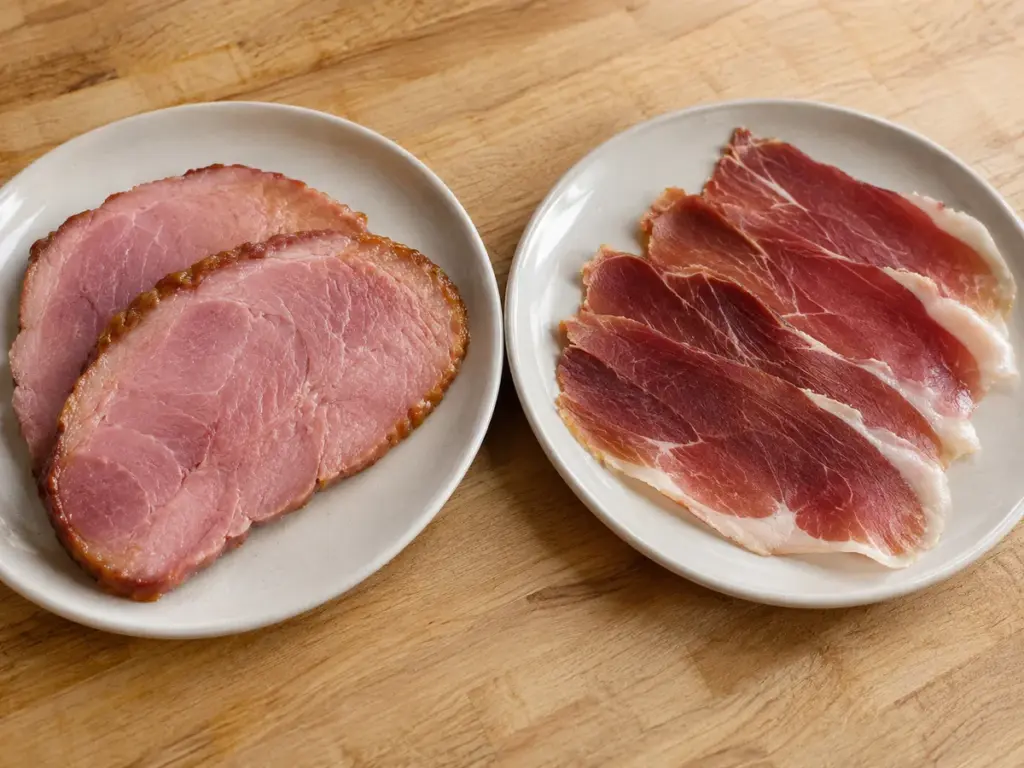
In short, city ham takes its cure as a liquid, and country ham takes it as dry salt. In the table, "sugar cured ham" means the common supermarket kind, a wet-cured city ham with sugar in its brine.
- Brine injected, then massaged or tumbled into the meat
- Cane or beet sugar is the main sweetener when the label says "sugar cured"
- Dry salt rubbed on the outside, never injected or soaked in brine
- Sugar is optional (Virginia Tech's home cure uses 2 pounds per 100 pounds of ham)
| Trait | Sugar cured city ham | Country ham |
|---|---|---|
| Water | Can gain water, so labels may say "water added" | Loses at least 18% of its weight, usually 20 to 25% |
| Aging | None to speak of | Months, with six months the traditional length |
| How it is sold | Usually fully cooked and ready to eat | Uncooked, unless the label says otherwise |
City ham is deep rose or pink and has 986 to 1,327 mg of sodium per 100 g (roasted). Country ham is pink to mahogany and has 2,695 mg per 100 g (raw lean).
Every row traces back to the cure. When you pull water out with dry salt, you get a denser, saltier, shelf-stable ham that still needs cooking. When you push a sweet brine in, you get a moist, mild ham that is usually cooked before it reaches the store.
2. What Does "Sugar Cured" Mean on a Ham Label?
"Sugar cured" tells you about the sweetener in the cure, and nothing about whether the cure was wet or dry. USDA's Food Safety and Inspection Service (FSIS) lets a cured meat use the term only when three things are true:
- The sugar is cane sugar or beet sugar.
- Sugar is the only sweetener, or any other sweeteners add up to no more than half the amount of sugar.
- There is enough sugar to flavor the ham or change how it looks.
Because the rule is about the sweetener alone, a country ham can be sugar cured too. Virginia Tech's home dry-cure for Virginia-style ham uses 8 pounds of salt and 2 pounds of sugar for every 100 pounds of fresh ham, and stores sell "sugar cured country ham" slices for the same reason.
3. How Is Each Ham Cured?
FSIS calls brine curing the most popular way to make ham. For a city ham, the plant injects the fresh leg with a solution that can include salt, sugar, sodium nitrite and flavorings, then massages or tumbles it so the brine spreads through the muscle and makes the meat more tender. The ham may be cooked in the same process.
Country ham works the other way. Federal rules (9 CFR 319.106) say it must be a single piece of ham, coated on the outside with dry salt, alone or mixed with sweeteners, spices and an optional nitrate or nitrite cure. Producers may add more salt as it soaks in, but they may not inject the ham or place it in brine.
Salt does the safety work in a country ham. With nitrate or nitrite, the finished ham needs at least 4% salt inside. Without them, the salt has to reach a brine concentration of at least 10% or a water activity of 0.92 or lower, and every finished ham must weigh at least 18% less than the fresh leg.

Virginia Tech's step-by-step guide shows how long the dry method takes. You won't need these numbers to buy a ham, but they explain why a country ham takes months to make:
- Salt the ham. Half the cure mix goes on the fresh leg on day 1 and the other half on day 7, with the meat held at 36 to 40°F.
- Let the cure soak in. The ham stays in the cold for about 1½ days per pound.
- Equalize the salt. After a short cold-water soak and a scrub, the ham rests at 50 to 60°F for about 14 days so the salt spreads evenly.
- Smoke it, if you like. Hardwood smoke below 90°F for 1 to 3 days turns the outside chestnut brown.
- Age it. The ham hangs for 45 to 180 days at 75 to 95°F and loses another 8 to 12% of its weight.
If a family recipe for country ham lists saltpeter, you'll find Virginia Tech's current guide still names saltpeter or sodium nitrite for the cure. If you cure at home, measure the cure from a tested recipe, since safe stand-ins for saltpeter are not swapped 1:1. Plain salt still does most of the work, and pink curing salt and table salt do different jobs in a cure.
4. How Do They Taste and Feel Different?
In FSIS's own words, dry curing produces a salty product. Because a country ham loses 20 to 25% of its weight as water, its flavor gets more concentrated, while the brine in a city ham keeps the meat moist and mild.
- Mild, sweet-salty and juicy
- Soft, tender slices you can cut thick
- Glaze adds most of the sweetness you taste
- Eaten cold, warmed or baked whole
- Intensely salty with a deep, aged pork flavor
- Firm and a little chewy, best sliced thin
- Smoked versions add a dark, woodsy edge
- Cooked before eating, a little at a time

For most people, the sweetness in "sugar cured" is subtle. USDA lists about 1 gram of carbohydrate or less per 100 grams of city ham, so the sugar mostly softens the salt and browns the outside. If you want a sweet ham, the glaze matters more than the cure, and the smoky, salty taste of ham still comes through underneath.
5. Do You Have to Cook Country Ham?
Usually yes. Federal rules define country ham as an uncooked product, and FSIS notes that dry-cured hams may be sold as items you must prepare to make them safe. Your label decides: a ham that needs cooking must say so and print cooking directions.
Prosciutto shows the other path. It is dry cured too, and FSIS says you can eat Italian prosciutto raw because its low water content stops bacteria from growing. A dry-cured ham sold ready to eat says so on the label, and if yours doesn't, treat the ham as raw.

For a whole or half country ham, the FSIS ham guide gives this method:
- Scrub off any mold. Wash the ham with hot water and a stiff vegetable brush.
- Soak it in the refrigerator. Cover it with water for 4 to 12 hours, or longer, to pull out some salt.
- Boil or simmer it. Cover it with water and cook it for 20 to 25 minutes per pound.
- Check the temperature. Cook-before-eating hams need 145°F in the thickest part, then a 3-minute rest.
- Glaze and brown it. Drain, glaze and bake at 400°F for about 15 minutes.
Some labels and older guides list 160°F for cook-before-eating ham. That is also safe, just a little drier. A fully cooked city ham needs no cooking at all: FSIS says you can eat it cold, or reheat it in a 325°F oven to 140°F if it was packaged at a USDA-inspected plant and to 165°F if it was repackaged elsewhere or is a leftover.
6. Which Ham Has More Salt?
Country ham does, by a wide margin. USDA FoodData Central lists the numbers below per 100 grams, and a 2-ounce serving is about 57 grams. The FDA's Daily Value for sodium is less than 2,300 mg a day, and it counts 20% of that in one serving as high.
| Ham (USDA FoodData Central) | Sodium per 100 g | Sodium per 2 oz | Protein per 100 g |
|---|---|---|---|
| Country-style ham, center slice, lean, raw (FDC 168282) | 2,695 mg | about 1,530 mg (66% DV) | 27.8 g |
| Cured whole ham, lean, roasted (FDC 168284) | 1,327 mg | about 750 mg (33% DV) | 25.1 g |
| Spiral-sliced ham with natural juices, lean, heated (FDC 168331) | 986 mg | about 560 mg (24% DV) | 22.6 g |
USDA lists country ham only raw, and soaking and simmering remove some of its salt, though no tested figure says how much. Even so, every ham in the table counts as high in sodium, so if you watch your salt, a city ham and a smaller portion help more than any label word.
7. How Long Does Each Ham Keep?
A whole, uncut country ham is one of the few meats you can keep at room temperature for up to a year, because it holds too little water for bacteria to multiply. FSIS says it is still safe after a year, though the quality may slip. Once you slice it, the moist inside must go in the refrigerator, since staph bacteria can grow there.

| Ham | Refrigerator | Freezer |
|---|---|---|
| Country ham, whole and uncut | Not needed: up to 1 year at room temperature | Not needed |
| Country ham, uncooked, cut | 2 to 3 months | 1 month |
| Country ham, cooked | 7 days | 1 month |
- Cooked city ham, whole, store wrapped, keeps 7 days in the refrigerator and 1 to 2 months in the freezer.
- Cooked city ham, half or slices, store wrapped, keeps 3 to 5 days in the refrigerator and 1 to 2 months in the freezer.
- Cooked ham, vacuum sealed at the plant, undated and unopened, keeps 2 weeks in the refrigerator and 1 to 2 months in the freezer.
Cured ham that is cook-before-eating and uncooked keeps 5 to 7 days or until the "use-by" date in the refrigerator, and 3 to 4 months in the freezer.
The freezer times are for quality only, because frozen ham stays safe indefinitely. A smoked city ham's fridge life follows the cooked-ham rows, so a sugar cured ham gives you days, while an uncut country ham gives you months.
8. Can You Use Country Ham Instead of Sugar Cured Ham?
You can, as long as you cut back on the amount and on the salt in the rest of the dish. Country ham works best where a little goes a long way: thin slices in a sandwich, diced into beans or greens, or crisped in a skillet next to eggs.
- Country ham in place of city ham: slice it thin, use less than the recipe's amount, and leave out added salt until you taste. It won't work as a thick-sliced, juicy centerpiece.
- City ham in place of country ham: it works in biscuits, beans and soups, but you will taste a milder, wetter ham, so season the dish more and brown the slices longer to dry them out.
- Either one in a cooked dish: add diced country ham early so it seasons the pot, and add a cooked city ham near the end so it only needs to heat through.
9. Which Should You Buy?
Pick by the meal you are planning. City ham feeds a crowd, and country ham seasons a meal. These situations show where each one clearly wins:
- A holiday dinner for a crowd: buy a fully cooked sugar cured city ham, about ⅓ to ½ pound per person bone-in or ¼ to ⅓ pound boneless. Spiral-sliced holiday hams save carving and are safe to serve cold.
- A Southern breakfast or brunch: buy country ham center slices. A few thin slices fill a batch of country ham biscuits to serve with eggs or grits.
- A ham to keep on hand for months: buy a whole, uncut country ham, which can wait in a cool pantry until you are ready to soak and cook it.
- A low-salt plan: buy city ham and keep portions small, since even the mildest ham in the USDA table tops 20% of the Daily Value in 2 ounces.

Value comes down to water. A city ham can carry added solution, and FSIS allows a product labeled "ham, water added" to hold 10% added solution, so part of what you pay for is brine. A country ham has already lost at least 18% of its weight, so each ounce holds more meat, though you eat less of it at a time.
Sources
- USDA Food Safety and Inspection Service, Hams and Food Safety: dry curing and brine curing, the "sugar cured" and "honey cured" label rules, weight loss and aging, room-temperature storage, mold, cooking times and temperatures, the storage chart, and serving amounts.
- Legal Information Institute, 9 CFR 319.106: the federal definition of country ham, dry salt only, optional sweeteners and nitrate or nitrite, salt and water activity limits, and the 18% weight loss.
- Legal Information Institute, 9 CFR 319.104: protein limits behind the "ham," "with natural juices" and "water added" labels.
- Virginia Cooperative Extension, Dry Curing Virginia-Style Ham at Home: the salt and sugar cure, curing, equalizing, smoking and aging times and temperatures, weight loss, soaking and cooking to 145°F.
- USDA FoodData Central, FDC 168282, FDC 168284 and FDC 168331: sodium, protein and carbohydrate.
- U.S. Food and Drug Administration, Sodium in Your Diet: the 2,300 mg Daily Value and the 20% "high" mark.
Frequently Asked Questions
No. FSIS lets a ham say "honey cured" only when honey is the main sweetener, with any other sweeteners at no more than half the amount of honey. "Sugar cured" follows the same rule with cane or beet sugar.
Yes. FSIS describes Smithfield ham as an aged, dry-cured ham made only in Smithfield, Virginia. A label that says "Smithfield style" still has to come from Smithfield.

Food writer at GustoMeadow. Writes ingredient substitutes, food comparisons, taste guides and storage guides for home cooks.
Storage and food-safety numbers follow USDA, FDA and university extension guidance.



