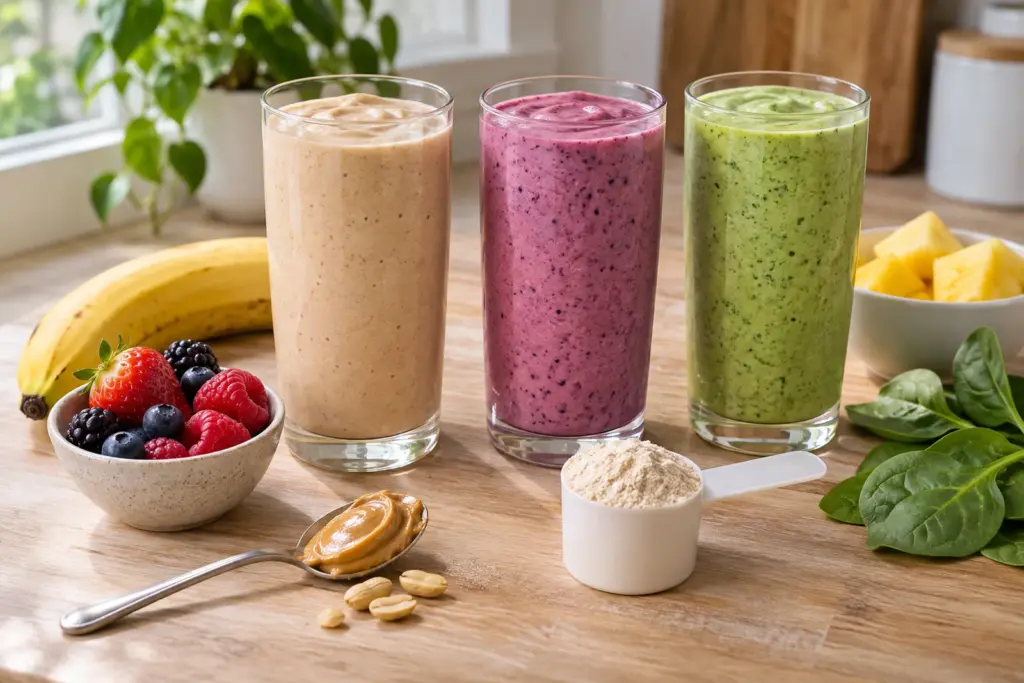
These 20 smoothies have 20 to 49 grams of protein per serving.
- 19 of them get there with one scoop of protein powder (about 25 g) plus Greek yogurt, milk, nut butter or seeds.
- The peanut butter banana (47 g), berry Greek yogurt (49 g) and apple cinnamon (49 g) are the highest.
- The mocha coffee (26 g) is the lightest of the powder smoothies.
Adults need at least 0.8 g of protein per kilogram of body weight a day, which is just over 7 g for every 20 pounds.
If you weigh 150 pounds, you need about 54 g, so one smoothie here covers roughly half of it, and the top ones cover nearly all of it.
| Body weight | Daily minimum | One 30 g smoothie covers |
|---|---|---|
| 120 pounds | 44 g | 69% |
| 150 pounds | 54 g | 55% |
| 180 pounds | 65 g | 46% |
| 200 pounds | 73 g | 41% |
You get one serving from every recipe, and the grams come from USDA FoodData Central for the exact amounts in each ingredient list.
These totals count the powder as one 25 g scoop, so if your brand's scoop holds a different amount, its label gives you the number to swap in. Each smoothie takes only a blender and about 5 minutes.
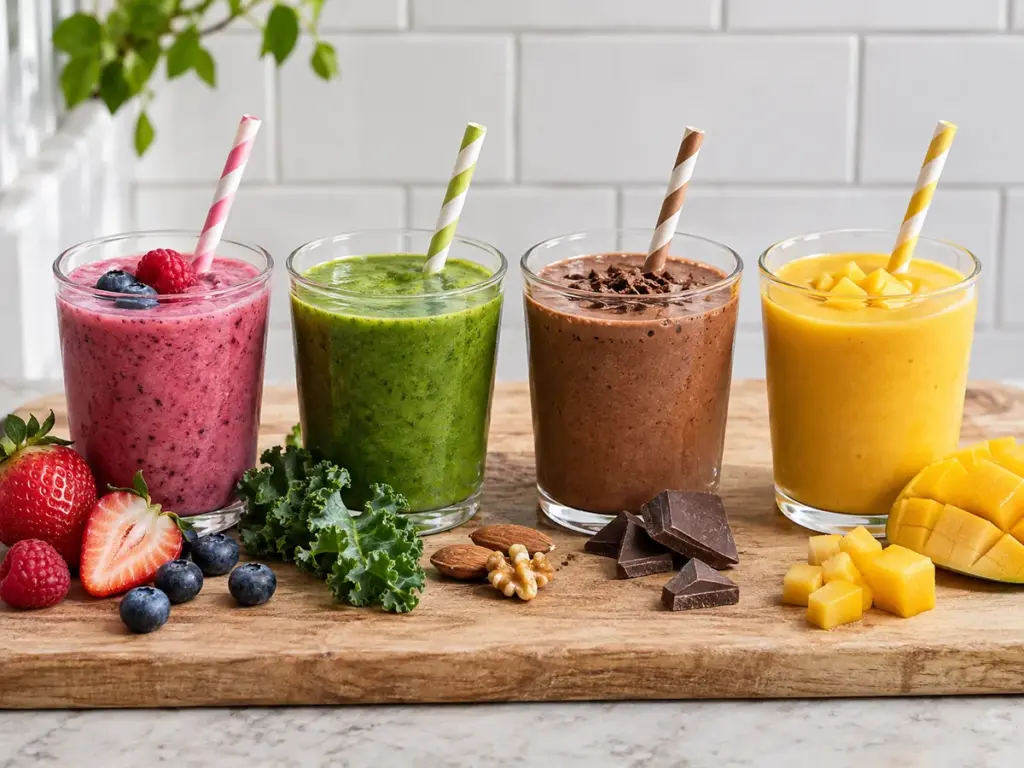
How Much Protein Is in Each of These Smoothies?
| Smoothie | Protein | Protein besides the powder |
|---|---|---|
| 1. Peanut Butter Banana | 47 g | Greek yogurt 12 g, peanut butter 7 g |
| 2. Berry Greek Yogurt | 49 g | Greek yogurt 19 g, milk 4 g |
| 3. Apple Cinnamon | 49 g | Greek yogurt 12 g, milk 8 g, oats 3 g |
| 4. Peach Ginger | 48 g | Greek yogurt 12 g, milk 8 g |
- 5. Kale and Kiwi: 41 g, with 12 g from Greek yogurt.
- 6. Oats and Banana: 40 g, with milk 8 g, oats 3 g and Greek yogurt 3 g.
- 7. Strawberry Cashew: 40 g, with milk 8 g and cashew butter 6 g.
- 8. Chocolate Almond Butter: 35 g, with almond butter 7 g.
- 9. Hazelnut Mocha: 35 g, with hazelnut butter 5 g and milk 4 g.
- 10. Mocha Coffee: 26 g, where cold brew and almond milk give you about 1 g.
- 11. Mocha Banana: 28 g, with banana and almond milk at about 3 g.
- 12. Chocolate Avocado: 28 g, with avocado and cocoa at about 2 g.
- 13. Blueberry Hemp: 20 g, with Greek yogurt 12 g and hemp seeds 6 g, no powder.
- 14. Green Spinach and Pineapple: 31 g, with spinach, chia and banana at about 6 g.
- 15. Cucumber Mint: 30 g, where coconut water, cucumber and mint give you about 5 g.
- 16. Coconut Mango: 31 g, with coconut milk 5 g and mango 1 g.
- 17. Tropical Turmeric Pineapple: 33 g, with coconut milk 5 g and chia 2 g.
- 18. Pumpkin Spice: 28 g, with pumpkin, banana and almond milk at about 3 g.
- 19. Vanilla Chia Seed: 28 g, with chia and almond milk at about 3 g.
- 20. Vanilla Date: 27 g, with dates and almond milk at about 2 g.
If you scan the table, you'll see where each total comes from: Greek yogurt does most of the lifting in the top five, nut butter, milk and oats fill the middle of the list, and the fruit and green smoothies get almost everything from the powder.
How Do You Keep a Protein Smoothie From Tasting Chalky?
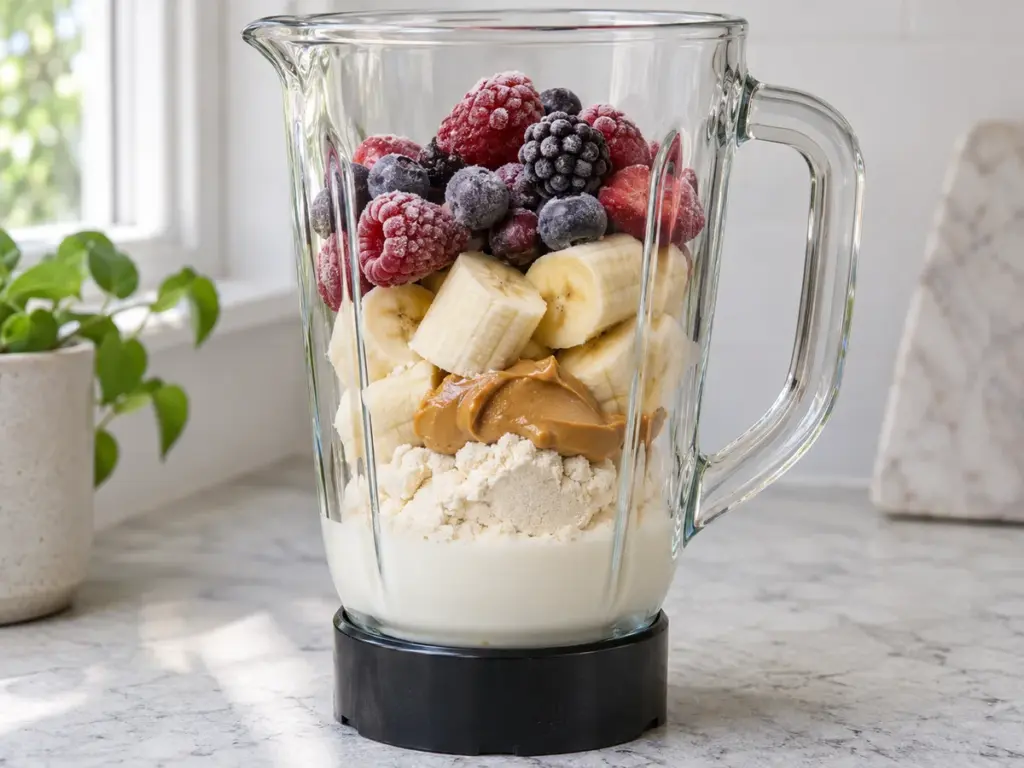
A smoothie turns chalky when the powder never fully wets, so what helps is the order you load the jar, the fat you add and how long you blend.
When you put the liquid in the jar first and the powder on top of it, the powder soaks right away instead of packing into dry clumps against the blades.
- Liquid first. Pour in the milk, almond milk, coffee or coconut water.
- Powder second. Scoop it on top so it gets wet at once.
- Soft ingredients third. Add yogurt, nut butter, banana, avocado or fresh fruit.
- Frozen fruit last. Pile the fruit and ice on top so the blades reach softer layers first.
- Blend on high. Run it 30 to 60 seconds, and if you see anything stuck, scrape the sides once and taste.
These three habits keep the texture smooth, and you can use them in every recipe below.
- Grainy powders need creamy partners. Pea and hemp powders feel grainier than whey, so you give them banana, mango or coconut milk.
- Fat helps. Two tablespoons of nut butter or half an avocado coats the powder, so you get less chalk.
- Cold hides the powder. Frozen fruit and ice hide powder flavor, and when you cool the coffee first, it does not melt the ice.
How Do You Fix a Protein Smoothie That Came Out Wrong?
Most problems come from five causes, and each one has a quick repair you can make in the jar.
| Problem | Cause | Fix |
|---|---|---|
| Too thick | Oats, chia or frozen fruit soaked up the liquid | Add 2 tablespoons of milk and blend 10 seconds |
| Too thin | Too much liquid, or the ice melted | Add ½ cup of frozen fruit or 1 tablespoon of chia and wait 5 minutes |
| Gritty | Powder, oats or seeds never got wet | Soak oats, chia and dates, then blend a full minute |
The last two come from the flavor of a single ingredient, so blending longer will not fix them for you.
- Bitter: kale stems, too much turmeric or strong coffee cause it, so you cut the stems, keep turmeric at ½ teaspoon and add 1 teaspoon of maple syrup.
- Strong powder taste: unflavored powder with little to cover it causes it, so you add ½ teaspoon of vanilla extract, a tablespoon of cocoa or a frozen banana.
You'll get a better result by changing one thing at a time and tasting after each, because a single splash of milk or spoonful of chia moves the texture more than you expect.
Which Protein Powder Works Best in a Smoothie?
Whey, soy, pea and hemp powders all blend into these recipes, and the protein in one scoop ranges from about 17 to 25 g across the USDA powder entries below.
USDA lists a whey-based powder at 78 g of protein per 100 g, so its 32 g scoop gives 25 g, and a soy-based powder gives 25 g in a 45 g scoop.
| Powder (USDA entry) | Scoop | Protein per scoop |
|---|---|---|
| Whey-based, FDC 173180 | 32 g | 25 g |
| Soy-based, FDC 173181 | 45 g | 25 g |
| Whey isolate, FDC 173177 | 29 g | 17 g |
| Pea, hemp or a blend | See label | Varies by brand |
If the powder you buy gives 20 g per scoop instead of 25 g, you subtract 5 g from every protein total in the recipes.
Whey blends smoothest, while pea tastes earthier, which is why the pea recipes (15 to 17) lean on lime, mint, mango, pineapple and coconut milk.
Flavor matters as much as grams, so you'll want a powder that suits the smoothie you pick.
| Powder flavor | Fruit and add-ins that suit it | Smoothies |
|---|---|---|
| Vanilla | Berries, peaches, apples, strawberries, dates, chia | 2, 3, 5, 7, 19, 20 |
| Chocolate | Banana, coffee, avocado, almond or hazelnut butter | 8 to 12 |
| Unflavored | Pineapple, mango, spinach, pumpkin, coconut milk | 1, 4, 6, 14 to 18 |
With unflavored powder, you'll want ½ teaspoon of vanilla extract and a little honey or maple syrup to make it taste finished.
What Can You Add for Protein Besides Powder?
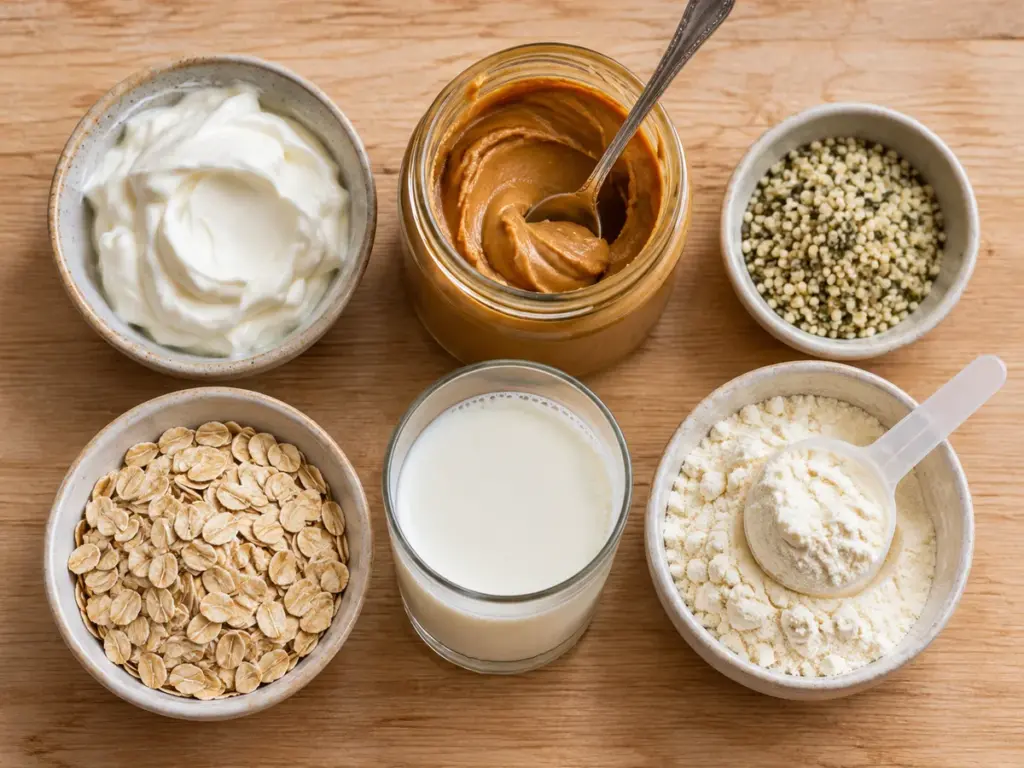
A scoop is the biggest single source, but yogurt, milk, nut butter and seeds add 4 to 14 g each, and you get a creamier smoothie from them too.
Dairy, Soy and Tofu
| Ingredient | Amount | Protein |
|---|---|---|
| Cottage cheese, 1% | ½ cup | 14 g |
| Greek yogurt, plain nonfat | ½ cup | 12 g |
| Kefir, lowfat | 1 cup | 9 g |
| Milk, 1%, or soy milk | 1 cup | 8 g |
| Silken tofu, soft | 3 ounces | 4 g |
Cottage cheese tastes tangy and can leave curds, so you blend it for a full minute with the milk first.
Nut Butters, Seeds and Oats
| Ingredient | Amount | Protein |
|---|---|---|
| Peanut butter | 2 tablespoons | 7 g |
| Almond butter | 2 tablespoons | 7 g |
| Hulled hemp seeds | 2 tablespoons | 6 g |
| Cashew butter | 2 tablespoons | 6 g |
| Rolled oats | ¼ cup | 3 g |
| Chia seeds | 1 tablespoon | 2 g |
Per 100 g, hemp seeds hold about 32 g of protein, pumpkin seed kernels about 30 g, sunflower kernels about 21 g, flaxseed about 18 g and chia about 17 g, but you use only a spoonful of each.
That formula is your fallback when the tub runs out. Greek yogurt, cottage cheese and nut butter carry the most protein in the tables above, which makes them the strongest substitutes for the powder.
Greek Yogurt Smoothies With the Most Protein
Greek yogurt is the reason these five land between 41 and 49 g. A half cup has about 12 g of protein, and a 6-ounce container (170 g) has about 17 g, which is close to the ¾ cup you add in the berry smoothie.
It also thickens the smoothie, which helps hide the powder. If you halve the milk, the glass turns spoonable and becomes a base for smoothie bowls.
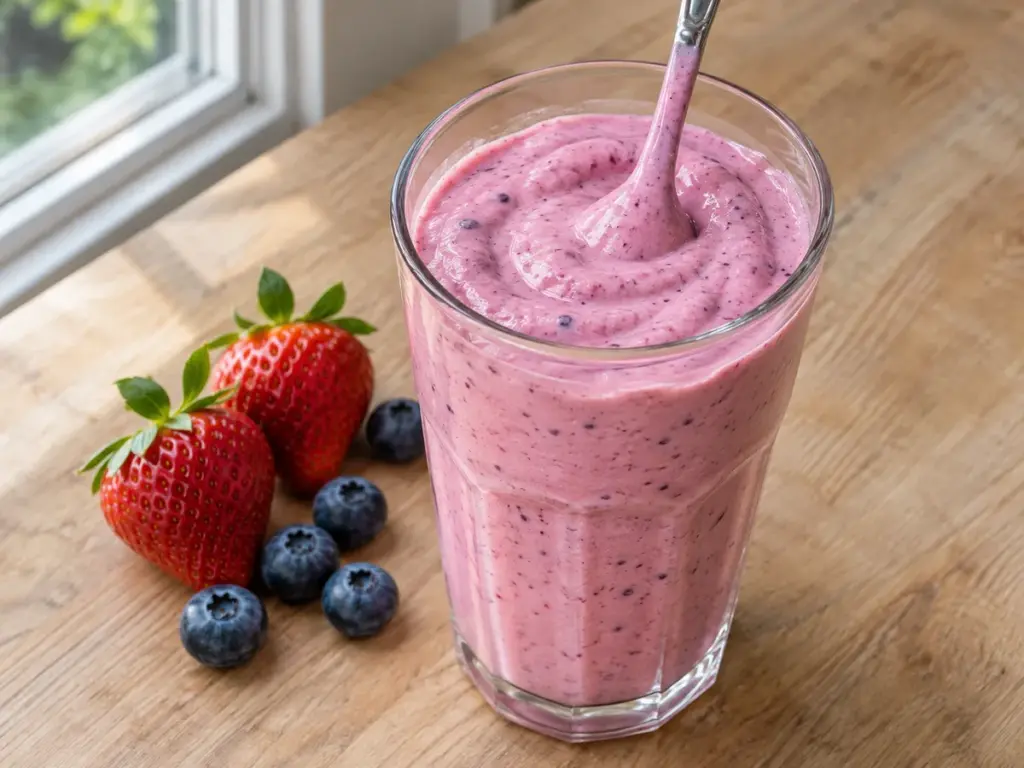
1. Peanut Butter Banana Protein Smoothie
Banana and peanut butter set the flavor here, and the Greek yogurt gives you enough body that a full scoop of powder goes down smoothly, for about 47 g of protein in one glass.
The peanut butter alone adds about 7 g of protein, and a banana with brown freckles is sweet enough that you can skip the honey.
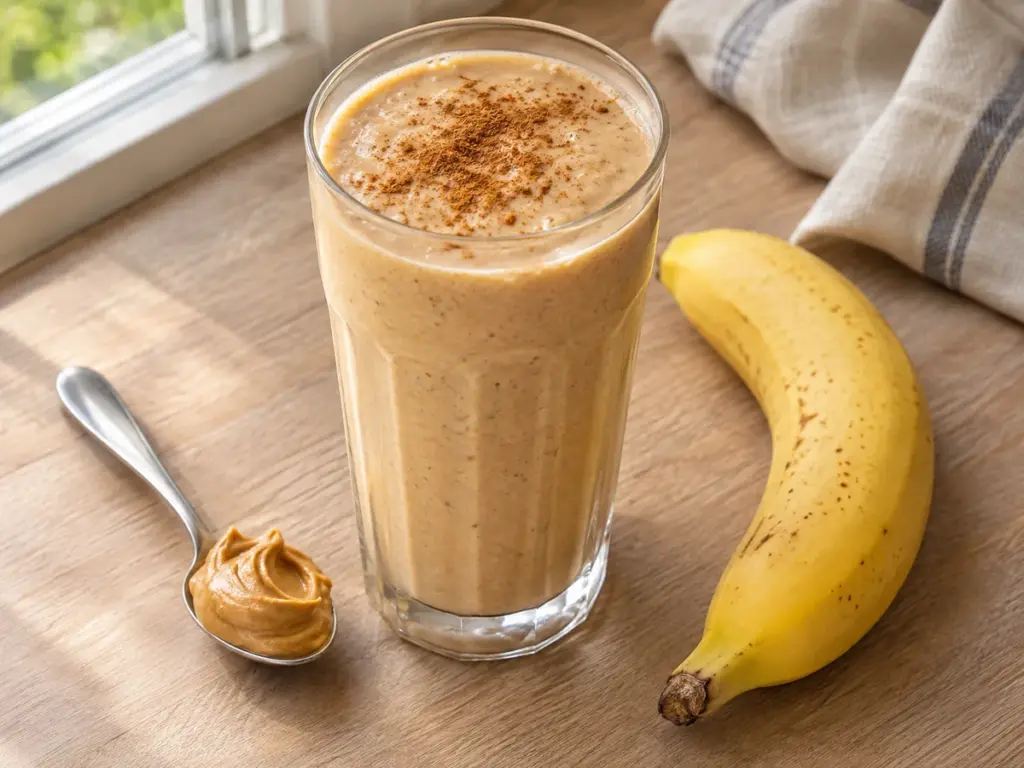
If banana is the part you want to avoid, half an avocado or a cup of frozen mango gives you banana-free thickness in the same recipe.
If you leave out the yogurt, the total falls to about 35 g and the glass gets thinner.
- 1 large ripe banana, peeled and chopped (freckled ones give you the most sweetness)
- 2 tablespoons smooth peanut butter (creamy blends fastest, while crunchy leaves bits of peanut you will chew)
- 1 scoop protein powder (whey or plant, vanilla or unflavored)
- 1 cup unsweetened almond milk (unsweetened lets the banana stay in charge of the sweetness)
- ½ cup plain Greek yogurt (vanilla yogurt adds sugar this recipe does not need, so you buy plain)
- ½ teaspoon ground cinnamon
- A handful of ice
- Liquid first. Pour in the almond milk, then scoop the powder on top.
- Soft ingredients next. Add the banana, peanut butter, yogurt and cinnamon.
- Blend on high. Run it for 30 to 60 seconds, until you see no streaks of peanut butter.
- Ice and taste. Blend again, then taste and loosen it with milk or sweeten it with honey if you like.
- Pour and drink. Serve it right away in a tall glass. It thickens as it sits, so stir in a splash of milk if you wait.
You can swap the peanut butter, and each swap moves the protein by a gram or more.
- Almond butter gives you about 7 g, and sunflower seed butter about 5.5 g for a peanut-free glass.
- Cottage cheese at ½ cup of 1% adds about 14 g instead of the yogurt and needs 30 more seconds of blending.
- Dairy-free: a plant powder, soy yogurt and the almond milk bring it to about 37 g.
- Dairy or soy milk instead of almond milk adds about 7 g.
If you slice overripe bananas and freeze them flat on a plate, you can skip the ice every time for a thicker, colder glass.
2. Berry Greek Yogurt Protein Smoothie
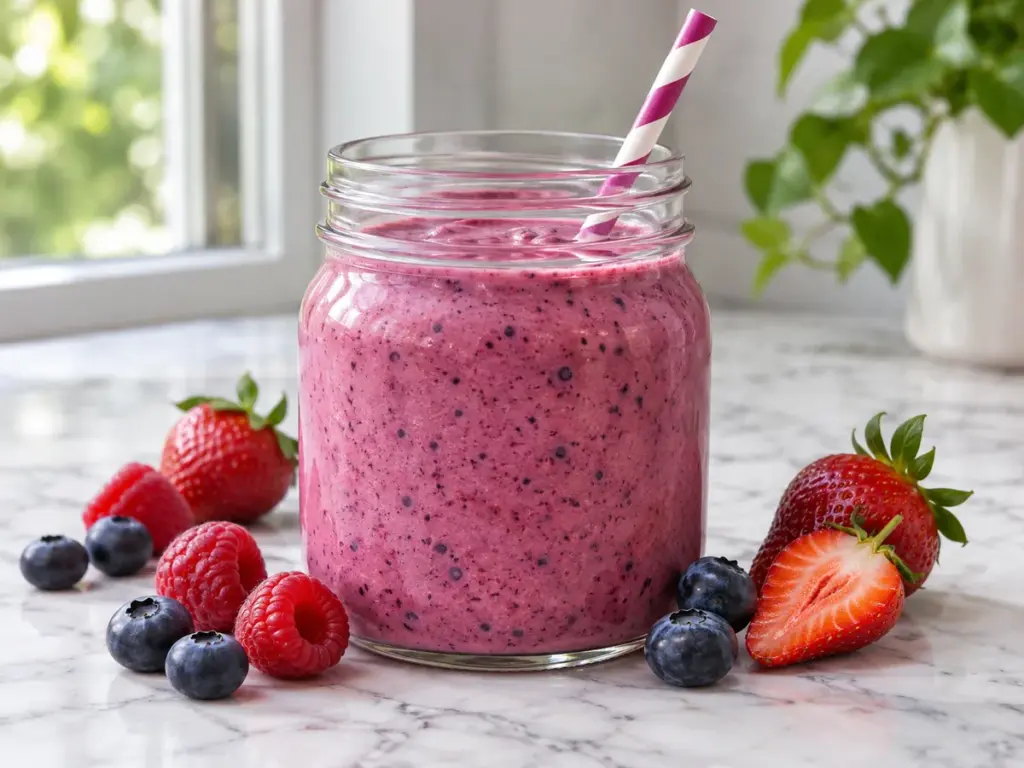
Three-quarters of a cup of Greek yogurt supplies about 19 g by itself, which is how this berry glass reaches about 49 g of protein. The tart berries also cut through the sweet vanilla powder.
If you use frozen berries, they work as well as fresh and replace most of the ice, so the smoothie stays thick instead of watery.
- 1 cup mixed berries, fresh or frozen (strawberries, blueberries, raspberries and blackberries), with fresh ones rinsed, strawberries hulled and frozen ones left as they are
- ¾ cup plain Greek yogurt (plain lets you control the sugar that vanilla yogurt would add)
- 1 scoop vanilla protein powder
- ½ cup milk or milk alternative (in this amount 1% milk adds about 4 g of protein and almond milk almost none)
- 1 teaspoon honey or maple syrup (optional, because ripe berries are often sweet enough that you will not miss it)
- ¼ teaspoon vanilla extract
- Ice, if the berries are fresh
- Milk and powder. Pour the milk into the jar and scoop the powder on top.
- Yogurt and berries. Add the yogurt, berries, honey and vanilla.
- Blend until smooth. Run it on high for 45 seconds, until you see no berry skins or powder flecks.
- Ice and taste. Add ice only if the berries are fresh, and thin it with milk if needed.
- Drink it cold. Pour it right away while it is thick. If the yogurt made it stand in the glass, you'll want a spoon.
One berry, one powder flavor or one yogurt swap changes this recipe the most.
- Single berries work in place of the mix: blueberries give the deepest color and strawberries the sweetest taste.
- Unflavored powder works if you raise the vanilla extract to ½ teaspoon.
- Dairy-free: plant powder, soy yogurt and plant milk keep the flavor and bring the total to about 35 g.
- Coconut water or almond milk thins the glass if the yogurt makes it too thick.
Raspberry and blackberry seeds can leave specks in a weaker blender, so you can strain the glass through a fine sieve or use strawberries and blueberries.
3. Apple Cinnamon Protein Smoothie
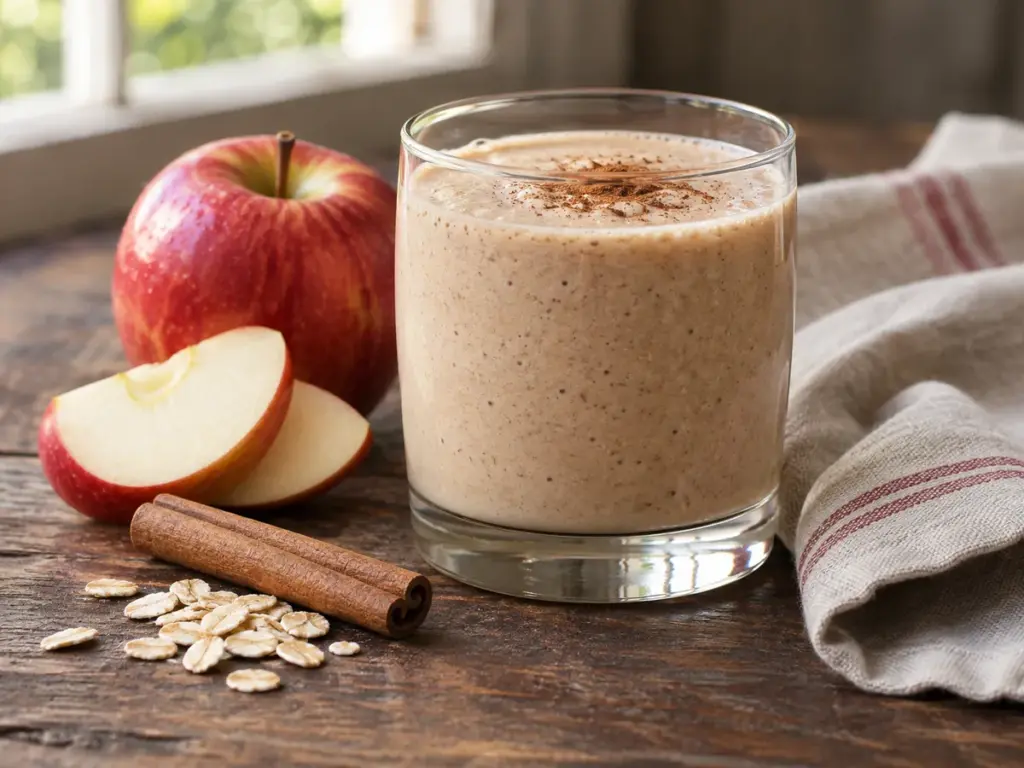
Rolled oats soak up the milk and thicken this glass to a texture close to apple pie filling, and the total comes to about 49 g of protein.
If you keep the skin on the apple, it blends in and adds fiber.
Powder, yogurt, milk and oats give 25 g, 12 g, 8 g and 3 g, and the apple adds the last gram or so.
- 1 medium apple, cored and sliced with the skin on (Fuji or Gala gives you a sweet glass, and Granny Smith a tart one)
- ½ teaspoon ground cinnamon
- ¼ cup rolled oats (steel-cut oats stay hard in a smoothie, so you buy rolled)
- 1 scoop vanilla protein powder (whey or plant)
- 1 cup milk (dairy or soy milk keeps the 8 g per cup)
- ½ cup plain Greek yogurt (its tang goes well with apple)
- 1 teaspoon honey or maple syrup
- A handful of ice
- Soak the oats. Stir the oats into the milk and wait 10 minutes.
- Add the rest. Core and slice the apple with the skin on, then add it with the yogurt, powder and cinnamon.
- Blend on high. Run it for 30 to 60 seconds, until you see no oat flakes or apple skin.
- Ice and honey. Add the ice and honey last, then taste.
- Spoon it up. Serve it right away and stir before each sip. The oats keep soaking, so you'll notice the glass getting thicker within a few minutes, and it eats like a filling breakfast.
You'll find the oats and the milk the easiest places to change in this smoothie.
- Pear replaces the apple in the same amount and tastes softer and juicier.
- Chia at 1 tablespoon takes the oats' place and adds about 2 g of protein, close to the oats' 3 g.
- Almond milk cuts about 7 g from the milk, so the total drops to about 42 g. Soy milk keeps the 8 g.
The apple decides the sweetener: you skip the honey with a sweet Fuji, while a tart Granny Smith wants a full teaspoon.
4. Peach Ginger Protein Smoothie
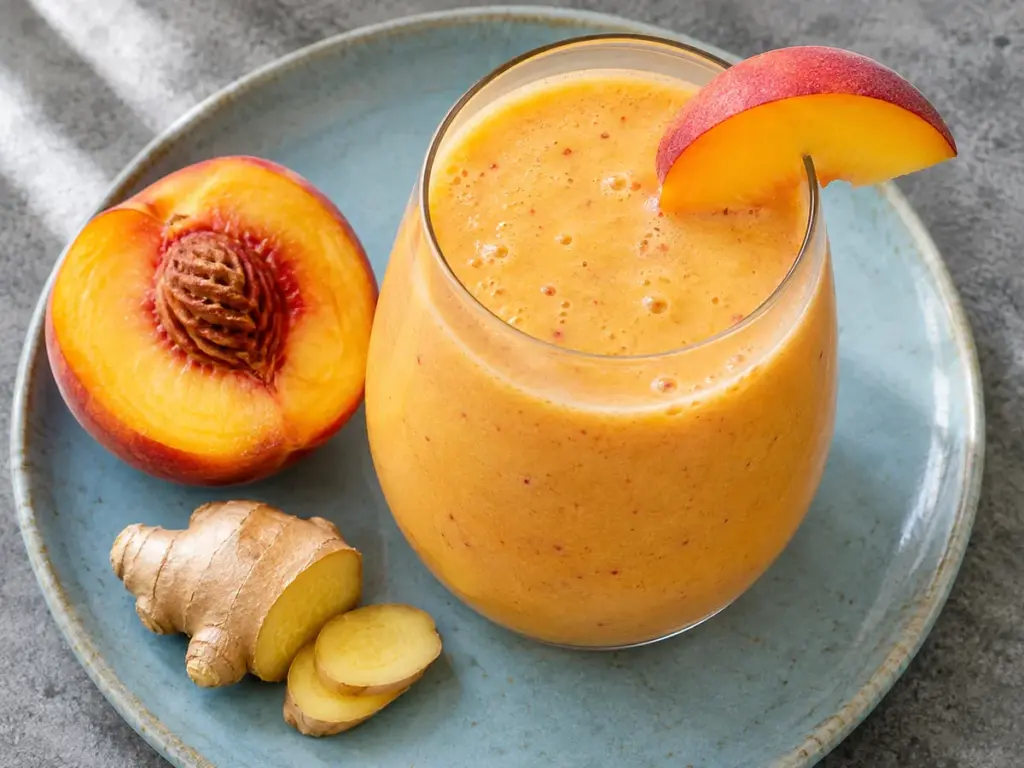
With a half teaspoon of grated fresh ginger, this glass of about 48 g of protein gets a peppery edge that keeps whey from tasting flat. Ripe peaches are sweet enough that you need very little honey.
You can swap oat milk for the milk, but oat milks differ by brand, so you read the label before you count on it for protein.
Whey, yogurt and milk supply 25 g, 12 g and 8 g of the 48 g, and the peaches add about 3 g.
- 2 ripe peaches, peeled, pitted and sliced (a ripe one gives a little when you press it, and frozen slices work when fresh ones are hard)
- ½ teaspoon fresh ginger, finely grated so that no fibers stay in the glass
- 1 scoop vanilla or unflavored whey protein powder (whey blends smoothest with soft fruit like peach)
- 1 cup 1% milk (8 g of protein per cup)
- ½ cup plain Greek yogurt
- 1 teaspoon honey
- A handful of ice
- Grate the ginger. Use the fine side of the grater so no fibers survive.
- Liquid and powder. Pour in the milk, then add the powder and yogurt.
- Add the fruit. Put in the peaches, ginger and honey.
- Blend on high. Run it until smooth, and add ice or use frozen peaches if you want a colder glass.
- Serve it cold. Pour it into a chilled glass right away, and add a little more ginger if you find the peaches mild.
Peaches and ginger are the flavor here, so the swaps keep both.
- Nectarines need no peeling and taste about as sweet as peaches.
- Ground ginger is stronger than fresh, so you start with ⅛ teaspoon and taste.
- Soy milk keeps the 8 g of protein, while oat milk varies by brand.
You want peaches that smell sweet at the stem and give slightly under a thumb, because hard peaches taste flat and need more honey.
5. Kale and Kiwi Protein Smoothie
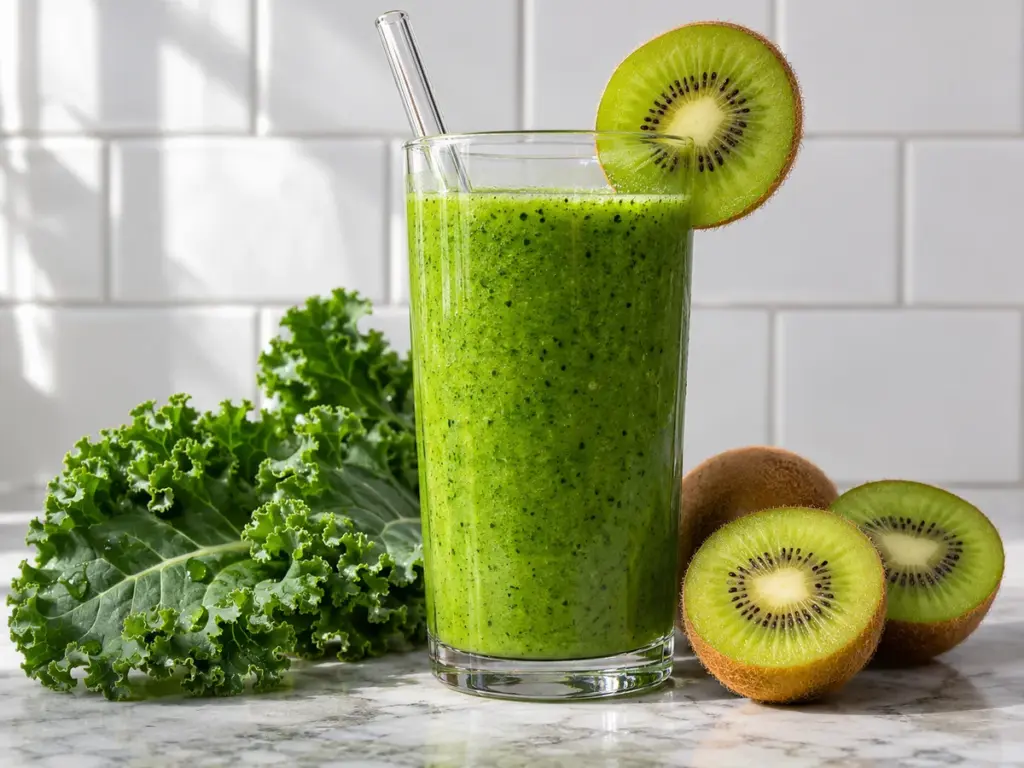
Tart kiwi covers the grassy taste of kale, and Greek yogurt softens what is left, so you barely notice the green in a glass with about 41 g of protein.
- 1 cup chopped kale with the stems removed (you wash and dry the leaves first, then chop and measure them)
- 2 ripe kiwis, peeled and chopped (a ripe kiwi gives when you press it, and a hard one tastes sour)
- 1 scoop vanilla protein powder (vanilla powder softens the kiwi tartness)
- ½ cup plain Greek yogurt
- 1 cup unsweetened almond milk
- 1 teaspoon honey or maple syrup
- ½ cup ice
- Strip the kale. Pull the leaves off the stems and measure them chopped.
- Blend the base. Blend the kale, kiwi, powder, yogurt and almond milk until you see no green flecks.
- Add the ice. Blend again until it is cold and thick.
- Taste before you pour. Add honey if the kiwis were sharp.
- Drink it fresh. Serve it right away while the kiwi tastes brightest. The yogurt makes the glass thick enough to hold as a breakfast, and a squeeze of lime sharpens the kiwi if you want more bite.
If you swap the greens or the fruit, the protein barely moves.
- Baby spinach is milder than kale and needs no stem removal, and USDA lists both at about 3 g of protein per 100 g.
- Green apple or pineapple replaces the kiwi when you want a tart note.
- Dairy-free: soy yogurt and a plant powder bring the total to about 31 g.
- Coconut water or oat milk replaces the almond milk for a lighter glass.
If you peel and freeze the kiwi slices, the frozen fruit replaces the ice without watering down the tartness.
Nut Butter and Oat Smoothies for Breakfast
These three lean on pantry staples instead of yogurt. Two tablespoons of nut butter add 5 to 7 g of protein and coat the powder with fat, and oats add about 3 g and thicken as they soak.
6. Oats and Banana Protein Smoothie
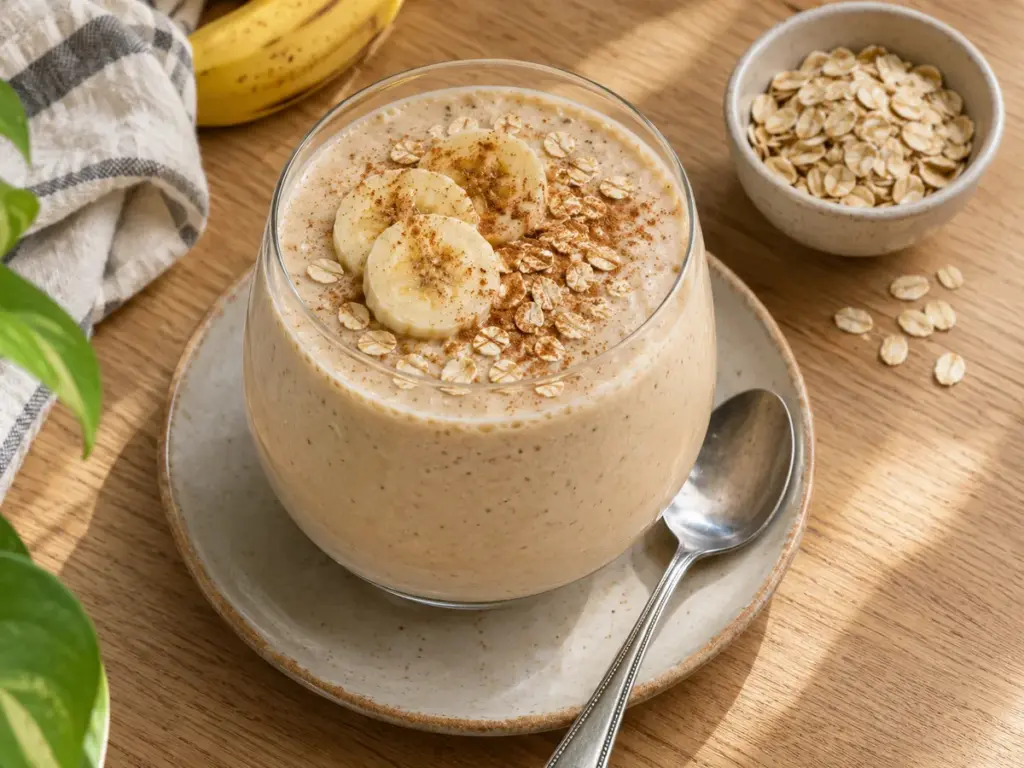
About 40 g of protein sits in a glass that stays thick without much ice, because rolled oats add about 3 g of protein and plenty of body.
A 10-minute soak in a little milk keeps the oats from leaving a gritty feel, so they go into the jar already soft.
- ¼ cup rolled oats (steel-cut oats stay hard even after soaking, so you want rolled)
- 1 medium ripe banana, sliced (brown freckles mean sweeter fruit, and an underripe banana tastes starchy)
- 1 scoop whey protein powder, vanilla or unflavored (whey blends smoothest with oats)
- 1 cup milk
- 2 tablespoons Greek yogurt (it adds creaminess and about 3 g of protein)
- 1 teaspoon honey or maple syrup
- ¼ teaspoon ground cinnamon
- A few ice cubes
- Soak the oats. Stir them into a few tablespoons of the milk for 10 minutes.
- Liquid and powder. Pour the rest of the milk into the jar, then add the powder and yogurt.
- Soft ingredients. Add the banana, soaked oats and cinnamon.
- Blend until smooth. Pulse in a few ice cubes if you want it colder.
- Eat it thick. Pour it right away, and eat it with a spoon if it came out thick. It keeps thickening as it sits, so you thin a second glass with milk, and a glass this size works as a full breakfast.
The oats and the banana are the easiest pieces to trade.
- Quinoa at ¼ cup, cooked and cooled, gives a similar body.
- Avocado or cooked sweet potato replaces the banana when you want less sweetness and the same creaminess.
- Dairy-free: a plant powder and soy milk, with the 2 tablespoons of yogurt left out, give about 37 g.
- Gluten-free: you buy oats labeled gluten-free.
If you make it the night before with the same soak as overnight oats, the oats are already soft when you blend.
7. Strawberry Cashew Protein Smoothie
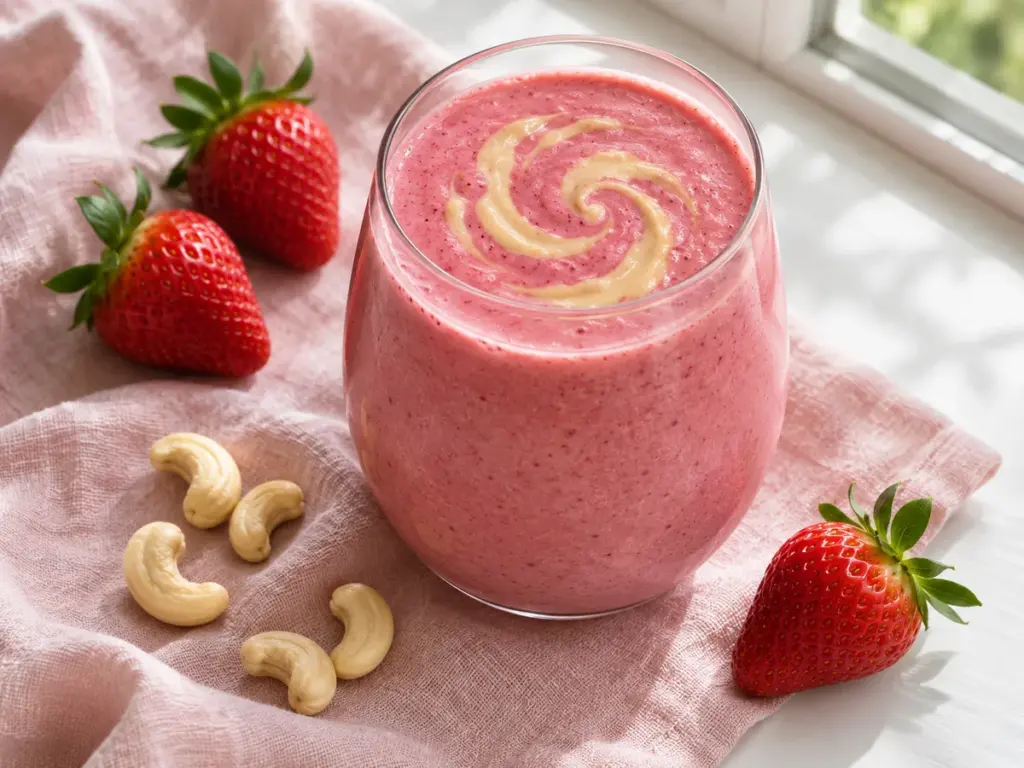
Cashew butter is milder and sweeter than peanut butter, so strawberry stays the main flavor in this pink glass with about 40 g of protein.
Two tablespoons add about 6 g of protein and enough fat that you get a creamy smoothie even with plain milk.
- 1 cup strawberries, fresh or frozen (you hull fresh berries and leave frozen ones unthawed)
- 2 tablespoons cashew butter
- 1 scoop vanilla protein powder (vanilla powder matches the strawberry and keeps the glass pink)
- 1 cup milk (dairy or plant-based)
- ½ teaspoon pure vanilla extract.
- ½ cup ice
- Milk and powder. Pour the milk into the jar and scoop the powder on top.
- Add the rest. Drop in the cashew butter, strawberries and vanilla.
- Blend until creamy. Run it on high without the ice first.
- Add the ice. Blend again, and thin it with milk a splash at a time.
- Pour and serve. Drink it right away. A leftover glass separates in the fridge, so you stir it before the next sip.
A different nut butter changes both the taste and the protein you get.
- Almond butter adds about 1 g more than cashew butter, and peanut butter adds about 1 g more.
- Frozen strawberries or raspberries replace the ice and keep the glass thick.
- Almond milk instead of dairy milk lowers the total to about 33 g, and soy milk keeps all 40 g.
The oil in cashew butter rises to the top of the jar, so you stir it before you measure to get oil and solids in every tablespoon.
8. Chocolate Almond Butter Protein Smoothie
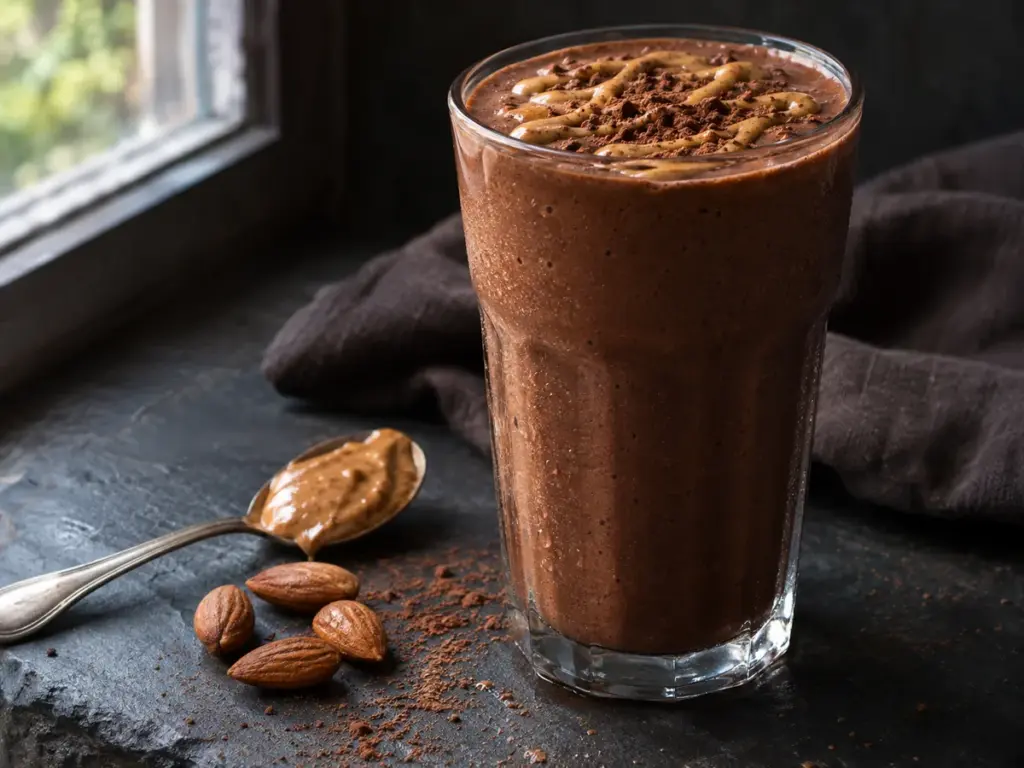
Unsweetened cocoa on top of a chocolate powder deepens the chocolate without adding sugar. With 2 tablespoons of almond butter at about 7 g, the glass holds about 35 g of protein.
A small frozen banana does the thickening, so you rarely need ice.
- 1 cup unsweetened almond milk
- 1 scoop chocolate protein powder (you want one that dissolves easily, because the cocoa is already strong)
- 2 tablespoons almond butter (smooth almond butter blends faster than crunchy)
- 1 small frozen banana (if you freeze it in slices, the blender breaks it up in seconds)
- 1 tablespoon unsweetened cocoa powder
- ½ teaspoon vanilla extract
- Ice, only if you want it thicker
- Liquid and powder. Pour the almond milk into the jar, then add the powder and cocoa.
- Soft ingredients. Put in the almond butter, frozen banana and vanilla.
- Blend on high. Scrape the sides once, and you'll find no cocoa left on the jar.
- Adjust the thickness. Pulse in ice only if the smoothie is thinner than you like.
- Serve it cold. Pour it right away, and add a few chopped almonds on top if you like crunch.
This recipe works with nearly any nut or seed butter.
- Peanut butter gives about 7 g, the same as almond butter, with a stronger roasted taste.
- Sunflower seed butter gives about 5.5 g and suits a peanut-free and nut-free diet.
- Frozen mango or half an avocado replaces the banana when you want a different thickness.
- A date or a teaspoon of maple syrup sweetens it for a dessert-style glass.
When you reach for cocoa, pick unsweetened cocoa powder over hot cocoa mix, because the mix already holds sugar and milk powder.
Coffee and Chocolate Smoothies
Coffee and cocoa are strong enough to cover the taste of most protein powders, so these four need fewer extra ingredients. They also hold at 26 to 35 g of protein.
A cup of brewed coffee has about 95 mg of caffeine (USDA), and cold brew varies by brand, so you want decaf for an evening glass.
9. Hazelnut Mocha Protein Smoothie
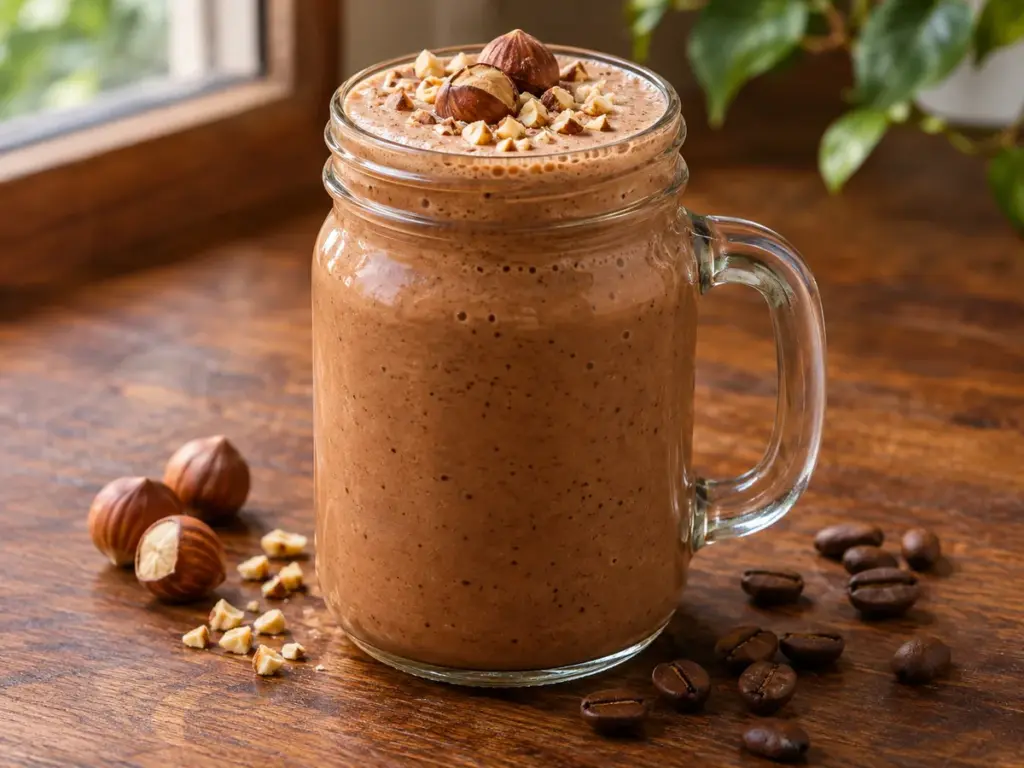
This one tastes like a hazelnut latte with about 35 g of protein, and a teaspoon of cocoa keeps it from tasting thin.
If the coffee is still hot, it melts the ice before the blender can use it to thicken the drink, so you cool it first.
- 1 cup brewed coffee, cooled to room temperature (if you brew it strong and cool it fully, the coffee taste survives the milk and ice)
- 2 tablespoons hazelnut butter (you stir the jar first, because the oil rises to the top)
- 1 scoop chocolate protein powder
- ½ cup milk (dairy or plant-based)
- 1 teaspoon unsweetened cocoa powder
- 1 tablespoon maple syrup or honey (maple syrup stirs in without clumping, and honey works too)
- ½ teaspoon pure vanilla extract
- 1 cup ice
- Cool the coffee. Let it reach room temperature so it does not melt the ice.
- Liquid and powder. Pour the coffee and milk into the jar, then add the powder.
- Add the flavor. Stir in the hazelnut butter, cocoa, maple syrup and vanilla.
- Blend with ice. Run it on high until completely smooth.
- Pour over ice. Serve it right away, and pour it over a few extra ice cubes if you want it colder.
The coffee, the nut butter and the milk each take a swap.
- Peanut butter adds about 2 g more than hazelnut butter, and almond butter adds about 2 g more.
- Espresso at one or two chilled shots, topped up with water to 1 cup, gives you a deeper coffee taste.
- Plant milk with a plant powder makes the glass dairy-free, and almond milk lowers the total to about 31 g.
If you freeze leftover coffee in an ice tray, coffee ice cubes keep the glass cold without thinning the flavor.
10. Mocha Coffee Protein Smoothie
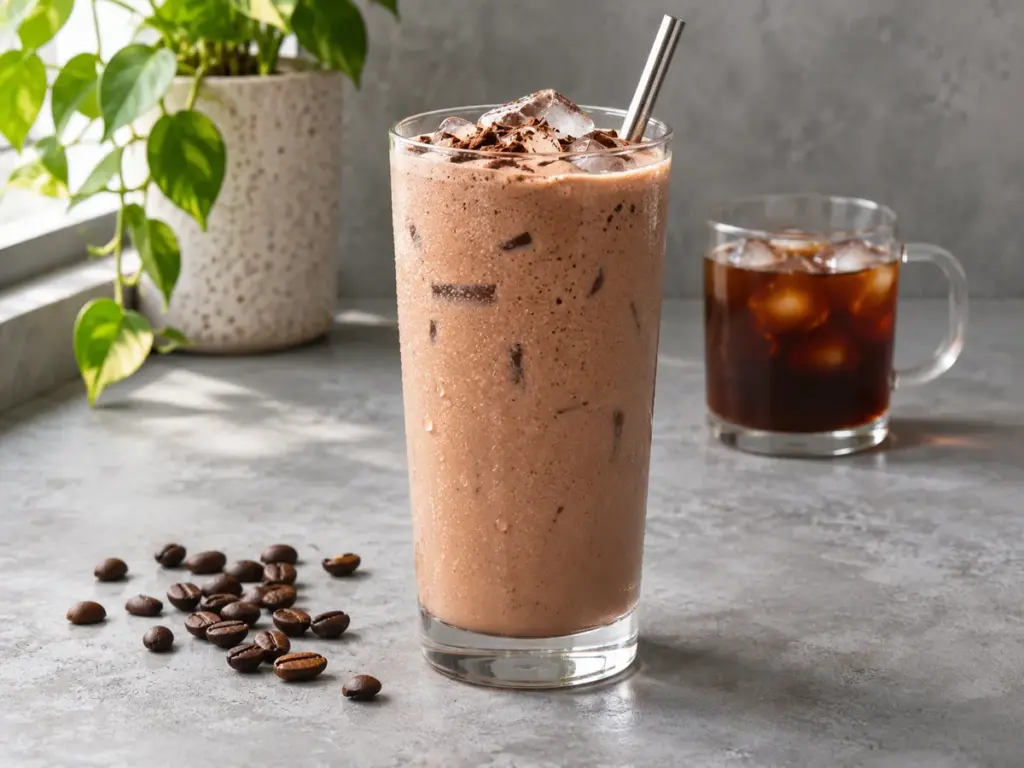
At about 26 g of protein, this is the lightest powder smoothie in the list, which suits a morning when you want something light to drink.
With no fruit or yogurt to hide it, the powder has to blend well, so you'll want a chocolate powder you already know mixes smoothly. If you add ½ cup of Greek yogurt, it comes to about 38 g.
- 1 cup unsweetened cold brew coffee (you buy it unsweetened from a carton, or chill your own overnight)
- 1 scoop chocolate protein powder
- 1 cup unsweetened almond milk (unsweetened almond milk keeps the glass light)
- ½ cup ice
- ½ teaspoon vanilla extract.
- 1 teaspoon maple syrup or honey, if you like it sweeter
- Pour the liquids. Add the cold brew and almond milk to the jar.
- Add the powder. Scoop it on top with the vanilla.
- Blend a full minute. Run it on high until you see no powder specks on the surface.
- Ice and sweetener. Add the ice, taste, and blend a few seconds more.
- Pour and sip. Serve it over ice right away. It separates a little if left, so stir it before you sip.
Since this recipe is mostly liquid, you'll see small swaps clearly.
- 1% milk instead of almond milk adds about 7 g, which brings the total to about 33 g.
- Cashew or oat milk makes the glass creamier, and the label tells you their protein.
- Vanilla powder with 1 tablespoon of unsweetened cocoa gives the same mocha taste.
A short blend leaves tiny powder clumps, so you give it the full minute.
11. Mocha Banana Protein Smoothie
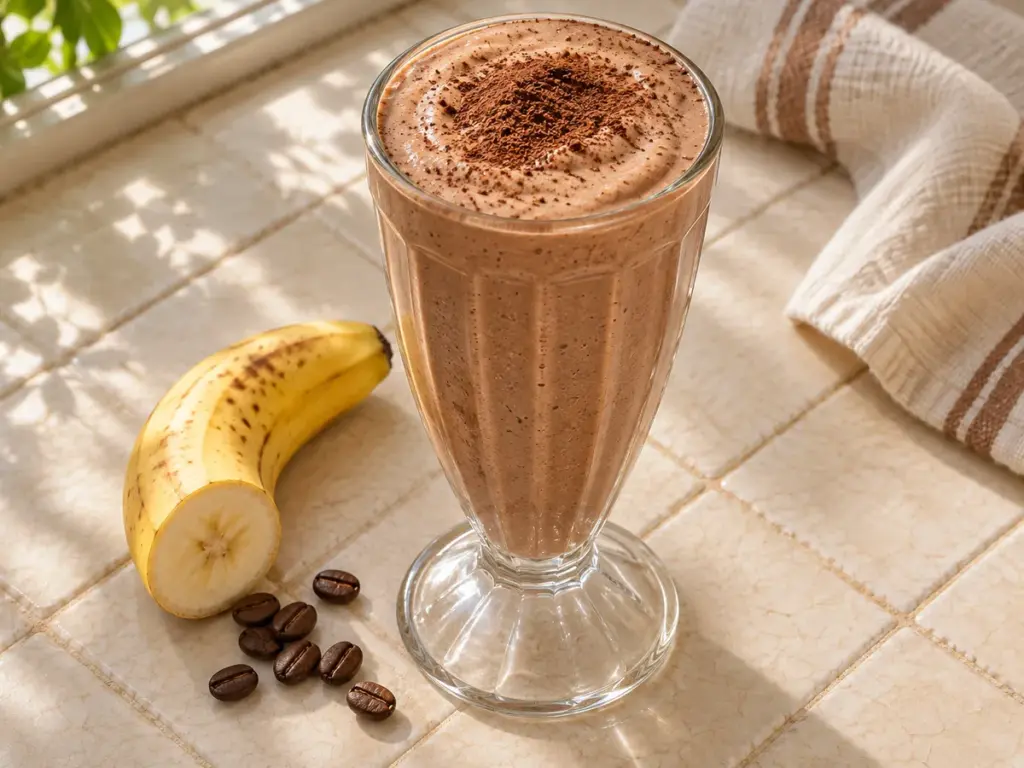
A banana turns the same coffee-and-chocolate flavor thick and sweet enough that you can skip the sweetener, and the glass holds about 28 g of protein.
If you slice and freeze the banana the night before, you get a milkshake-style texture without ice.
- 1 cup brewed coffee, cooled to room temperature (you cool it fully so the banana stays cold and thick)
- 1 medium ripe banana, sliced (freckled fruit sweetens the glass, so you can leave out the syrup)
- 1 scoop chocolate protein powder
- 1 cup unsweetened almond milk
- ½ teaspoon vanilla extract
- Ice, if the banana is not frozen
- Pour the liquids. Add the cooled coffee and almond milk to the jar.
- Add the powder. Scoop it on top, then add the banana and vanilla.
- Blend on high. Run it until you see no banana chunks.
- Ice and sweetener. Add ice if the banana is not frozen, and sweeten only if needed.
- Pour and serve. Drink it right away in a tall glass. A frozen banana keeps it thick for several minutes while you drink.
Coffee strength and banana are the two things you can change.
- Cold brew tastes smoother than hot coffee, and espresso gives a stronger mocha.
- ¼ cup of Greek yogurt adds about 6 g, which brings the total to about 34 g.
- Half an avocado replaces the banana for less sugar and a creamier glass.
1 teaspoon of unsweetened cocoa powder adds flavor and almost no sugar if you find the mocha taste faint.
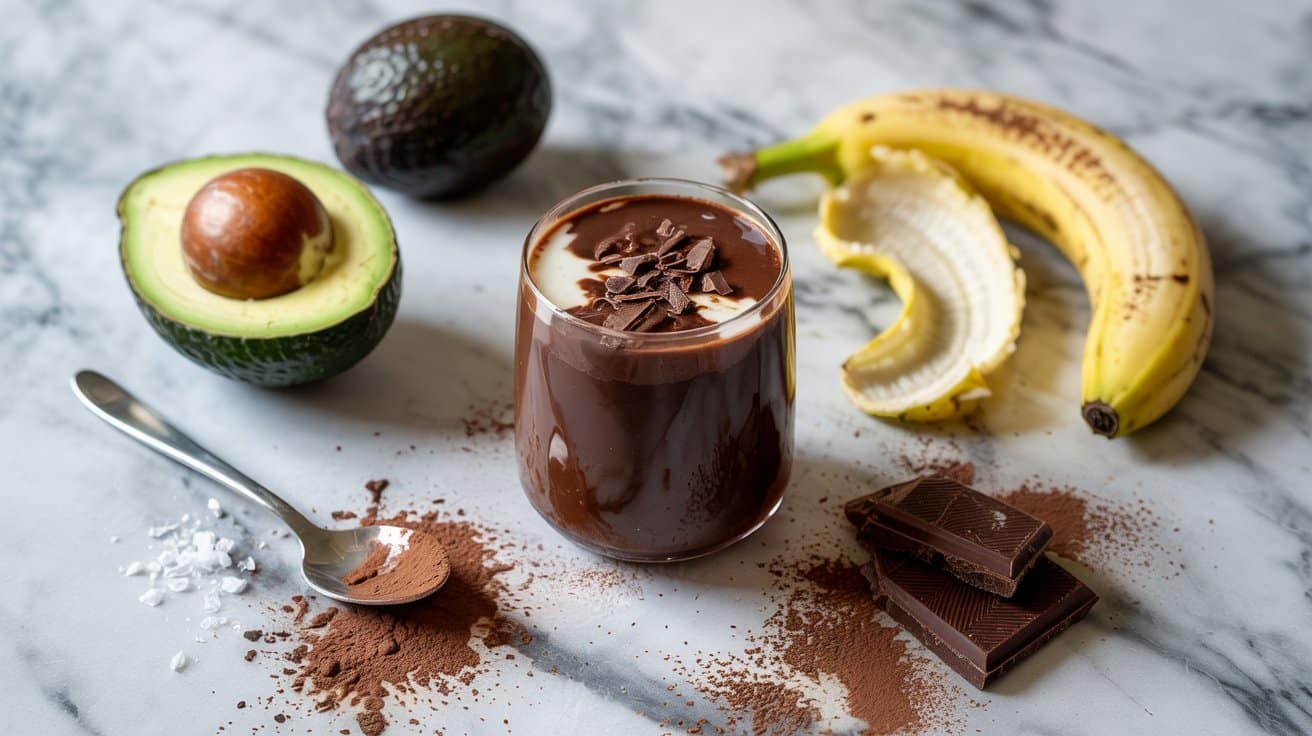
12. Chocolate Avocado Protein Smoothie
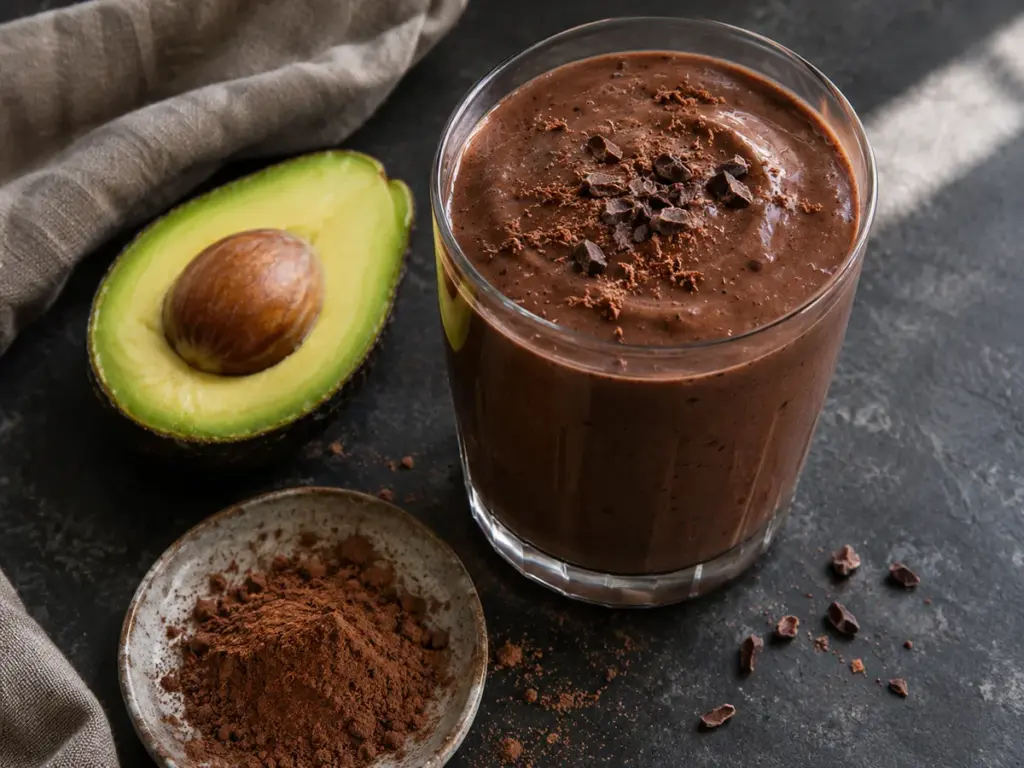
Half an avocado makes this smoothie creamy without banana or yogurt, and it still holds about 28 g of protein.
The avocado adds only about 1 g of protein, so the powder supplies the protein and the avocado gives you the texture.
Every ingredient is dairy-free when you use a plant-based powder, which makes it an easy starting point among dairy-free blends.
- ½ ripe avocado, peeled and pitted (a hard avocado blends lumpy, so you pick one that gives when pressed gently)
- 1 tablespoon unsweetened cocoa powder (cocoa deepens the chocolate flavor of the powder)
- 1 scoop chocolate protein powder
- 1 cup unsweetened almond milk
- ½ teaspoon vanilla extract
- 1 teaspoon honey or maple syrup (you add it only if the powder tastes bitter)
- ½ cup ice
- Liquid and powder. Pour the almond milk into the jar, then add the powder and cocoa.
- Add the avocado. Drop it in with the vanilla and sweetener.
- Blend and scrape. Run it on high, scraping the sides once.
- Add the ice. Blend in the ice.
- Drink it fresh. Pour it right away, because the avocado darkens as the glass sits. A pinch of salt makes the chocolate taste richer.
The avocado is the one ingredient you can replace for a different texture.
- Soft silken tofu at 3 ounces adds about 3 g more protein than the avocado and tastes milder, but the glass is less rich.
- Soy milk adds about 7 g over almond milk, and a plant-powder version stays dairy-free.
- A soaked Medjool date sweetens in place of honey.
If you freeze the unused avocado half in chunks, the frozen pieces thicken the next glass without ice.
Light and Fresh Smoothies
These three taste the lightest and hold 20 to 31 g, so you'd drink them beside a meal more than in place of one.
If you add ½ cup of Greek yogurt (about 12 g) to the spinach or cucumber smoothie, you pass 40 g.
13. Blueberry Hemp Protein Smoothie
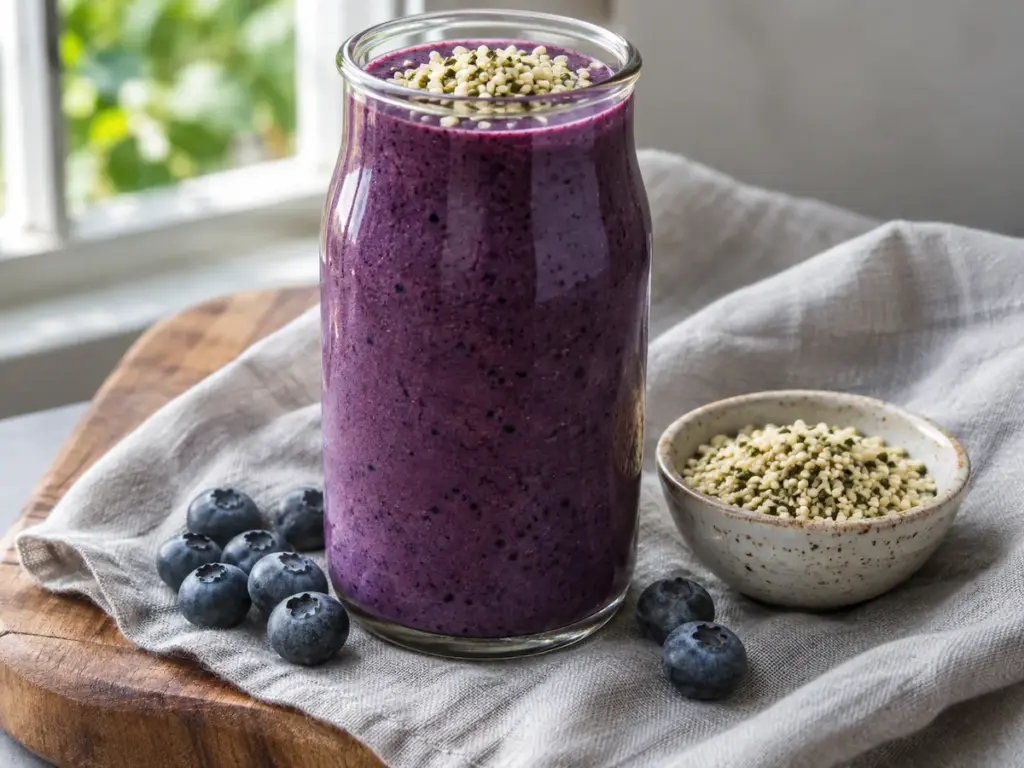
This is the only smoothie here with no protein powder, so its about 20 g of protein comes from Greek yogurt at about 12 g and 2 tablespoons of hulled hemp seeds at about 6 g.
If you add one scoop of powder, the total goes up to about 45 g, so the smoothie works as a light snack or a full post-workout drink.
- 1 cup blueberries, fresh or frozen (frozen ones need no thawing and keep the glass cold)
- ½ cup plain Greek yogurt
- 2 tablespoons hulled hemp seeds, also sold as hemp hearts, which you add without any soaking
- 1 cup cold water or plant milk (plant milk makes the glass creamier than water)
- ½ teaspoon vanilla extract
- 1 teaspoon honey or maple syrup, if needed
- A handful of ice
- Pour the liquid. Add the water or plant milk to the jar.
- Add the rest. Put in the yogurt, hemp seeds, blueberries and vanilla.
- Blend until even. Run it on high until you see one color all through.
- Ice and sweetener. Add ice, and sweeten only if the berries are sharp.
- Top and serve. Pour it right away and scatter a few whole blueberries on top.
This is the lowest-protein recipe in the list, so the swaps add or remove a few grams.
- Pumpkin seed kernels at 2 tablespoons replace the hemp seeds and add about 5 g.
- 1% milk instead of water adds about 8 g, so the total reaches about 28 g.
- Soy yogurt makes it dairy-free and drops the total to about 10 g.
- Frozen blueberries work the same and replace the ice.
Hemp seeds hold a lot of oil, so you keep the opened bag in the fridge to protect the flavor.
14. Green Spinach and Pineapple Protein Smoothie
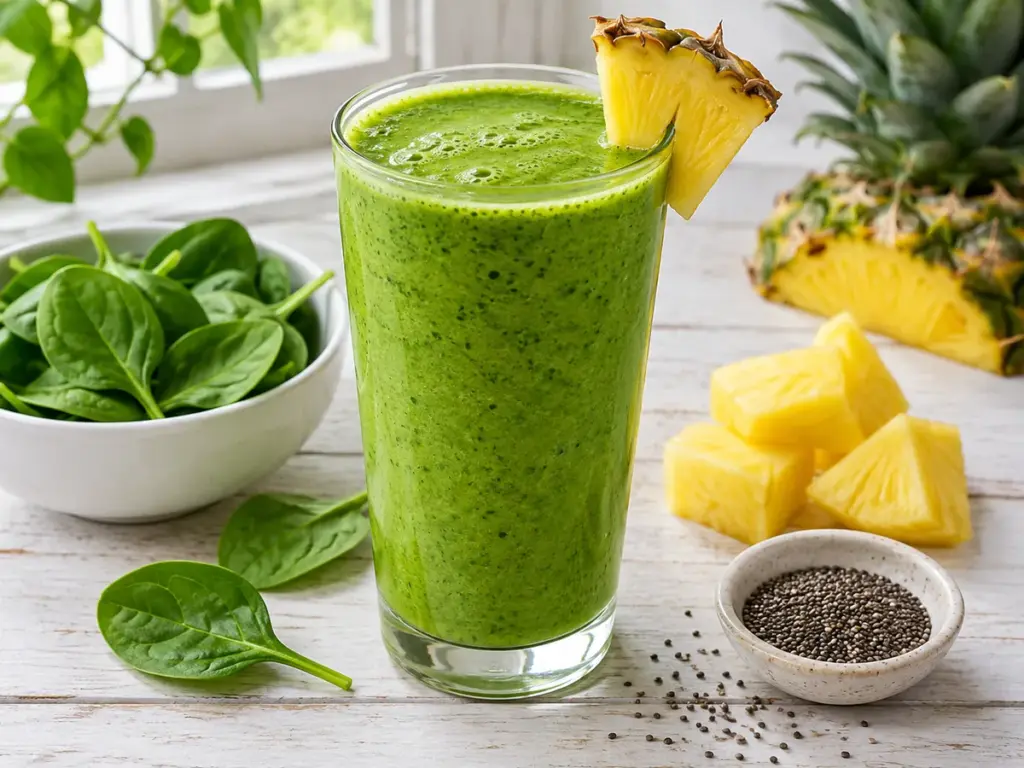
Mild baby spinach disappears behind pineapple and banana, so the glass tastes more of fruit than greens and holds about 31 g of protein. That mild taste makes it an easy start if you are new to green smoothies.
Two cups of spinach add about 2 g of protein, and a tablespoon of chia adds about 2 g more and thickens the smoothie as it sits.
- 2 cups fresh spinach, loosely packed (baby spinach is milder than mature leaves and needs no stem removal)
- 1 cup pineapple chunks, fresh or frozen (frozen pineapple thickens the glass and replaces the ice)
- 1 scoop plant-based protein powder, vanilla or unflavored
- 1 cup unsweetened almond milk
- ½ medium banana (it hides the greens and adds body)
- 1 tablespoon chia seeds
- Ice, if you want it colder
- Greens first. Run the spinach and almond milk for 30 seconds.
- Add the rest. Put in the pineapple, banana, chia and powder.
- Blend until smooth. Scrape the sides once if you see leaves stuck.
- Ice last. Add a few cubes at a time for a thicker glass.
- Pour and serve. Drink it right away.
The greens and the fruit trade easily, so the protein stays close to 31 g.
- Kale or Swiss chard replace the spinach.
- Mango or orange segments replace the pineapple for a different sweetness.
- Pea, hemp or a blend all work as the powder, but plant powders vary by brand, so you read the label.
If you bag the spinach, pineapple, banana and chia as one portion and freeze it, only the milk and powder are left to add in the morning.
15. Cucumber Mint Protein Smoothie
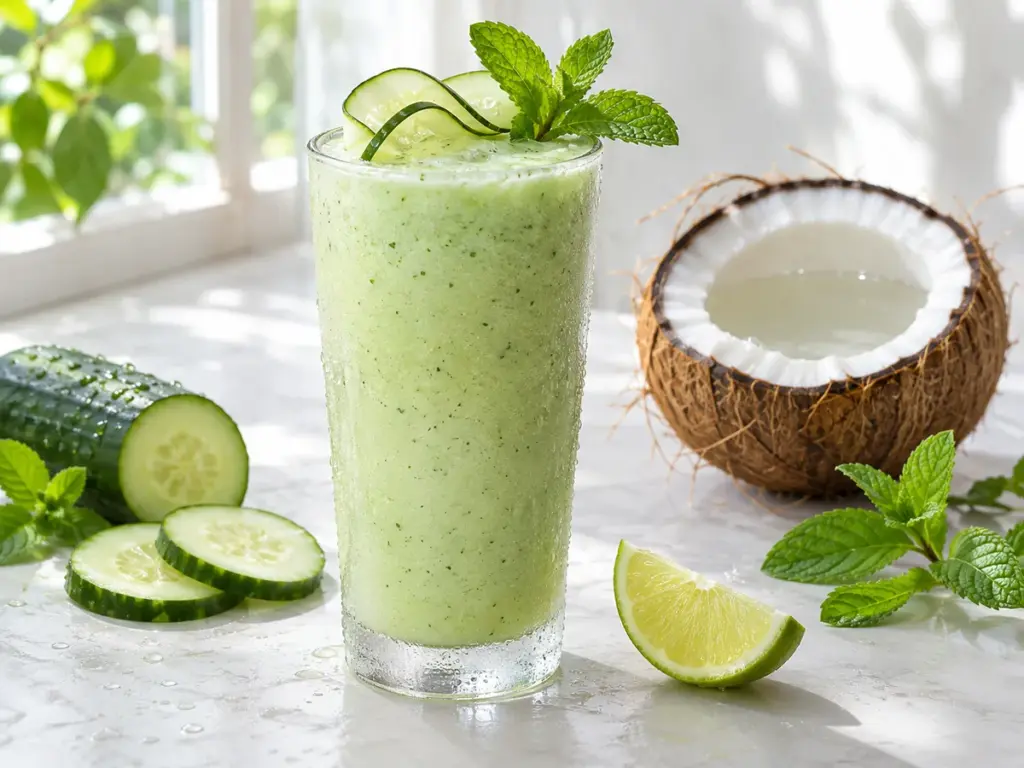
Coconut water makes this the lightest-tasting smoothie in the list and the only one built on it, and its 1 ½ cups add about 3 g toward a total of about 30 g of protein.
Mint gets loud fast, so a large handful, about ¼ cup, is plenty, and a full cup would take over. A few spoonfuls of Greek yogurt make it creamier, the way cucumber-mint yogurt smoothies do.
- 1 medium cucumber (about 200 g), peeled and chopped (you peel it if the skin is waxed or bitter and leave the seeds in)
- ¼ cup loosely packed fresh mint leaves (dried mint tastes dusty here, so you buy fresh)
- 1 scoop pea protein powder, unflavored or vanilla
- 1 ½ cups chilled coconut water, plain with no added sugar. A carton gives about 2 g less protein than the raw entry the 30 g total counts, so you may land slightly under 30 g.
- 1 tablespoon fresh lime juice (it tastes brighter than bottled, so you squeeze it fresh)
- 1 teaspoon honey or maple syrup, optional
- 1 cup ice
- Pour the liquids. Add the coconut water and lime juice to the jar.
- Add the powder. Scoop it on top of the liquid.
- Add the greens. Put in the cucumber and mint.
- Blend with ice. Run it on high, then add more mint if you taste too little.
- Serve very cold. Pour it right away and add a mint sprig.
Mint, cucumber and the liquid all take swaps.
- Basil or parsley gives a different herbal note than mint.
- Zucchini replaces the cucumber with a similar mild taste.
- ¼ cup of Greek yogurt adds about 6 g and a creamier body, which lifts the total to about 36 g.
- Almond milk instead of coconut water makes the glass creamier.
You'll want to chill the cucumber and the coconut water first, because cold ingredients taste fresher and need less ice.
Tropical and Plant-Based Smoothies
All five are dairy-free when you choose a plant-based powder. Coconut milk, chia and nut butter do the thickening that yogurt does in the first group.
16. Coconut Mango Protein Smoothie
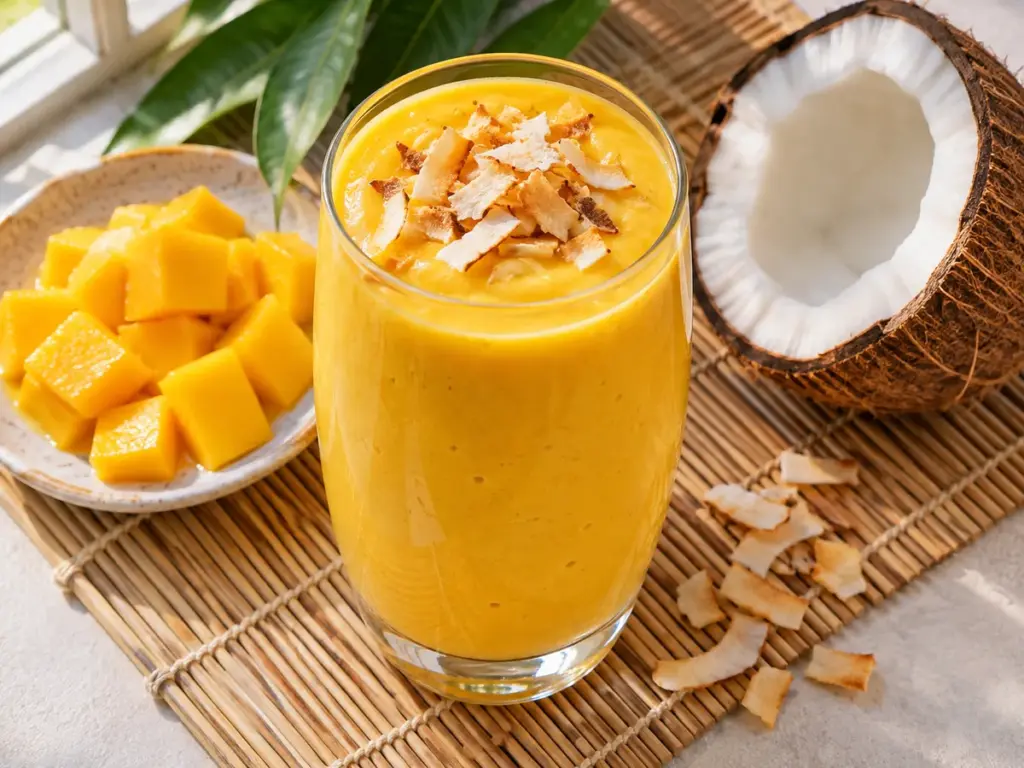
A cup of canned coconut milk replaces both the milk and the fat that nut butter would add, and its 5 g or so brings this glass to about 31 g of protein.
If you use carton coconut milk instead, it is thinner and adds about 4 g less. Pea powder tastes earthy, and the mango's sweetness covers it.
- 1 cup canned coconut milk, stirred
- 1 cup mango chunks, fresh or frozen (you'll smell a ripe mango sweet at the stem end, and frozen chunks make the glass thick)
- 1 scoop pea protein powder
- ½ cup ice
- ¼ cup water, which you add a tablespoon at a time if the blender stalls
- 1 teaspoon honey or maple syrup, optional
- Stir the can. Canned coconut milk separates, so stir it until smooth.
- Liquids first. Pour the coconut milk and water into the jar.
- Add the rest. Put in the mango, powder and ice.
- Blend on high. Run it until creamy, and add a splash of water if it will not move.
- Pour and serve. Serve it cold right away. It keeps thickening in the glass, so thin it with a splash of water.
The coconut milk sets both the richness and the protein.
- Soy milk adds about 3 g more protein than canned coconut milk, but the glass is less rich.
- Almond or oat milk makes it lighter, and almond milk lowers the total by about 3 to 4 g.
- A tablespoon of chia disappears into the flavor and adds about 2 g.
You rarely need a whole can, and opened canned coconut milk keeps about 4 days in the fridge, according to USDA FoodKeeper, so you pour the rest into a lidded jar.
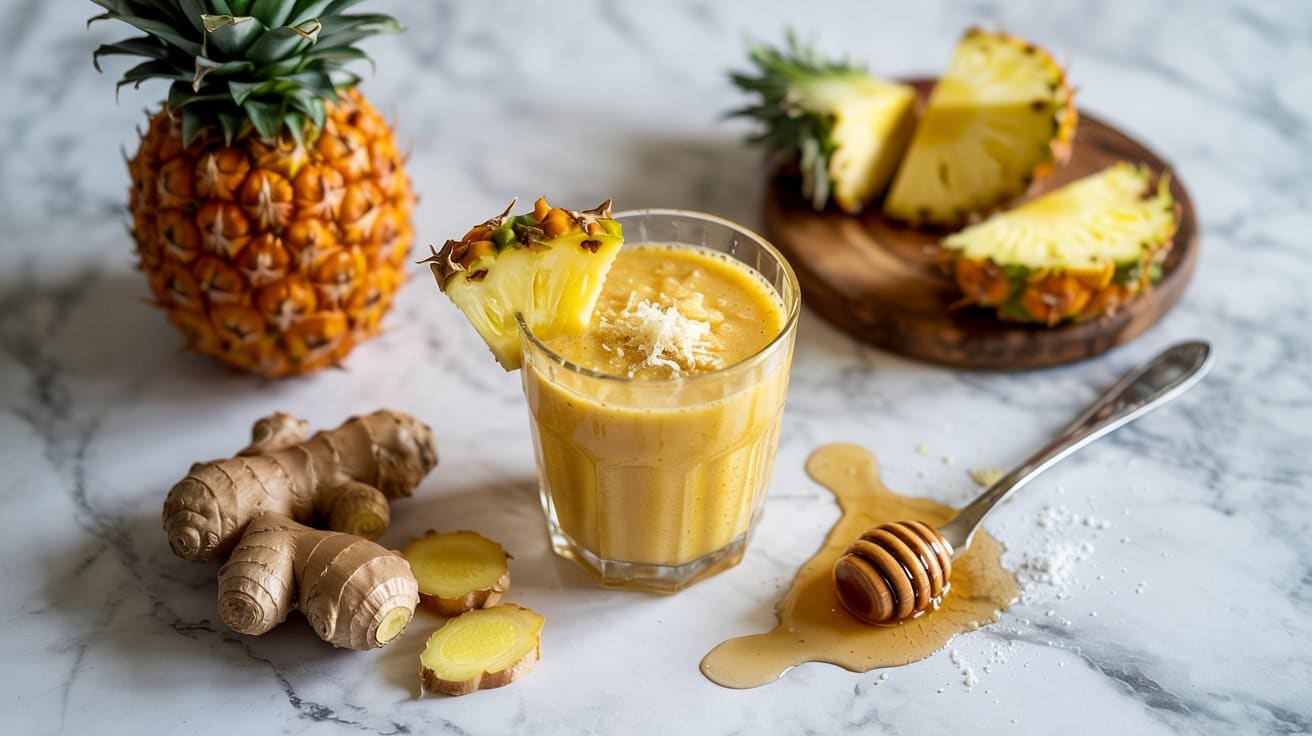
17. Tropical Turmeric Pineapple Protein Smoothie
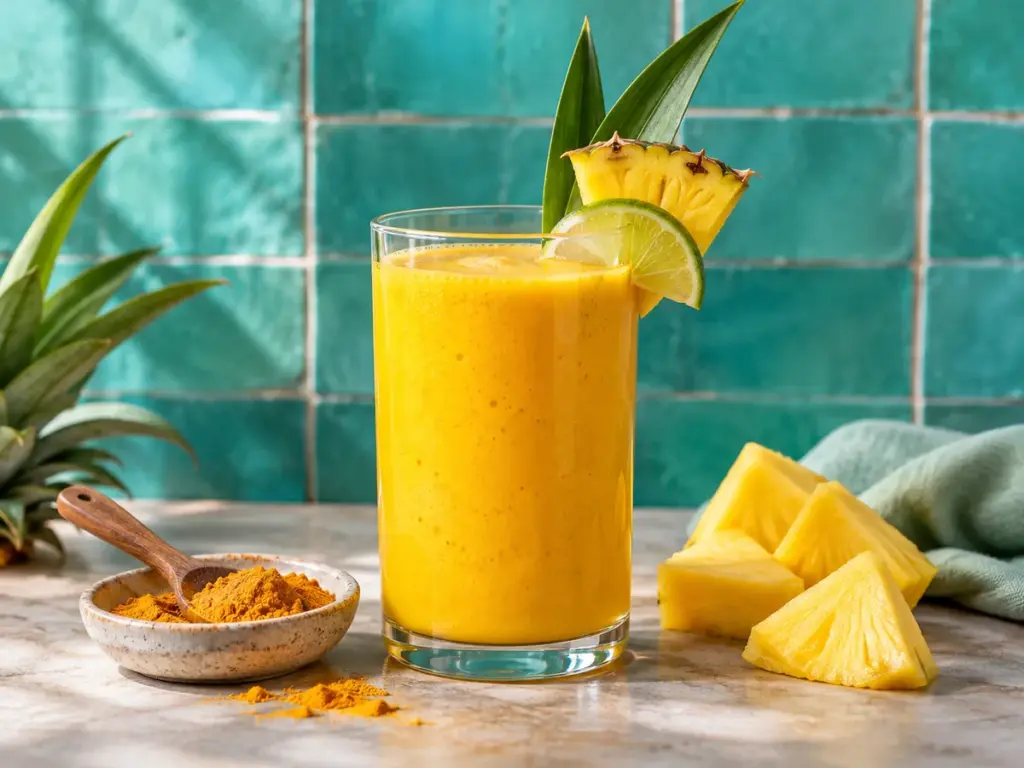
Pineapple and lime keep the turmeric tasting bright and clean in this glass with about 33 g of protein.
You'll want to stay at ½ teaspoon, because more turns the smoothie bitter, and turmeric stains a plastic blender jar yellow.
- 1 cup pineapple chunks, fresh or frozen
- ½ teaspoon ground turmeric (old turmeric tastes dull and dusty, so you open a fresh jar)
- 1 scoop pea protein powder
- 1 cup canned coconut milk
- ½ frozen banana
- 1 tablespoon chia seeds (chia thickens the glass and adds about 2 g of protein)
- 1 teaspoon fresh lime juice.
- ½ cup ice
- Liquid first. Pour the coconut milk and lime juice into the jar.
- Dry items. Add the powder, turmeric and chia.
- Add the fruit. Put in the pineapple, frozen banana and ice.
- Blend on high. Run it until you see no streaks of turmeric.
- Pour and serve. Drink it right away from a glass you do not mind staining.
The turmeric strength and the liquid are the two choices you make here.
- Fresh turmeric at about 1 ½ teaspoons grated replaces the ground, and you should taste before adding more.
- Almond milk instead of coconut milk lowers the total by about 3 to 4 g, and soy milk raises it by about 3 g.
- A soaked Medjool date sweetens a tart pineapple.
Turmeric stains plastic jars yellow once it dries, so you rinse the jar with cold water right after you pour.
18. Pumpkin Spice Protein Smoothie
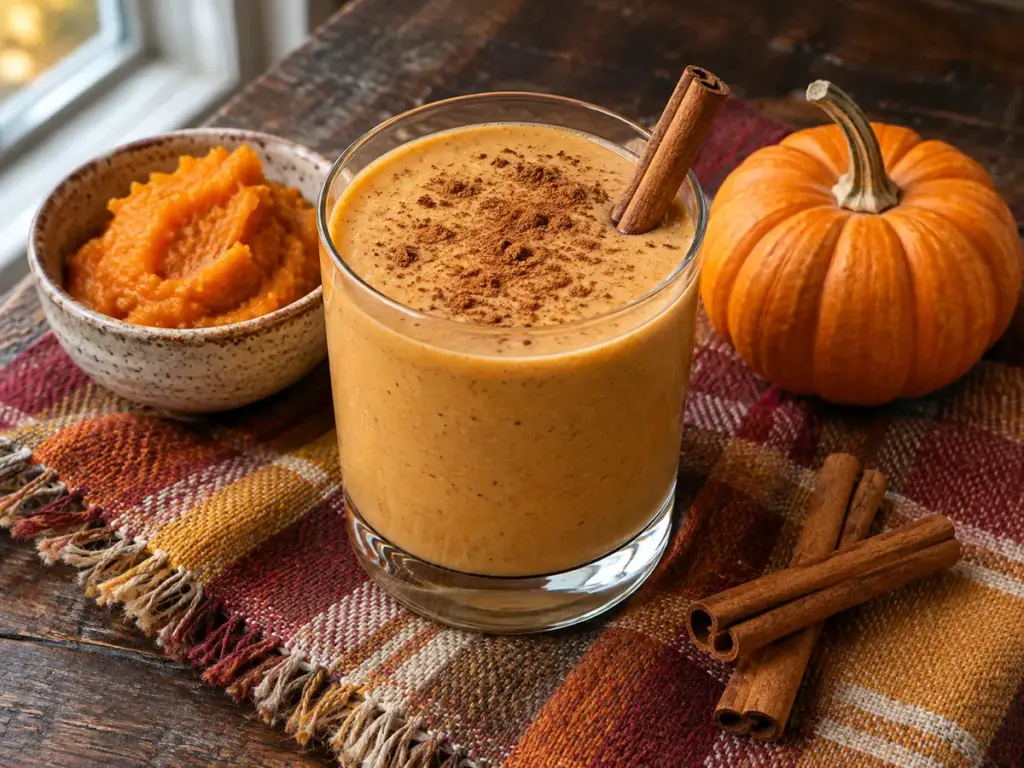
You use plain canned pumpkin here, since pumpkin pie filling already has sugar and spices in it, and the glass holds about 28 g of protein.
Pumpkin adds only about 1 g of protein, so the powder does the work and the pumpkin gives you body and color.
Opened canned puree keeps 3 to 4 days in the fridge (USDA FoodKeeper, opened low-acid canned goods), so you can make this a few times from one can.
- ½ cup plain pumpkin puree
- 1 scoop plant protein powder, vanilla or unflavored
- ½ teaspoon ground cinnamon (you add it with the powder so it does not clump on top of the milk)
- ¼ teaspoon ground nutmeg
- 1 cup unsweetened almond milk
- ½ frozen banana (if you freeze it in slices, the pumpkin smoothie turns thick)
- ½ teaspoon pure vanilla extract
- Ice, if you want it colder
- Liquid and powder. Pour the almond milk into the jar, then add the powder.
- Add the pumpkin. Put in the puree, frozen banana, spices and vanilla.
- Blend on high. Run it for 30 to 45 seconds, until you see no lumps of pumpkin.
- Taste for spice. Add ice if you want it colder.
- Dust and drink. Sprinkle a little cinnamon on top and drink it right away.
The pumpkin, the powder and the spice mix each have an easy swap.
- Butternut squash puree works in place of pumpkin, and USDA lists both at about 1 g of protein per 100 g.
- Whey or pea powder gives the same 25 g as the plant powder, but whey is not dairy-free.
- ¾ teaspoon pumpkin pie spice replaces the cinnamon and nutmeg.
- Maple syrup adds sweetness if you want more than the pumpkin gives.
If you freeze leftover puree in ½-cup scoops on a tray, the frozen pumpkin thickens the glass like ice does.
19. Vanilla Chia Seed Protein Smoothie
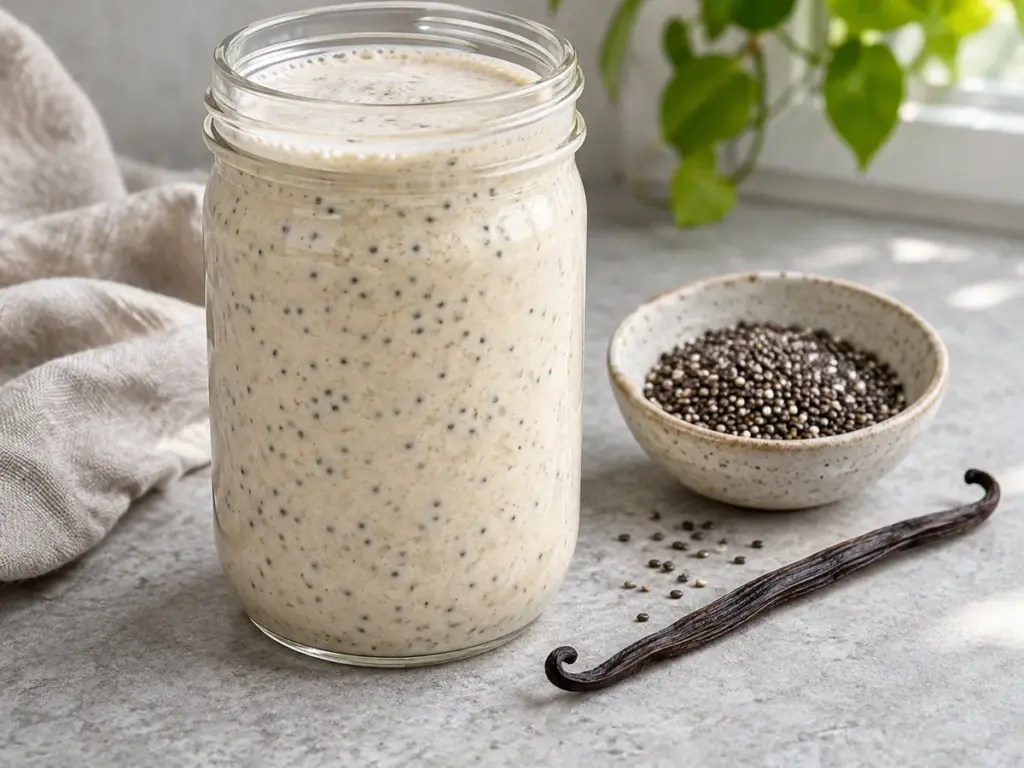
Chia seeds soaked for 10 minutes form a gel that thickens this glass without fruit or ice, and it holds about 28 g of protein.
The tablespoon adds about 2 g of protein, and the almond milk adds about 1 g more, so the powder carries almost all of it.
- 1 tablespoon chia seeds, soaked in 3 tablespoons water for 10 minutes
- 1 scoop vanilla protein powder (vanilla powder suits the cinnamon and chia)
- 1 cup unsweetened almond milk
- ¼ teaspoon ground cinnamon.
- 1 teaspoon pure maple syrup or honey
- ½ cup ice
- Soak the chia. Stir it into 3 tablespoons of water and wait 10 minutes.
- Liquid and powder. Pour the almond milk into the jar, then add the powder.
- Add the gel. Put in the chia gel, cinnamon and maple syrup.
- Blend with ice. Add the ice and blend 30 to 45 seconds, until creamy.
- Pour and serve. Drink it right away, because the gel keeps thickening it while you wait.
The chia, the spice and the milk can each change.
- Hulled hemp seeds at 1 tablespoon add about 3 g, while ground flaxseed adds about 1 g.
- Nutmeg or cardamom gives a different warm spice than cinnamon.
- Soy milk adds about 7 g over almond milk.
Whole chia stays slightly crunchy, so a longer soak or ground chia gives you a perfectly smooth glass.
20. Vanilla Date Protein Smoothie
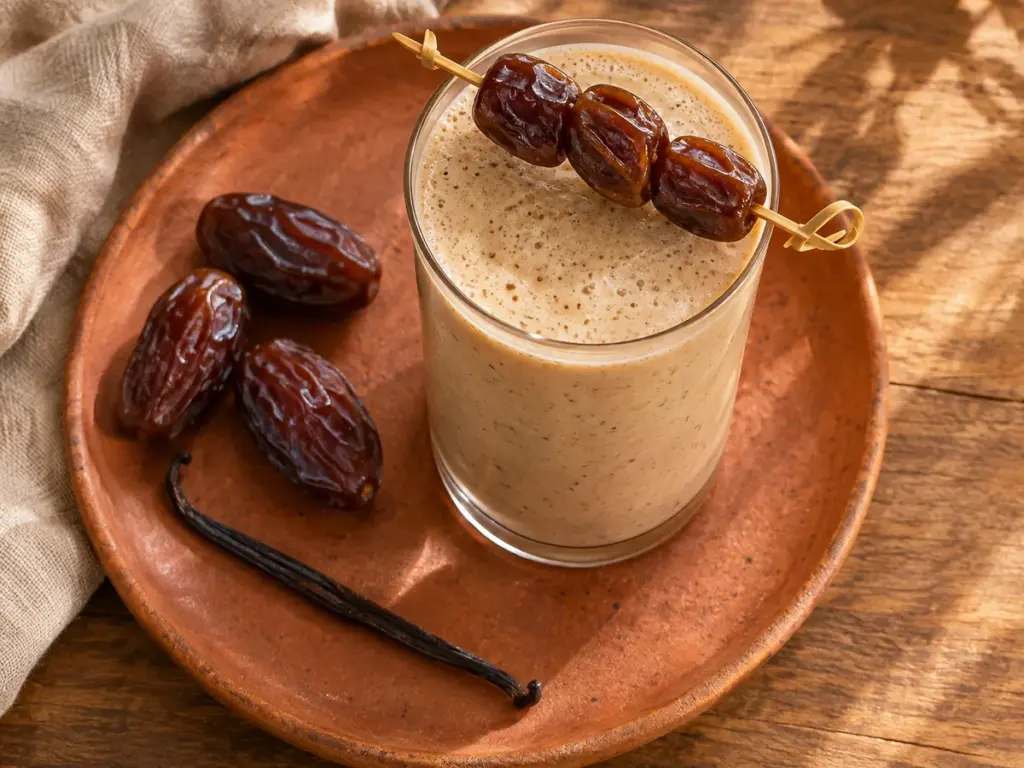
Two Medjool dates add caramel sweetness and about 1 g of protein with no sugar added to the jar, for about 27 g of protein in all.
Dates can leave bits in a weaker blender, so you soak them in the almond milk for 5 minutes first. A tablespoon of nut butter makes it richer if you want it more like a milkshake.
- 1 cup unsweetened almond milk (unsweetened milk lets the dates do all the sweetening)
- 2 pitted Medjool dates (Medjool dates are soft and sweet, and if you use drier dates, you soak them longer)
- 1 scoop vanilla protein powder
- ½ teaspoon vanilla extract
- ½ cup ice
- Soak the dates. Let them sit in the almond milk for 5 minutes.
- Add the powder. Scoop it in with the vanilla.
- Blend on high. Run it until you see no pieces of date.
- Ice and thickness. Add the ice, and thin it with milk if needed.
- Pour and serve. Serve it cold right away. A pinch of cinnamon on top suits it.
Dates sweeten this recipe, and a few swaps change the body.
- A small frozen banana sweetens and thickens in place of the dates, with about 1 g of protein.
- 1 tablespoon of peanut butter adds about 3.5 g and makes it richer.
- Soy milk adds about 7 g over almond milk.
Pitted dates can still hide a pit piece, so it pays to tear each date open before you drop it in the jar.
What Should You Keep Stocked for These Smoothies?
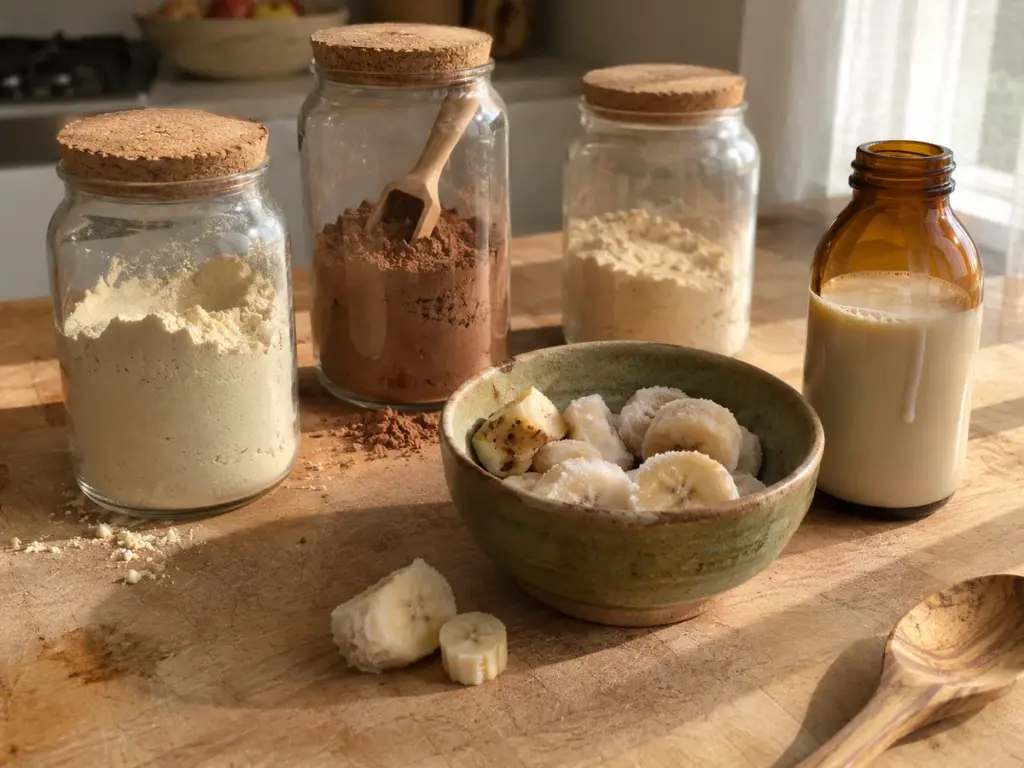
A short shopping list covers most of the 20 recipes, and the counts below come from the ingredient lists you just read.
- Protein powder: 19 of 20 recipes. One vanilla, one chocolate and one unflavored tub cover all 19, so three tubs are all you need.
- Ice or frozen fruit: all 20 recipes, and frozen fruit can replace the ice.
- Unsweetened almond milk: 10 recipes.
- Honey or maple syrup: 12 recipes, always optional or to taste.
- Vanilla extract: 10 recipes.
- Plain Greek yogurt: 7 recipes: numbers 1 to 6 and the blueberry hemp one.
- Bananas: 7 recipes, and sliced and frozen bananas thicken the glass without ice.
If you start with the three tubs of powder and a carton of almond milk, the rest of the list is fruit you can slice and freeze in bags.
How Do You Build Your Own High-Protein Smoothie?
Every recipe above stacks the same five layers, so you can change the flavor and keep the protein by choosing the first three layers first.
- Pick the protein. You take one 25 g scoop of powder, or 1 cup of plain nonfat Greek yogurt (about 24 g).
- Pick the liquid. You pour 1 cup of 1% or soy milk (about 8 g) or unsweetened almond milk (about 1 g).
- Pick the creamy part. You add 2 tablespoons of nut butter (6 to 7 g) or ½ cup of Greek yogurt (about 12 g).
- Pick the fruit. About 1 cup of berries, mango or pineapple, or one banana, gives you sweetness and about 1 g.
- Pick the cold. Frozen fruit or a handful of ice keeps the glass thick.
Three builds show how far the same layers can stretch the total.
- 1 scoop (25 g)
- ½ cup Greek yogurt (12 g)
- 1 cup 1% milk (8 g)
- 1 cup Greek yogurt (24 g)
- 1 cup 1% milk (8 g)
- 2 tablespoons peanut butter (7 g)
- 1 banana (1 g)
- 1 scoop (25 g)
- 1 cup almond milk (1 g)
- Fruit and ice
If you leave out one protein layer, raise another: a second tablespoon of nut butter or ¼ cup more yogurt covers a small gap.
Which Smoothie Should You Make Today?
You'll choose best by what is in your kitchen and how much protein you want from one glass.
| You want | Make | Why |
|---|---|---|
| 45 g or more | 1 to 4 | Greek yogurt plus a full scoop |
| No yogurt in the fridge | 8, 10 or 11 | Powder, nut butter or banana carry it |
| Mild greens | 5 or 14 | Kiwi and pineapple cover the taste |
You can also choose by texture, drink and season.
- A spoonable texture: you'll want 3 or 6, because the oats thicken as they soak.
- A coffee drink: 9, 10 or 11 suit you, because coffee and cocoa hide the powder.
- A fall flavor: 18 gives you pumpkin, cinnamon and nutmeg.
For a dairy-free glass, you choose 8, 10 to 12 or 14 to 20 with a plant powder and plant milk.
The lighter smoothies, 10, 13 and 20, hold 20 to 27 g, so you can serve them as a snack or beside a bigger high-protein breakfast.
Can You Make Protein Smoothies Ahead or Freeze Them?
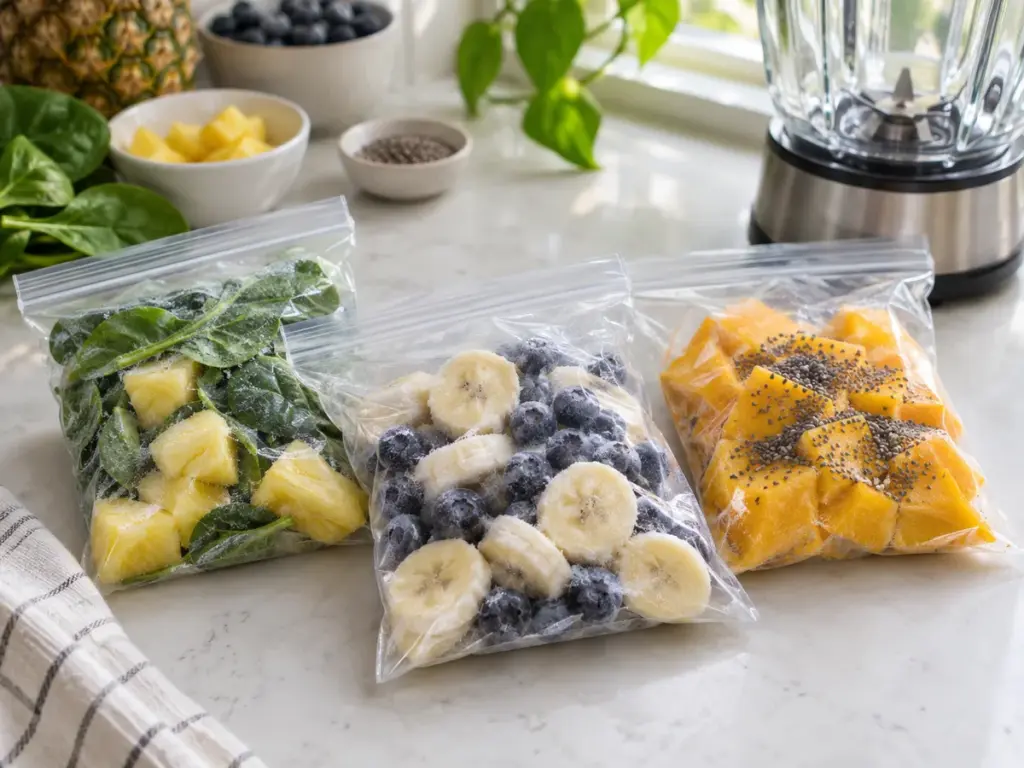
Yes, and the easiest way is to freeze the fruit, greens and seeds in one-serving bags, then add the liquid and powder when you blend.
- It tastes best the same day.
- USDA FoodKeeper gives cooked leftovers 3 to 4 days, but a smoothie loses its texture long before that.
- Chia and oats keep thickening, so a splash of milk thins it.
- One serving of fruit, greens and seeds goes in each bag.
- Food held at 0°F stays safe, and only quality fades.
Perishable food should not sit out more than 2 hours, or 1 hour above 90°F, so you throw away a dairy smoothie left in a warm car.
Avocado and banana smoothies darken and thicken in the fridge, so you'll want to blend those fresh.
How Do You Make These Smoothies Dairy-Free?
If you need these dairy-free, three ingredients carry the dairy in this list, and each has a swap that changes the protein count by a known amount.
You'll want a plant-based powder. FoodData Central's soy-based powder entry also works out to 25 g of protein per scoop, but pea and other plant powders vary by brand, so you read the label.
Soy yogurt works as the swap for Greek yogurt, but it has about 2.4 g of protein per 100 g in FoodData Central against 10.2 g for plain nonfat Greek yogurt.
If you swap ½ cup, you lose about 9 g, which a second scoop or a spoon of nut butter makes up. Other yogurt stand-ins change the texture too.
For milk, 1 cup of 1% milk has about 8 g of protein and 1 cup of unsweetened soy milk has about 7 to 8 g, while unsweetened almond milk has about 1 g. Soy milk is the closest swap.
A peanut or tree-nut allergy calls for sunflower seed butter, which gives about 5.5 g per 2 tablespoons. For gluten, you buy oats labeled gluten-free and read every powder label for allergens.
Sources
- USDA FoodData Central (SR Legacy data): protein per 100 g and cup, tablespoon and fruit weights for every ingredient, plus the whey-based and soy-based protein powder entries.
- Harvard T.H. Chan School of Public Health, The Nutrition Source: Protein: the 0.8 g per kilogram daily minimum for adults.
- USDA FSIS, How Temperatures Affect Food: the 2-hour and 1-hour rules and freezer safety at 0°F.
- USDA FoodKeeper: canned coconut milk and opened low-acid canned goods such as pumpkin, 3 to 4 days in the fridge once opened, and cooked leftovers, 3 to 4 days.
- USDA FoodData Central, SR Legacy records used for the swaps: FDC 174294 and 168588 (peanut and almond butter), 170163 (cashew butter), 170155 (sunflower seed butter), 173417 (cottage cheese), 170904 (kefir), 172446 (soymilk), 174292 (silken tofu), 170148 (hemp seeds), 170554 (chia), 169414 (flaxseed), 170556 (pumpkin seed kernels), 173904 (oats), 173177 (whey isolate).
Frequently Asked Questions
What Should You Look for in a High-Protein Smoothie Recipe?
You'll want printed protein grams and the amounts behind them. A recipe that lists "protein powder" with no scoop size or yogurt amount cannot tell you its total.
The base matters next, because Greek yogurt, milk, nut butter and seeds carry most of the protein besides the powder.
How Do You Sweeten a Protein Smoothie Without Honey?
A ripe banana, 2 Medjool dates or 1 cup of mango or pineapple sweeten the glass with no added sugar.
Frozen fruit seems less sweet while the glass is ice cold, so you taste again after blending.
Which Vegetables Hide Best in a Protein Smoothie?
Baby spinach (14), cucumber (15), canned pumpkin (18) and avocado (12) disappear fastest, and kale (5) needs tart kiwi to cover it.
Each adds only 1 to 2 g of protein, so they give bulk and color, not protein.
Do You Need a High-Speed Blender for a Protein Smoothie?
No, a basic blender handles powder, yogurt, milk and soft fruit. A stronger motor only matters for ice, frozen fruit, kale, dates and whole chia.
With a basic blender, you put the liquid in first, cut the fruit small, soak the oats and dates, and blend a full minute.
Can You Use Water Instead of Milk in a Protein Smoothie?
Yes, but you lose about 8 g of protein that 1 cup of 1% milk would add, and some creaminess.
If you add ¼ cup of Greek yogurt (about 6 g), you win part of it back.
Why Does a Protein Smoothie Turn Foamy?
Whey powder traps air when it blends fast and long, so the top turns to foam.
If you let the glass rest a minute or two or stir it with a spoon, the foam settles, and you can blend a little shorter next time.

Andrew Gray is the founder of Gusto Meadow, a food site for home cooks. He writes ingredient substitutes, food comparisons, taste guides, storage guides and dinner ideas, with numbers drawn from sources such as USDA, FDA and university extension services.
At Gusto Meadow, Andrew focuses on fresh, seasonal ingredients and simple methods that anyone can follow. His goal is to make cooking feel fun, doable, and rewarding — whether you’re preparing a quick weeknight dinner or exploring something new.
Storage and food-safety numbers follow USDA, FDA and university extension guidance.