
Buy a sandwich maker for sealed, cut-in-half toasted sandwiches on sliced bread, and a panini press for thick bread and grill marks.
- A sandwich maker has shaped plates that pinch the edges shut, so the filling stays inside.
- A panini press has flat ridged plates that squash without sealing.
- Pick the press if you also grill, the maker for kids' grilled cheese.
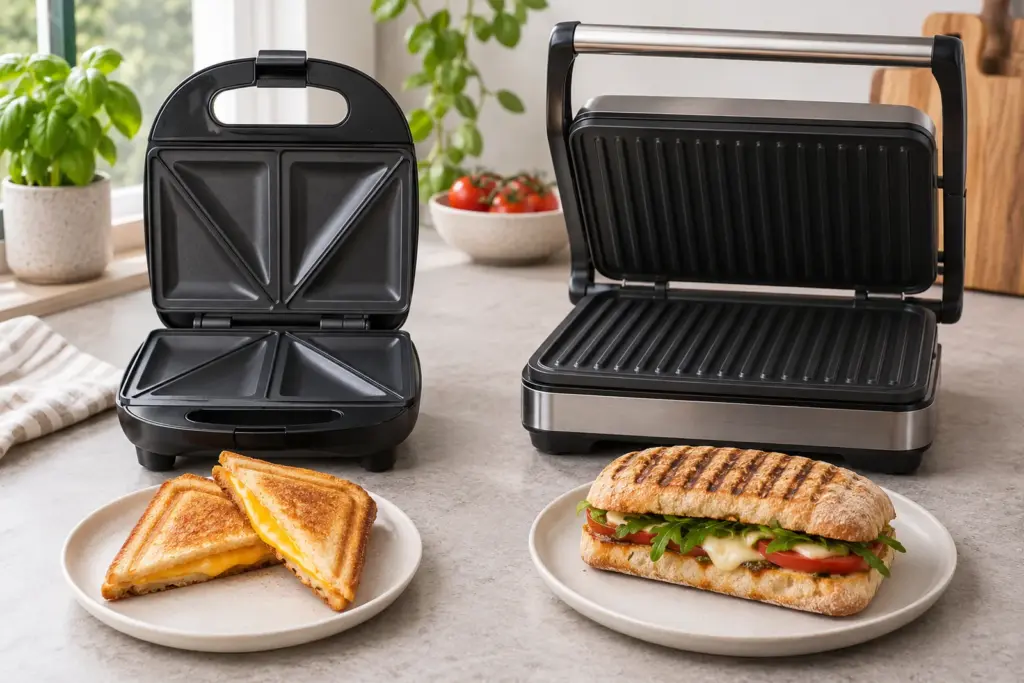
Both machines are two heated plates on a hinge, so people mix them up the same way they mix up other look-alike kitchen gadgets. The plate shape, what happens at the edges of the bread, and how the lid sits on a thick sandwich set them apart. Together those three decide what you can cook and how much cleanup you get.
1. What Is the Difference Between a Sandwich Maker and a Panini Press?
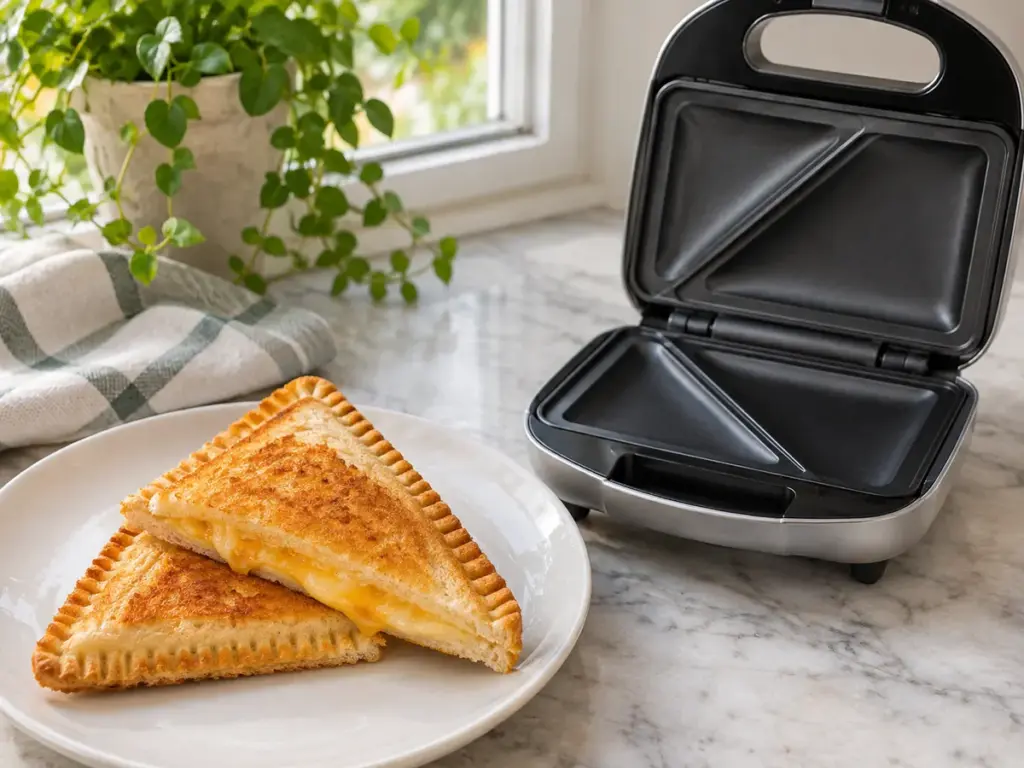
A sandwich maker is built around a mold. Its plates are usually smooth and non-stick, with a raised rim that presses the two slices of bread together and seals the edges, according to Food Republic. A panini press has plates that typically have ridges, so the lid flattens the whole sandwich and leaves grill marks.
| Trait | Sandwich maker | Panini press |
|---|---|---|
| Plates | Smooth non-stick, often shaped like triangles or squares | Ridged on top and bottom, often removable on pricier models |
| Edges of the bread | Pinched shut, so the filling stays in | Left open, so melted cheese can ooze out |
- The lid is a fixed clamp, made for two slices of sliced bread.
- It works best with soft sliced sandwich bread.
- The lid has a fixed or floating hinge, so a thick sandwich fits.
- It works best with ciabatta, focaccia, sourdough or any thick loaf.
- For other jobs, a sandwich maker makes toasted pockets and egg and cheese, and some models swap in waffle plates. A panini press also cooks burgers, chicken, vegetables and quesadillas, and works as a griddle when opened flat.
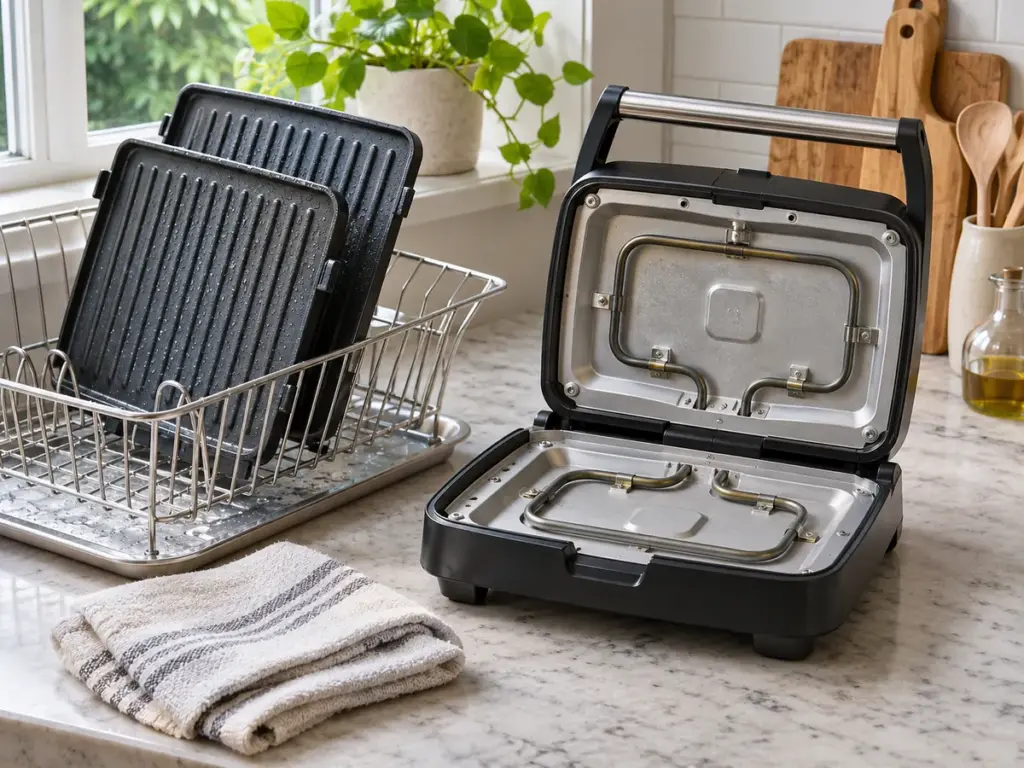
- For size and cleanup, a sandwich maker is smaller and wipes clean with a damp cloth. A panini press is bigger, but removable plates make it easier.
If the bread edges and the bread thickness matter to you, the first four rows already point to one machine, and the rest are tiebreakers.
2. What Does Each One Make Best?
Pick by the sandwich you make every week, because each machine is good at a narrow job.
- Sandwich maker: grilled cheese, ham and cheese, and egg and cheese breakfast sandwiches on regular sliced bread. Because the edges seal, a runny filling such as melted cheese stays put, which is why kids' lunches and dorm rooms lean on it.
- Panini press: turkey and avocado on ciabatta, ham and Swiss on sourdough, or a quesadilla. It handles thick bread and tall fillings, and the better models also grill chicken, vegetables or a burger.
A panini is traditionally built on Italian bread such as ciabatta or focaccia, which is what sets it apart from a regular sandwich. If you only want grill marks now and then, a griddle or grill pan with a heavy skillet pressed on top gets you part of the way without a new machine.
3. Do Ridged Plates Matter?
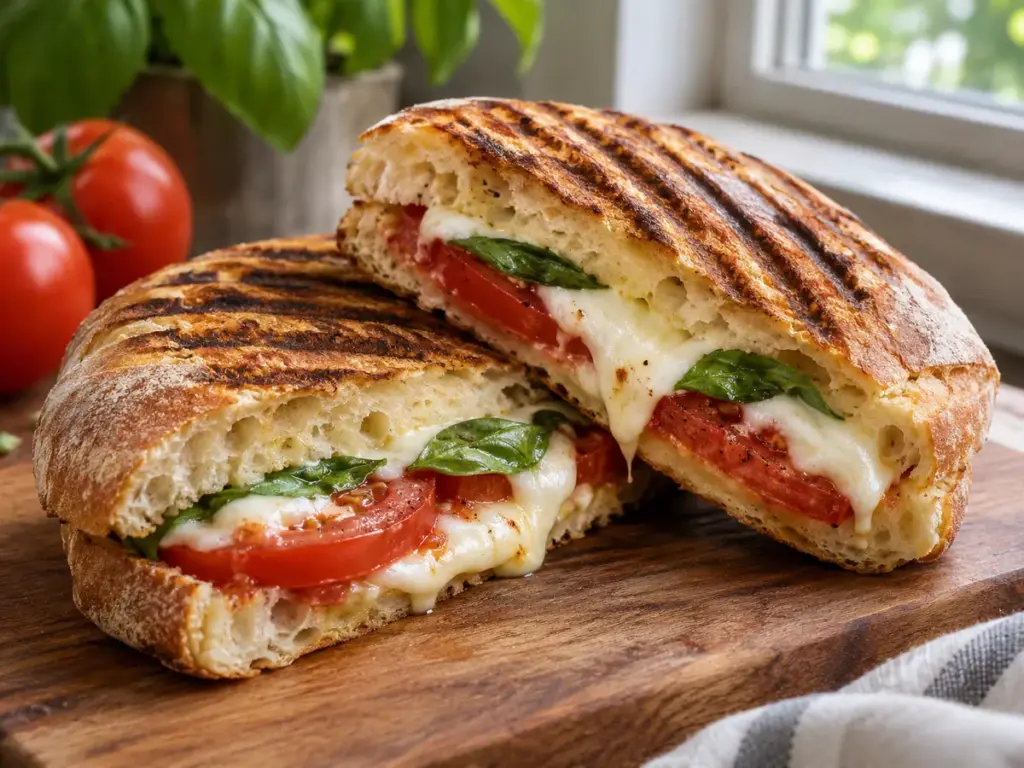
Ridges give you grill marks and let grease run off the sandwich into the grooves. America's Test Kitchen tested presses priced from about $20 to about $300 and found that ridges 0.125 to 0.25 inch tall worked best, and the favorites spaced them 0.5 inch apart, which also makes cleaning easier.
Smooth plates brown the bread evenly but leave no lines. That suits a sandwich maker fine, since its job is a sealed, golden sandwich rather than a grilled look. Pick ridges when the grill marks matter, and pick smooth plates when you want the edge seal and the least scrubbing.
4. What Is a Floating Hinge, and Do You Need One?
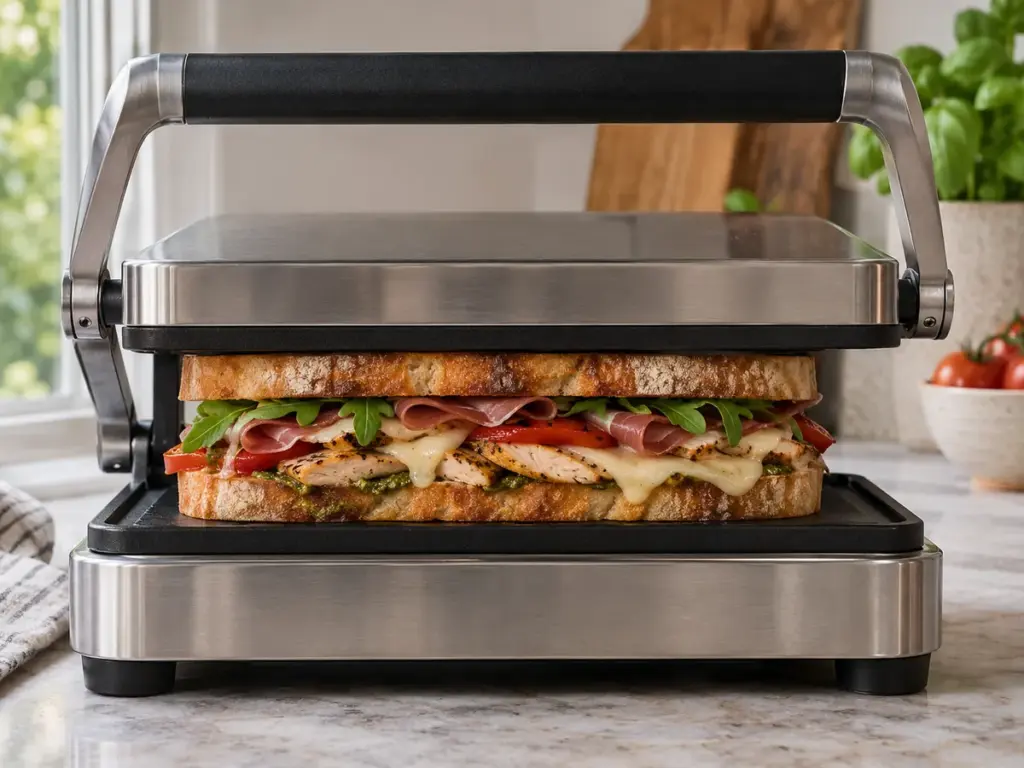
A floating hinge lets the top plate rise and rest level on whatever is underneath. America's Test Kitchen says a floating top plate lets you fit tall, bulky foods, and it noted that stiff hinges were a drawback. With a fixed hinge, the lid meets the sandwich at one angle, so a thick filling can get squeezed at the back while the front stays cool.
Check the hinge if you stack tall sandwiches. For thin grilled cheese on sliced bread, a fixed hinge is fine. The hinge is the feature that changes your results most, and a listing that never mentions it most likely describes a fixed one.
5. What Should You Check Before You Buy a Panini Press?
Run through these four checks in order, using the product listing and the specs on the box.
- Hinge. A floating hinge fits thick stacks, and a fixed one suits thin sandwiches only.
- Plates. America's Test Kitchen found higher-priced models have removable, flippable plates with a ridged and a smooth side, while cheaper ones have fixed plates.
- Heat. Its testers favored presses that held steady heat, because models that cycled on and off browned less evenly. Wattage in its spec sheets ran from 760 on a small Dash model to 1,800 on its Breville winner.
- Size. Its advice is to choose a compact press unless you cook for crowds, since a big one eats counter and cabinet space.
Cuisinart's Griddler line is a common example of a press that opens flat as a griddle, and shoppers often have to pick between the Deluxe and Elite versions. If you already own a George Foreman grill, hold it up against the hinge and plate checks above to see whether it can stand in for a press.
6. Which One Is Easier to Clean?
A sandwich maker is quicker for light messes: Food Republic says to wipe the smooth plates with a damp cloth once they have cooled. Melted cheese in the pinched seams is the usual trouble, so wipe it before it hardens.
A panini press has more surface and deeper grooves, which collect grease. Models with removable plates and a sloped grease collector clean up best, and America's Test Kitchen recommends hand-washing nonstick plates because the dishwasher wears the coating down. It found no performance difference between PTFE and ceramic nonstick coatings, so you can skip paying extra for ceramic on that basis.
7. Can You Use a Sandwich Maker as a Panini Press, or the Other Way Around?
A press can make nearly everything a sandwich maker makes, except the seal. Sliced bread in a panini press comes out flat, toasted and unsealed, and some cheese may ooze onto the plate. That makes the press the safer buy if you are unsure.
A sandwich maker is the one that struggles with thick builds. Its shaped plates are made for two slices of sliced bread, so a ciabatta roll or a heaped filling may keep the lid from closing. Check the plate depth in the listing, and never force the lid shut.
8. Which Should You Buy?
- You make grilled cheese or breakfast sandwiches on sliced bread
- You want sealed edges and triangle halves
- Your counter is tight on space
- You like thick bread such as ciabatta
- You want grill marks and the option to grill burgers
- You will use a floating hinge or griddle mode
Three common cases settle most decisions. A parent packing lunches wants the sandwich maker. A household that also cooks dinner on the counter wants the panini press. Someone with room for one machine who likes thick bread should buy a press with a floating hinge.
A panini goes well with a crisp salad or a bowl of soup, and there are sides that go with a panini to match. A sealed cheese triangle is closer to a grilled cheese, which is usually served with tomato soup or grilled cheese side dishes such as a crunchy slaw.
In the UK the same sandwich maker is sold as a toastie maker, and the sandwich it makes is a cheese toastie rather than an American grilled cheese.
Sources
- America's Test Kitchen, The Best Panini Presses: hinge, plates, ridge size, wattage and cleaning.
- Food Republic, the difference between a sandwich maker and a panini press: plate shape, edge sealing, cleaning.
- USDA FSIS, Safe Minimum Internal Temperature Chart: 165°F for leftovers and poultry.

Food writer at GustoMeadow. Writes ingredient substitutes, food comparisons, taste guides and storage guides for home cooks.
Storage and food-safety numbers follow USDA, FDA and university extension guidance.



