
Black-eyed peas need no soaking and cook in ½ to 1 hour, while pintos take 1½ to 2 hours, so black-eyed peas win when you cook on a weeknight.
- Pinto beans win for a soft, creamy bean in refried beans or chili.
- A cup of pintos has more fiber (15.4 g against 11.1 g).
- You can swap them cup for cup, but texture and time change.
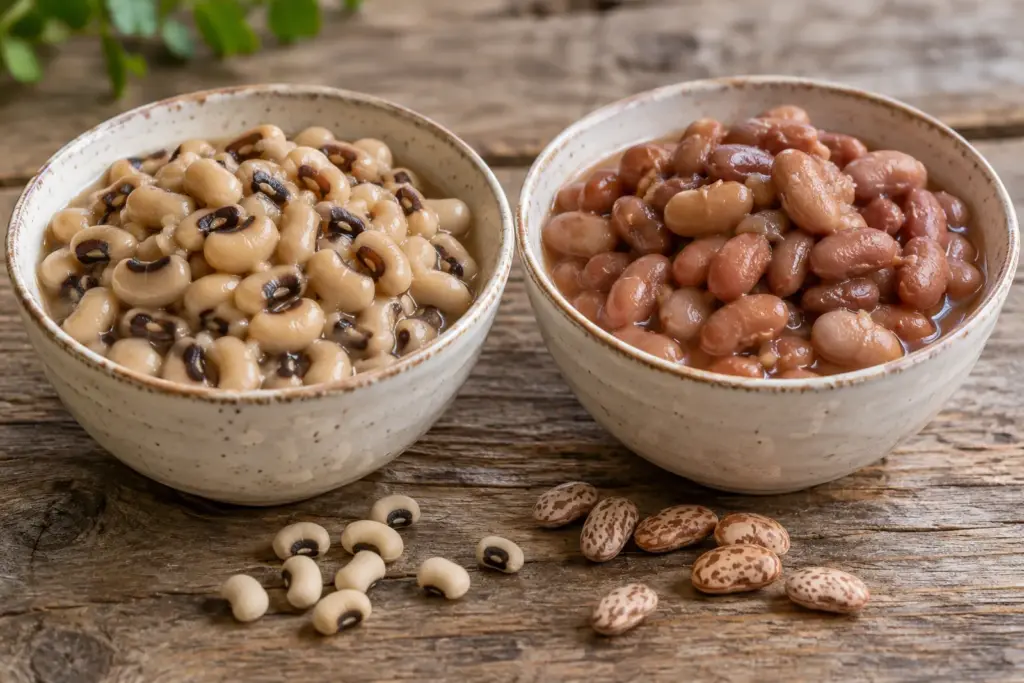
Both beans often end up in a pot with onion and pork, so this pair looks like an easy swap among the pantry foods we compare. They come from different plants, though, so you will notice the difference in how they cook, taste and mash.
1. What Is the Difference between Black-Eyed Peas and Pinto Beans?
No, they are not the same bean. Black-eyed peas are a cowpea (Vigna unguiculata), a crop that Clemson Extension says goes by the names southern peas, black-eyed peas and field peas.
Some packages label them black-eyed beans, while pinto beans are a common bean (Phaseolus vulgaris), the same species as kidney, navy and black beans.
In the kitchen you will notice the differences in look and texture first, and the plant behind each bean explains them.
| Trait | Black-eyed peas | Pinto beans |
|---|---|---|
| Plant | Cowpea | Common bean |
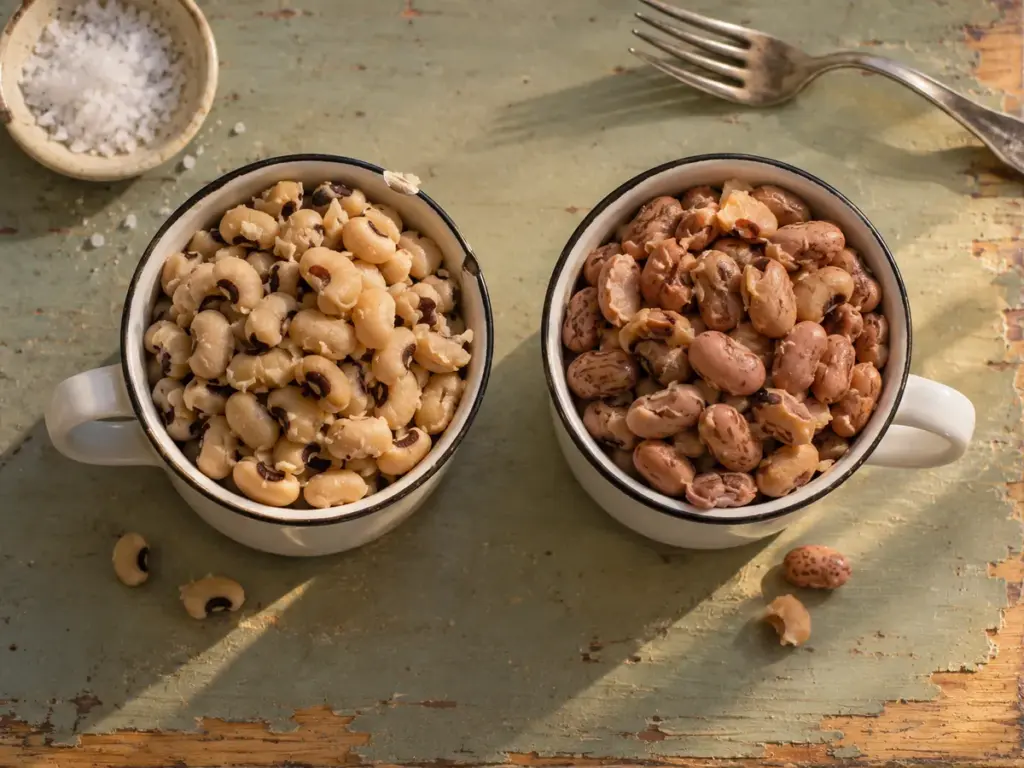
| Look (dry) | Small, cream, black "eye" | Larger, beige, reddish-brown speckles |
| Look (cooked) | Cream with the dark eye | Even pinkish brown |
| Texture | Firm, holds its shape | Soft, creamy, mashes easily |
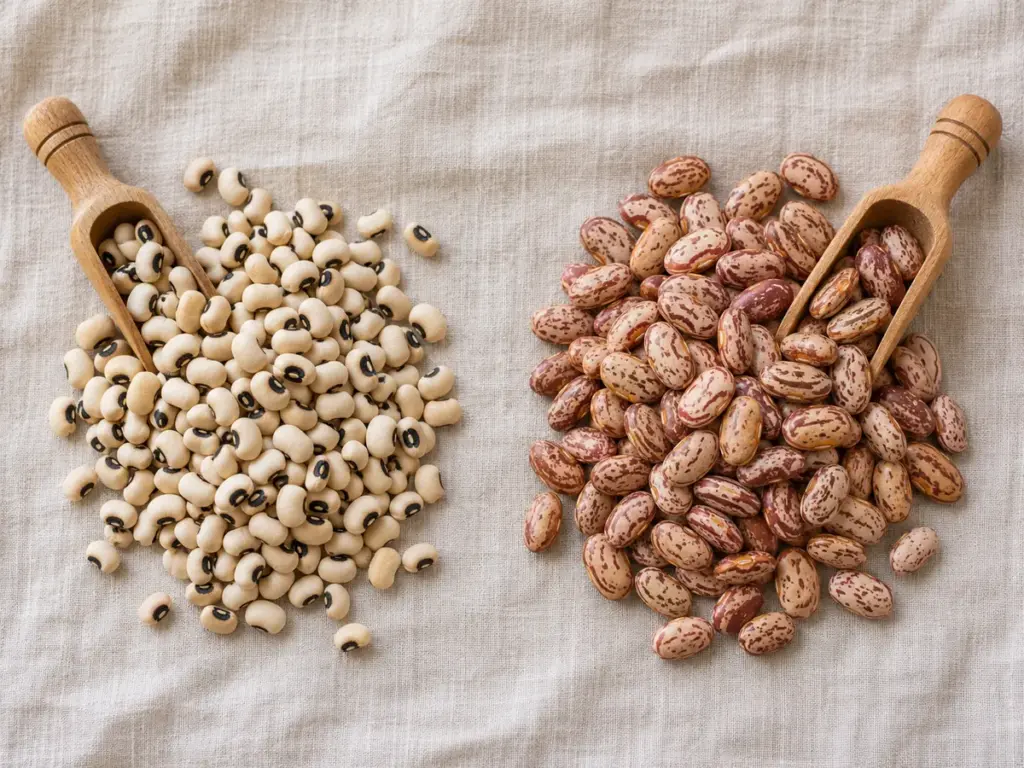
Black-eyed peas are the traditional southern bean for New Year's Day, since in Texas and across the South it is considered good luck to eat them on January 1st.
Pinto means "painted" in Spanish, after the speckled coat, and America's Test Kitchen (ATK) lists pot beans (charro beans), chili, soups and stews among its main uses.
Clemson Extension says cowpeas probably originated in Africa and reached the United States in early colonial times, and it sorts southern peas into three groups by how they cook:
- Crowder peas have starchy seeds packed tightly in the pod and normally cook up dark.
- Cream peas grow on a smaller plant and cook up light.
- Black-eyed peas fall between the two in plant type and in how the seeds cook.
2. How Do They Taste and Feel in a Dish?
ATK describes black-eyed peas as firm, dense and creamy, with a distinctively earthy taste. It adds that they hold their shape well, so you can stir them whole into a salad or a pot of rice.
Pintos are the softer and milder of the two, and ATK calls them creamy, with a mild nuttiness and a neutral flavor that suits many dishes. That creaminess, ATK says, makes them especially good for refried beans, and in a pot of chili some of them break down and thicken the broth.
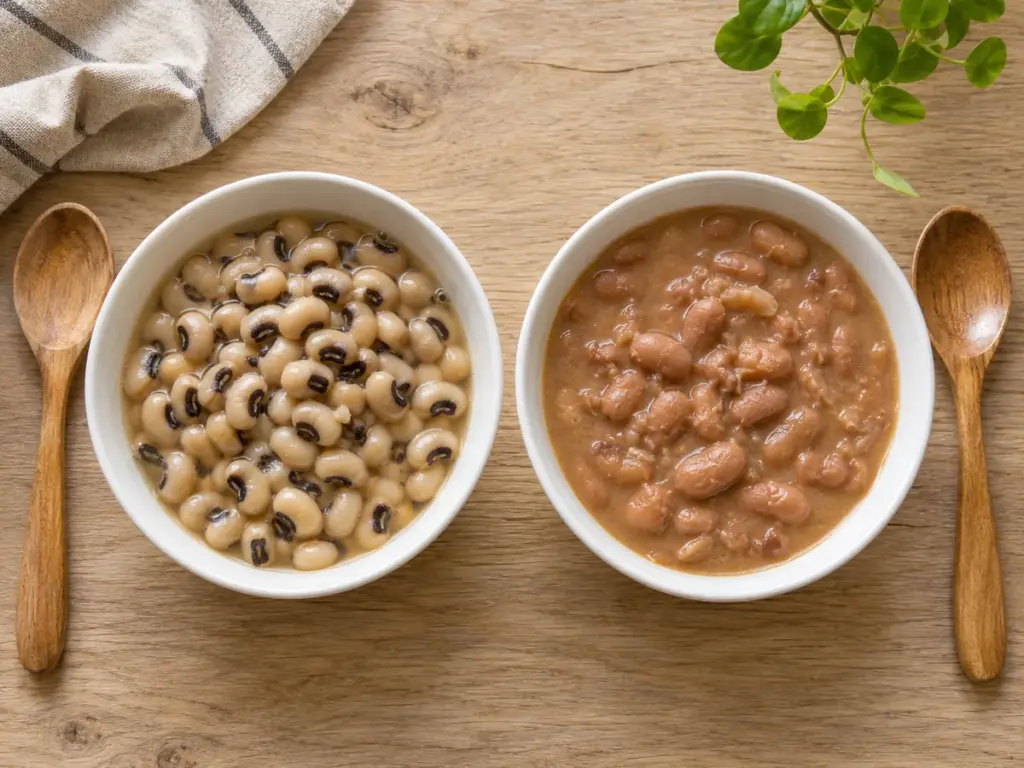
- You want beans that hold their shape in greens or salad
- You are short on time and did not soak
- The dish is Hoppin' John
- You want a thick, creamy pot or refried beans
- The dish is chili, burritos or pot beans
- You want the broth to turn rich on its own
Which Bean Goes Better with Ham Hock?
Either bean works with pork, but each pot runs on a different clock. A smoked ham hock is cured and brings its own salt, while a fresh pork hock is mild, so we'd taste the broth before any salt goes in.
- With black-eyed peas, you add the peas once the hock is simmering, because they finish in about an hour or less and stay whole in the broth.
- With pintos, the hock goes in from the start, since the beans simmer for 1½ to 2 hours. You can taste a bean to check that it is tender, and the ones that break down turn the broth thick and smoky.
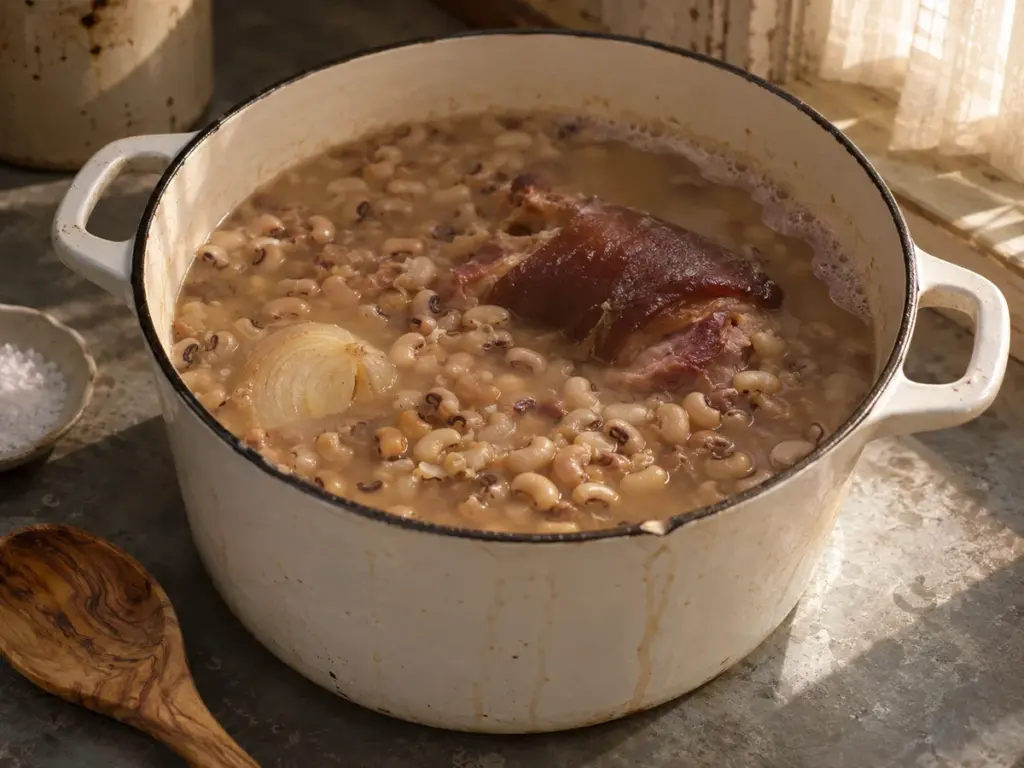
If your store has no hock, chopped bacon or smoked sausage give either pot a similar smoke. Salt pork gives you the salt and fat without the smoke.
3. How Long Does Each One Take to Cook?
The gap you will notice most is cooking time. University of Maine Extension lists black-eyed peas at ½ to 1 hour with no soaking required, and pinto beans at 1½ to 2 hours.
University of Nebraska-Lincoln Extension gives pintos 90 to 120 minutes on the stovetop after soaking, and says lentils, split peas and black-eyed peas don't need soaking.
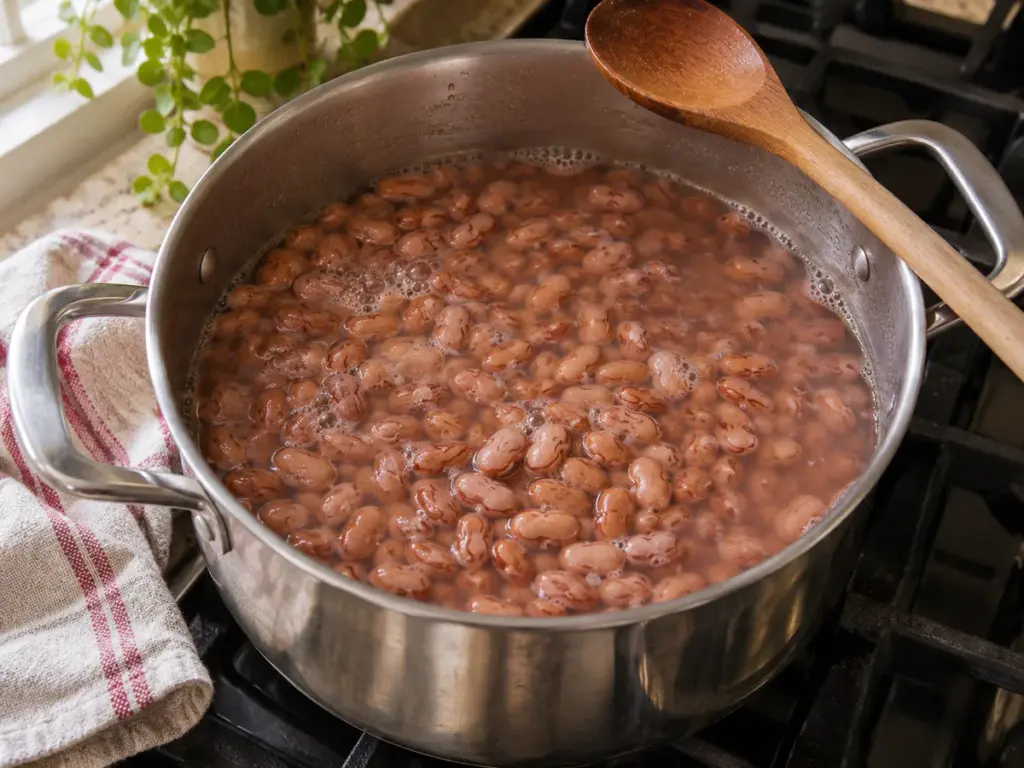
Before either bean goes in your pot, you pick through them, discard any that are discolored or shriveled plus any stray debris, and rinse them well.
Nebraska calls the hot soak its preferred method for dry beans because it cuts the cooking time, helps dissolve some gas-causing substances and most consistently gives tender beans. All three soaks below are general dry-bean methods, and Nebraska lists black-eyed peas among the beans that need none.
- Measure the water. Add 10 cups of water for each pound (2 cups) of dry beans.
- Boil briefly. Heat to boiling and boil for 2 to 3 minutes.
- Let it stand. Remove from the heat, cover and soak for up to 4 hours.
- Simmer. Drain, add fresh water and simmer covered until tender.
When time is short, the quick soak uses 6 cups of water per pound, a 2 to 3 minute boil and at least 1 hour of standing, while the overnight soak uses 10 cups of cold water per pound in the refrigerator for 8 hours or overnight.
Pintos share a species with kidney beans, so we'd give them the overnight soak, the one method here that clearly meets FDA's 5-hour minimum for kidney beans in the box below. The hot soak stops at 4 hours, and the quick soak can be as short as 1 hour.
Black-eyed peas are a cowpea, a different plant, and FDA's soak rule names kidney beans only. For them, you can follow the no-soak guidance from Maine and Nebraska Extension.
If you cook pintos under pressure, the same Nebraska source puts unsoaked pintos at 15 to 20 minutes plus about 20 minutes of natural release.
What goes into the pot changes the time too, because Nebraska says acidic foods such as tomatoes, vinegar, lemon juice or wine go in after the beans are cooked and acid can keep beans from becoming tender.
Maine Extension also says to hold the salt while the beans cook, so for chili you simmer the pintos in plain water until they are soft and stir in the tomatoes afterward.
4. Which One Has More Protein, Fiber and Iron?
Both are good sources of plant protein and fiber, and neither is the single healthier bean. The numbers below are USDA FoodData Central values for cooked, boiled beans without salt, per 1 cup (about 171 g of either bean):
| Per 1 cup, cooked | Black-eyed peas | Pinto beans |
|---|---|---|
| Calories | 198 | 245 |
| Protein | 13.2 g | 15.4 g |
| Fiber | 11.1 g | 15.4 g |
| Iron | 4.3 mg | 3.6 mg |
| Folate | 356 mcg | 294 mcg |
| Potassium | 475 mg | 746 mg |
| Calcium | 41 mg | 79 mg |
| Magnesium | 91 mg | 86 mg |
If you want the most fiber, protein, potassium or calcium from a cup, pinto beans lead, and if you want more iron and folate with about 47 fewer calories per cup, black-eyed peas lead.
By weight the gap is the same, since USDA lists 116 calories per 100 g for black-eyed peas and 143 for pintos.
Both beans are nearly fat-free, with about 0.9 g of fat per cup for black-eyed peas and 1.1 g for pintos. If you count carbohydrates, the gap is wider, at 35.5 g against 44.8 g per cup.
How Much of a Day's Needs Does a Cup Cover?
FDA's Daily Values are 28 g of fiber, 50 g of protein, 18 mg of iron and 400 mcg DFE of folate, and one cup of each bean covers these shares of them:
- One cup of pintos gives about 55% of the fiber Daily Value, against 40% from black-eyed peas.
- Protein follows the same order, with about 31% from pintos and 26% from black-eyed peas.
- Iron flips it, with about 24% from black-eyed peas and 20% from pintos.
- Folate favors black-eyed peas too, at about 89% against 74% from pintos.
5. Can You Use Black-Eyed Peas Instead of Pinto Beans?
Yes, you can swap them in most dishes by using a cup of cooked black-eyed peas for every cup of cooked pintos, and the other way round.
Dried beans swell, and Nebraska Extension counts about 6 cups cooked from 1 pound (about 2 cups) of dry beans, so a pound of either bean covers a recipe that calls for 6 cups.
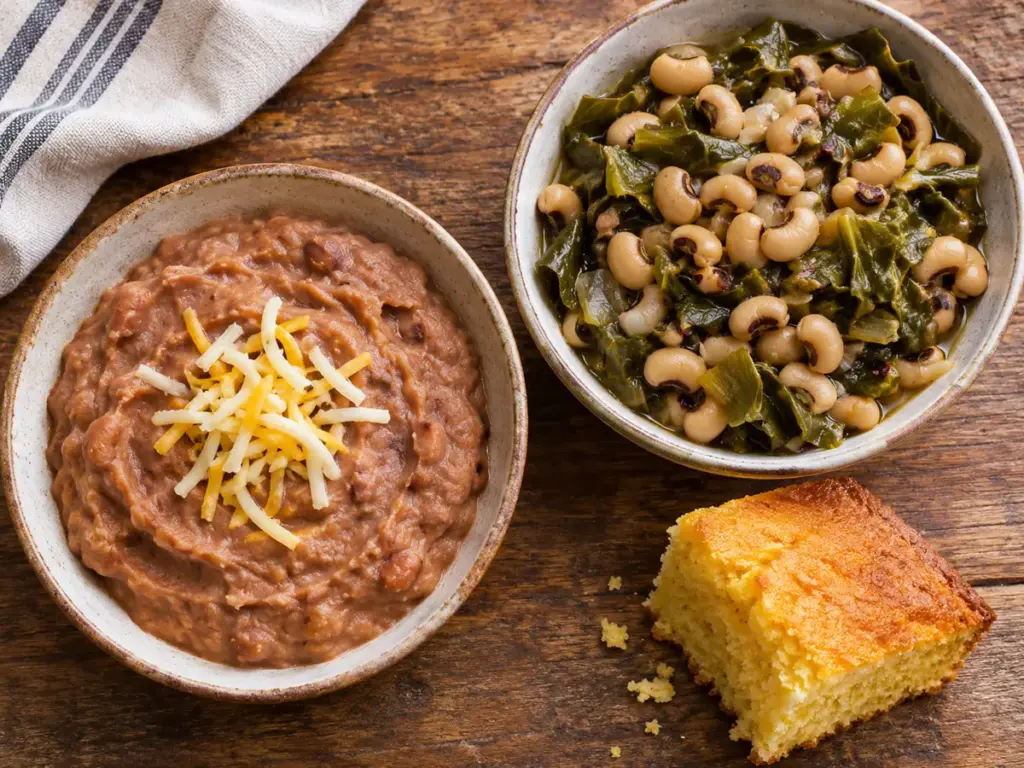
- Black-eyed peas in place of pintos cook in about half the time or less and stay firmer. Since they hold their shape, they mash less smoothly, so we'd keep pintos for refried beans.
- Pintos in place of black-eyed peas should be cooked until tender before you stir them into rice or greens, since they take far longer than the rest of the pot. They also turn the dish pinkish brown and creamier than whole black-eyed peas would.
If you have neither bean, other black-eyed pea stand-ins include purple hull peas, which Clemson lists as a black-eye type southern pea, and for pintos there are chickpeas, navy beans and cannellini beans.
Can Pinto Beans Stand In on New Year's Day?
The luck belongs to black-eyed peas, because Texas Standard describes Hoppin' John as black-eyed peas, rice, sometimes turnip greens and some kind of pork, so a pot made with pintos turns into a different dish.
If pintos are all you have, you can cook them with the same rice, greens and pork and give them the longer simmer they need.
Can You Cook Them in the Same Pot?
You can, but the two beans run on different clocks. Black-eyed peas need ½ to 1 hour and pintos need 1½ to 2 hours, so the pintos go in first and the black-eyed peas join them when about 30 to 60 minutes of simmering are left.
Other beans follow the same logic, since Nebraska lists Great Northern beans at 45 to 60 minutes and navy beans at 90 to 120 minutes after soaking. You add a northern bean to the pinto pot with 45 to 60 minutes to go, while navy beans can start alongside the pintos.
6. Canned or Dry: Which Works Better?
Canned versions of both beans are already cooked, so they erase the time difference. You pay for that in salt, because the canning liquid carries it, and USDA lists these sodium amounts:
- Pintos from a can carry 268 mg per 100 g with their liquid, about 640 mg in a 240 g cup.
- Black-eyed peas from a can carry 293 mg per 100 g, about 700 mg in a 240 g cup.
- A rinse drops canned pintos to 212 mg per 100 g, down from 239 mg drained only.
- Beans cooked from dry with no salt hold only 1 mg per 100 g for pintos and 4 mg for black-eyed peas.
Canned beans go best into a salad or pot drained and rinsed, and since Texas caviar is built on black-eyed peas, rinsed canned ones are the quick route there.
Canned pintos suit refried beans and chili, where a soft bean is the goal.
7. How Long Do Dry and Cooked Beans Keep?
Maine Extension says unused dry beans keep for up to one year when you store them in a resealable bag or tightly covered non-metal container in a cool, dry place away from heat and humidity.
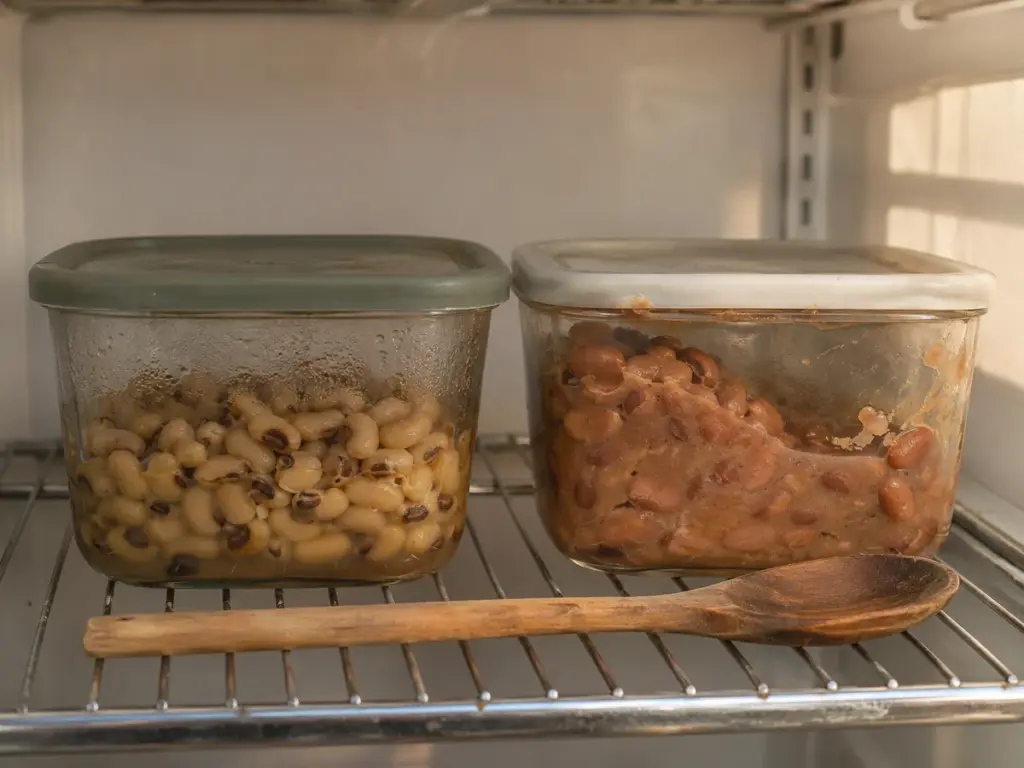
- In the refrigerator, cooked beans keep 3 to 4 days in a covered, non-metal container.
- In the freezer, cooked beans keep up to 6 months when you freeze them in 1-cup or 2-cup portions so you thaw only what you need.
- Frozen beans go into the refrigerator to thaw before you use them.
8. Which Should You Cook or Buy?
The dish and the clock decide which bean fits each of these situations:
- On a weeknight with beans and greens, black-eyed peas win, because you skip the soak and they are done in about an hour or less.
- Hoppin' John on New Year's Day calls for black-eyed peas, the traditional bean, and a cold salad like Texas caviar is one of the black-eyed pea side dishes that uses the whole peas well.
- Chili and refried beans go to pintos, because they break down and thicken the pot.
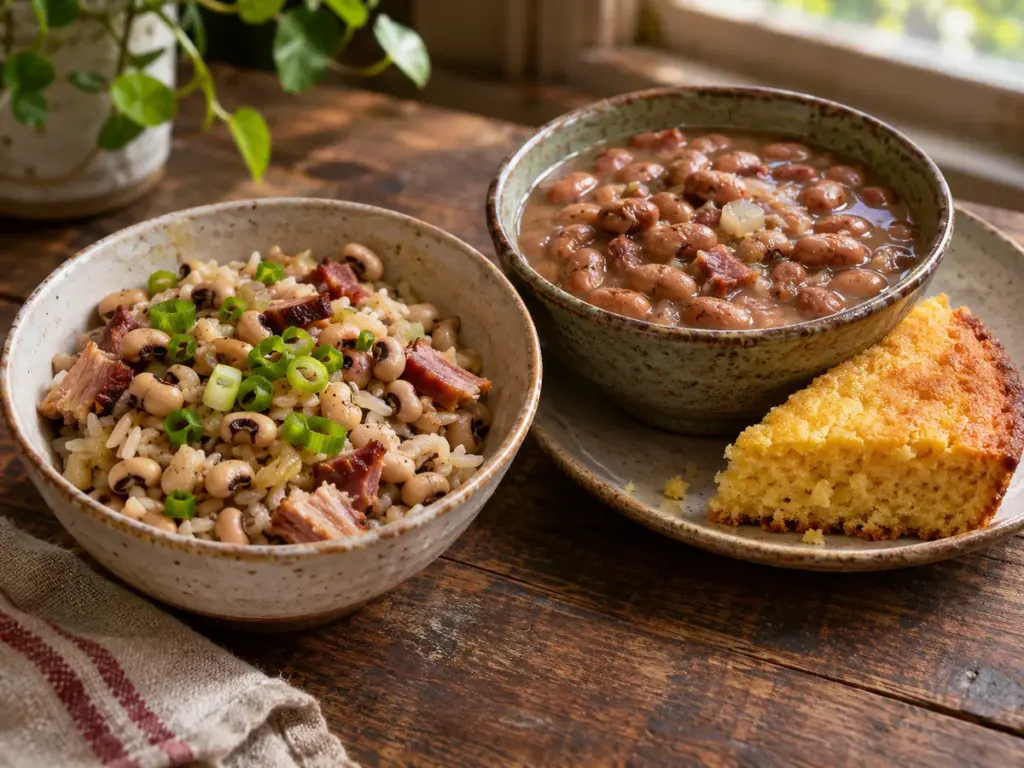
- A big pot to serve all week with cornbread suits pintos, with pinto bean side dishes such as slaw or fried okra on the plate.
- For a milder, smaller white bean, navy beans fit better than either one.
A bag of dry beans that looks whole and evenly colored through the plastic saves you sorting time, though you can still expect to throw out a few discolored or shriveled ones at home.
Sources
- USDA FoodData Central (SR Legacy): cowpeas (blackeyes, crowder, southern), mature seeds, cooked, boiled, without salt (FDC 173759) and pinto beans, mature seeds, cooked, boiled, without salt (FDC 175200), plus the canned entries for both
- University of Maine Cooperative Extension: How to Store and Cook Dried Beans
- University of Nebraska-Lincoln Extension: How to Cook Dry Beans from Scratch
- Clemson Cooperative Extension: Southern Peas
- America's Test Kitchen: 25 Types of Dried Beans and How to Use Them (taste, texture and uses of black-eyed peas and pintos)
- U.S. Food and Drug Administration: Natural Toxins in Food and Daily Value on the Nutrition and Supplement Facts Labels
- Centers for Disease Control and Prevention: Folic Acid: Sources and Recommended Intake
- Texas Standard: Black-Eyed Peas for Luck in the New Year

Food writer at GustoMeadow. Writes ingredient substitutes, food comparisons, taste guides and storage guides for home cooks.
Storage and food-safety numbers follow USDA, FDA and university extension guidance.



