Short answer: For salsa, guacamole and tacos, use the same amount of flat-leaf parsley plus about 1 teaspoon of lime juice for every ¼ cup. For a curry, soup or noodle bowl, tear in Thai basil or mint at the end. If you are out of cilantro and love the taste, culantro is the closest match, but if cilantro tastes like soap to you, skip culantro and Vietnamese coriander, because they carry the same kind of aroma compounds.
Most ingredient substitutes are about copying a flavor, and cilantro splits into two different problems. One cook is standing at the stove with an empty bunch and wants the fresh, citrusy lift back. Another cook has the bunch in hand and knows from experience that it will make dinner taste like dish soap. The swaps below are sorted for both.
Are You Missing Cilantro or Avoiding It?
The answer decides which herb you pick. If the store was out, you want something that tastes as close to cilantro as possible, and that is a narrow list. If you dislike cilantro, you want the opposite, an herb that stays far away from it, and that is a wider list.
- Culantro tastes like a stronger cilantro, so use about half as much
- Flat-leaf parsley with lime juice is the easy grocery-store option
- Vietnamese coriander adds a lemony, coriander-like note if you shop at an Asian market
- Flat-leaf parsley and lime juice for raw dishes
- Thai basil or mint for curries, soups and noodles
- Green onion tops and lime zest for rice and tacos
- Skip culantro and Vietnamese coriander, which share cilantro's aldehydes
Before the dish-by-dish swaps, the soap question is worth a minute, because it explains why the second list leaves out the herbs that look most similar to cilantro.
Why Does Cilantro Taste Like Soap to Some People?
Cilantro leaves get their smell from a family of aldehydes, which are strong-smelling compounds that also show up in soap. Roughly one in eight people in a large genetic survey said cilantro tastes soapy to them, and the study tied that answer to a variant near a smell-receptor gene called OR6A2. The receptor's rat version responds to several of these aldehydes in lab tests, which is why the researchers named it as their leading candidate in the 23andMe cilantro study.
The finding is narrower than the headlines made it sound. The survey asked 14,604 mostly European-ancestry participants about soapiness, and the variant explained only about 0.5% of the differences between people. The authors also wrote that it is suspected but not proven that the dislike comes mostly from smell and not from taste, and that they could not tell how much exposure and upbringing matter. So the gene is one piece of the answer, and plenty of people who dislike cilantro do not fit it.
| Group in the survey | Said cilantro tastes soapy |
|---|---|
| Ashkenazi Jewish | 14.1% |
| European (all) | 13.0% |
| African-American | 9.2% |
| Latino | 8.7% |
| East Asian | 8.4% |
| South Asian | 3.9% |
These are answers from people who sent their genetic data to one company, so they describe that group and are not national rates. They do show that the reaction turns up in every group. Gernot Katzer's spice reference notes the same split in how people describe the leaf: many Europeans call it soapy, like burnt rubber, while people in Asia, Latin America and Africa describe it as fresh, green and citrusy.
What Can You Use Instead of Cilantro in Each Dish?
These amounts replace ¼ cup of chopped cilantro and are our starting points, not tested ratios, so taste after a few minutes and adjust. Each swap below is soap-safe, meaning it does not share cilantro's aldehyde-heavy oil.
| Dish | Best swap | Amount for ¼ cup cilantro | What it adds |
|---|---|---|---|
| Salsa, pico de gallo, guacamole | Flat-leaf parsley and lime juice | ¼ cup parsley, 1 teaspoon lime juice | Green freshness, with the acid cilantro usually brings |
| Tacos and tostadas | Parsley and green onion tops | 3 tablespoons parsley, 1 tablespoon thin-sliced green onion tops | A mild onion bite on top of the green taste |
| Cilantro-lime rice | Parsley, lime zest and lime juice | ¼ cup parsley, ½ teaspoon zest, 1 tablespoon juice | Citrus smell, as long as you zest only the green part and leave the bitter white pith |
| Thai and Indian-style curries, soups | Thai basil or mint | 3 tablespoons torn basil, or 2 tablespoons chopped mint | Anise or cool-mint notes that hold against spice |
| Green chutney and herb sauces | Mint with parsley | 3 tablespoons parsley, 1 tablespoon mint | Cooling flavor with a clean green base |
The table puts parsley first because it is the one swap that works in nearly every raw dish. Plain parsley is grassy and mild, so the lime juice does the work that cilantro's citrusy smell does in the original. Choose flat-leaf over curly, since the University of Wisconsin Extension notes that curly types have much less essential oil than broad-leaved ones, and curly leaves can taste like very little in a salsa. Flat-leaf parsley is often sold as Italian parsley, so look for either name on the label.
How Do You Swap Parsley Into Salsa or Guacamole?
Raw dishes need one extra step, because parsley does not carry any acid and cilantro-heavy recipes usually count on that brightness. Work through it in this order:
- Chop the parsley fine. Use the leaves and the thin upper stems, and skip the thick lower stems, which taste woody.
- Mix in the lime first. Stir 1 teaspoon of lime juice per ¼ cup of parsley before it goes into the bowl.
- Let it sit for 10 minutes. The salt and acid pull the herb flavor into the tomato or avocado.
- Taste and fix. If the mix tastes flat, add a pinch more salt, then a little more lime.
Fresh lime tastes brighter than the bottle, which matters here because the juice is doing the cilantro's job, so squeeze fresh lime juice when you can. The same method works whether you are making a chunky pico or a smooth avocado dip, and the difference between an avocado salsa and guacamole mostly comes down to how much you mash it.
Which Swaps Work in Curry, Soup and Noodles?
Cooked and saucy dishes can take a stronger herb than a salsa can. Thai basil has an anise-like smell and is the herb many Thai curries and noodle dishes use, so tear it in after you turn the burner off. Mint works the same way in a coconut curry or a noodle soup, where it adds a cool note against the chili. Use less mint than the cilantro you are replacing, about 2 tablespoons for every ¼ cup, because it is easy to overshoot into a toothpaste flavor.
If you only have regular basil, it will work for a Thai-style dish, though its sweeter, clove-like basil flavor is not the anise note of Thai basil. Dill is a less common pick, but its dill weed flavor is light and grassy enough to suit yogurt sauces and fish tacos.
Can You Use Culantro or Vietnamese Coriander Instead?
If you like cilantro, yes, and culantro is the best stand-in you can buy. Katzer's reference says its aroma is strong and very similar to fresh coriander leaves, with a taste that is similar but even stronger, and that cooks in Vietnam use it as a fully equivalent substitute. That is why we would start with about half the amount. You can usually find it at Latin and Asian grocers, where the labels for culantro, cilantro and coriander are easy to mix up.
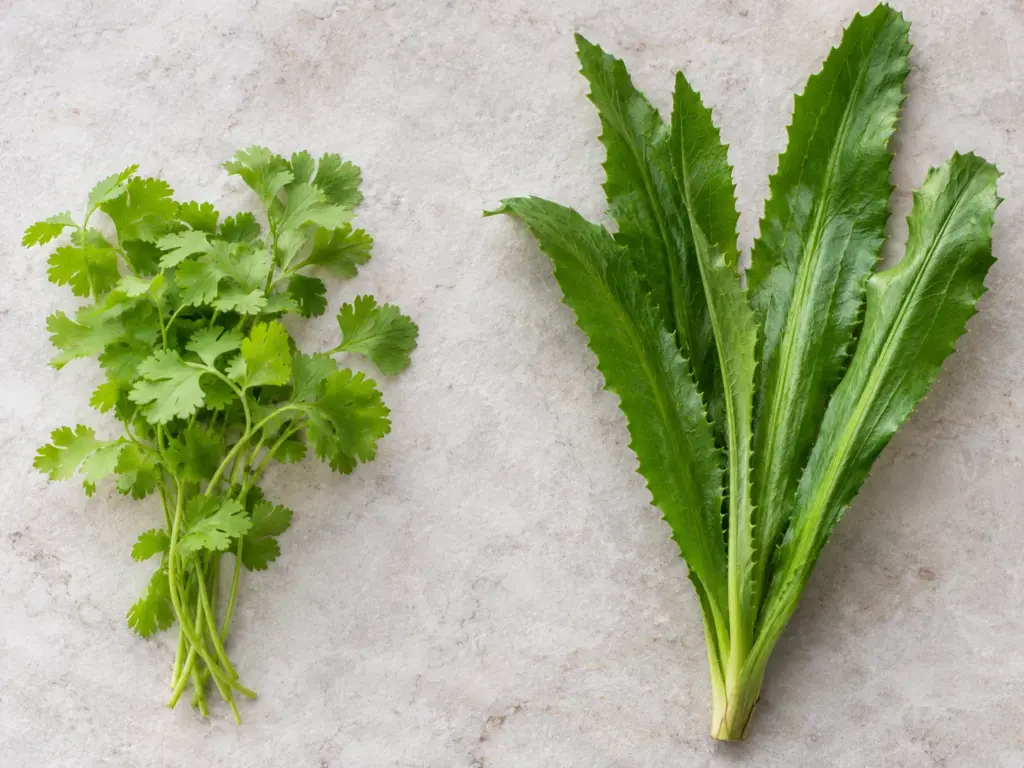
If cilantro tastes like soap to you, leave culantro on the shelf. The leaf oil of culantro is rich in the same type of unsaturated aldehydes, with one called (E)-2-dodecenal making up around 60% of it, and a 2021 plant study described the aroma compounds of the two herbs as similar. We cannot promise that every person who dislikes cilantro will dislike culantro, since no study we found tested that directly, but the shared chemistry makes it the riskiest swap. Vietnamese coriander is a similar case. Its oil is mostly long-chain aldehydes (about 28% decanal and 44% dodecanal), although the smell is described as coriander-like with a clear lemony note, and it is used fresh, sprinkled over the bowl at the end.
Does Dried Cilantro Work As a Substitute?
Not for salsa, guacamole or tacos. Those dishes use cilantro raw, and a dried herb cannot give the same fresh, green hit, so parsley with lime will taste closer. Dried cilantro is a weak backup for a long-simmered pot of beans or soup, since dried cilantro lacks the fresh, green hit of the leaf. A fresh bunch that has turned slimy has spoiled, so spoiled cilantro belongs in the trash and a swap from the table above takes its place.
What If the Recipe Calls for Ground Coriander?
In US recipes, "coriander" on a spice list means the dried seed of the cilantro plant, and it is a different ingredient from the leaf. Katzer's spice reference calls the seed and leaf totally different in flavor, so one cannot stand in for the other. The seed smells warm, nutty and spicy, with some orange-like notes, and its oil is mostly linalool instead of the leaf's aldehydes. So you cannot sprinkle fresh cilantro into a rub that wants ground coriander, and parsley will not help either.
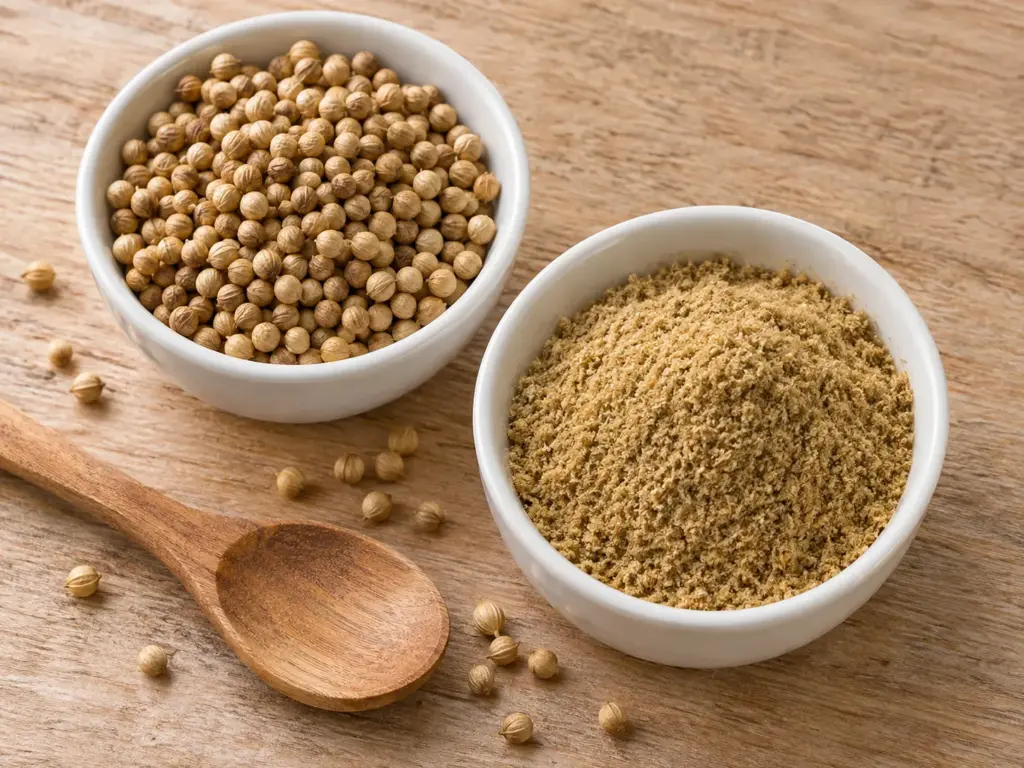
When the jar is empty, these are the swaps we would try, measured against 1 teaspoon of ground coriander:
| Swap | Amount for 1 teaspoon | Best in | Watch for |
|---|---|---|---|
| Ground cumin | ½ teaspoon, then taste | Chili, taco meat, rubs, bean dishes | Earthier and stronger, with no citrus |
| Ground caraway | ¾ teaspoon | Breads, roasted vegetables, stews | Anise-like, so keep it light |
| Curry powder or garam masala | 1 teaspoon | Curries, lentils, roasted cauliflower | Adds turmeric, heat or other spices |
| Cumin with lemon zest | ½ teaspoon cumin, ¼ teaspoon zest | Marinades, dressings, rice | Zest fades, so add it near the end |
Cumin is the most common pantry swap, but it is stronger and more earthy than coriander seed, which is why the amount above starts at half. Add it a pinch at a time, because cumin's earthy taste is easy to overdo. Many curry blends already contain coriander seed, so a spoonful of curry powder fills in the warm base without much extra work.
Sources
- Eriksson et al., "A genetic variant near olfactory receptor genes influences cilantro preference," Flavour 2012 (read via the arXiv preprint): sample sizes, OR6A2 candidate, 0.5% variance, ancestry percentages, authors' caveats.
- Gernot Katzer's Spice Pages, Coriander: leaf versus seed flavor, leaf aldehydes, regional descriptions.
- Gernot Katzer's Spice Pages, Long coriander (culantro): strength, (E)-2-dodecenal, use as a substitute.
- Gernot Katzer's Spice Pages, Vietnamese coriander: lemony note, decanal and dodecanal, fresh use.
- Journal of Horticulture and Postharvest Research (December 2021), comparison of cilantro and culantro aroma compounds.
- University of Wisconsin Extension, Parsley: curly types have much less essential oil than broad-leaved types.
Frequently Asked Questions
In a cooked dish, yes, and you will mostly lose a little freshness. In salsa, guacamole or cilantro-lime rice, leaving it out makes the dish taste flat, so add the parsley and lime combination or a bit more lime and salt.
We found no study that compared stems and leaves for soapiness, so we cannot say. If you dislike cilantro, treat the stems as part of the same herb and use a swap for them too.
They come from the same plant. In the US, cilantro is the fresh leaf and coriander is the dried seed, while in the UK and other countries the leaf is also called coriander. When a recipe lists a spice, assume the seed.

Andrew Gray is a passionate food writer and recipe creator who built Gusto Meadow to celebrate delicious, approachable cooking. With years of experience in restaurants and catering, he brings a grounded, real-world understanding of flavors, technique, and what truly works in a home kitchen.
At Gusto Meadow, Andrew focuses on fresh, seasonal ingredients and simple methods that anyone can follow. His goal is to make cooking feel fun, doable, and rewarding — whether you’re preparing a quick weeknight dinner or exploring something new.