
Cardamom tastes citrusy and floral, while nutmeg tastes warm, sweet and woody.
- Use nutmeg in pumpkin pie and eggnog and cardamom in chai and Scandinavian buns.
- Replace 1 teaspoon cardamom with ¼ teaspoon nutmeg plus ½ teaspoon cinnamon.
- Replace nutmeg with the same amount of cardamom.
- Nutmeg is toxic in very large amounts, far more than any recipe uses.
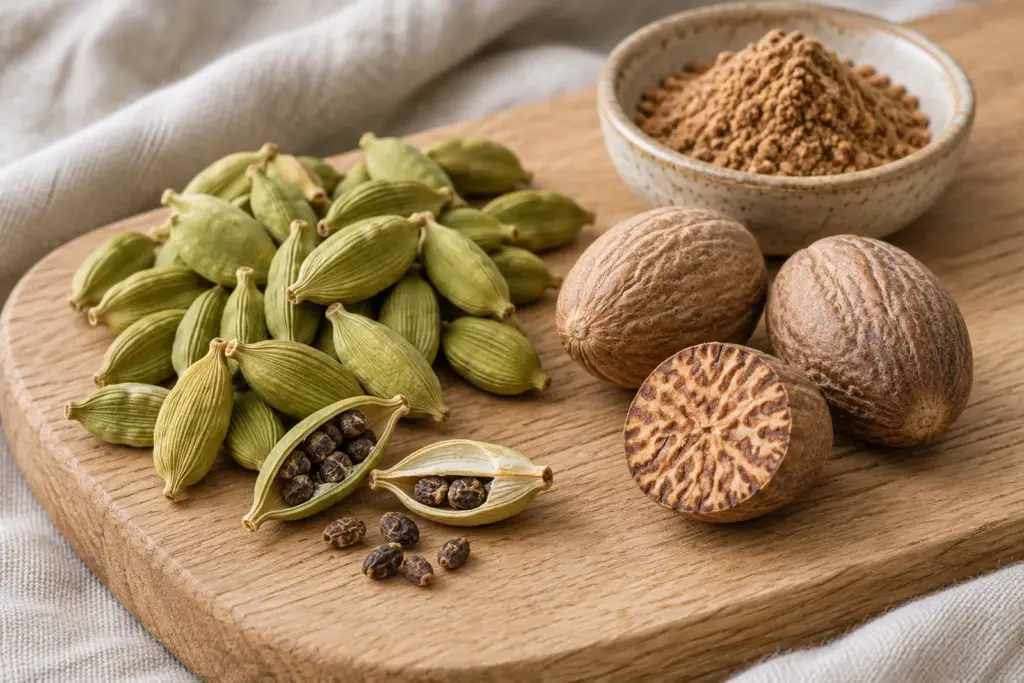
Both spices belong to holiday baking, but they come from different plants and taste nothing alike. If you are choosing between them, this is one of the spice comparisons where the right pick depends on the dish, because one smells like lemon and flowers and the other like a sweet, woody nut.
1. What Is the Difference Between Cardamom and Nutmeg?
Cardamom is the small black seed inside a papery pod from a ginger-family plant, and nutmeg is the hard seed of a tropical tree. These are the traits that change what you cook with them.
| Trait | Cardamom | Nutmeg |
|---|---|---|
| What it is | Seeds in a pod of a ginger-family plant | Seed of the Myristica fragrans tree |
| Taste | Citrus, floral, a little minty | Warm, sweet, woody |
| What you buy | Whole pods, loose seeds or ground | Whole nuts to grate, or ground |
- Classic dishes include chai, Swedish buns, rice pudding and coffee.
- It grows in southern India, and now mostly in Guatemala.
- 1 teaspoon ground (USDA) has about 6 calories and 0.1 g fat.
- Classic dishes include pumpkin pie, eggnog, white sauce and mulled wine.
- It grows in the Moluccas of Indonesia, and in Grenada.
- 1 teaspoon ground (USDA) has about 12 calories and 0.8 g fat.
Taste decides most recipes. Cardamom adds a lemony brightness, and nutmeg adds a sweet, woody warmth that settles into milk, eggs and cream. A teaspoon of either adds only a few calories, so you pick between them for flavor.
2. Which Cardamom Is in Your Recipe, Green or Black?
Recipes that say "cardamom" mean green cardamom unless they name the other kind. Green pods are small and pale, and their seeds taste sweet and citrusy, which is why bakers and chai makers reach for them.
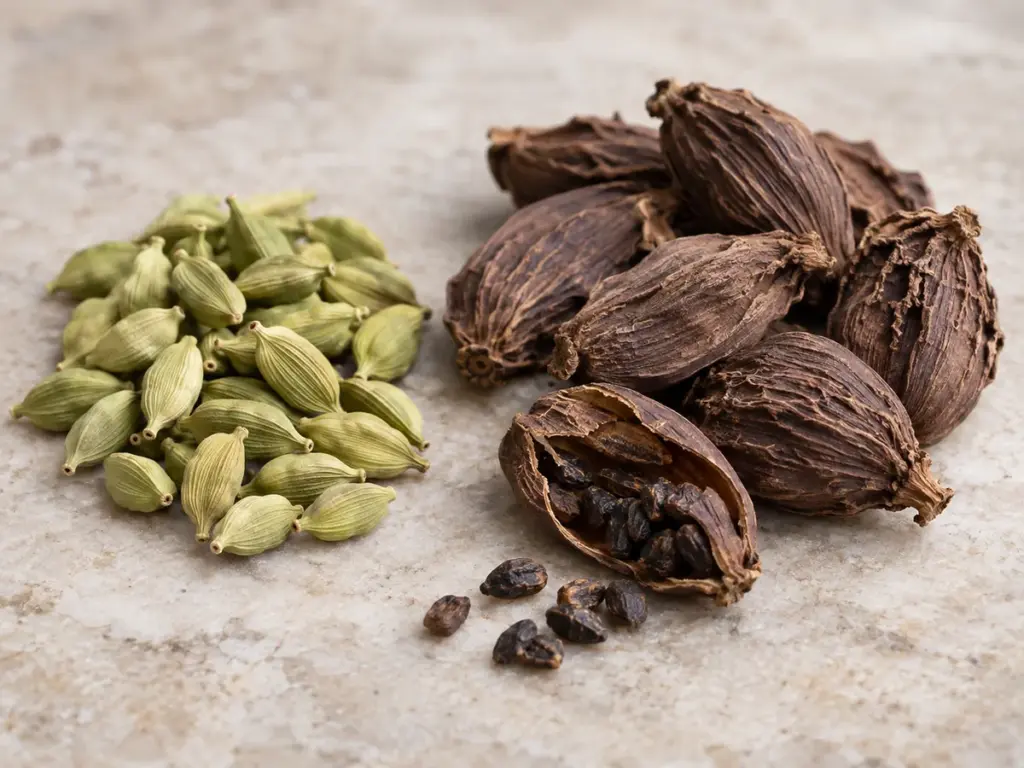
- Small, pale-green pods
- Sweet, citrusy and floral
- Chai, buns, rice pudding, coffee
- Grind the black seeds inside
- Larger, dark, wrinkled pods
- Smoky and earthy
- Curries, stews and rice dishes
- Leave it out of cakes and buns
The smoky black pods come from a different plant and are dried over a fire, so a bun made with them tastes of smoke. Keep black cardamom for savory dishes and use green for every sweet recipe here.
For baking, crack the pods and grind only the black seeds inside. Milk Street grinds green cardamom seeds for its Swedish buns because the pre-ground spice lacks flavor, and for the same reason you should buy whole pods over loose seeds when you can.
3. How Are Nutmeg and Mace Related?
Nutmeg and mace come from the same fruit. The Myristica fragrans tree grows a yellow fruit that splits open when ripe, and inside sits a brown seed wrapped in a bright red, net-like covering. The seed is nutmeg, and the covering is mace. The tree is native to the Moluccas in Indonesia, and Indonesia and Grenada have long been its two main growers (FAO).
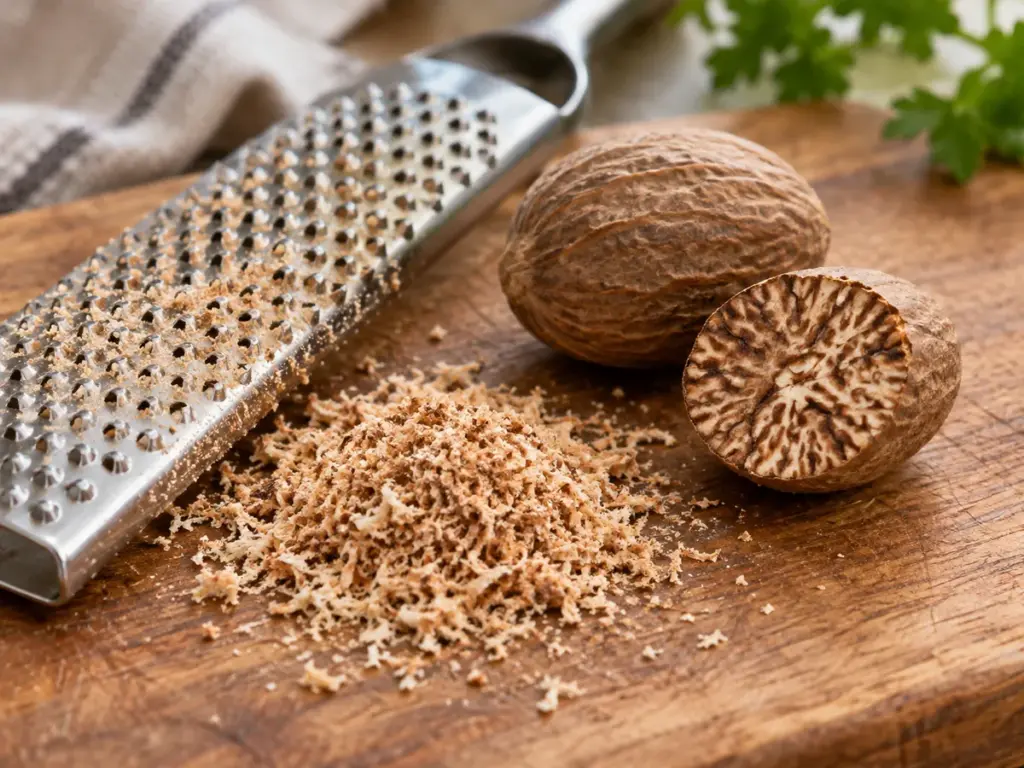
The dried red covering is sold as mace, which makes it the nearest swap when your nutmeg runs out. You can also grate a whole nutmeg as you cook, and its aroma is stronger than the jar of ground.
4. Which Spice Belongs in Pumpkin Pie, Eggnog, Chai and Scandinavian Buns?
In holiday cooking the winner changes with the dish, so these are the defaults for four common ones.
| Dish | Better pick | What the other spice does |
|---|---|---|
| Pumpkin pie | Nutmeg | Cardamom adds a citrus note the pie does not expect, so use a pinch at most |
| Eggnog | Nutmeg | Cardamom makes the drink floral and less like classic eggnog |
| Chai | Cardamom | Nutmeg is an occasional extra and cannot replace the cardamom |
| Scandinavian buns | Cardamom | Nutmeg gives a warm bun, but it no longer tastes Scandinavian |
Pumpkin pie belongs to nutmeg. Store-bought pumpkin pie spice usually lists cinnamon, ginger, nutmeg and allspice, so a recipe that calls for the blend already has nutmeg in it. If you bake with canned pie filling instead of plain puree, the spice is already in the can, so skip extra nutmeg. If you want cardamom in the pie, we'd add a pinch beside the nutmeg and not in its place.

Eggnog wants nutmeg. Poison Control says nutmeg "tastes great in cookies and eggnog", and its sweet, woody notes sit well with eggs, milk and cream. A little grated into the cup or over the top is the classic finish for eggnog.
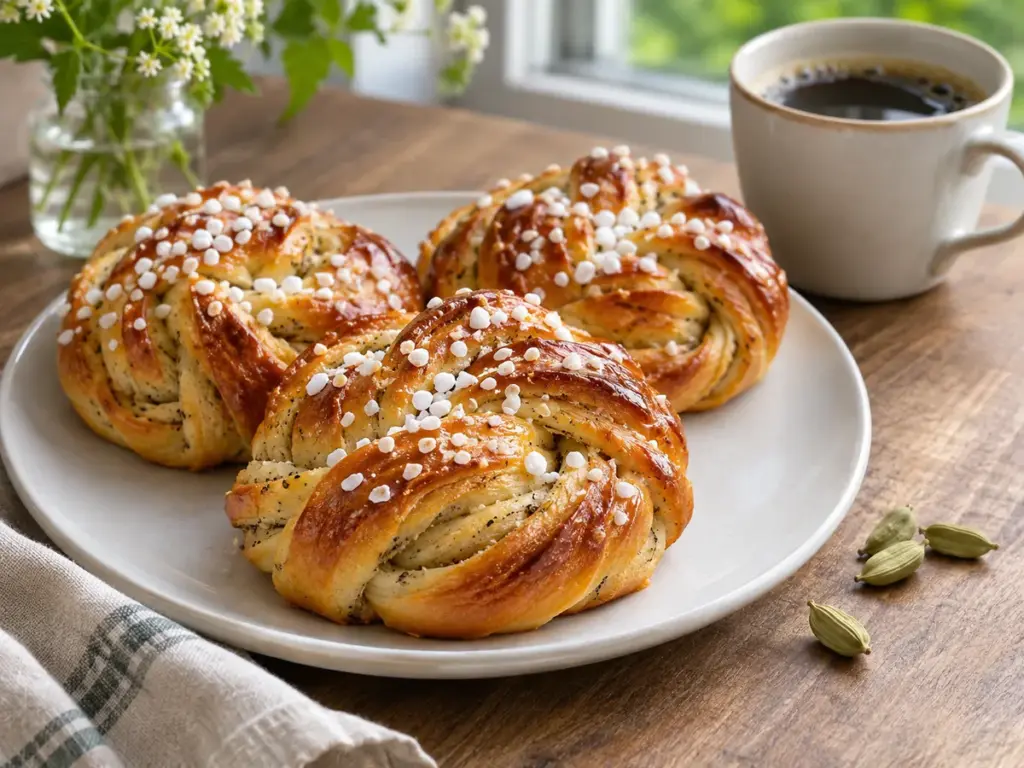
Chai wants cardamom. It is one of the main spices in a chai latte, usually next to ginger and cinnamon, and it supplies the fresh, floral edge. Scandinavian buns are built on cardamom. Milk Street says that to Swedes the spice is "indelibly linked" to baking, perfuming both the dough and the buttery filling of kardemummabullar, and that Swedes eat about 60 times as much of it as Americans do each year.
5. Can You Use Cardamom Instead of Nutmeg, or the Reverse?
Yes, in sweet baking, and the dish will taste different. Nutmeg with cinnamon makes a workable stand-in for cardamom, and cardamom can fill in for nutmeg when you have none. Use the amounts below as a starting point.
| Swap | Amount | What changes |
|---|---|---|
| Nutmeg in place of cardamom | For 1 teaspoon cardamom, use ¼ teaspoon nutmeg plus ½ teaspoon cinnamon | Warmer, with no citrus. It fails in chai, where cardamom leads |
| Cardamom in place of nutmeg | For 1 teaspoon nutmeg, use 1 teaspoon ground cardamom | Floral citrus replaces woody warmth. It fails in eggnog and cream sauces |
The second row works by weight, because a teaspoon of ground cardamom weighs about 2 g and a teaspoon of ground nutmeg about 2.2 g (USDA). Add half of the swap first, mix, smell the dough or batter, and then decide whether to add the rest.
If you have neither jar, allspice is the usual third choice because it carries cinnamon, nutmeg and clove notes. Mace, the red covering of the nutmeg fruit, also ranks among the closest nutmeg replacements. Never swap black cardamom into a sweet recipe.
6. Is Nutmeg Toxic in Large Amounts?
Nutmeg is safe in the amounts recipes use, but very large amounts can poison you. Poison Control says too much can cause hallucinations, and that people who swallow a lot become "miserably sick", with nausea, vomiting, agitation, prolonged drowsiness and coma all possible. Researchers link nutmeg poisoning to myristicin, a compound in the seed's oil.
At about 2.2 g per teaspoon (USDA), the 25 g figure works out to roughly 11 teaspoons of ground nutmeg, far more than any recipe uses.
A full teaspoon in a pie is about a tenth of that 25 g, and it is split across every slice. Cardamom has no comparable warning in the sources we used for this page.
7. Which Should You Buy, and How Do You Store It?
- Buy nutmeg whole and grate it as you cook, because a fresh grating smells stronger than ground. Use ground nutmeg when you need a measured teaspoon for baking.
- Buy cardamom as green pods and grind the seeds yourself. Pre-ground cardamom loses flavor, as Milk Street found.
- Keep both airtight, away from heat and light. USDA FoodKeeper lists whole spices at 3 to 4 years in the pantry and ground spices at 2 to 3 years for best quality, and nutmeg follows the same pattern.
Sources
- USDA FoodData Central, FDC 170919: Spices, cardamom
- USDA FoodData Central, FDC 171326: Spices, nutmeg, ground
- Poison Control: Kitchen surprises and cautions
- Ehrenpreis et al., Nutmeg Poisonings: A Retrospective Review of 10 Years Experience from the Illinois Poison Center, 2001-2011 (Journal of Medical Toxicology, 2014)
- FAO: Production, handling and processing of nutmeg and mace, the plant and the environment
- 177 Milk Street: Sweden's Sweetly Spiced Cardamom Buns
- USDA FoodKeeper: spices, whole and ground

Food writer at GustoMeadow. Writes ingredient substitutes, food comparisons, taste guides and storage guides for home cooks.
Storage and food-safety numbers follow USDA, FDA and university extension guidance.



