
Calphalon sells mid-priced block sets with built-in ceramic sharpeners, while Henckels runs from $150 stamped sets to German-forged Zwilling.
- Pick Calphalon Premier for a full block with built-in sharpeners for straight blades.
- Pick Zwilling Four Star, made in Germany, for one forged chef's knife.
- Henckels Classic is made in Spain and Statement is stamped, so read the line name.
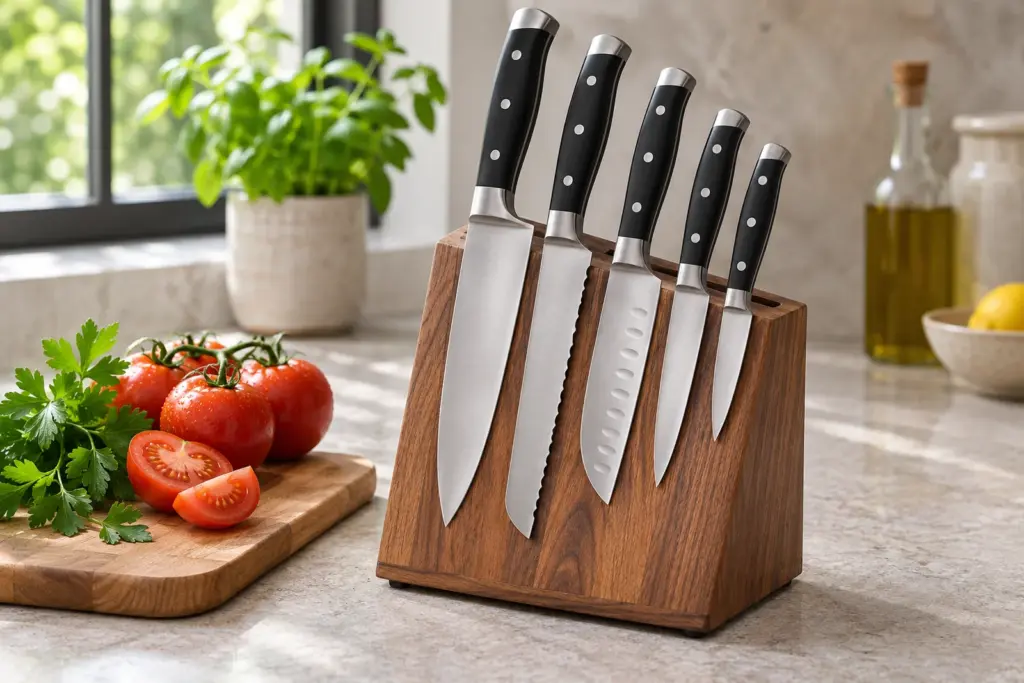
Shoppers choose between these two brands the way they choose in any kitchen comparison, by lining up price, build and upkeep. The trouble is that each name covers more than one product. Calphalon lists seven knife lines on its warranty chart, and Henckels covers two separate groups of knives, so this page compares line against line, using the brands' own US product pages.
1. What Does Henckels Mean on a Knife Box?
Zwilling J.A. Henckels is the Solingen company that advertises "quality since 1731." Its own site lists Pro, Professional "S," Four Star and Twin 1731 as made in Solingen, Germany, under the Zwilling name.
The same company sells a second brand. On Zwilling's US site, HENCKELS is the everyday line, "established in 1895," and ZWILLING is the expert line crafted in Solingen.
- Four Star, Pro, Professional "S" and Twin 1731 are made in Solingen
- The Four Star chef's knife is forged in one piece and ice-hardened
- An 8-inch Four Star chef's knife lists at $149.99
- Classic is fully forged in Spain from German stainless steel
- Statement is stamped, and its 15-piece set lists at $149.99
- Classic steak knives can be made in China or India
The series descriptions on Zwilling's own site show how wide the German group is:
- Four Star: the best-selling series worldwide, with seamless synthetic handles.
- Pro: a wedge-shaped blade and a curved bolster for safer, more precise cutting.
- Professional "S": a classic three-rivet design.
- Twin 1731: the luxury line, in Cronidur 30 steel with Bocote wood handles.
Whichever Henckels set you are looking at, find the line name and the country of origin first, because they decide which of the two groups you are buying.
2. What Is the Difference Between Calphalon and Henckels Knives?
The first table sets Calphalon's 15-piece Premier set against the two Henckels lines and a single Zwilling Four Star knife. A second table below it covers origin, warranty and price.
| Trait | Calphalon Premier | Henckels Classic and Statement | Zwilling Four Star |
|---|---|---|---|
| Blade build | Full tang, bolstered | Classic: fully forged. Statement: single-piece stamped | Forged in one piece, raised bolster |
| Steel | High carbon stainless | Classic: German stainless. Statement: stainless | High-carbon stainless, FRIODUR ice-hardened |
| Sharpening | Ceramic slots in the block | Steel in the box, then you hone | You hone and sharpen it yourself |
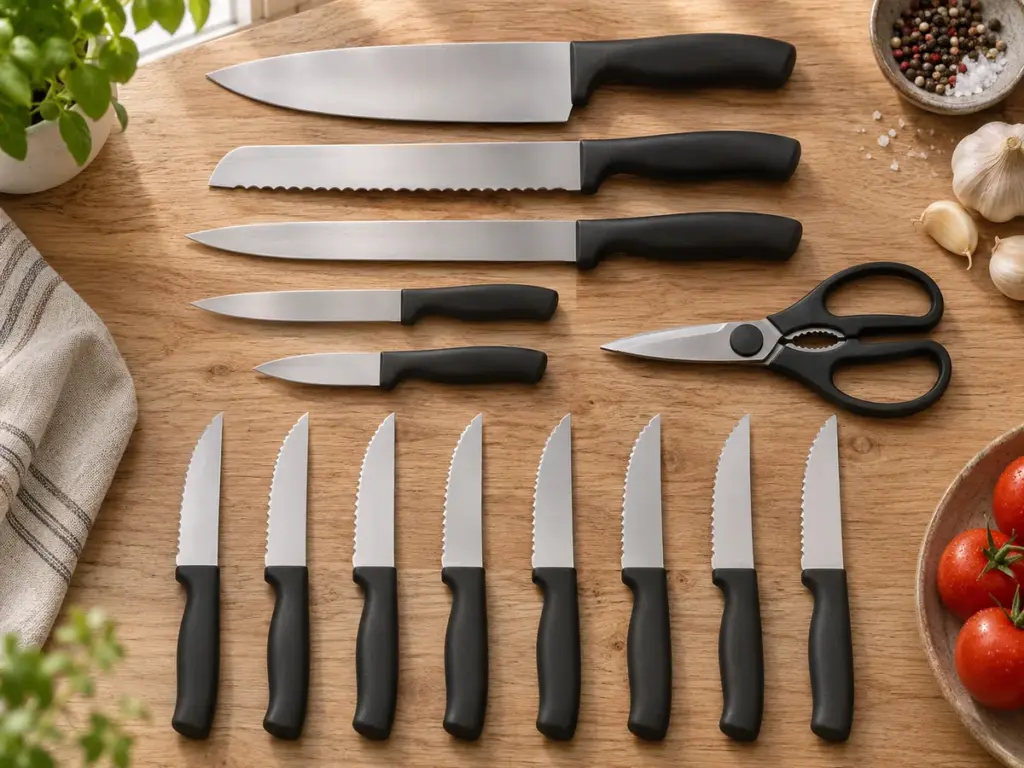
The sharpening row changes your week the most. Calphalon says its block touches up the edge each time you slide in a straight knife, while the Henckels Classic 16-piece and Statement 15-piece sets list a sharpening steel among their pieces, so honing is your job.
Henckels and Zwilling prices in the next table are list prices on their US sites on November 17, 2026, and sale prices move often.
| Trait | Calphalon Premier | Henckels Classic and Statement | Zwilling Four Star |
|---|---|---|---|
| Made in | Not listed on the page | Classic: Spain. Statement 20-piece: China | Germany |
| Warranty | Limited lifetime | Lifetime (Classic set page) | Lifetime |
| List price | About $240 on Calphalon's own listing (out of stock when checked; other sellers vary) | Classic 16-piece $299.99, Statement 15-piece $149.99 | $149.99 for one 8-inch chef's knife |
The prices do not line up one to one. A full Calphalon block lists for about $90 more than a single Four Star chef's knife, which sold for $59.99 on November 17, so the real question is whether you want a block with five cooking knives, eight steak knives and shears, or one very good chef's knife.
Calphalon also reuses the names Classic and Premier for pans, so a review of "Calphalon Premier" may describe Premier cookware instead of knives.
Piece counts also hide how many cooking knives a set holds. Henckels' own pages show it:
- Classic 16-piece: four knives (paring, serrated utility, carving, 8-inch chef's), a carving fork, eight steak knives, a steel, shears and the block.
- Statement 15-piece: six knives (paring, serrated utility, two santoku, chef's, bread), six steak knives, a steel, shears and the block.
3. Do Forged or Stamped Blades Matter?
A forged blade is shaped from one bar of steel and usually has a thick bolster, the band of metal between blade and handle. A stamped blade is cut from a flat sheet. Henckels calls its Statement blade "lighter than traditionally forged knives," and its Classic line fully forged.
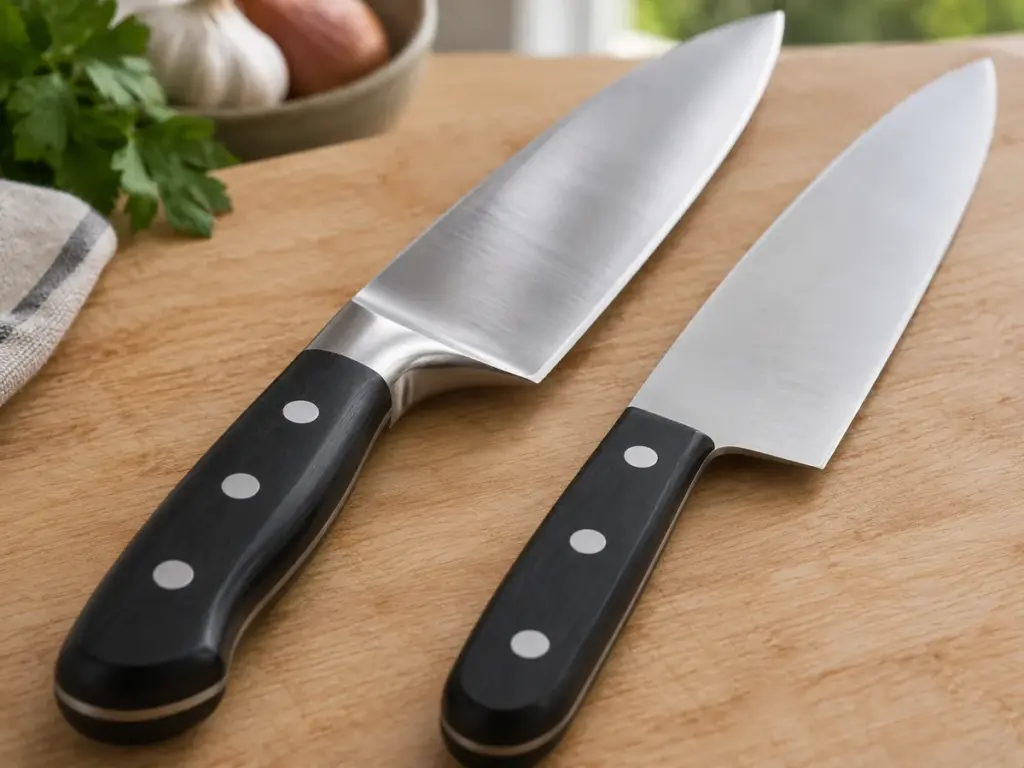
Between forged and stamped knives, weight is what you feel first. A forged knife with a thick bolster sits heavier, and Henckels' own stamped Statement blade is the lighter one. In Henckels' lineup, the stamped set also costs less.
- Calphalon Premier: the 15-piece page says "full-tang" and "bolstered" but does not say forged or stamped, so check the box.
- Calphalon Contemporary and Precision: Prudent Reviews describes the blades as fully forged German steel, with steak knives in stamped Asian steel.
- Calphalon Select: the same review lists it as stamped.
- Henckels Classic: the set page says "fully forged from high-quality German stainless steel."
- Zwilling Four Star: the page says "SIGMAFORGE - Single piece, forged knife."
- Henckels Statement: "single-piece, stamped blade construction is lighter than traditionally forged knives."
Forged does not guarantee a sharper edge. It guarantees a heavier knife with a bolster, and the next section looks at what the steel itself brings.
4. How Hard Is the Steel, and How Sharp Is the Edge?
Rockwell hardness, written HRC, rates how hard the steel is. Harder steel usually holds an edge longer, but it also resists your honing rod and whetstone more.
- Calphalon: Prudent Reviews lists Classic at 48 to 52, Contemporary at 54 to 56 and Precision at 56 to 58. Calphalon says Precision stays sharper 20% longer than Contemporary.
- Zwilling Four Star: the chef's knife page says "57 Rockwell Hardness" and lists 55 to 58 HRC in its specifications.
- Wusthof Classic 8-inch: Wusthof's page lists 58 HRC.
- Henckels Classic and Statement: the set pages give no hardness number.
Read side by side, Calphalon Precision and Zwilling Four Star sit within a point or two of each other, while Calphalon Classic is the soft one. Prudent Reviews does not list Premier at all.
Edge angle is the other half of sharpness, and only one brand states it. If you own a Zwilling, you hone it at about 15 degrees, the angle the brand gives. If you own a Calphalon, you will not find one: Prudent Reviews reports that Calphalon's support line did not know its edge angles.
5. Which Handles Feel Better in Your Hand?
Handles decide how a knife feels after twenty minutes of dicing. Zwilling Four Star has a polypropylene handle that the product page says is made with "a minimum amount of 75% recycled plastics," and Zwilling's series page calls the handles seamless. Your palm meets no rivets.
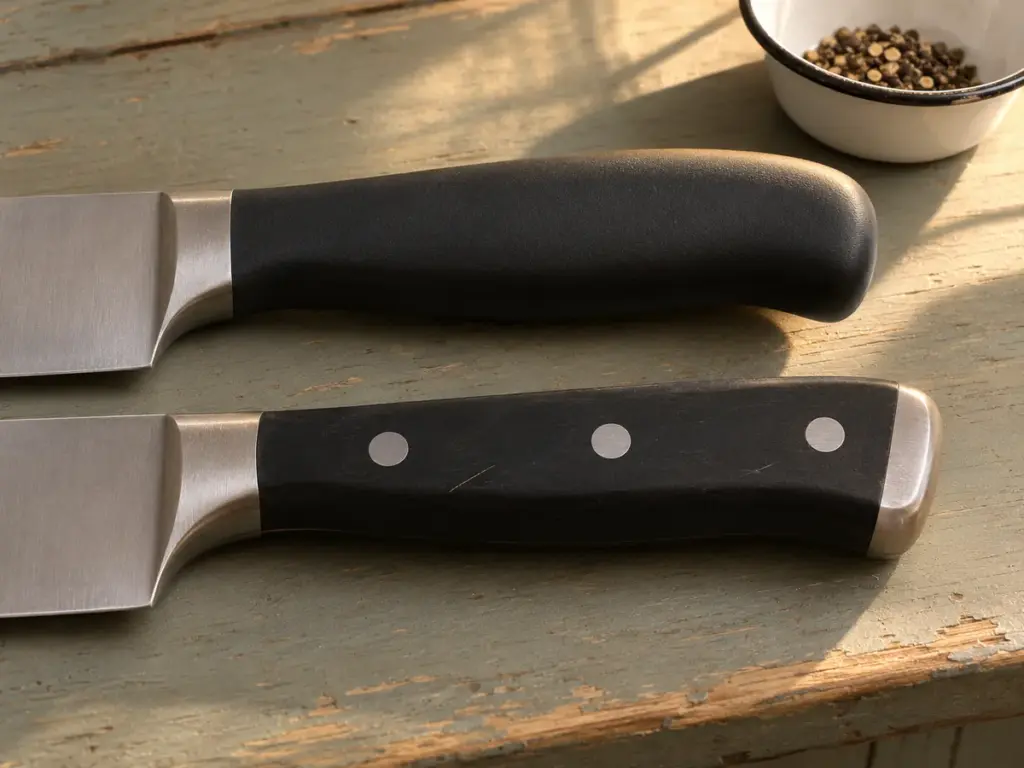
On both Henckels lines you grip a triple-rivet handle. The Statement page adds that the handles are "curved for comfort and balance" and capped with stainless-steel endcaps.
Calphalon varies by line. Prudent Reviews says the Classic handles are poly-resin and larger than other knives of similar design and blade length. Calphalon also lists a Premier 15-piece set with stainless steel handles, so you can pick metal over resin.
If you hold a chef's knife with a pinch grip, thumb and finger on the blade just ahead of the bolster, a slim bolster helps. Prudent Reviews says knives with slimmer bolsters, such as Zwilling, are much easier to pinch-grip, so check the bolster on any set you consider.
6. How Does Calphalon's Self-Sharpening Block Work?
Calphalon's SharpIN blocks hold spring-loaded ceramic sharpeners inside the slots. Each time you slide a knife in or pull it out, the ceramic runs along the blade. Calphalon says this keeps blades sharp "for a lifetime," which reads as marketing, because a ceramic slot sharpens by rubbing the edge against ceramic and so removes a little steel every time.
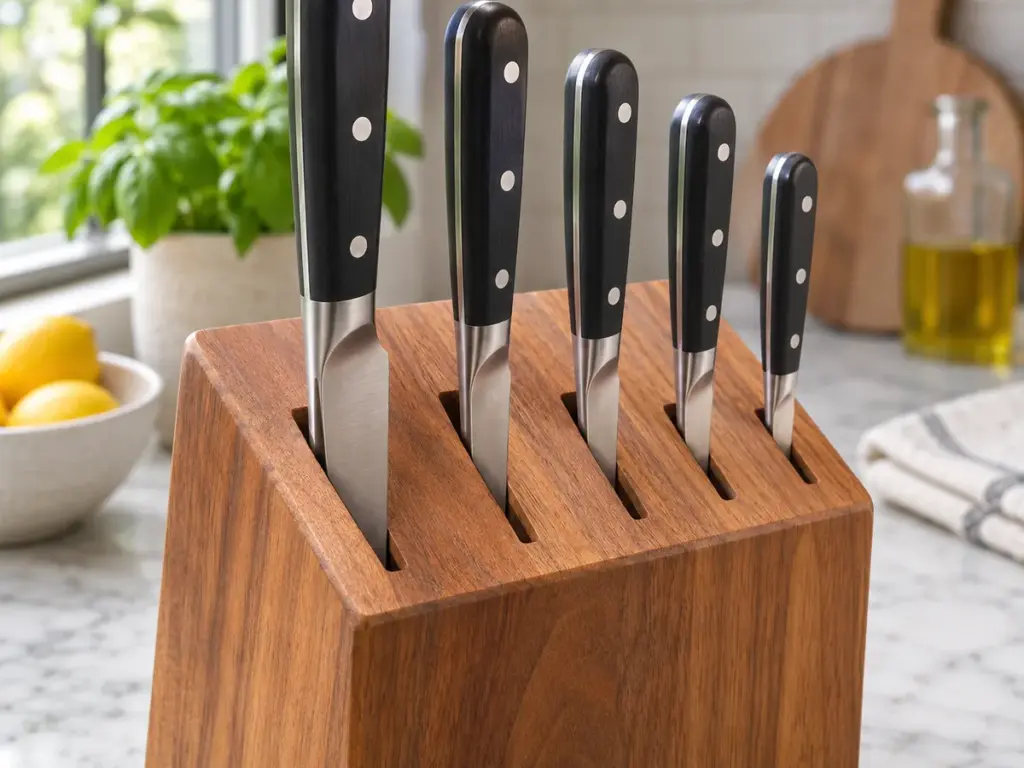
- Chef's, paring and utility knives
- Any straight-edge blade in the set
- Serrated knives such as the bread knife
- Steak knives
- Kitchen shears
Calphalon's own page says the technology is "specifically designed for straight-edge knives." The sharpeners live in the block, so a set bought for this feature has to stay in its block instead of moving to a magnetic strip.
Prudent Reviews reports that the blocks "don't hold up well over time" and that Calphalon sells no other sharpening tools or sharpening service.
Henckels sells self-sharpening blocks too. Its Statement collection page lists a 20-piece Self-Sharpening Knife Block Set, though the page does not say how that block works.
7. How Do You Keep Henckels and Calphalon Knives Sharp and Clean?
A Henckels or Zwilling knife depends on you to keep its edge. The guide on Zwilling's site says knives "should be honed regularly and sharpened occasionally." Honing realigns the edge, and sharpening regrinds it once honing no longer renews it.
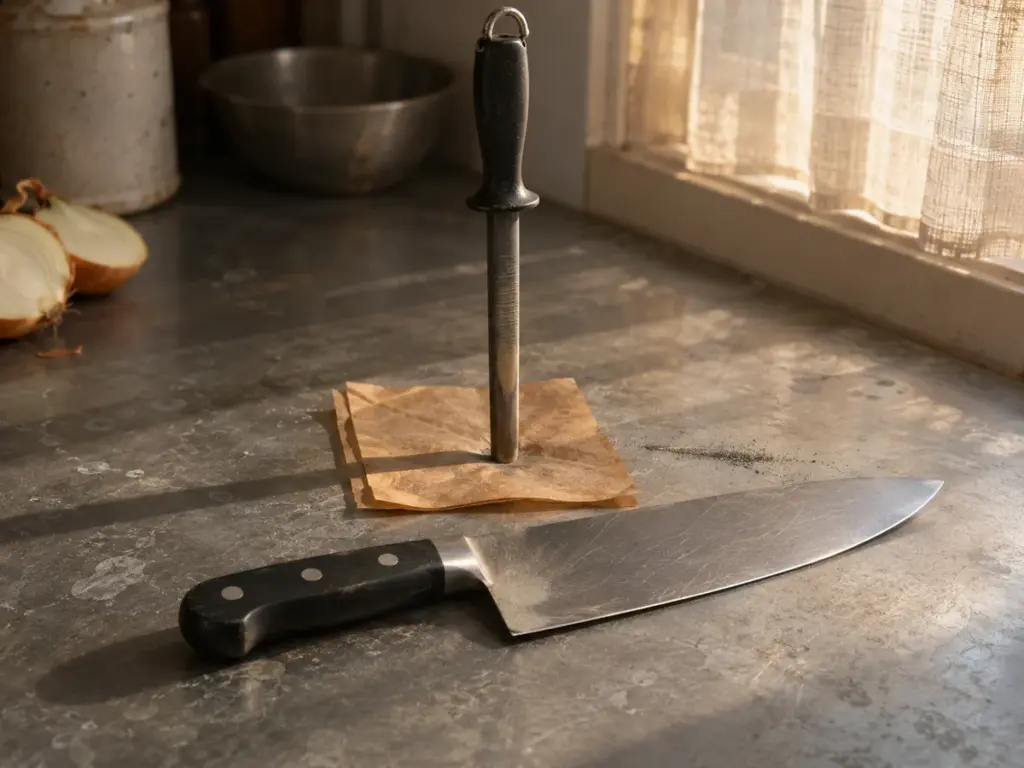
A honing rod straightens the edge between uses. You pick a steel harder than your knife, hold the blade at about 15 degrees, and make 3 to 10 strokes, switching sides after every stroke. Santoku and Miyabi knives take 9 to 12 degrees, per the same guide.
When honing stops working, you can sharpen the edge on a whetstone:
- Soak the stone in water for about five minutes.
- Angle the knife on the stone at 10 to 20 degrees.
- Rinse the knife under running water and dry it right away.
If you want a set that tolerates the machine, Henckels pages are friendlier. The Statement sets say "Dishwasher safe," and the Classic set page lists the knives as dishwasher safe or hand wash. The Four Star page says "Dishwasher safe, hand wash recommended," so you protect the edge by washing it by hand anyway.
8. What Do the Warranties Cover?
- Calphalon: Classic, Premier, Contemporary, Precision, Katana and LX knives carry a limited lifetime warranty, which runs "as long as you own the product." Select by Calphalon carries 10 years.
- Henckels: the Classic and Statement set pages promise "a lifetime warranty for all our products."
- Zwilling: the Four Star chef's knife page lists a lifetime warranty.
Calphalon's coverage is for manufacturing defects under normal household use, and you get it only on products bought from Calphalon or an authorized US seller. A set from an unauthorized online seller may not be covered.
9. What Do Calphalon and Henckels Knives Have in Common?
- Both sell block sets that bundle steak knives and kitchen shears with the cooking knives.
- Both put a lifetime warranty on their main lines.
- Calphalon Premier and Henckels Statement both list a full tang.
- Both make their blades from stainless steel.
Those overlaps explain why the two brands get compared, and the differences above are what separate a set you hone from a set that hones itself.
10. How Do They Compare with Wusthof and Other Brands?
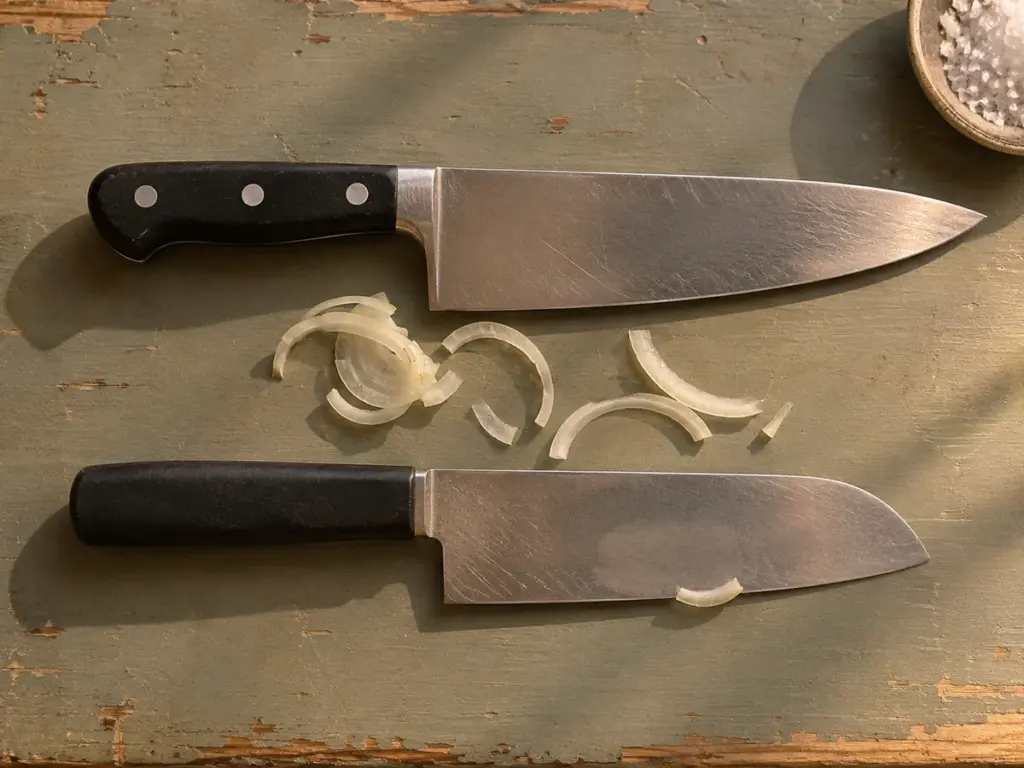
Blade shape is the difference you see at a glance. A German-style chef's knife curves up to a point, while a santoku has a flatter edge and a rounded tip.
Wusthof's Classic 8-inch chef's knife is listed as forged, made in Germany, at 58 HRC, which puts it next to Four Star at 57.
If a Chicago Cutlery block is also on your list, Chicago Cutlery against Henckels compares those two brands.
Prudent Reviews puts the Calphalon verdict plainly: "For a similar price, brands like Henckels offer better quality and durability." It adds that Wusthof, Zwilling and Victorinox give "significantly better performance and longevity" at higher prices.
The same reviewer found Calphalon knives very sharp out of the box, and the knives dulled within a couple of months. If you want a first block and expect to hone it, that trade can still make sense.
11. How Much Do They Cost, and Is It Worth It?
These prices come from the brands' US sites on November 17, 2026, and they change often.
- Henckels Statement: $149.99 for 15 pieces, $219.99 for 20.
- Henckels Classic 16-piece: $299.99 list, shown at $249.99.
- Zwilling Four Star 8-inch chef's knife: $149.99 list, shown at $59.99.
That day the forged Four Star knife cost less than half the Statement 15-piece set, so a list price alone can mislead you. Watch a listing for a week or two before you decide.
You can also divide by cooking knives instead of pieces. The Statement set works out to about $25 per cooking knife ($149.99 for six), and the Classic set to about $75 at list price ($299.99 for four), or about $62 at the $249.99 shown price. That is simple division, not a Henckels figure, and it leaves out the steak knives, steel and shears each set includes.
12. Who Makes Calphalon and Henckels Knives?
- Calphalon: Prudent Reviews traces it to Commercial Aluminum Cookware, founded in 1963 and bought by Newell Brands in 1998. Newell's site still lists Calphalon among its brands.
- Zwilling: the company says that since 1731 it has made knives "in our original Solingen factories," from forging and hardening to final polishing and sharpening.
- Henckels: the everyday brand, established in 1895. Where a set is made depends on the line.
Country of origin follows the same split. Prudent Reviews says all Calphalon knives are made in China, and the Premier page lists no country. On a Henckels box you will find the Classic knives made in Spain, the Classic steak knives made in China or India, and the Statement 20-piece set made in China.
13. Which Knife Set Should You Buy?
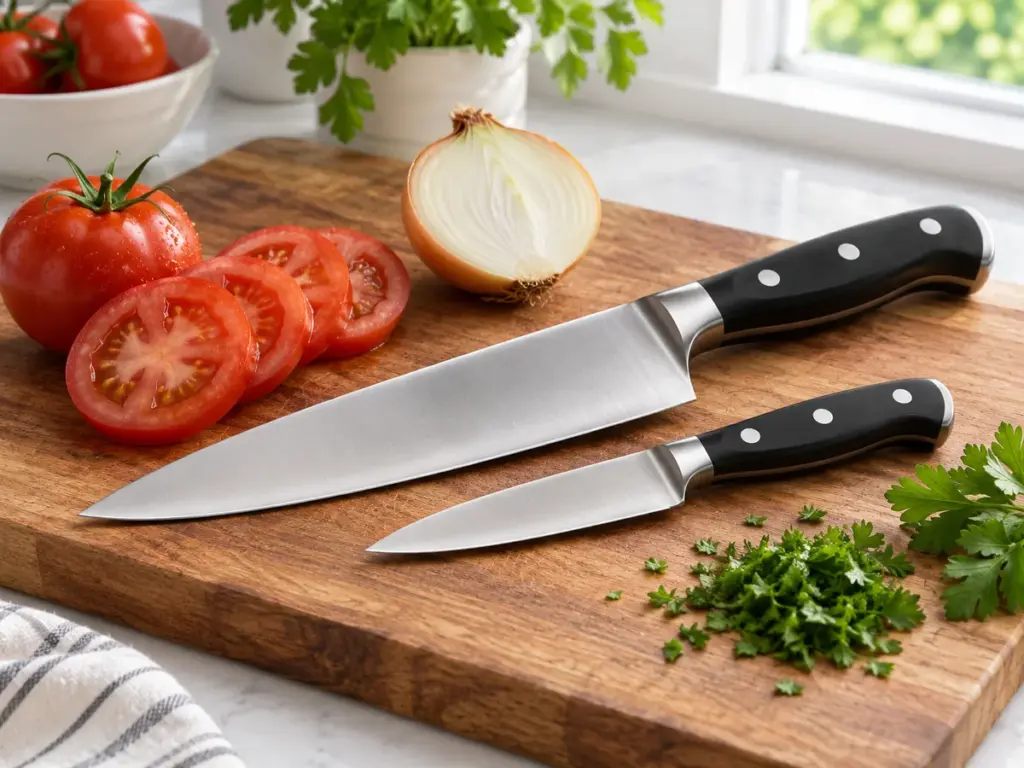
- You want a full block with the least upkeep. Calphalon Premier costs about $240 for 15 pieces on its own listing, other sellers' prices vary, and Calphalon says the block sharpens straight-edge knives for you.
- You want the lowest price for a full set. The Henckels Statement 15-piece set lists at $149.99, with lighter stamped blades.
- You want one knife you will keep for years. A Zwilling Four Star 8-inch chef's knife lists at $149.99, and you add a honing rod.
- You prefer thin Japanese-style blades. Shun and Miyabi both make premium Japanese-style knives, so check how Miyabi and Shun knives differ before you pay more than a Four Star costs.
- You cook steak dinners for guests. The Henckels Classic 16-piece set includes eight steak knives and the Statement 15-piece set six.
- You have small hands or use a pinch grip. Check the handle size and the bolster in a store, since Prudent Reviews found the Calphalon Classic handles large.
- You rarely hone a knife. Calphalon's block is built to do part of that job on straight blades, and a Henckels set leaves it to you and the steel in the box.
Sources
- Calphalon, Warranty Information: warranty periods by knife line, coverage limits, dishwasher exclusion.
- Calphalon, Premier 15-Piece Knife Set with SharpIN Edgetech: steel, full tang, ceramic sharpeners, straight-edge limit, dishwasher note, price.
- Calphalon, Cutlery by Feature: Classic Self-Sharpening sets and SharpIN technology.
- Prudent Reviews, Calphalon Knives Review: hardness by line, forged and stamped notes, handles, block durability, verdict against Henckels and Wusthof.
- Prudent Reviews, Where Is Calphalon Made: founding year, Newell Brands purchase, country of origin.
- Newell Brands, Our Brands: Calphalon listed as a Newell brand.
- Henckels, Classic 16-Piece Knife Block Set: origin, forged blades, set contents, warranty, price.
- Henckels, Statement 15-Piece Knife Block Set: stamped blade, set contents, dishwasher note, price.
- Henckels, Statement 20-Piece Knife Block Set: origin, dishwasher note, price.
- Henckels, Statement Collection: triple-rivet handle, stamped blade, self-sharpening set.
- Zwilling, ZWILLING and HENCKELS Brands: how the two brands are positioned, founding years.
- Zwilling, Knives Made in Germany: Solingen lines, FRIODUR, 1731.
- Zwilling, Four Star 8-Inch Chef's Knife: forged build, handle, hardness, care, warranty, price.
- Zwilling, How To Sharpen Your Knives: honing, angles, whetstone steps.
- Wusthof, Classic 8-Inch Chef's Knife: forging method, hardness, country of origin.

Food writer at GustoMeadow. Writes ingredient substitutes, food comparisons, taste guides and storage guides for home cooks.
Storage and food-safety numbers follow USDA, FDA and university extension guidance.



