
New York and Kansas City strips are the same strip loin steak from the short loin, sold under two names.
- Either name can mean a bone-in or a boneless steak, so you check the tray label.
- The muscle and fat cap are identical, so grade and thickness change your steak more.
- USDA advises cooking either steak to 145°F and resting it 3 minutes.
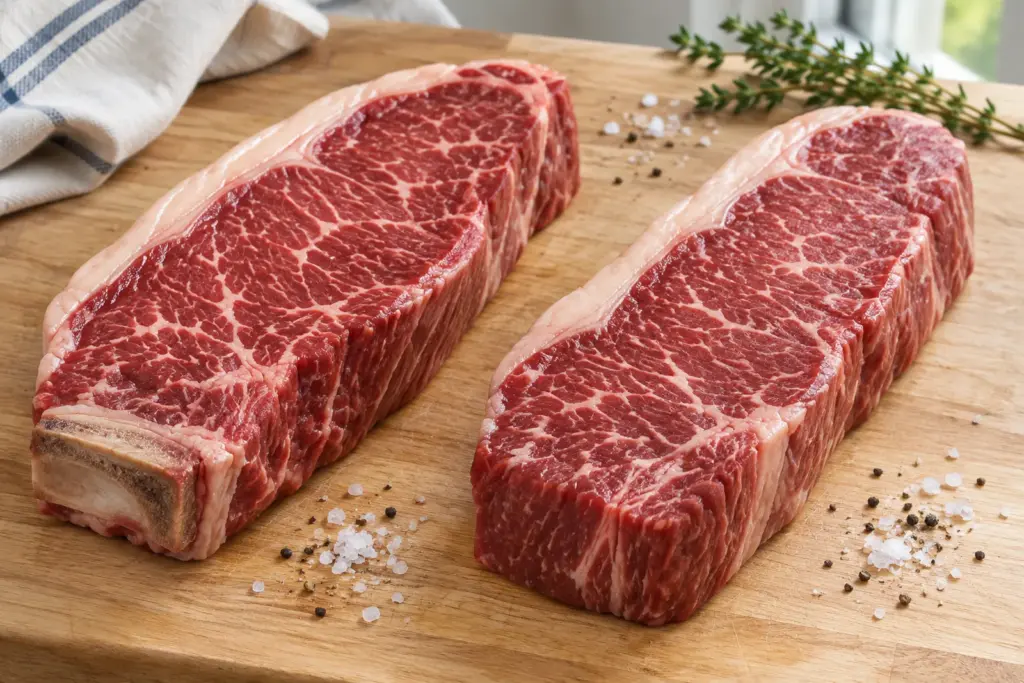
The two names split along regions and sellers, much like other look-alike foods that differ more on the label than on the plate.
Both steaks are cut from the strip loin, a long muscle that runs along the back just behind the ribs, and the only part you can see change at the meat counter is the bone along one edge.
1. What Is the Difference Between a New York Strip and a Kansas City Strip?
Most traits match, so the real choice you make at the counter is bone-in or boneless, whichever name the tray carries.
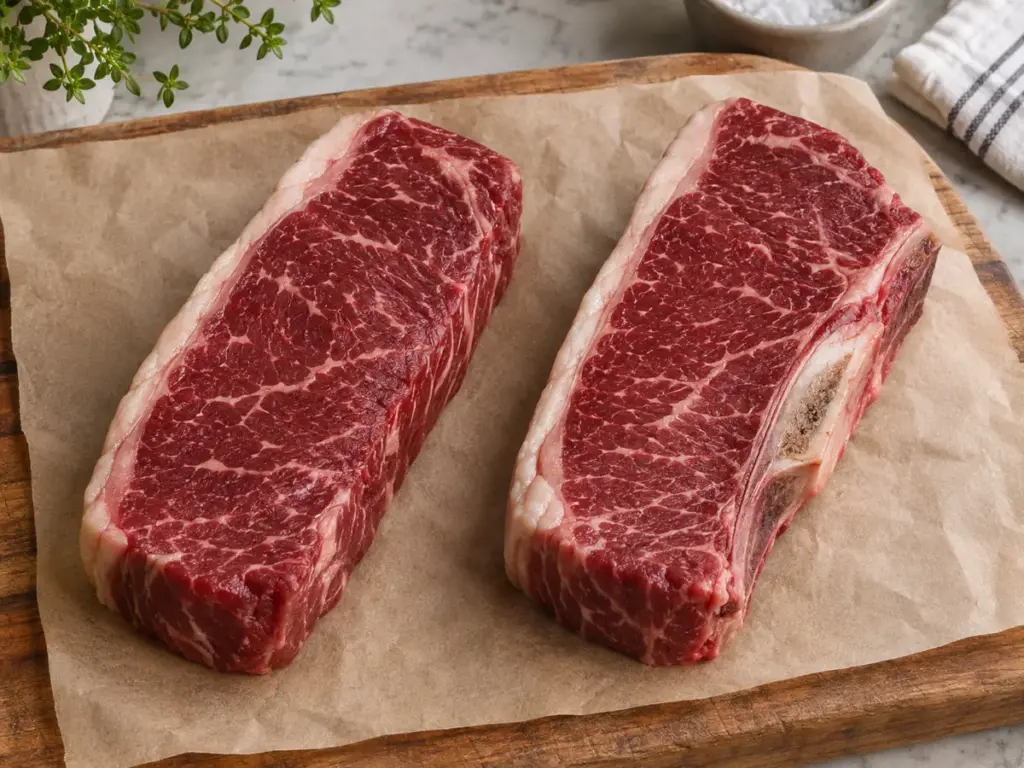
| Trait | New York strip | Kansas City strip |
|---|---|---|
| Cut | Strip loin steak from the short loin | The same cut |
| Bone | Sold bone-in or boneless under this name | Also sold bone-in or boneless |
| Meat buyer's number (IMPS/NAMP) | 1180 when boneless, 1179 when bone-in | The same two numbers |
- Fat: both steaks carry a thin cap along one long edge, and the grade and the trim change that cap more than the name does.
- Where the name is common: Kansas City Steak Company, a steak seller, says on its site that the two names describe the same cut, with the Kansas City name more common in the Western U.S. and the New York name on the East Coast.
- What you pay for: with boneless, every ounce you buy is meat, while a bone-in steak is priced by total weight, so part of what you pay for is bone.
If a recipe or a menu names either steak, any strip loin steak will do, and the bone is the only thing that changes how you handle it at the stove.
2. Does Kansas City Strip Always Mean Bone-In?
Some sellers do tie the name to the bone, and Kansas City Steak Company, for one, sells a bone-in Kansas City strip, yet no meat buying standard makes that split a rule.
A store tray or an online listing usually says "bone-in" or "boneless" next to the name, and at a steakhouse the server can tell you when the menu does not.
3. Where Do the Two Names Come From?
The name "New York strip" has a restaurant behind it, since Delmonico's in New York City sold a short loin steak under the Delmonico name and the steak later picked up the city's name.
The Kansas City story comes mostly from a steak seller: Kansas City Steak Company calls the cut a Kansas City original and says the New York name grew once New York chefs began using it.
The city did have the cattle trade behind it, because the Kansas City Stockyards ran from 1871 to 1991 and at their peak ranked second only to Chicago's Union Stock Yards.
4. What Else Is the Strip Steak Called?
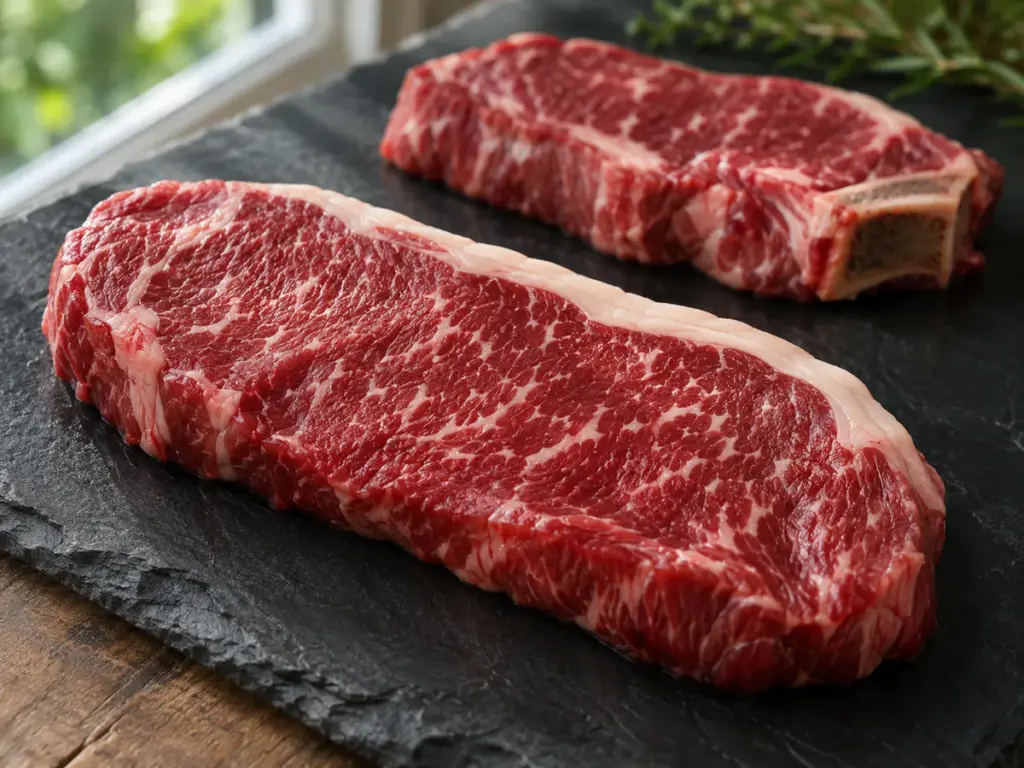
The Beef Checkoff's cut chart, as reproduced by American Foods Group, gives one steak a long list of labels, and these are the ones you are likely to meet.
- Strip steak and top loin steak are the plain names for the same cut, and the closest-sounding mix-up is strip steak versus New York strip.
- Kansas City steak is the short form of the same name, which the National Cattlemen's Beef Association lists for the strip.
- Shell steak means a bone-in strip with no tenderloin attached.
- Ambassador steak and hotel-style steak are two more names the beef chart lists for the strip, though you rarely see them on a store tray.
- Club steak appears on the beef chart as a strip name, with "boneless club steak" among the entries, but butchers use it differently, so it is worth asking which muscle you are getting.
- Delmonico was the name the restaurant once used for a strip and now uses for a thick ribeye, so a "Delmonico" on a menu can be either one.
- Striploin and sirloin are the names abroad, where Ireland calls the cut striploin, the United Kingdom sirloin, and Australia and New Zealand sirloin or porterhouse, and that sirloin is not the US cut described in top sirloin versus plain sirloin.
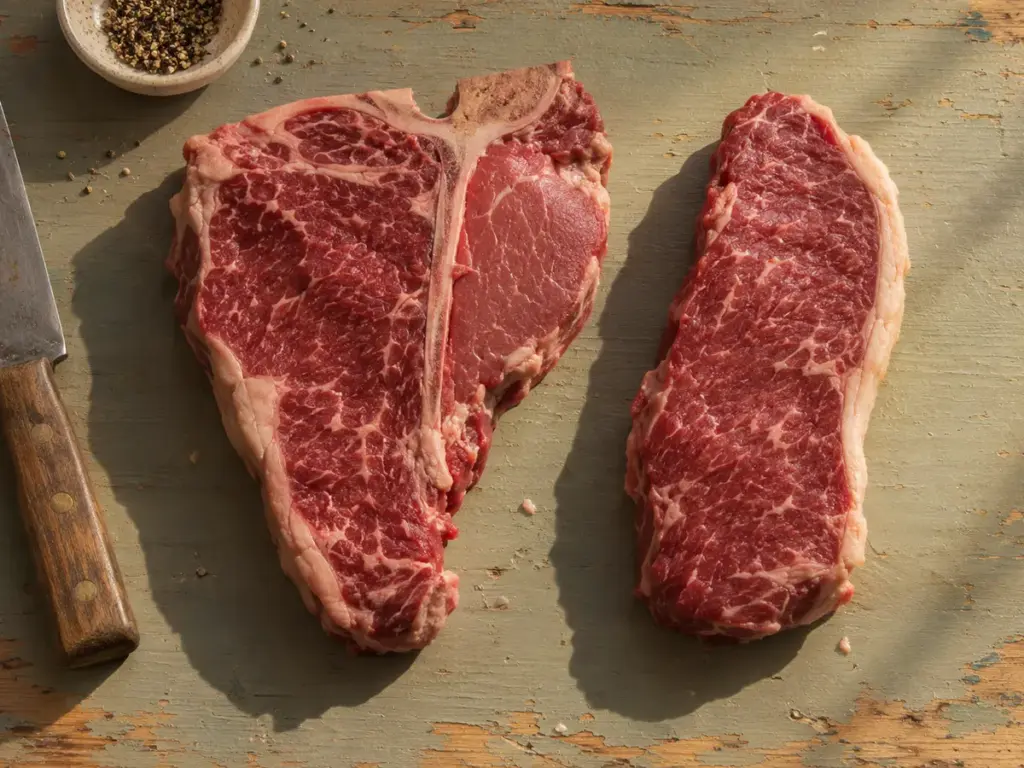
A steak that includes the tenderloin is a different purchase, because a T-bone and a porterhouse have a strip on one side of the bone and a tenderloin on the other.
USDA's meat specifications call it a porterhouse when the tenderloin is at least 1.25 inches wide and a T-bone when it is at least 0.5 inches.
A porterhouse adds the tenderloin to the strip, and that extra meat is what separates porterhouse vs New York strip on price.
5. What Do the Numbers 1179 and 1180 Mean?
Restaurant suppliers and butchers order beef by number from the NAMP Meat Buyer's Guide, which follows USDA's Institutional Meat Purchase Specifications (IMPS).
1179 is the bone-in strip loin steak and 1180 is the boneless one, and the Beef Checkoff chart files both under the same list of names, Kansas City and New York included.
You can give either number to a butcher or a foodservice supplier, and the number is the one place where the bone is written down with no regional name attached.
6. Where Does the Strip Sit on the Cow?
You find the strip in the short loin, the stretch of back just behind the ribs.
The strip does little work on a live animal, so you get tender meat, though less tender than the tenderloin that lies beside it.
- Ribeye comes from the rib section, in front of the short loin.
- You will see the long muscle on top of the short loin sold as strip steak, New York strip or Kansas City strip.
- T-bone and porterhouse are short loin steaks with a strip on one side of the bone and tenderloin on the other.
In an American store a Kansas City strip is never a sirloin, because a U.S. sirloin steak is cut behind the short loin.
A butcher can cut larger portions than the tenderloin allows from the strip, since that muscle is long and wide.
7. What Changes the Taste of a Strip Steak?
Both names describe one muscle, so the name does not change the taste you get. Kansas City Steak Company calls its strips tender, juicy and lean, and says they are not as tender as filet mignon.
What changes the steak on your plate is the grade, the aging and the trim, and the grade is the one printed on the label you can read before you buy.
Does the USDA Grade Matter?
USDA grades beef mainly on marbling, the white flecks of fat you can see inside the muscle.
Montana State University Extension puts Prime at slightly abundant marbling or more, Choice at a small amount and Select at a slight amount, and fewer than 5 percent of carcasses usually reach Prime.
South Dakota State University Extension estimates how likely you are to get a good eating experience for a strip loin steak, by grade:
- Prime: about 97%
- Premium Choice: about 93%
- Low Choice: about 82%
- Select: about 66%
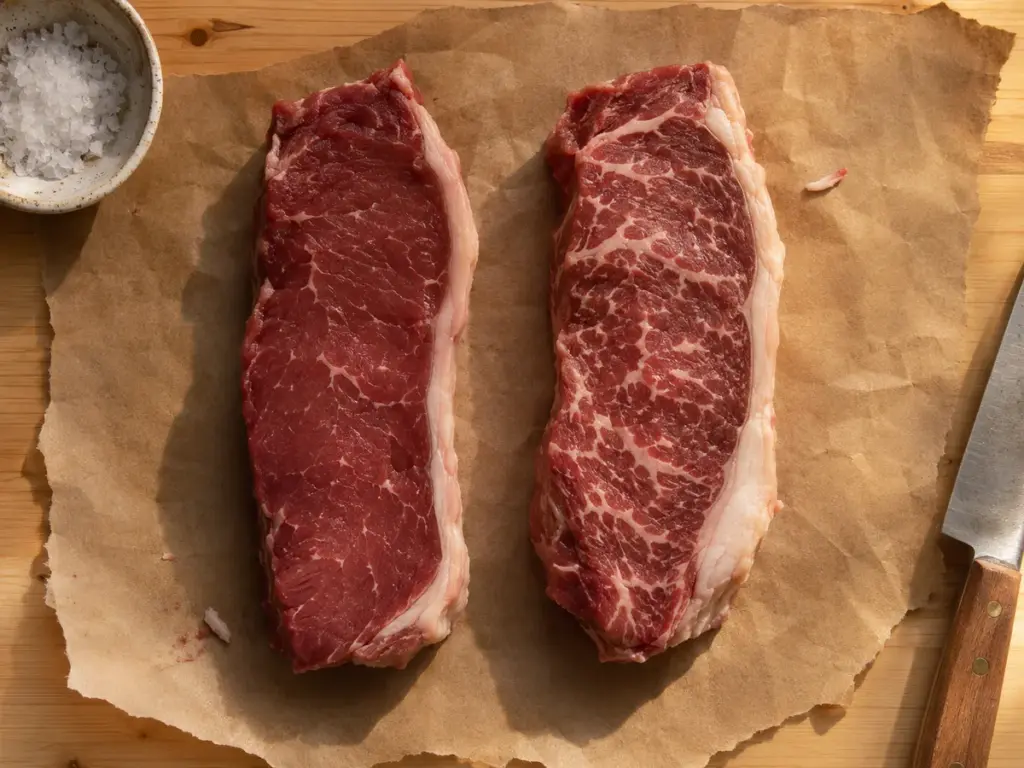
The fat shows up in the numbers too, since USDA FoodData Central lists a raw top loin steak with lean and fat, trimmed to ⅛ inch, at 15.5 g of fat and 228 calories per 100 g for all grades, and 22.2 g and 281 calories for Prime.
A grilled Choice top loin steak with lean and fat has 26.2 g of protein and 18.5 g of fat per 100 g.
Does Dry Aging Make a Strip More Tender?
A 2019 University of Nevada, Reno study aged 48 Prime and Choice short loins for 21 or 42 days.
It found that dry aging did not make strip steaks more tender than wet aging, while Prime steaks were more tender than Choice.
Dry aging does cost the seller meat, because the loin loses moisture, and shrinkage reached up to 9.66 percent after 42 days while wet aging showed no change in yield with time.
The study did not measure flavor, so it says nothing about the nutty taste people credit to dry aging, and what dry-aged steak tastes like is a separate question.
8. How Do You Cook a Bone-In or Boneless Strip?
You cook both versions the same way, with a very hot pan or grill, a hard sear, and a thermometer, and the steps below flag the two things the bone changes.
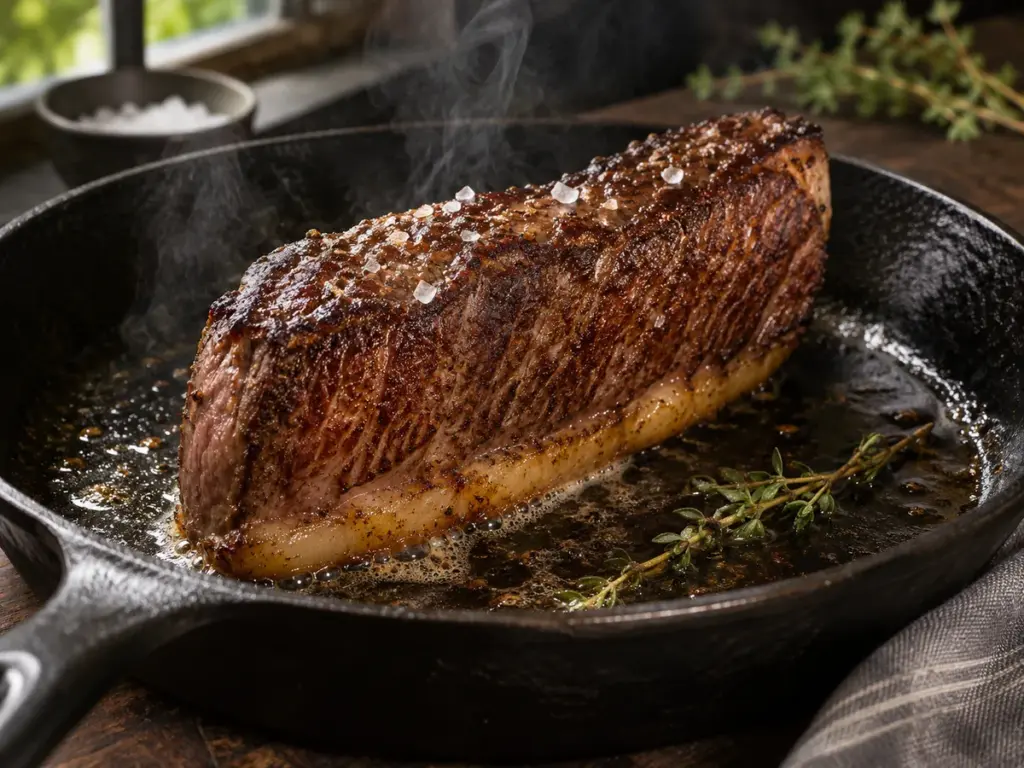
- Salt and dry. Salt both sides and pat the surface dry, because a dry steak browns instead of steaming.
- Heat hard. Get a heavy skillet or a grill very hot before the steak goes on.
- Sear and render the edge. Brown both faces, then stand the steak on its fat cap with tongs for the first minute or so, so the fat melts and crisps.
- Check the thickest part. Put the thermometer tip in the thickest section, away from bone and fat, as USDA's thermometer guidance says. On a bone-in steak, expect the meat touching the bone to finish a little later than the rest.
- Rest. Take it off the heat at 145°F, set it aside for at least 3 minutes, then slice or serve.
USDA's safe minimum for steaks is 145°F with a rest of at least 3 minutes, and its food safety service explains that the temperature holds or keeps rising during those minutes.
If you cook a strip below 145°F, you take a food safety risk, even though some steakhouses serve it that way.
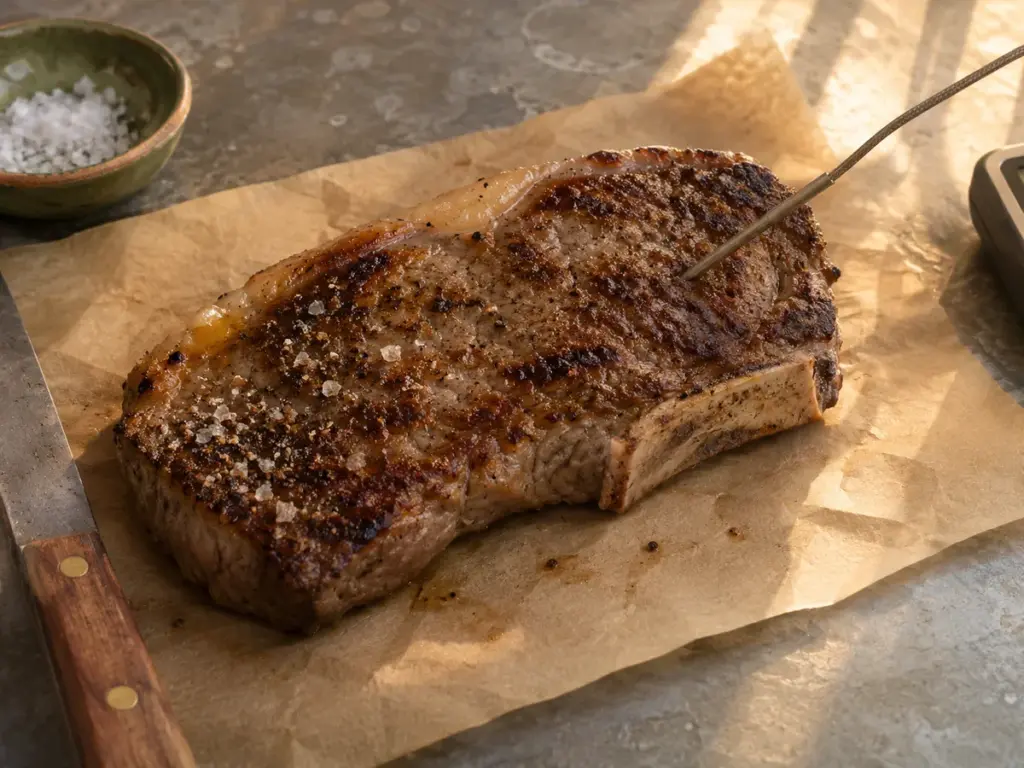
- It takes a little longer, and you keep the thermometer tip away from the bone.
- You carve the meat off the bone at the table, which gives the plate a steakhouse look.
- The whole face browns against the pan because the steak lies flat.
- It slices into even strips with no bone to work around.
- It cooks evenly all the way across.
Grill or Skillet for a Strip?
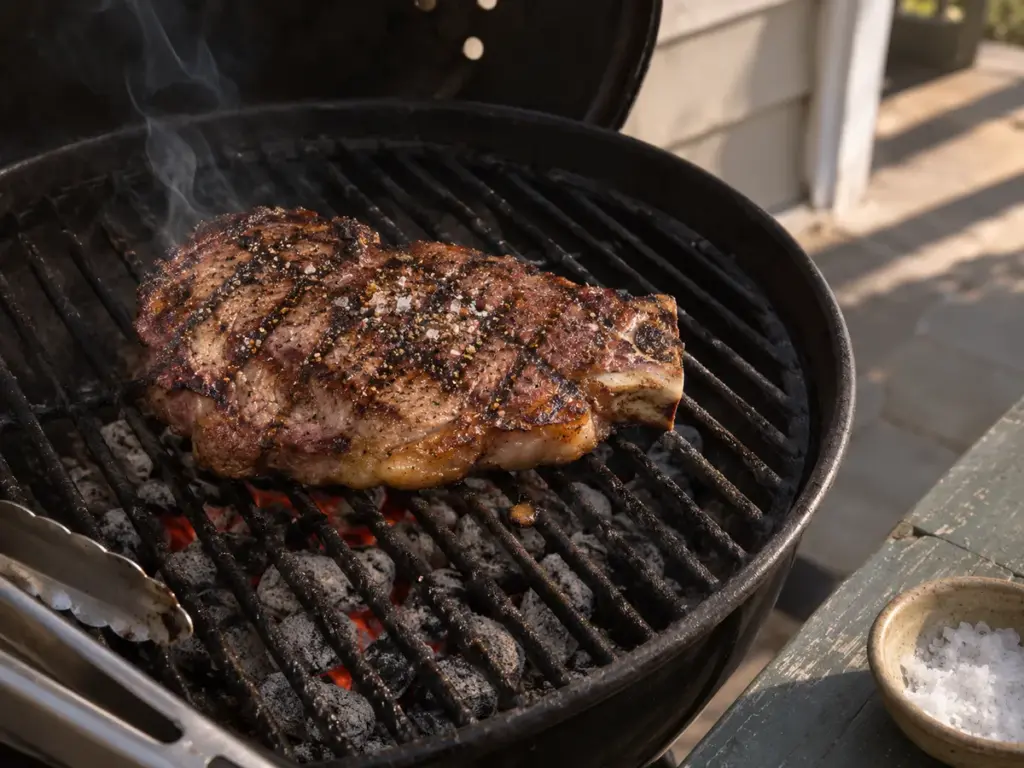
A flat boneless strip gives you a crust through full contact with a hot skillet, while a thick bone-in strip suits the open heat of a grill, and the choice between grill and cast iron changes the crust and the smoke flavor.
What Seasoning and Sauce Suit a Strip?
We'd season a strip with only coarse salt and cracked black pepper before the sear, since the crust and the rendered fat edge carry most of the flavor you taste.
If you want a sauce, we'd pick béarnaise, a butter and egg-yolk sauce, for the lean center, or chimichurri, a sharp vinegar and herb sauce, to sit against the fat edge.
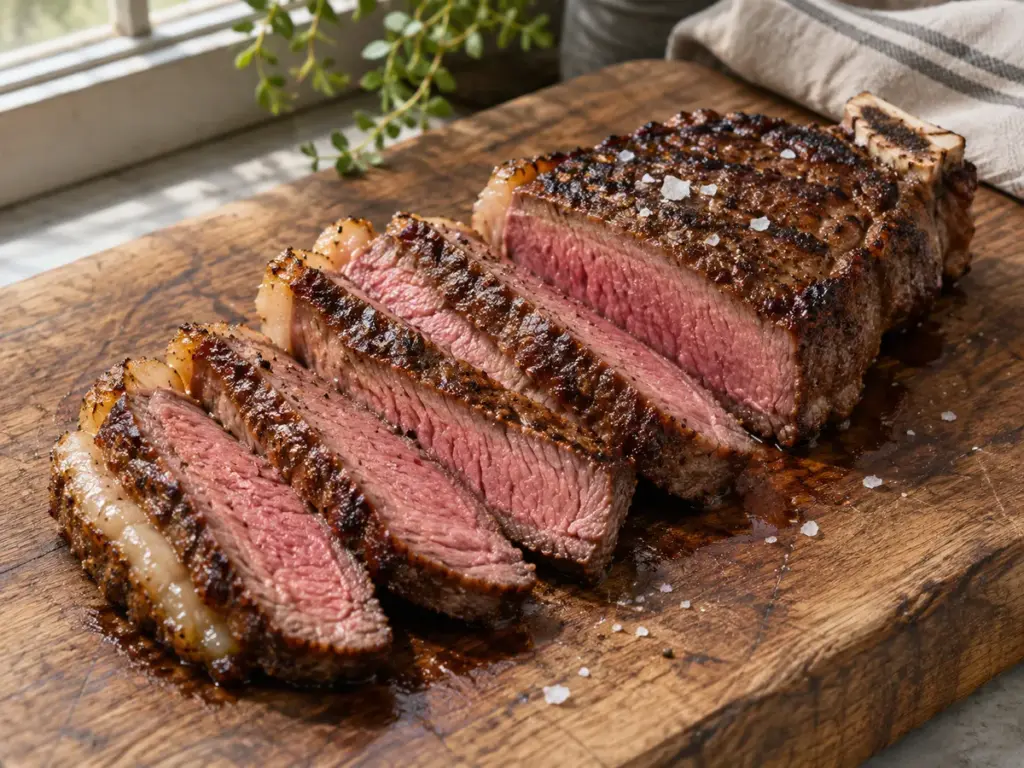
9. What Dishes Suit a Strip Steak?
After the steak rests, you slice it across the grain so every bite has short muscle fibers.
- Steak frites suits a sliced boneless strip laid over fries, and the extras that round out a steak and chips plate fit here too.
- Sandwiches, salads and tacos take the thinnest slices from a boneless strip.
- A steakhouse plate suits a bone-in strip, and the same T-bone steak side dishes work with it.
- Mashed potatoes, roasted vegetables and grilled corn are easy sides you can serve with either steak.
- Leftover slices go cold into a salad or sandwich the next day, and a leftover steak recipe can use up a bigger batch.
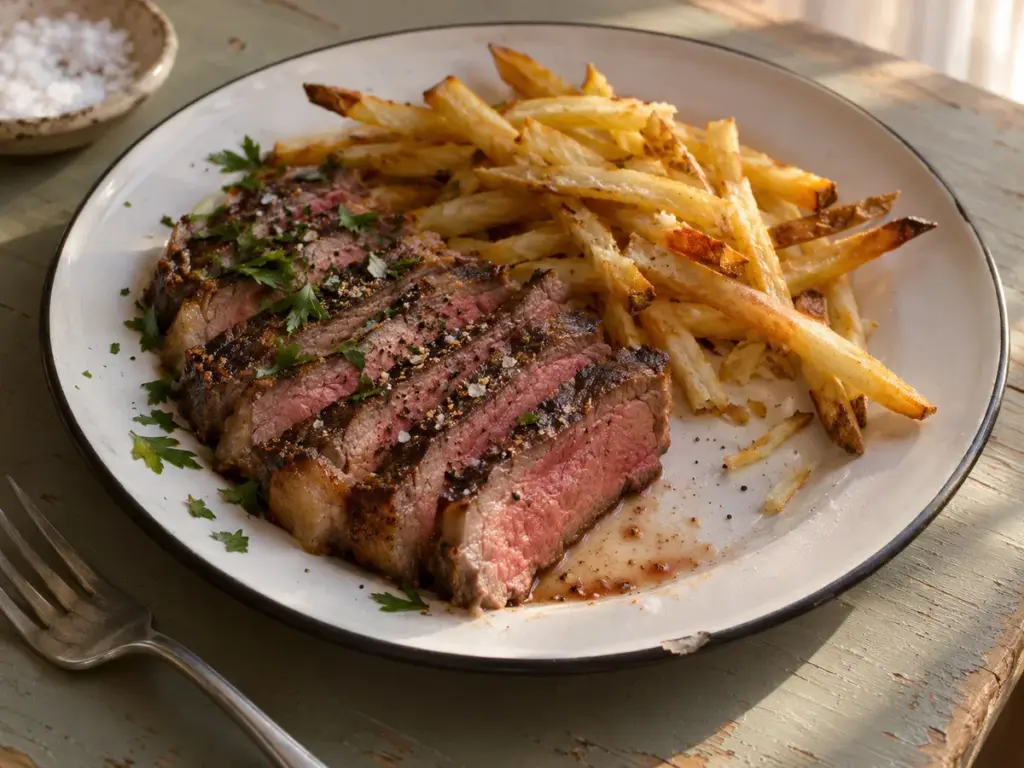
10. Can You Use a New York Strip Instead of a Kansas City Strip?
Yes, in both directions, because the meat is the same. You match the two by thickness, since the weight on the label includes any bone.
A bone-in steak that weighs 16 ounces has noticeably less meat than a 16-ounce boneless one, so you buy a little more if you are feeding hungry people.
When a boneless steak stands in for a bone-in one, the thermometer reaches 145°F a little sooner than the recipe says, and the reverse swap runs a little later.
11. Which Strip Should You Buy?
- For a weeknight pan sear for two, boneless suits you best, since it sits flat in the skillet, you pay only for meat, and it cooks the same all the way across.
- For a grill night or a plate that should look like a steakhouse, bone-in fits, because you can carve the meat off the bone and keep the bone on your plate as a handle.
- For sliced steak in salads, sandwiches or tacos, boneless is the easier buy, with less waste on the cutting board.
Before you pay, ask the butcher three things that the name does not answer:
- Bone-in or boneless? If the name is unclear, you can ask by number: 1179 has the bone and 1180 does not.
- Which grade? Prime, Choice or Select sets the marbling and much of the price.
- How thick is the steak? Thickness decides how long it takes to reach 145°F.
If you want more marbling than a strip carries, we'd look at a ribeye next, and a bone-in ribeye such as the tomahawk steak brings the same bone question.
If you want a softer bite, the tenderloin that sits beside the strip on a T-bone is sold alone as filet mignon.
Raw steaks keep 3 to 5 days in the refrigerator or 4 to 12 months in the freezer, according to USDA FoodKeeper, so a strip you buy on sale can wait for the right night.
Sources
- Strip Steak, Bone-In (IMPS/NAMP 1179), American Foods Group beef chart credited to the Beef Checkoff
- Strip Steak, Boneless (IMPS/NAMP 1180), American Foods Group beef chart credited to the Beef Checkoff
- Strip steak: location, names and the National Cattlemen's Beef Association list (Wikipedia)
- Delmonico steak (Wikipedia) and T-bone steak, citing USDA IMPS Fresh Beef Series 100 (Wikipedia)
- USDA FoodKeeper (raw beef steaks: 3 to 5 days refrigerated, 4 to 12 months frozen; leftovers with meat: 3 to 4 days refrigerated, 2 to 3 months frozen)
- Kansas City Steak Company: Kansas City strip FAQ (same cut as the New York strip, with regional naming)
- How to Choose Beef: Consumer Choices and Meat Grading (Montana State University Extension)
- USDA Beef Quality Grades: What Do They Mean? (South Dakota State University Extension)
- Effects of wet and dry aging on yields, tenderness and microbial loads of beef loins (University of Nevada, Reno, FS 19-01)
- USDA FoodData Central: FDC 169538 (top loin steak, all grades, raw) FDC 168721 (top loin steak, Prime, raw) and FDC 168718 (Choice, grilled)
Frequently Asked Questions
Can a Strip Steak Replace a T-Bone or Porterhouse in a Recipe?
Yes, a strip steak works in most recipes written for a T-bone or porterhouse, though you lose the tenderloin side and the bone, so the plate has less of the soft, mild meat.
How Long Do Leftover Strip Steaks Keep?
Cooked steak counts as leftovers with meat, so you can keep it in the refrigerator for 3 to 4 days or in the freezer for 2 to 3 months, according to USDA FoodKeeper.

Food writer at GustoMeadow. Writes ingredient substitutes, food comparisons, taste guides and storage guides for home cooks.
Storage and food-safety numbers follow USDA, FDA and university extension guidance.



