
Strip steak and New York strip are the same cut, the strip loin steak from the short loin.
- The beef industry's cut chart uses "New York strip steak" for both bone-in and boneless strip.
- What changes from tray to tray is the bone, fat trim, grade and thickness, not the name.
- Cook either one to 145°F and rest it for 3 minutes.
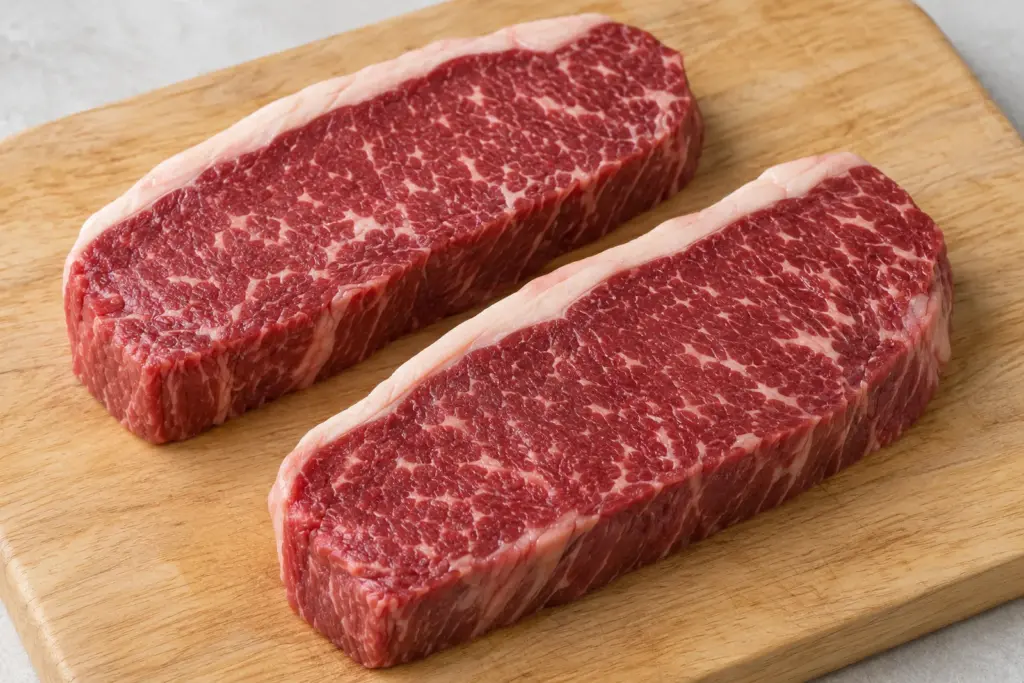
You see this at the meat counter: one tray says strip steak, the next says New York strip, and the prices differ. Like other confusing food pairs, this one is a naming habit, so the useful question is what actually differs between the two trays in front of you.
1. What Is the Difference Between Strip Steak and New York Strip?
As cuts of beef there is no difference. The chart that the American Foods Group publishes for the Beef Checkoff files "Strip Steak, Boneless" (IMPS/NAMP 1180) and "Strip Steak, Bone-In" (1179) under the same list of other names, and "New York Strip Steak" is on both lists.
| Trait | Strip steak and New York strip | What can differ on the tray |
|---|---|---|
| Cut | The strip loin steak from the short loin | Nothing |
| Muscle | The longissimus, which does little work | Nothing |
| Bone | Bone-in (IMPS 1179) or boneless (1180) | Whether your tray has a bone |
| Fat edge | A strip of fat along one long side | How wide the butcher left it |
The muscle is the longissimus. Wikipedia's strip steak entry describes it as a muscle that does little work, which is why the steak is tender, and says it is less tender than the tenderloin beside it.
Texas A&M's meat science page for the top loin steak lists the longissimus lumborum among its muscles. Two names on two trays still mean one muscle.
2. Why Do Stores Sell Them as Two Different Steaks?
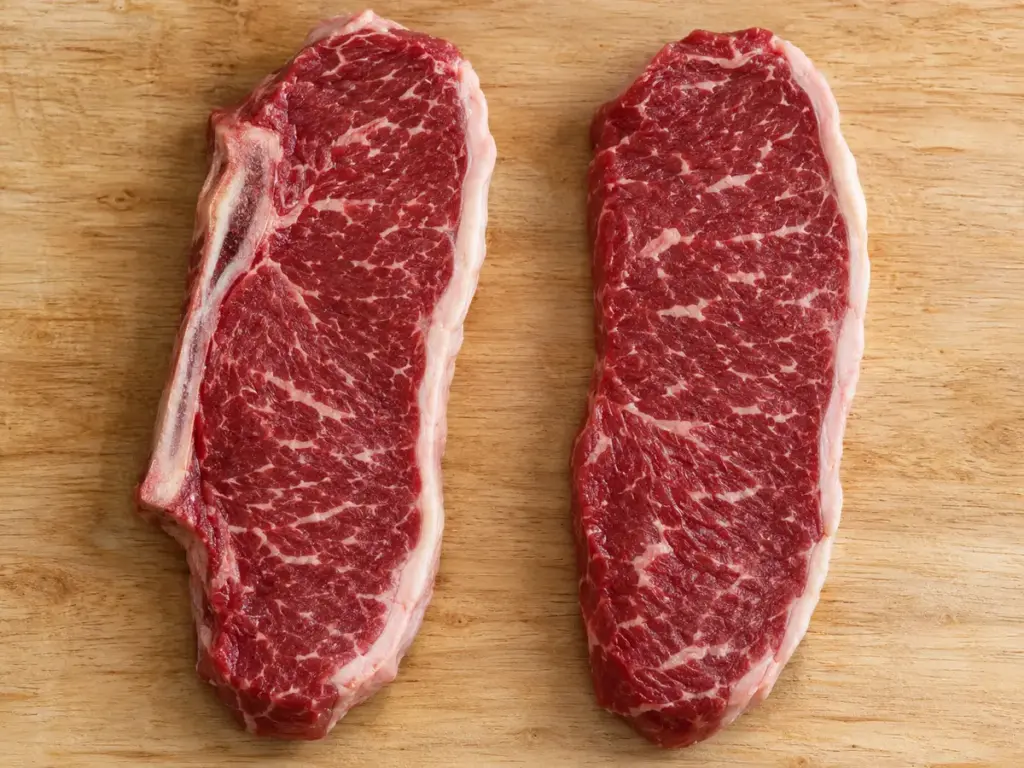
The chart lists both names for the same cut, so each seller can use either one. Four things on the tray change your dinner:
- Bone: a bone-in strip weighs more per steak, so part of the price is bone.
- Fat edge: butchers trim the long edge to different widths, so two strips in one case can look different.
- Grade: the Prime, Choice or Select label tells you more about the steak than the name does.
- Thickness: a thick steak keeps a pink center while it browns, and a thin one overcooks before it browns.
3. What Else Is the Strip Steak Called?
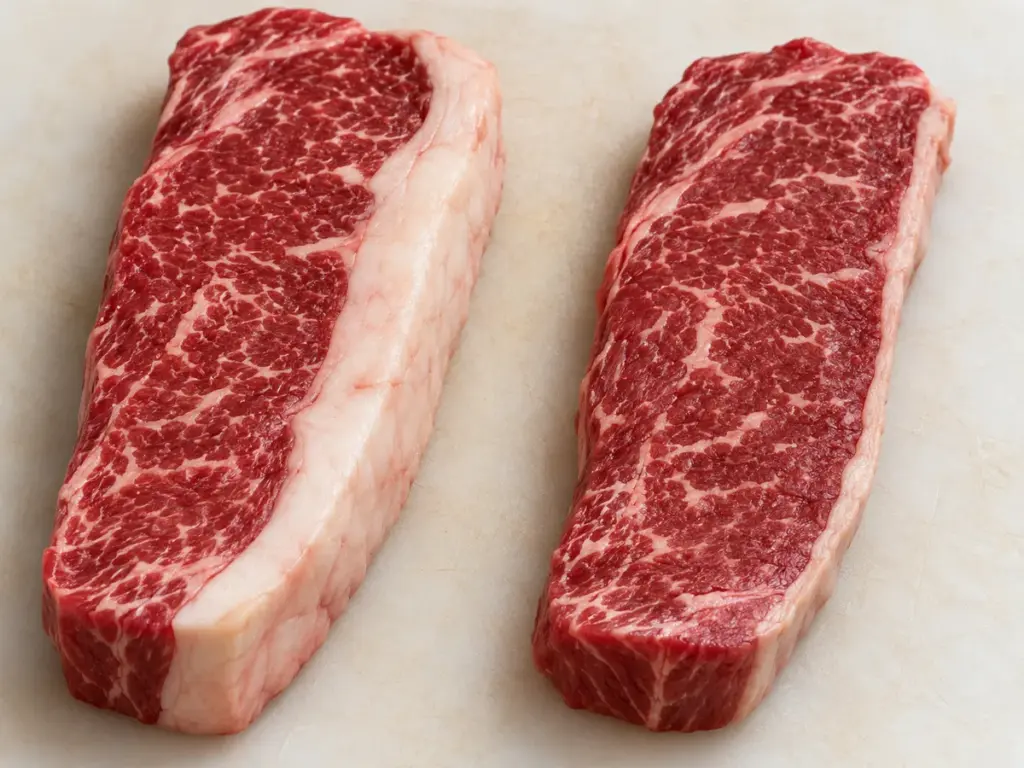
The same beef chart lists a long run of alternate names, and these are the ones you are likely to meet:
- Top loin steak: the plain butcher name, and the one Texas A&M uses.
- Shell steak: a bone-in strip without any tenderloin attached.
- Ambassador steak and hotel-style steak: older names on the chart that you rarely see on a store tray.
Wikipedia, quoting the National Cattlemen's Beef Association, also lists New York steak and veiny steak for the same steak.
Kansas City Steak Company calls the Kansas City strip the same cut as the New York strip, with the Kansas City name more popular in the Western U.S. and the New York name on the East Coast. Grill Seeker adds that a Kansas City strip usually keeps a piece of the bone, and the chart lists the name for both bone-in and boneless strips.
A tray that says only club steak needs one look at the cut face. The chart lists "club steak" for the strip, but a club steak and a ribeye look different: the strip shows one large muscle, and a ribeye shows a round eye with a curved cap.
Striploin is the same steak under its trade name. Canadian butchers say strip loin or striploin (the French label is contre-filet), and Wikipedia says Ireland also says striploin, so when you shop there, a striploin and a New York strip are one steak.
In the UK the strip is sold as sirloin, which in the U.S. is the sirloin steak cut behind the short loin.
- Boston strip: a different steak. Grill Seeker says it is a cross cut from the bottom sirloin flap.
- Manhattan strip: the chart does not list this name for the strip, so ask the seller which cut is in the tray.
Keep the tenderloin out of the picture, because it changes the purchase. A T-bone or porterhouse has a strip on one side of the bone and a piece of tenderloin on the other, and the extra muscle is part of the price gap between the porterhouse and the strip.
4. Is a Strip Loin Roast the Same as Strip Steak?
You get the same meat in a bigger piece. The beef chart lists the strip loin (IMPS 180) as a well-marbled boneless roast from the short loin, near the tenderloin, and says it "can be prepared as a roast or Strip Steak."
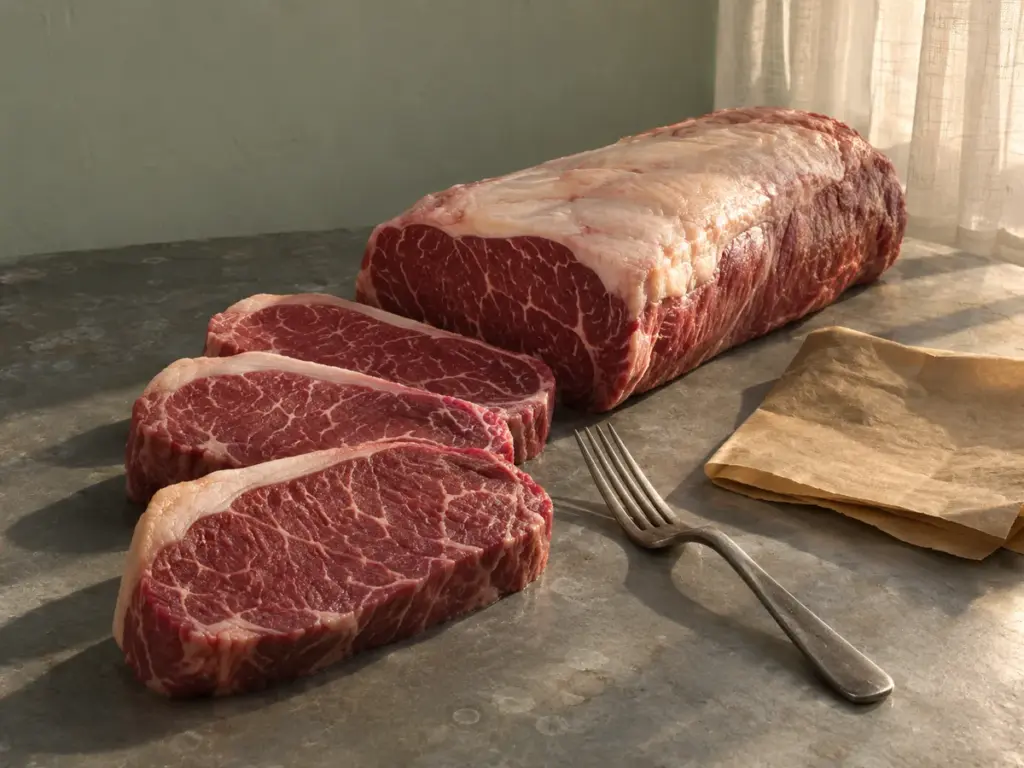
You cook a roast to the same safety number as a steak: the University of Maine Extension chart lists steaks, roasts and chops at 145°F with a 3-minute rest. A roast takes longer to reach it, so the thermometer decides, not a timer.
- Strip steaks: buy them for a fast sear for one or two plates.
- A strip loin roast: buy it to carve one thick, even piece for a table.
- A whole strip loin: buy it when you want to slice your own steaks at the thickness you like.
5. Does Strip Steak Taste Different From New York Strip?
It should not, because the muscle is the same. The cut chart and the meat science page give no fat or location difference between the names. Thickness, grade, trim and doneness change the bite far more than the name does.
The one part you control is the fat edge. Brown it along with the two faces and it renders into the crust, and a steak trimmed to a thin edge gives you less fat on the fork than one with a wide edge. Ask the butcher for the trim you like, or trim the edge yourself before you cook.
- 15.49 g fat per 100 g raw
- 228 kcal (USDA FDC 169538)
- 8.17 g fat per 100 g raw
- 163 kcal (USDA FDC 171750)
Both USDA entries are raw top loin steaks, all grades. USDA lists the lip-off steak about 7 g lower per 100 g than the lip-on one, while grade moves it much less: with the lip off, USDA lists Choice at 9.16 g and Select at 6.67 g (FDC 171751 and 171752), a gap of about 2.5 g.
Grade is the USDA's Prime, Choice or Select, which graders assign from marbling, maturity, color and texture. Montana State Extension says most carcasses are Choice or Select, so those are the grades you will usually find at the meat counter, and Prime is generally sold in upscale restaurants.
Angus is a breed, not a grade. Certified Angus Beef says beef must be Choice or Prime before it can carry the brand, so when your tray says only "Angus", look for a grade printed beside it. A "Choice beef strip steak" is the same strip with its grade on the label.
6. How Do You Cook Strip Steak or New York Strip?
The method is the same for both names. You need a very hot pan or grill, a hard sear and a thermometer.
- Grill or broiler: the chart says loin cuts suit the grill or a broiler.
- Skillet or pan-fry: the chart lists both for the boneless strip.
- Stir-fry: the chart lists it too, so thin strips of strip steak work in a hot wok.
- Salt and dry. Salt both sides and pat the surface dry, because a dry steak browns instead of steaming.
- Heat hard. Get a heavy skillet or a grill very hot before the steak goes on.
- Sear and render the edge. Brown both faces, then stand the steak on its fat edge with tongs for a minute so the fat melts.
- Check the thickest part. Put the thermometer tip into the center of the thickest part, away from the bone and fat.
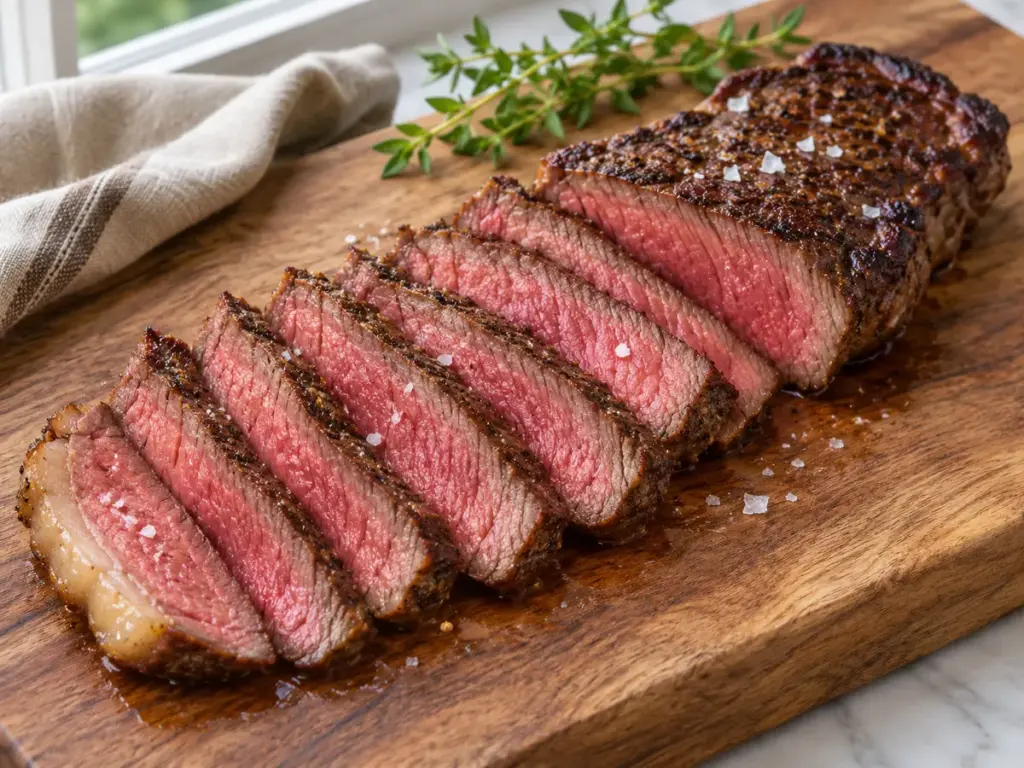
- Rest. Take the steak off the heat at 145°F, let it rest for at least 3 minutes, then slice.
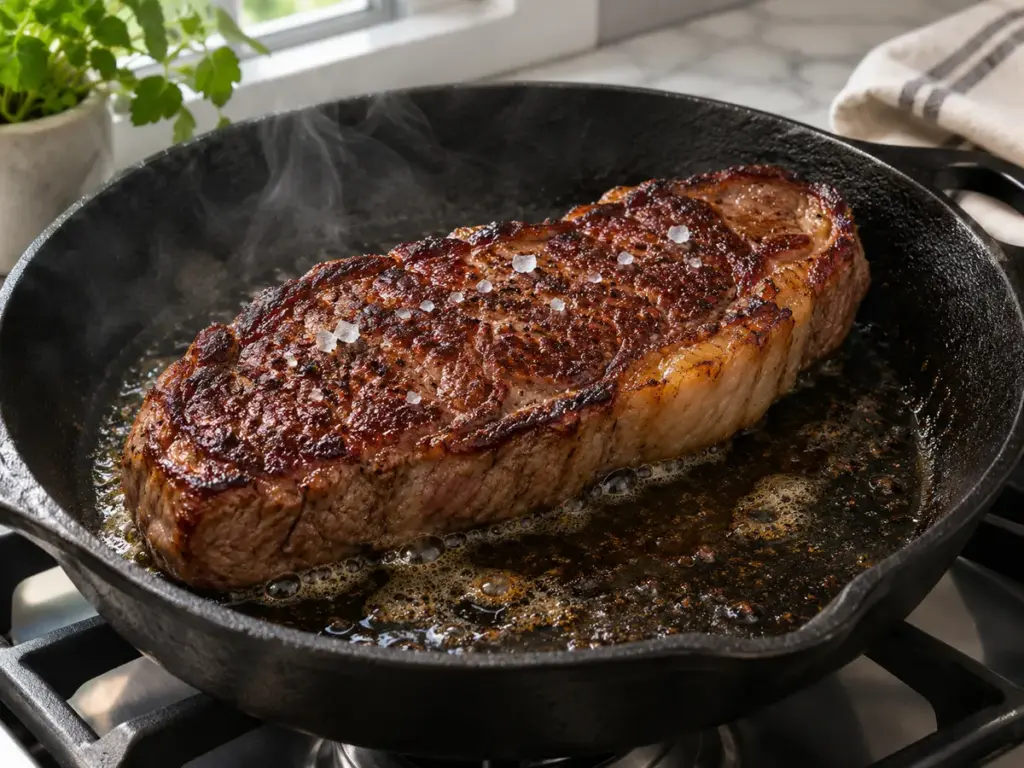
A heavy skillet and a hot grill both sear a strip well, and many cooks choose between cast iron and a grill by the crust they want. Whichever you pick, the thermometer decides doneness.
| Doneness | Internal temperature | What to know |
|---|---|---|
| Medium-rare | 145°F | The USDA safe minimum for steaks, with a rest of at least 3 minutes |
| Medium | 160°F | Labeled medium by the Illinois chart |
| Well-done | 170°F | Labeled well-done by the Illinois chart |
The numbers come from the University of Illinois Extension, and the University of Maine Extension repeats the 145°F and 3-minute rest from the federal chart. A steak pulled below 145°F is below the USDA minimum, and you decide whether to serve it that way.
If you aim for a chef's range, ThermoWorks says to pull the steak about 5°F early. A steak keeps climbing off the heat, by roughly 3 to 5°F on a thin one and 10 to 15°F on a large one.
7. Can You Use New York Strip Instead of Strip Steak?
Yes, in both directions, because the cut is the same. Match the steaks by thickness and not by weight: a bone-in steak that weighs 16 ounces holds less meat than a boneless 16-ounce one, so buy a little more when you cook bone-in for a hungry table. Start checking the temperature a bit earlier on a boneless steak.
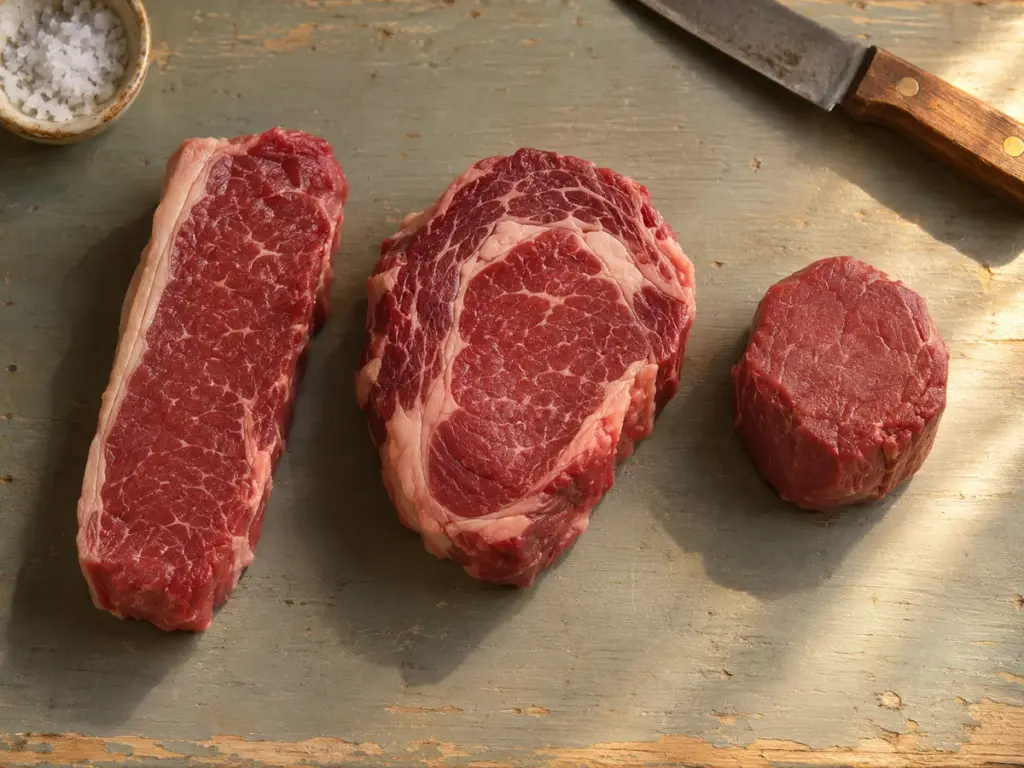
When the case has no strip at all, two neighbors fill in. A ribeye has more fat, 18.73 g per 100 g raw against 15.49 g for the strip (USDA FDC 172156 and 169538), and a bone-in ribeye brings the same bone question. A softer bite comes from the tenderloin, sold alone as filet mignon, which has less fat and needs gentler heat.
You may also meet two cuts that look close but are not strip steak. Tri-tip and bavette (flap steak) come from the bottom sirloin, behind the short loin, and tri-tip is usually cooked whole and sliced across the grain.
8. Which One Should You Buy?
- A weeknight pan sear for two: buy a boneless strip. It lies flat in the skillet and every ounce is meat, and you can sear it with one pan and one thermometer.
- A grill night or a steakhouse-style plate: buy bone-in, which looks good on the plate and carves off the bone.
- Sliced steak for salads, sandwiches or tacos: buy boneless, so you slice without working around a bone.
- Cooking for a crowd: compare the price per ounce of meat you will eat, since the bone counts toward the weight on a bone-in label.
Raw beef steaks keep 3 to 5 days in the refrigerator and 4 to 12 months in the freezer, according to USDA FoodKeeper, so a strip bought on sale can wait for the right night.
Sources
- Strip Steak, Boneless (IMPS/NAMP 1180), American Foods Group beef chart credited to the Beef Checkoff
- Strip Steak, Bone-In (IMPS/NAMP 1179), American Foods Group beef chart credited to the Beef Checkoff
- Strip Loin (IMPS/NAMP 180), American Foods Group beef chart
- Texas A&M AgriLife meat science: Beef Loin, Top Loin Steak
- Strip steak: muscle, names by country and shell steak (Wikipedia)
- University of Illinois Extension: Cooking Temperatures and University of Maine Extension: Safe Minimum Internal Temperatures
- ThermoWorks: Steak Temperatures, Getting It Right (chef doneness ranges and carryover)
- USDA FoodKeeper (raw beef steaks: 3 to 5 days refrigerated, 4 to 12 months frozen; leftovers with meat: 3 to 4 days refrigerated, 2 to 3 months frozen)
- Kansas City Steak Company: Kansas City strip FAQ (same cut as the New York strip, with regional naming)
- USDA FoodData Central, SR Legacy: FDC 169538, 171750, 171751, 171752, 172156, 168718 and 168631
- Montana State University Extension: How to Choose Beef, Consumer Choices and Meat Grading
- Certified Angus Beef: beef grades
- Grill Seeker: Kansas City Steak vs New York Steak vs Boston Strip Steak
Frequently Asked Questions
How Long Do Cooked Strip Steak Leftovers Keep?
You can keep leftovers with meat 3 to 4 days in the refrigerator and 2 to 3 months in the freezer, according to USDA FoodKeeper. Slice the cold strip thin for tacos or salads, or fold it into dishes that use up cooked steak.
How Many Calories Are in a Strip Steak?
Grilled Choice top loin with its fat edge has 278 kcal, 26.16 g protein and 18.45 g fat per 100 g cooked (FDC 168718). A Select steak with the fat lip off has 207 kcal and 9.12 g fat (FDC 168631).

Food writer at GustoMeadow. Writes ingredient substitutes, food comparisons, taste guides and storage guides for home cooks.
Storage and food-safety numbers follow USDA, FDA and university extension guidance.



