
Both come from the hock, the joint above a pig's foot, so the difference is what happened to the meat after butchering.
- A ham hock brings salt and smoke to beans or greens because it is usually cured and smoked.
- A pork hock is usually fresh and raw, so it tastes mild and suits a roast.
- Labels overlap, so the package wording tells you which one you have.
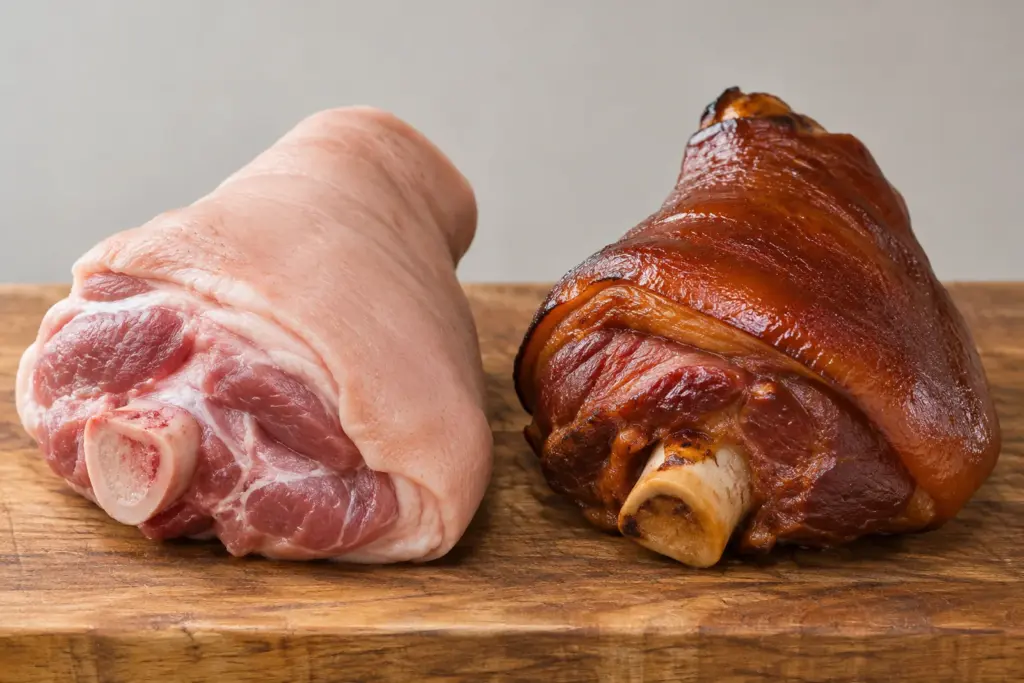
One body part and a pile of names make these two as easy to mix up as other look-alike foods. Pork knuckle, pig's knuckle and hough all name the same joint, and a package marked "smoked pork hock" is a ham hock under another name.
1. What Is the Difference Between Pork Hock and Ham Hock?
US stores follow no single naming rule, so you still need the label even when a package looks like one column of the table. America's Test Kitchen notes that ham hocks are often sold smoked or cured, but you can also find them fresh or frozen.
| Trait | Pork hock (usually fresh) | Ham hock (usually smoked) |
|---|---|---|
| What it is | Raw, unsmoked hock | Hock that was cured with salt and smoked |
| Look in the package | Pale pink meat under pale skin | Dark brown skin, pink cured meat inside |
| Flavor | Mild, plain pork | Smoky and salty |
A fresh hock has no salt unless it was brined, while a smoked hock arrives already salted and can season a whole pot by itself.
- Its soft skin and sticky gelatin surround tender meat.
- It suits roasts, braises and unsalted stock.
- It is the cut German cooks roast for Schweinshaxe.
- Its meat is firmer and ham-like, and its skin is softer.
- It suits collard greens, navy beans, split pea soup and Hoppin' John.
Both hocks give a pot the same gelatin body, so your choice comes down to whether you want smoke and salt added along with it.
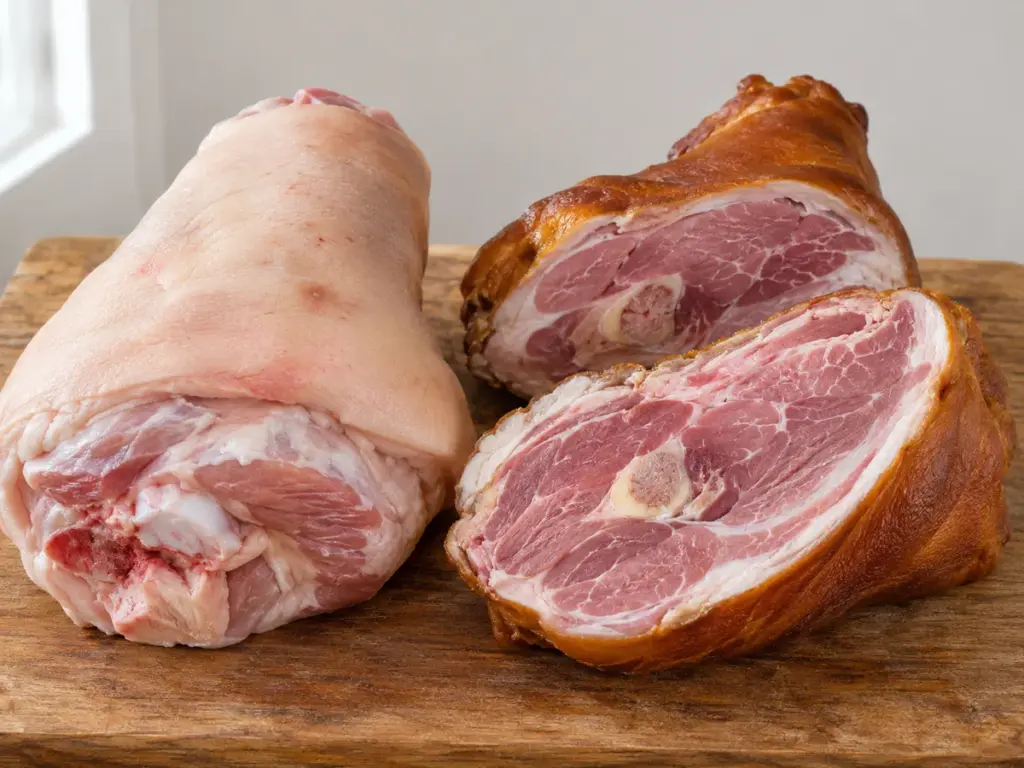
2. Where on the Pig Does a Hock Come From?
The hock is the joint where the lower leg bones meet the foot, between the shank and the trotter. A pig has one on each leg, so you can find both front and hind hocks at the butcher.
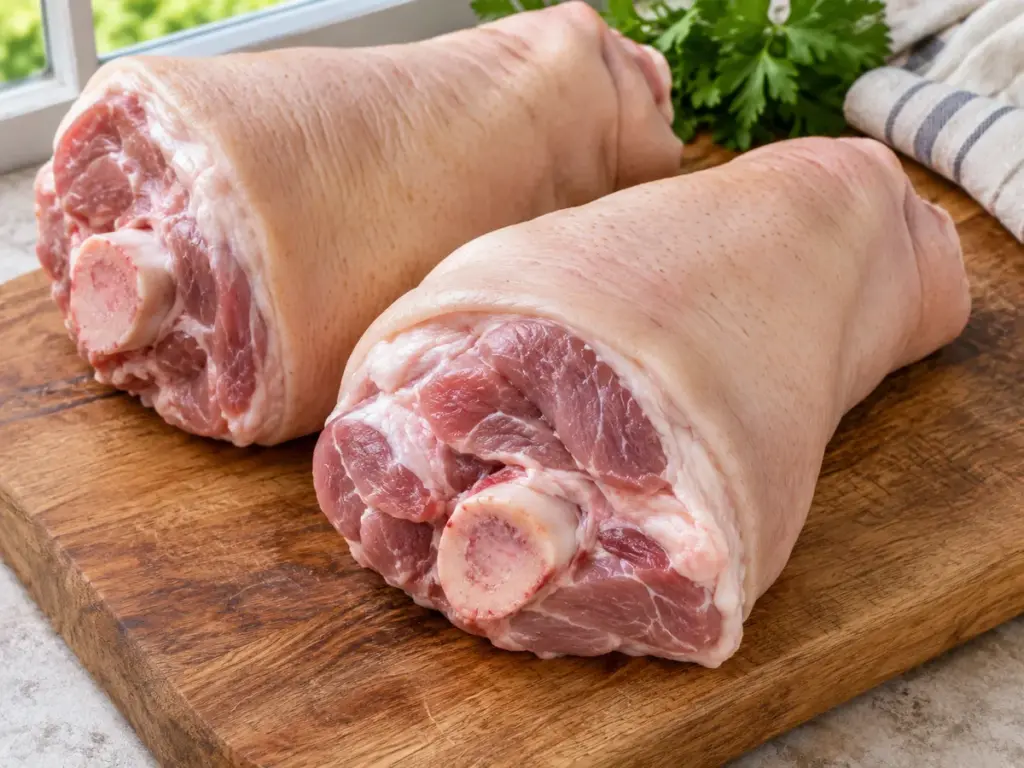
Skin, tendon and bone make up most of a hock, with only a little meat on it. America's Test Kitchen describes the cut as rich in collagen-heavy connective tissue that needs long cooking.
A long, wet cook melts that collagen into gelatin, which is why a pot with a hock in it turns silky and a bean soup thickens without any flour. Beef shank and oxtail give you the same silky body for the same reason.
Food Network calls a ham hock the shank end of the hind leg, while Wikipedia's definition names no leg at all, so the leg cannot tell the two apart and only the cure separates them.
3. How Do Other Countries Cook the Hock?
German cooking shows the split clearly. In the north, Eisbein is a cured hock that is boiled, while in the south Schweinshaxe is a hock roasted, usually without a cure, until the skin blisters.
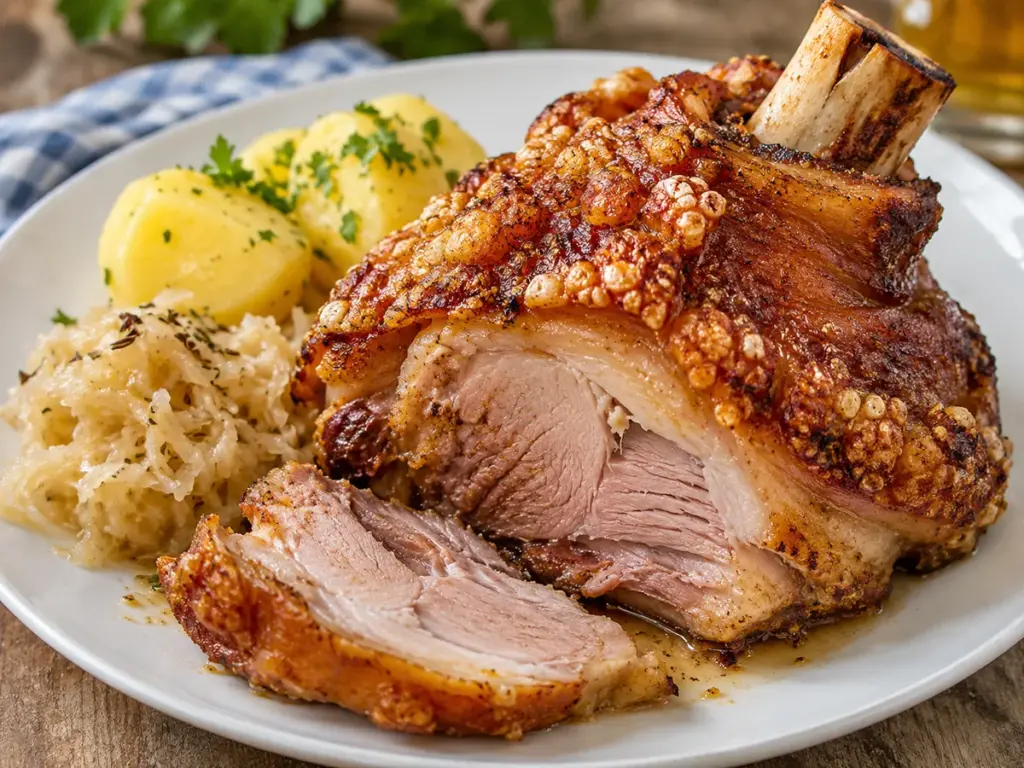
The same joint turns up all over Europe, and Wikipedia lists dishes you can look for:
- Austria and Switzerland: Stelze and Wädli are roasted hocks.
- Poland: golonka comes in a sauerkraut soup in Silesia.
- Northern Italy: stinco is roasted with sauerkraut.
- Sweden: cooks serve cured hocks with mashed rutabaga and potatoes.
The hock travels well outside Europe too:
- American South: hocks flavor soul food, and Appalachian cooks simmer them with pinto beans.
- Montreal: "pigs' knuckles" come with baked beans.
- Taiwan and China: the knuckle is simmered in spiced broth or served with bok choy in gravy.
- Philippines: crispy pata starts with a hock cooked tender, then dried and fried for crackling skin.
4. How Can You Tell Which One You're Buying?
Stores label hocks loosely, so you can work through the package in this order:
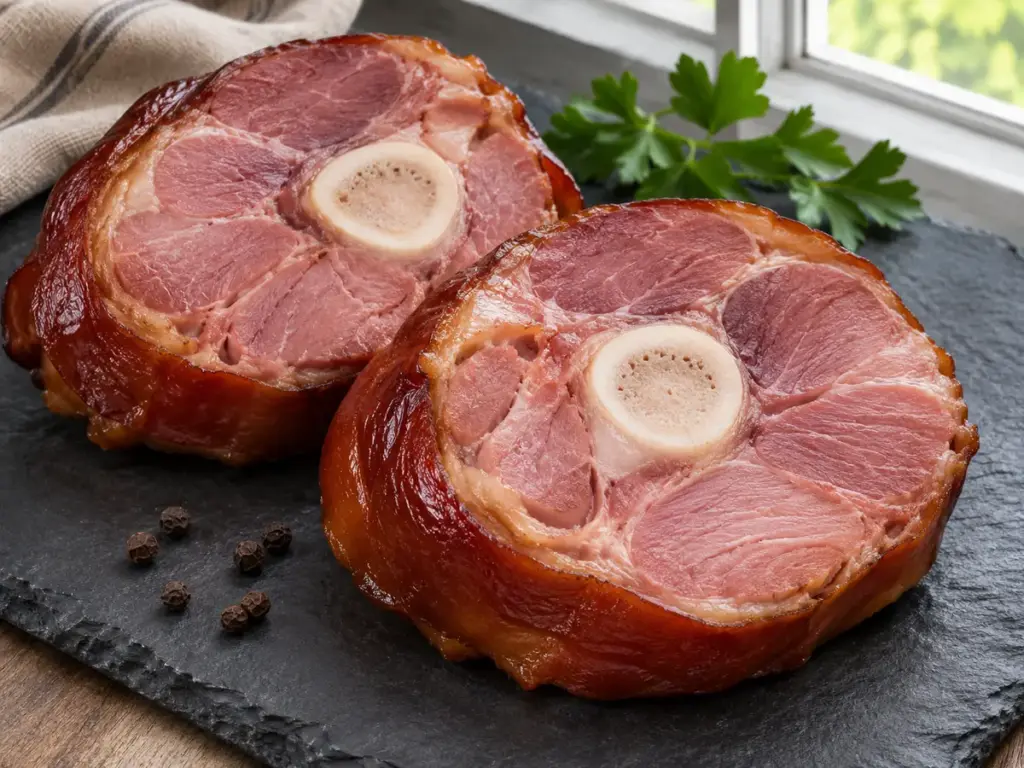
- Read the full name. "Smoked," "cured" or "ham hock" means the hock was treated. "Fresh" or a bare "pork hock" most likely means raw.
- Read the ingredient list. A fresh hock lists only pork, while a cured one lists salt and usually a curing ingredient. A nitrite curing salt is what keeps cured meat pink.
- Look at the color. Dark brown, shiny skin usually points to smoke, and pale skin usually points to a fresh hock.
- Follow the cooking instructions. Meat that must be cooked before eating carries cooking and safe handling instructions on the label.
- If you still can't tell, treat it as raw pork. Cook it to at least 145°F, then keep going until it is tender.
5. How Is a Ham Hock Cured and Smoked?
A ham hock is a fresh hock that went through two extra steps before it reached the store.
- Cure. The hock is rubbed with salt or soaked in a salt brine, usually with a nitrite curing salt. Wikipedia describes gammon, the cured hind leg, as dry-salted or brined.
- Smoke. Smoke usually gives the bacon-like flavor and the dark, shiny skin.
Gammon may or may not be smoked, so a "cured" label alone does not promise you a smoky pot.
A whole ham gets the same kind of cure, and sugar-cured and country hams are its two main styles.
6. How Do the Flavor and Texture Differ?
As a smoked hock simmers, its smoke and salt carry into the broth, and you can stir the firm, ham-like picked meat back into a pot of collard or mustard greens.
A fresh hock tastes like plain pork, so how you season it decides the dish. If you braise it, the skin turns soft and sticky, and if you roast it, the skin blisters into pork crackling over meat that stays moist.
A fresh hock makes the better base when you want a clear stock to season yourself, since it gives you gelatin without smoke or salt.
7. How Is a Hock Different From Trotters, Neck Bones, Jowl and Shank?
Hocks sit among several bony cuts that flavor a pot of beans or greens, and recipes often swap one for another even though each brings a different amount of meat and smoke.
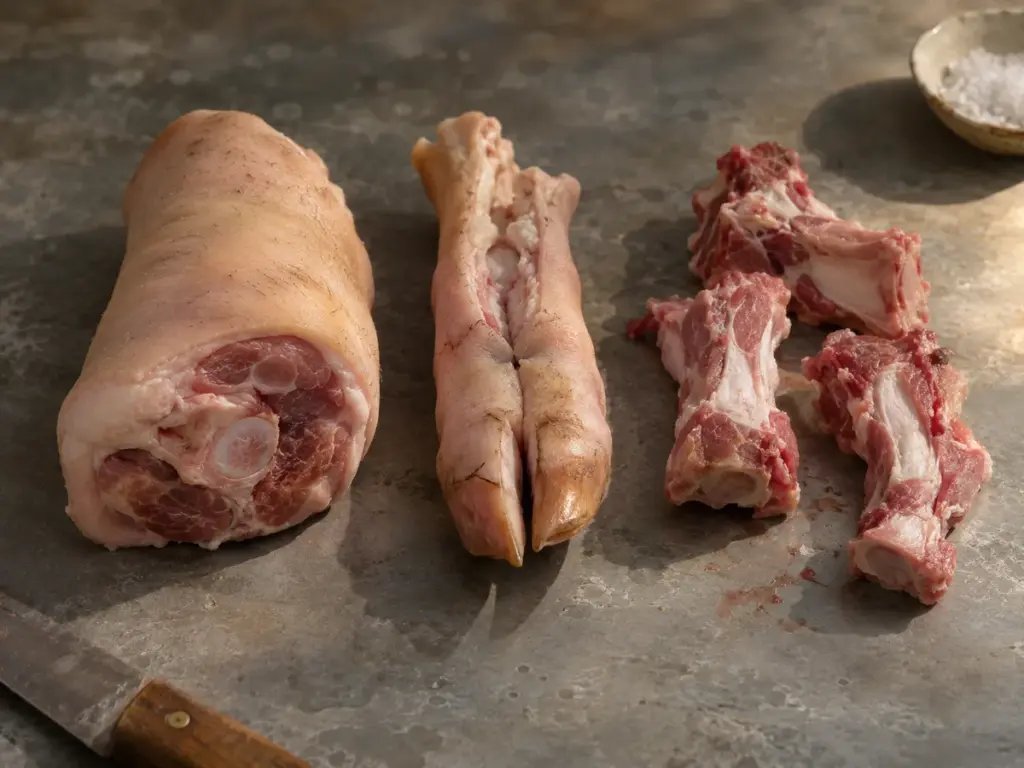
Pig's Feet (Trotters)
The trotter is the foot itself, below the hock. The Takeout calls it extremely bony and gristly, while the knuckle, another name for the hock, sits higher between the ham and the trotter.
Neck Bones
Neck bones come from the spine near the shoulder. Tasting Table says they hold more meat than a hock, though they are still mostly bone and connective tissue.
Neck bones are mostly sold raw, so you can use them in place of a hock in red beans and rice, black-eyed peas and braised greens. If the recipe wants smoke, a strip of bacon adds it, and you can plan sides for the neck bone pot around the broth.
Pork Jowl
Jowl is the pig's cheek, and once it is cured and smoked it is sold as jowl bacon or hog jowl. Southern cooks season beans, black-eyed peas and greens with it the way they would with a hock.
Italy's guanciale is the cured, unsmoked cousin, and you will often see cooks compare it with bacon.
Ham Shank
A ham shank sits just above the hock. Mashed reports that shanks tend to be meatier than hocks and cost more.
- A smoked shank can flavor a pot the way a hock does.
- You can braise a fresh shank as a main dish.
Bacon Joint and Gammon Hock (UK)
In the UK, the hock end of a gammon is called a gammon hock, and it holds more connective tissue and sinew than the rest of the joint.
A bacon joint can include a hock from the front leg, a collar from the shoulder or a gammon from the hind leg, so a bacon joint sometimes contains a hock and sometimes does not.
8. Which Has More Meat on the Bone?
The name on the label does not change the meat, since both come from the same joint. Crowd Cow says you can expect a few ounces from an average hock, and America's Test Kitchen says most of what you pay for is fat, collagen and flavor.
Hocks vary in size, so the heaviest one in the case gives you the most meat, and a big, meaty one can be the main dish.
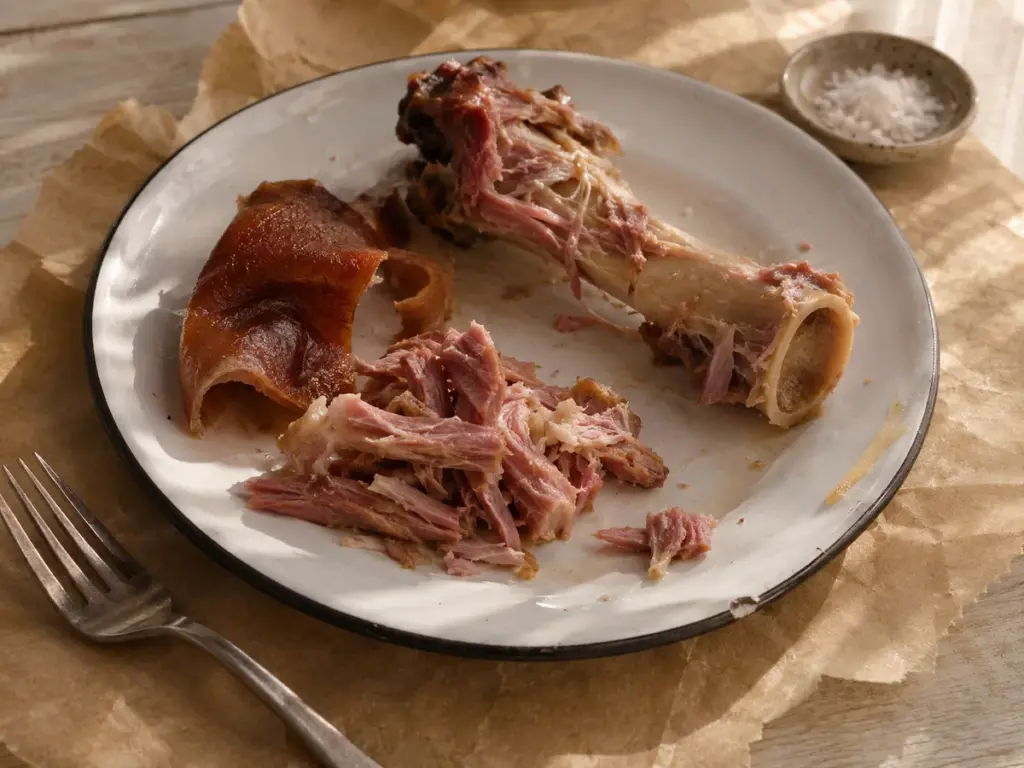
For more meat in the pot, neck bones or a smoked shank give you more than a second hock would.
9. How Do You Cook Each One?
Both need slow, moist heat, but the first steps differ:
- You score the skin so the fat can render out.
- Nothing in it is salted, so you season it yourself.
- It is braised or roasted until tender.
- America's Test Kitchen advises that you rinse it to wash off salt.
- A split along the bone lets the collagen melt out.
- It simmers with beans or greens.
Once the hock is in the pot, the steps are the same for both:
- Cover and season. Put the hock in whole, add water or stock to cover and a bay leaf, garlic and thyme, as the James Beard Foundation recipe does.
- Hold a bare simmer. Keep the pot just below a boil for 2 to 3 hours, because a rolling boil turns the broth cloudy and greasy.
- Pull the meat. When the hock is cool enough to handle, pick off the meat that comes away easily and stir it back into the pot.
- Salt last. A smoked hock releases salt into the liquid, so taste the pot before you season it.
America's Test Kitchen simmers a hock for 2 hours in its black bean recipe, so you can start testing at 2 hours and allow up to 3. The hock is done when the skin has gone soft, the meat gives up the bone and the broth coats a spoon, according to Crowd Cow.
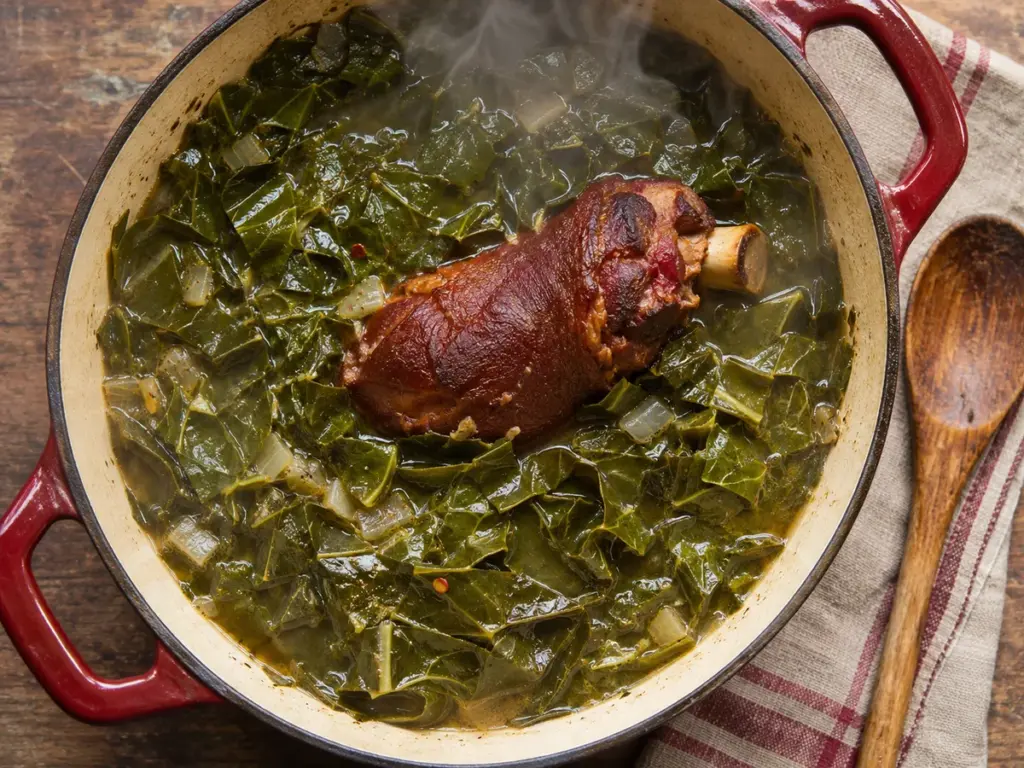
You can stir pulled hock meat back into the pot or use it in salads, quiches and casseroles, according to Food Network, as long as you leave out the bone and tendon.
Cooked hock meat and broth count as leftovers, and USDA FoodKeeper gives 3 to 4 days in the refrigerator and 2 to 3 months in the freezer for leftovers with meat. A raw fresh hock keeps 3 to 5 days in the refrigerator.
A whole cured ham keeps on a different schedule, so it is worth checking how long smoked ham keeps before you stock up.
America's Test Kitchen adds that you can cook a frozen hock without thawing it and that hocks store well in the freezer.
10. Can You Use Pork Hock Instead of Ham Hock?
You can swap them one hock for one hock, as long as you make up for what the swap removes or adds.
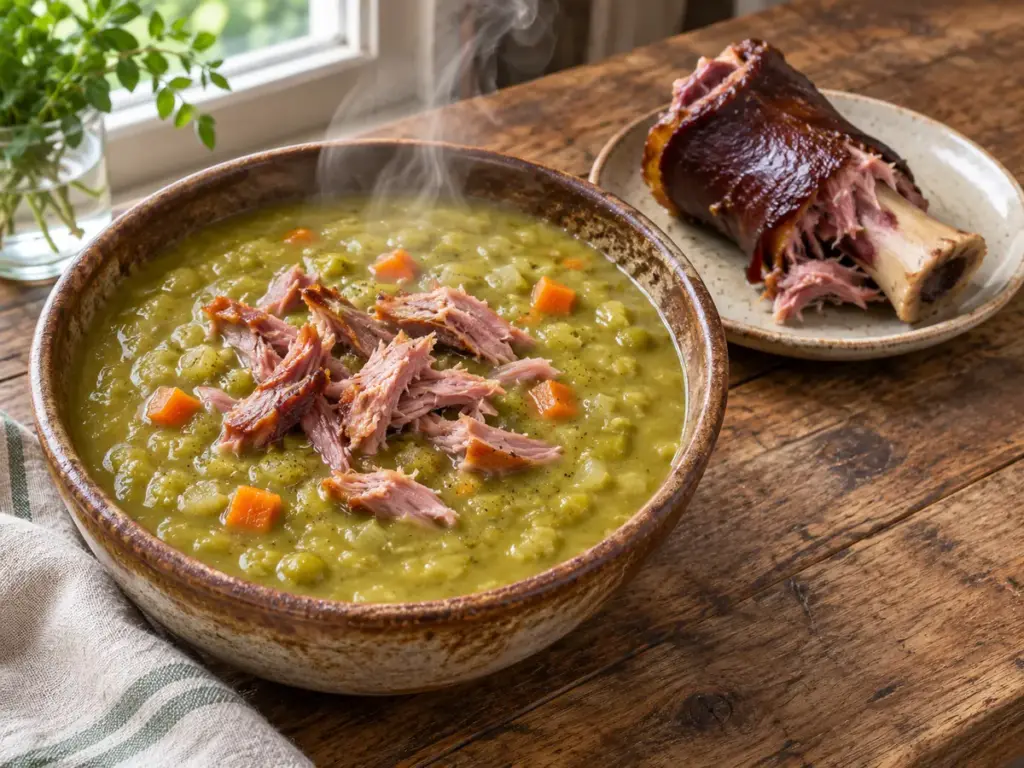
- If you use a fresh hock in place of a smoked one, the pot tastes flat, because the hock brings body but no smoke or salt. A few slices of chopped bacon or a piece of salt pork put the smoke and salt back, and you add the pot's salt at the end.
- In place of a fresh hock, a smoked one adds salt and smoke the recipe was not written for. A quick rinse takes off some surface salt, but roasts and light broths are better off without a smoked hock, because the smoke would take over.
A recipe that asks for a smoked ham hock takes a smoked pork hock too, since they are the same thing. In split pea soup, the hock has already salted the broth, so you can season the split pea pot once it is done.
If the store has no hock, other ham hock stand-ins such as smoked sausage work in beans and greens too. According to Food Network, a plain ham bone adds flavor but is not a full replacement.
11. Which Should You Buy?
The dish you are making decides which hock to buy:
| If you are making | Buy | Why |
|---|---|---|
| Collard greens, navy beans, split pea soup or Hoppin' John | Smoked ham hock | Its smoke and salt season the whole pot |
| A roast with crisp skin, such as Schweinshaxe | Fresh pork hock | The skin can blister and the meat stays unsalted |
| A clear stock you want to season yourself | Fresh pork hock | It adds gelatin without smoke or salt |
Hocks with the skin intact are the better buy for any of these, because the skin is where much of the gelatin comes from.
You need only one hock to give a pot of navy or pinto beans a deep, meaty flavor.
Sources
- America's Test Kitchen: What Is a Ham Hock?
- Wikipedia: Ham hock
- Wikipedia: Eisbein
- Wikipedia: Gammon
- Wikipedia: Jowl bacon
- Food Network: What Is Ham Hock?
- Crowd Cow: Ham hock
- James Beard Foundation: Ham Hock and Tomato Stew
- The Takeout: Pig Knuckle vs. Trotter
- Tasting Table: Pork Neck Bones
- Mashed: Ham Hock and Shank
- Erin Nudi: Bacon cuts
- Anova: Crispy Pata
- USDA FoodData Central, FDC 167875, 168222 and 169157
- USDA FSIS: Safe Minimum Internal Temperature Chart
- USDA FSIS: Ham and Food Safety
- USDA FoodKeeper
Frequently Asked Questions
Is Pork Hock or Ham Hock Healthier?
The cure makes a ham hock far saltier. USDA FoodData Central has no record for a smoked ham hock alone, but it lists cured ham at 1,284 mg of sodium per 100 g and fresh ham at 47 mg, with about 245 calories each.
Pickled pork hocks come in at 1,050 mg per 100 g, and a fresh hock lets you set the salt yourself.
Where Can You Find Ham Hocks in a Store?
The meat counter is the first place to look, since butchers carry hocks fresh and smoked. If you do not see any there, the freezer case is next, because hocks are often sold frozen too.

Food writer at GustoMeadow. Writes ingredient substitutes, food comparisons, taste guides and storage guides for home cooks.
Storage and food-safety numbers follow USDA, FDA and university extension guidance.



